
_Pollux writes_:
Stories and news reports about Bo, the First Dog, had for a time that whiff of newness and now-ness, like the snatches of a Susan Boyle song. But the whiff of newness has now been replaced by that regular doggy smell, and taking care of Bo has been added to Obama’s long, long list of concerns, worries, and responsibilities. _The New Yorker_ “once depicted”:http://www.newyorker.com/magazine/toc/2008/12/08/toc_20081201 Obama carefully interviewing potential candidates for the First Pet position.
“Bob Staake’s”:http://www.bobstaake.com cover for the April 27, 2009, issue of _The New Yorker_ now gives us Bo and gives us Bo’s new, immense domain: the White House Lawn. The lawn looks lush, welcoming, velvety, and verdant—and lonely. Have we forgotten Bo?
“The mob is fickle, brother,” Lucilla says to her brother, the Emperor Commodus, in a scene from _Gladiator_. “He’ll be forgotten in a month.” Commodus, as played by Joaquin Phoenix, gives her a sickly grin. “No, much sooner than that,” he replied. “It’s been arranged.”
Whoever arranges the sequence of news stories at Fox and CNN (I imagine the culprits are the same Ringwraiths who pursued Frodo and friends in the _Lord of the Rings_ trilogy) has arranged for the Bo Story to slip from the public consciousness. We are interested in newer things now—did you know that they’re coming out with “an Octomom musical?”:http://www.tmz.com/2009/04/25/now-casting-octomom-the-musical/
Perhaps no one cares about Bo anymore; the months of anticipation leading up to it may be responsible for that. We’ve burned ourselves out, like a child sitting in a pile of destroyed wrapping paper on Christmas Day.
If the general public has forgotten Bo, _The New Yorker_ certainly has not, nor has Staake, who is finding a publisher for his new book, _The First Pup: The Unofficial Story Of How Sasha and Malia’s Dad Got the Presidency—And How They Got a Dog_.
“You put any dog on the cover and everyone goes crazy,” Staake “has remarked.”:http://www.newyorker.com/online/blogs/books/2009/04/bob-staake-and-the-first-dog.html “This cover is good at being cute, but it also works as a metaphor for Obama. The best _New Yorker_ covers are the ones where the reader looks and brings their own interpretation, which brings the image to a new dimension.”
_The Phoenix_ “has suggested”:http://thephoenix.com/BLOGS/dontquoteme/archive/2009/04/21/the-new-yorker-s-obama-cover-addiction.aspx that the cover is symptomatic of a general fixation with Bo, and Obama in general, that exists at _The New Yorker_ offices. “We’re now reaching the point where it’ll be a surprise,” Adam Reilly of _The Phoenix_ writes, “when the New Yorker _doesn’t_ feature an Obama-related image on its cover—and the problem actually seems to be intensifying. Two Obama-pooch covers in short succession? What were they thinking?!?”
But I believe that Staake’s cover isn’t so much emblematic of a fixation with Bo as much as it comments on the fact that, now that the excitement over the selection of the First Pet has receded, we are now left only with all that we see on this cover: a dog, a lawn, and a house. And that’s a general artistic comment that isn’t necessarily based on a burning social issue of our time, but it is one that is effectively made nonetheless.
Staake’s covers, composed of digitally constructed shapes and soft PhotoShop brushes, are effective in their simplicity: the vast green square that fills the New Yorker cover has almost swallowed Bo up. This dog is one Magic Eraser click away from being digitally eradicated.
Obama’s dog doesn’t have a normal life anymore. Neither does Obama. Staake’s White House is beautiful, imposing, and lifeless. There isn’t a living soul on this cover besides Bo himself, who presumably has the run of the house. Maybe the house has the run of the dog.
The “website”:http://www.pwdca.org/breed/FAQs.html for the Portuguese Water Dog Club of America, which I imagine saw a lot of traffic in recent weeks, recommends that “Porties” not be “left alone for long periods of time.”
It’s lonely at the top—for Portuguese Water Dogs as well as for humans.
Category Archives: Sempé Fi
Sempé Fi (On Covers): Journey’s End

Pollux writes:
A collection of world monuments grace the cover of the April 20, 2009, issue of The New Yorker. These are the landmarks you have to see before you die—or at least, that’s what people say. It may be that one becomes reincarnated as a docent at the Taj Mahal or a Qualified, Talented, Experienced, Enthusiastic, Friendly employee of Walking Tours of Pisa, thus making your travels in this lifetime pointless.
Despite the world’s construction efforts and fervid competition between nations, the list of famous world landmarks has remained fairly standard over the past half-century or so. New buildings and structures have not supplanted Big Ben, the Eiffel Tower, and the Statue of Liberty. The London Eye has not become the landmark most associated with London.
In Italy, efforts to recreate the “Bilbao Effect,” the economic boom that occurred after the building of Frank Gehry’s Guggenheim Museum in that Basque city, have produced exciting, interesting buildings (Renzo Piano’s Parco della Musica; Richard Meier’s Jubilee Church; Meier’s Ara Pacis Museum), none of which are instantly recognizable landmarks, although we can judge Berlusconi’s Ego to be a recognizable Italian landmark.
China, despite gargantuan Olympic efforts, still relies on that ancient but great Wall to the north, as ineffective against marauding Mongolians in centuries past as it is effective at pulling in tourists.
Jacques de Loustal, who is, according to his website, a fan of the Fauvists, here holds back from the vivid coloring that characterizes his work and that of the Fauvist movement. His New Yorker cover is almost lugubrious, as if he were expressing the fact that all of the challenges and adventures associated with traveling are gone. Gone are the strong reds and bright blues that usually characterize his work.
His cover, entitled “Ultimate Destination,” is ultimately an exercise in sobriety, displaying little of the playfulness seen in his other travel-themed cover for The New Yorker, for example, which depicted two travelers dressed for a hard winter strolling across an exotic, subtropical beach.
“How do you see these trees? They are yellow,” Gauguin once advised. “So, put in yellow; this shadow, rather blue, paint it with pure ultramarine; these red leaves? Put in vermilion.” De Loustal puts in none of these. Perhaps it is intentional. All travel requires these days is a stroll in a graveyard of monuments, where we’re immunized from “real life” in Russia, China, or Australia, for example. Perhaps we are all traveling gnomes when we travel, and all we require is to have our picture taken in front of a landmark. And then we move on. We have conquered and landmark-spotted the monuments on our list, and now we can ignore the country and the routes that surround them.
The famous monuments have been transplanted for the benefit of two well-dressed travelers, who drag Samsonites down an unmarked and lonely route. The Statue of Liberty shares the same Loustalian waterway with a Venetian gondola, while the Parthenon looks over both. The Leaning Tower of Pisa tilts perilously close to the Pyramids while the Eiffel Tower remains as ramrod straight as a 1,000-foot baguette.
The world is flatter and the world is smaller. In this shrunken world of ours, it is possible to get a picture taken in front of St. Basil’s Cathedral and the next day find oneself at the Sydney Opera House’s gift shop, located in the lower concourse of that New South Wales landmark. You’ll be exhausted, of course, which will explain your purchase of a box of authentic tile fragments collected during the building’s original construction and sold for 135 Australian dollars.
As the Spanish say, “el mundo es un pañuelo“—”the world is a handkerchief,” and the world has become more a single ultimate destination devoid of context than a series of diverse, disparate locations.
Sempé Fi (On Covers): Hoppers, Bears, and Nighthawks
_Pollux writes_:
“You people should be ashamed of yourself,” Elaine complains to _The New Yorker_’s cartoon editor in one _Seinfeld_ episode. “You know ya doodle a couple of bears at a cocktail party talking about the stock market ya think you’re doing comedy.”
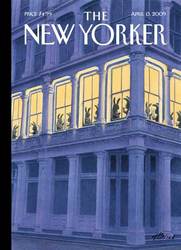
At first glance, “Harry Bliss’s”:http://www.harrybliss.com cover for the April 13, 2009 issue of _The New Yorker_ seems to be exactly what Ms. Benes was complaining about: a couple of cute animals talking about the stock market at a cocktail party. In this case, we see rabbits, not bears, but what is perceived as the spirit of the stereotypical _New Yorker_ cartoon and _New Yorker_ cover is there.
But Bliss’s cover is serious in intent, not comedic, and it visualizes a world in which we’re outside looking up at a convention of earnest Easter Rabbits, or perhaps ordinary gray rabbits (if rabbits who attend cocktail parties are ordinary), taking place in a late hour of the night. We’re shut out from the conversation, and from the warm yellows of a social club as we stand in a cold, violet-tinted avenue.
From street level, we can only imagine the low murmur of the rabbits and the clink of glasses bearing classy drops of Romanée-Conti. What are they discussing? Hindgut fermentation? The bail-out of Fannie Mae and the Flopsy Bunnies? The crisis in Mr. McGregor’s rubbish heap? The endless, expensive war with the badgers?
Bliss’s covers are beautiful, ranging from an “illustration”:http://www.cartoonbank.com/product_details.asp?mscssid=N75BLQT1QCKS9NR183NUWJWU397MBJ28&sitetype=1&did=5&sid=121165&pid=&keyword=Harry+Bliss§ion=all&title=undefined&whichpage=30&sortBy=popular of King Kong drenching grateful New Yorkers with a Super Soaker to “two museum-goers”:http://www.cartoonbank.com/product_details.asp?mscssid=N75BLQT1QCKS9NR183NUWJWU397MBJ28&sitetype=1&did=5&sid=123907&pid=&keyword=Harry+Bliss§ion=all&title=undefined&whichpage=9&sortBy=popular gazing at a digital camera’s rendering of a photograph of a painting while the original painting lies before them. Bliss is a master draftsman and his drawings are beautiful in the details.
The building in this cover is elegant and stately, the kind of place that you’re likely to feel nervous about entering if you have any number of social anxieties. You feel as if there may be a tough bouncer at the door—perhaps a hare from one of the tougher burrows, or a coney from below Coney Island’s Riegelmann Boardwalk.
Bliss’s cover evokes the feeling of separation and isolation encapsulated in an “Edward Hopper”:http://en.wikipedia.org/wiki/Edward_Hopper painting. Most of the cover, which is called “Spring Vision”, is enshrouded in darkness, emphasizing the coldness of a vantage point of a stranger looking into this springtime vision. It’s not only the distance but also the height that separates us from the warm light of a very exclusive leporid party. It may be springtime for these little rabbits, but it’s not spring yet for the rest of us.
Hopper’s paintings are less about loneliness than about the differences that keep people apart. Annie Proulx and Hopper himself felt that the lonely aspect of Hopper’s paintings was exaggerated. “The loneliness thing is overdone,” Hopper “once remarked.”:http://www.guardian.co.uk/artanddesign/2004/may/08/art His paintings, as Proulx “writes,”:http://www.guardian.co.uk/artanddesign/2004/may/08/art “were studies in mass and light expressed through the idiom of American landscape, architecture and figures.”
In the same way, Bliss’s cover is a study in mass and light. The sheer mass of the building dominates the cover. Bliss’s rabbits are an anonymous, almost featureless, mass of tipplers.
Bliss is an old hand at drawing rabbits for _New Yorker_ covers, which appear in the “form of skeletons”:http://www.cartoonbank.com/product_details.asp?mscssid=N75BLQT1QCKS9NR183NUWJWU397MBJ28&sitetype=1&affiliate=ny-slideshowsitetype=1&did=5&sid=51206&pid=&advanced=1&keyword=undefined&artist=Harry+Bliss§ion=covers&caption=&artID=&topic=&pubDateFrom=&pubDateTo=&pubDateMon=&pubDateDay=&pubNY=&color=0&title=undefined&whichpage=19&sortBy=popular of prehistoric megafauna or as “fedora-wearing commuters.”:http://www.cartoonbank.com/product_details.asp?mscssid=N75BLQT1QCKS9NR183NUWJWU397MBJ28&sitetype=1&affiliate=ny-slideshowsitetype=1&advanced=1&keyword=&artist=Harry+Bliss§ion=covers&caption=&artID=&topic=&pubDateFrom=&pubDateTo=&pubDateMon=&pubDateDay=&pubNY=2&color=0&isCacheSearch=1&whichpage=10 They also appear between the covers, in the form of loving rabbit families: a father hands his son a gift at a train station. The son is leaving for college. “Your mother wanted you to have this for good luck,” the father says. “It’s her foot.”
Bliss’s rabbits appear in various manifestations and display different attitudes. In “Spring Vision” they represent an image of exclusivity. We can’t reach them. Perhaps we don’t want to.
Sempé Fi (On Covers): Caveat Emptorium’s Wonder Emporium
_Pollux writes_:
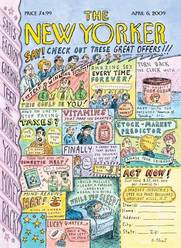
The pirates fired their grappling hooks into the sides of the ship, and reeled in their prize. They boarded the vessel and set up a television set and forced the crew, at ballpoint, to watch their sinister programming. They bombarded the crew with ad after ad, and afterward handed out newsletters, brochures, vouchers, catalogues, and promotional DVDs.
The US Navy arrived too late: the crew had already had their credit cards swiped against portable, wireless credit card terminals. E-mail receipts had been sent immediately. It all happened so quickly.
The crew bought face cream that kept a person young forever; stock market predictors; vitamins that made you smarter (you have to be stupid not to buy them); guides to turn your children into domestic servants and to avoid paying taxes; mind-reading hats; and candy bars that burn five-hundred calories as you eat them. Amazing! It really works!
Who wouldn’t want to build muscles and learn a foreign language and earn big bucks while you sleep? Who wouldn’t want amazing sex _every time forever_? Astonishing!
All you have to do is send a check for $25,000,000 (per item) to Madoff Industries. Yes, the one on Old Ponzi Boulevard. And then, in about 6-8 weeks, you’ll get your appetite reducers that will trim down your weight to ridiculous levels and your male enhancers that will really turn your private life around and leave her begging for more.
Or you might not. They already have your money, and good luck getting it back.
“April Fool” is the title of the cover for the April 6, 2009 issue of _The New Yorker_. It was drawn by “Roz Chast”:http://en.wikipedia.org/wiki/Roz_Chast, a master of the multi-paneled, multi-gag cartoon. Chast, a “veteran staff cartoonist”:http://www.cartoonbank.com/search_results_category.asp?sitetype=1§ion=all&keyword=Roz+Chast&advanced=0 since 1978 for _The New Yorker_ (which has run more than a thousand of her cartoons), creates illustrations that seem, at first glance, to be light, improvised, and airy, as if quickly sketched out in a well-worn drawing pad, dabbed with color, scanned, and e-mailed to the _New Yorker_ HQ, all in the space of a few minutes. But they are laden with substance and significance. For Chast, “whom Emily interviewed in 2006”:http://emdashes.com/2006/11/interview-with-roz-chast.php, “writing is always patching together stuff that happened, stuff that never happened, stuff you wish happened, stuff you would dread happening…” And Chast’s cover “April Fool” falls under the last category.
The materialistic frenzy that pervades our society is very sinister and very real. Chast’s ads are not as fantastical as one may think. I have seen ads on TV that promise to teach me Albanian and Hittite in the space of a week. Rafael AlbertÃ’s poem, “The Avaricious Angel,” captures the mania caused by insatiable greed, the kind of voracity that causes a living death: “That man is dead / and doesn’t even know it./ He wants to rob the bank, / steal clouds, stars, golden comets, / to buy the scarcest thing: / heaven. / And he’s a dead man.”
Chast’s drawings inhabit what _New Yorker_ Editor-in-chief David Remnick has “described”:http://www.cbsnews.com/stories/2007/04/01/sunday/main2635083.shtml as “really weird corners of domestic and psychic life.” Chast’s explorations of domestic anxiety, but this sense of anxiety has no longer become the preserve of individuals.
Domestic anxieties have become national ones. We live in a land of promises propped up by hopes of easy money and quick returns. It has been acceptable and encouraged, a mode of thinking that is becoming unhinged by national catastrophe caused by toxic mortgages and default credit swaps and other financial tricks that I for one have yet to understand.
The dreamland of America can become a nightmare complete with Dali-esque melting clocks and burning giraffes with mouths stuffed with money -our money. And it’s burning too.
“In my mind’s eye I will always be a short, frizzy-haired twelve year old,” Chast “has remarked”:http://www.cbsnews.com/stories/2007/04/01/sunday/main2635083.shtml, but her cartoons reflect the viewpoint of an adult who has looked right through the hucksters and promoters and seen the ugliness. The balloon has popped, but Chast isn’t weeping as a child would, but making us laugh by means of her very sharp pen and sharp mind. She, after all, has momentarily popped the balloon that distracted us from the reality of the worst of American materialism and consumerism. We have all been April fools, bamboozled by American businessmen, scrubbed clean, waving offers and making false promises.
As Ron Chernow points out in his “March 23, 2009 article for _The New Yorker_”:http://www.newyorker.com/reporting/2009/03/23/090323fa_fact_chernow, Madoff put on a “bravura performance” as a man who pretended to not want people’s money, posing as “a man beleaguered by his own generosity, who took on new clients as a favor to friends.” Despite his thespian abilities, Madoff showed signs of inner turmoil. “Only his facial twitches,” Chernow writes, “and the ghost of an old stammer gave the lie to his calm, avuncular image.”
Madoff isn’t the exception; he is simply a high-profile businessman who was caught. Much has been made of Madoff’s mysterious smirk. “I myself have examined it.”:http://emdashes.com/2009/03/the-wavy-rule-a-daily-comic-by-163.php Now Chast allows us to smirk back at those who would lure us to our collective destruction with promises of golden comets, lucky quarters, and lottery-winning secrets.
Sempé Fi (On Covers): Base of Operations

_Pollux writes_:
In the 13th century, when all of Europe’s cities were competing with one another to build taller and grander cathedrals, we find an interesting historical figure in the form of Henri de Dreux, Archbishop of Reims. Henri’s archrival was the Bishop of Amiens, and they were both ambitiously expanding and rebuilding their respective city’s cathedrals. Henri assured his place in posterity by adding his own image to one of the stained glass windows.
And he made sure that Reims Cathedral could be all that it could be: after completing an entry porch, he quickly had it demolished and then rebuilt when he learned that his rival’s entry porch was better. These kinds of things mattered. The entry porch was, after all, a point of access for worshipers into the main structure.
These days cities in America strive to build bigger and better stadiums and sports venues, “cathedrals of baseball” involving millions of dollars, much political maneuvering, and Barnum-like hoopla. And we have two such cathedrals depicted on the cover of _The New Yorker_ for the March 30, 2009 issue. The cover is called “Opening Day,” and the artist is “Bruce McCall”:http://en.wikipedia.org/wiki/Bruce_McCall, who has “a knack”:http://www.cartoonbank.com/search_results_category.asp?sitetype=1§ion=all&keyword=Bruce+McCall&advanced=0 for creating images that juxtapose reality with a touch of the surreal.
Baseball is of course not necessarily the religion of America. The religion of America is religion. However, in a way, baseball stadiums truly do function in the same manner as cathedrals, with the very geographic centrality of their locations within the city, their hallowed traditions, and their crowds of worshipers. And instead of stained glass windows depicting saints and bishops, you have 39-foot banners of Babe Ruth and Lou Gehrig in the Great Hall of the new Yankee Stadium.
Whether New Yorkers like it or not, they have recently received two brand-new stadiums. The new Yankee Stadium opened on April 3, 2009, and carries a price-tag of $1.5 billion. It’s sixty-three percent larger than the old Yankee Stadium, has improved sight lines from the seats, as well as a martini bar, art gallery, private luxury suites, and, according to the “Relocation Guide”:http://newyork.yankees.mlb.com/nyy/components/ballpark/New_Yankee_Stadium_Relocation_Guide.pdf, “more restrooms, including family-style restrooms … providing greater convenience and more choices for all fans.” April 3 also marked another occasion: the Mets played their first game at their new stadium, Citi Field, which carries a slightly more modest price tag ($850 million).
The stadiums have not been built without controversy or criticism. For one thing, the construction of the new Yankee Stadium entailed the annexation of much-needed parkland in the city, green areas that were snatched without the benefit of a public hearing or referendum. The high costs have also been an issue. As Rick Morrissey “rightly asks”:http://www.chicagotribune.com/sports/chi-04-morrissey-cubs-yankees-chapr04,0,95762.column, “Is anyone creeped out by the money spent on this place while the nation is in the middle of serious financial difficulties?”
In the meantime, Citi Field was built amidst a controversy over the naming rights to the park, with Citigroup’s plan to pay $20 million a year for naming rights, unbelievable in light of the fact that the company, burdened by financial woes, has received $45 billion in taxpayer funds (Two New York City Council members have suggested renaming the stadium “Citi/Taxpayer Field.”). That $20 million could of course go towards reopening a hospital or fixing the plumbing in a leaky, overcrowded school, but that would just be namby-pamby socialist thinking.
Bruce McCall’s cover gleams with the color of gold, while the city below, dwarfed by the two enormous stadiums, appears weak and fragile, an elaborate collection of brittle buildings almost washed out by the brightness of doubloons. McCall’s New York City is the color of sand, as if it were a sort of American Abu Simbel, dry and devoid of trees (377 mature oak trees were in fact sacrificed in order to build the new Yankee Stadium).
The city is lifeless and threatened by the sheer scale of its new prestige architecture. It is significant to note that Henri, the Archbishop of Reims, taxed the population so heavily that he provoked a revolt in 1233 in which his archiepiscopal palace was attacked and the pope and the King of France were forced to intervene to calm the situation down.
It’s also significant to note that Bruce McCall’s illustration depicts no cheering citizens, no crowds of appreciative fans and fanfare. The two behemoth-sized boxes have been plunked down as if from a stern celestial being amidst the diminutive skyscrapers of New York. There has no discussion, no dialogue. A messy form of precipitation in the form of foam peanuts drops from the boxes like dandruff from a giant’s scalp, littering the city with Styrofoam.
McCall’s book, _The Last Dream-o-Rama_, attacked and lampooned the Detroit auto industry by depicting the cars the city “forgot to build” during the boom years of the 1950s and 60s. Each page contains an automobile more ridiculous than the last. “The automobile was no longer just an appliance,” McCall “has remarked”:http://www.businessweek.com/magazine/content/01_46/b3757021.htm, “but a rolling boudoir, a metal mistress, a leather-clad dominatrix with great big pointed silver bumpers. And the industry’s leaders had the vision to follow the mob.”
I feel the same anger emanating from McCall’s “Opening Day” cover. The new stadiums are undoubtedly impressive and beautiful in their own way, as his satirical dream-cars are, but, like his Quizfire 5000 Jackpot, his Nixoneer Squelchchoramic or his 1954 Redscare Phantom Witchhunter, they seem to reek of materialism, crassness, excess, and pharaonic arrogance. The introduction to the Yankee Stadium Relocation Guide was entitled “A Fabled Stadium Inspires the Future”. Let’s hope that the future is inspired by more than that.
Sempé Fi (On Covers): Multiple Dearth
_Pollux writes_:
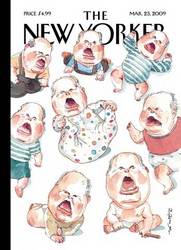
Eight bawling babies squirm across the cover of the March 23, 2009 issue of _The New Yorker_. By some unfortunate genetic defect, the octuplets have all been born with the features and demeanor of Rush Limbaugh. The same tragic defect has affected these babies’ ability to close their mouths and stop bawling. Blitt’s babies cannot be mollified, cannot be placated, even when given their favorite cigar (a Ramon Allones Gigante Double Corona).
From a pile of humidors and dirty diapers, a barrage of noise emerges. It is unceasing, brutal, and unnerving. Barry Blitt’s “OctoRush” is a collection of infants that could very well represent the eight sides or shades of Limbaugh. Here we have a chance to explore the heretofore hidden aspects of Limbaugh’s personality, a chance to excavate at an octahedron lying in the desert sand.
Excitedly, we dig at the seven hidden sides only to discover… that all of the sides are exactly the same, that they all represent a “colossal wreck, boundless and bare,” to quote Shelley.
Limbaugh is nothing but pure noise, like _The Phantom Tollbooth_’s Awful Dynne, a mindless megaphone whose core philosophy seems to be centered on the idea that constant repetition equals fact and that wishing that the failure of President Obama can be the patriotic hope of a “real American.” There is no complexity to this 21st-century Father Coughlin.
But I’ll stop myself here. The less I say about the man who calls himself “The Fourth Branch of Government” and “America’s Truth Detector” the better, for he feeds off controversy and publicity, like a mushroom growing and flourishing in the shadows, and seems to be the de facto leader of the Republicans, whether Republicans like it or not (if they don’t like it, they largely keep it to themselves, for fear of a very real form of punishment from “The Mandarin of Talk Radio”).
Limbaugh’s “entertainment” manufactures clouds of poison from which emerges nothing but barren rhetoric. This rhetoric builds and grows nothing, and offers no hope or sense of optimism, all of which are needed in these hard times. As Kurt Andersen “remarked”:http://www.time.com/time/nation/article/0,8599,1887728,00.html in a recent article in _Time_, “hyperbolic rants and rigid talking points, in either Limbaughian or Olbermannian flavors, now seem worse than useless, artifacts of a bumptious barroom age.”
Blitt’s eight babies of course refer to that other figure in the media, dubbed the “Octomom,” as if she were a nemesis of Spiderman or the Blue Beetle. Whether you agree with Nadya Suleman’s decision to have eight more babies (in addition to the six other young children she already had) or not, it is clear that the media has created a villain for our condemnation. The Octomom represents the same noise, the same hysterical cry of negativity that drowns out any hope for constructive and worthwhile dialogue. It is a story that has subsisted on endless coverage as well as the willingness of Ms. Suleman herself to maneuver her way towards the lucrative goal of flash-in-the-pan notoriety.
In fact, Barry Blitt has masterfully captured the essence of Limbaugh, the Octomom story, and the cacophony that both have produced. Blitt seems to be used by _The New Yorker_ as a sort of illustrator-hitman, and sometimes he hits his target cleanly and clearly (“and sometimes not”:http://emdashes.com/2009/02/sempe-fi-pinch-hitter.php).
Here, Blitt has expertly captured the open mouth and gray hair of Limbaugh while seamlessly grafting these features onto the Spring Line of Designer Baby Clothes. Artistically speaking, Blitt has accomplished what can be difficult to do: he has combined the fragility and immaturity of a two-year old with all the grizzled and bloated pomposity of a fifty-year old. You can almost hear the bawl of eight badly-behaved babies emanate from _The New Yorker_ cover. We can only hope that it is a bellow that one day we can learn to completely ignore.
Sempé Fi (On Covers): Elle
_Pollux writes_:
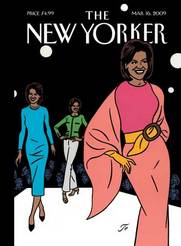
The _Chicago Tribune_ “once asked”:http://www.chicagotribune.com/news/politics/obama/chi-michelle-obama-dress-story,0,1949360.story, “With her gumball pearls, flip hairstyle and chic dresses, could Michelle Obama be the next Jacqueline Kennedy for stylephiles?” The March 16, 2009 issue of _The New Yorker_ is “The Style Issue” and who better to grace its cover than Mrs. Obama, who has quickly become a new fashion icon and a new source of fashion excitement? Michelle Obama is, “as one French blog described her”:http://lhommedanslafoule.blogspot.com/2009/03/new-yorker-couverture-16-mars-2009.html, _la nouvelle first lady des Etats Unis d’Amérique pour un numéro “The Style Issue.”_
That Michelle Obama has chosen to wear the most exciting names in American fashion is an indication of the qualities that also characterize her husband: confidence, self-assurance, elegance, and optimism. Having assumed the mantle of fashion icon, the First Lady has taken advantage of this new role to wear clothes designed not by established, big-name designers, but by rising stars in the world of fashion (Jason Wu, Isabel Toledo, Jimmy Choo), and she has mixed designer clothes with brands like J. Crew.
The choice of “Floc’h”:http://en.wikipedia.org/wiki/Floc%27h as cover artist is significant: a practitioner of the precise drawing style known as _ligne claire_, Floc’h has contributed illustrations to _Elle_ and _GQ_. The French cartoonist has also created drawings for the Parisian men’s wear shop known as Albert’s on the Rue de Courcelles, and contributed “fashion sketches”:http://www.breuer.fr/site.html for the Spring-Summer 2009 catalogue for the Breuer house of fashion.
His enormous output (Floc’h has been an illustrator since the late ’70s) includes “book cover designs”:http://bookdesign.wordpress.com/2008/12/22/floch-illustrateur-de-livres/, movie posters, and collections of comics often issued as handsome limited editions bound like portfolios and replete with lavish lithographs. Floc’h’s collaboration with the writer François Rivière, _Une trilogie anglaise_, which features the adventures of Olivia Sturgess and Sir Francis Albany, are a celebration of British elegance, fashion, and class. And his collaboration with another writer, Jean-Luc Fromental, has produced works like _Jamais deux sans trois_ (“Things Always Happen in Threes”), the story, inspired by the writings of F. Scott Fitzgerald, of a love triangle affecting three chic protagonists.
Floc’h’s “past covers for _The New Yorker_”:http://www.cartoonbank.com/search_results.asp?mscssid=N75BLQT1QCKS9NR183NUWJWU397MBJ28&sitetype=1&advanced=1§ion=all&artist=Jean+Claude+Floc%27h always had a timeless sense of class about them, with their depictions of ski-wear, evening gowns, and well-tailored indoor wear. Floc’h loves to draw clothes, and he draws them precisely.
Floc’h’s “Michelle O” is less a caricature or portrait of Michelle Obama than a portrait of the Michelle Obama Collection, of the fashions inspired by a woman who is of course more than just a manikin. A “recent article in _The Economist_”:http://www.economist.com/world/unitedstates/displaystory.cfm?story_id=13326771 warns of the “Oprah-isation” and “Jackiefication” of a First Lady who is more than a “celebrity mother-cum-clothes-horse” and condemns the media’s obsession with Michelle’s decision, for example, to go bare-armed in public. The article refers to Floc’h’s “cover of the March 16th issue [which] features the first lady strutting on the catwalk in three different outfits (none of them featuring bare arms).” I, too, feel, like the article’s author, that “it would be good to hear a bit more about what Mrs Obama thinks and a lot less about what she wears.”
But if her fashions bring a sense of hope and color (whether those colors be summer sky blue, periwinkle, or volcanic red) to a depressed nation, there is nothing unjust or iniquitous about featuring her on the cover of “The Style Issue.” She has style, and many other qualities besides. Her thoughts and speeches, no doubt, will be the subject of other drawings -not necessarily by the fashion-loving Floc’h, but by other writers and artists who will explore other sides of her character and good sense.
The goal of Floc’h’s cover is to introduce us to the clothes of a new age, and it is a role befitting a French Anglophile who has worked on both sides of the Atlantic, and who is very modern but also very consciously inspired by fashions from earlier decades, and whose output includes as much commercial work as artistic and literary.
The First Lady’s sure-footed and self-assured style of course extends beyond the realm of fashion, but the focus here is on the excitement inspired by her goal to sweep away the dowdiness of the past four decades. Floc’h’s Michelle represents the promise and bright colors of a new era.
Sempé Fi (On Covers): Man of Means

_Pollux writes_:
In a gloomy office, darkened by heavy, purple curtains, in a building that towers high above the city, a captain of industry scribbles a modest sum. He does so with a stubby pencil on a sheet of elementary school paper, the kind that always tore when you rubbed it vigorously with an eraser. The pencil is red, suggesting bankruptcy, insolvency, and failure. “I start by creating the most basic shapes and then refine with details as I go,” the cover artist, “Bob Staake”:http://www.bobstaake.com/enter, “has remarked”:http://drawn.ca/2008/10/06/bob-staake-creates-a-cover-for-the-new-yorker/ in regards to his methods, and a significant detail in his March 9, 2009 cover for _The New Yorker_, called “Downsized,” is in the math problem being worked on by the dome-shaped businessman. Two plus two always equals four, but the executive maneuvers his pencil in a downward swing that suggests that he is writing anything but the number four. He’s getting the simple math problem wrong.
Something else is of course wrong too. The senior executive’s head rests uncomfortably on a Brobdingnagian body. He is disproportionate, a brontosaurus, all body with a tiny head. But is he also all body and no brains? The incorrect answer to the simple math problem seems to suggest this. The executive’s body, long nourished by three-martini lunches, bottom-line brunches, and profitability picnics, now fills a room oppressive with defeatism and doom, its curtains suggesting the closing act of a once powerful business. Behind and below him, a once mighty city now exists entirely in the red.
Perhaps it was put there by the kind of executive that Staake depicts, who has been feeding on lucrative payouts and salary increases, and whose head rests on titanic shoulders like an olive on a Boehm porcelain plate. The bodies of these executives are draped in red, white, and blue power ties and Kiton suits fitted by master tailors from Naples, their fingers trembling in the presence of witless tycoons. Staake’s executive may be an idiot, but he’s not going anywhere.
Staake’s basic shapes work well here. His executive is entrenched, the sheer volume and solidity of his frame filling up an office that remains _his_ office. He’s settled, probably unaware of the chaos outside, an archetypical fat cat and plutocrat, who doesn’t need a top hat and cigar to look and appear rich.
Staake’s “past _New Yorker_ covers”:http://www.bobstaake.com/nyer/reflection.shtml, from his “Minimalist Christmas” to his beautiful “Reflection,” remain beguiling and expressive, as simple as their components may be. His illustration style, in part inspired by artists of the 1930s such as “Adolphe Mouron Cassandre”:http://en.wikipedia.org/wiki/Adolphe_Mouron_Cassandre, “Jean Carlu”:http://en.wikipedia.org/wiki/Jean_Carlu, and “Donald Brun”:http://www.idesirevintageposters.com/brun.html, evokes the earliest _New Yorker_ covers, harkening back to another economic depression that terminated an era of heady prosperity and optimism.
However, as much as Staake’s style may be rooted in the machine age aesthetic of 1930s Art Deco, his theme is all too modern. The economy is on everyone’s mind, whether that mind is large or small. Staake’s image of reduced power (economic power, brain power, and political power) speaks to a society, that, as of 2009, has come to realize that our captains of industry have failed us, and failed us badly.
Sempé Fi (On Covers): The Office
_Pollux writes_:
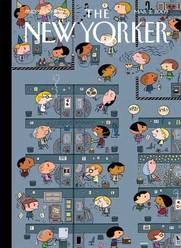
The color gray dominates Ivan Brunetti‘s bird’s-eye-view of a typical American cube farm on the cover of _The New Yorker_ for March 2, 2009. In this corporate necropolis of worthless PCs, dried-out water coolers, filthy coffee pots, and nauseating microwaveable meals, the wheels of American commerce fitfully turn like those on a rusty pump trolley. Even more defective than the machinery are the workers themselves: they weep, sleep, drink coffee, throw around office equipment, argue, and suffer termination, germophobia, and Post-it Note overload. They look for shoes and romance, both of the online and office varieties, and dance fitfully at a potluck. They get caught looking at pornography and lose precious time as the bespectacled Help Desk Guy dismantles their computer with a ruthless drill.
Brunetti’s “Ecosystem” is a corporate world that at first glance seems to be a beehive of industry and activity, but we soon come to an awful conclusion about this American workplace: little work is actually being done. In the sickly gasps of a failing economy, we hear verses, through a defective intercom system, from Alighieri’s _Inferno_: “Here heartsick sighs and groanings and shrill cries / Re-echoed through the air devoid of stars.”
I wish this world were imaginary, for the U.S. economy’s sake, but as a reluctant inhabitant of this type of purgatory myself, I find Brunetti’s vision all too familiar. I have witnessed a Mardi Gras Potluck in which managers and supervisors walked around in feathered carnival masks while workers happily clipped their fingernails, checked Facebook for the umpteenth time, made multiple trips to the break room for bratwurst, Lay’s Potato Chips, and stomach-churning lumps of cheese and steak, and looked forward to a night of office-sponsored glow-in-the-dark miniature golfing.
By a trick of perspective we look at Brunetti’s egg-headed, stick-limbed figures not from above, but follow them on a downward trajectory as if in “an etching by Piranesi.”:http://upload.wikimedia.org/wikipedia/commons/2/29/Piranesi9c.jpg All are locked in their compartments, doomed to scamper endlessly on a hamster wheel they themselves have maintained. The artist’s cartoon figures, normally subjected to the most wicked and outrageous torments (see, for example, his book HAW!: Horrible, Horrible Cartoons), now participate in the most perverse ordeal of all: the daily routine of office life.
Sempé Fi (On Covers): Strikeout Leader
_Pollux writes_:
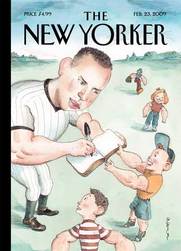
“I know I can make a difference on this issue,” baseball player Alex Rodriguez, called A-Rod by some (and A-Fraud by others), has “recently remarked”:http://www.nytimes.com/2009/02/18/sports/baseball/18yankees.html in regards to educating the young on the dangers of steroid use. Blitt’s February 23, 2009 _New Yorker_ cover depicts just exactly what difference Rodriguez will make on today’s youth: bigger biceps.
Blitt’s cartoon takes place in an idyllic, as-American-as-apple-pie parkland: Rodriguez blithely and humbly signs young Timmy’s autograph book as other local kids enthusiastically gather around their hero. Rodriguez’s arms are as large as coiled pythons, and the children have imitated their hero by hopping themselves up on illegal ‘roids.
In response to Blitt’s now infamous Obama cover, the cartoonist “has stated”:http://www.huffingtonpost.com/2008/07/13/barry-blitt-addresses-his_n_112432.html that “it seemed to me that depicting the concept would show it as the fear-mongering ridiculousness that it is.” Fair enough, but Blitt’s new cover, which he calls “Off Base,” strikes an ambivalent note. As with the Obama cover, Blitt once again produces an ambiguous message. Is Blitt capturing and satirizing fears regarding Rodriguez’s promise to educate kids on the dangers of steroids? Or is he attacking Rodriguez directly? Blitt’s watercolors and linework haven’t created the monster that the cover itself suggests that Rodriguez may be, but rather a sympathetic, benevolent figure. The drawing inhabits the soft towns of Norman Rockwell rather than the ruthless landscapes of Hogarth and Daumier. Blitt, although immensely talented as an artist, wants it both ways again: he wants to represent fear-mongering ridiculousness without agreeing with this fear-mongering ridiculousness himself.
But that really isn’t possible, and this iffiness has produced a less than successful cover. Whether you care about baseball or not, A-Rod’s cheating and perjury make him a less than attractive figure in an American landscape that already seems to be ravaged more than usual by cheats and liars, from the corked bats and Primobolan in the world of athletics to the corked hedge funds of Madoffian financing, from Bush’s yellowcake uranium claims to Blagojevich’s sleazy influence peddling and pay-to-play schemes. It isn’t the time for fuzzy and hesitant artistic attacks or for pulling punches. Blitt once again has created a cover whose actual target is unclear. Is Rodriguez the actual target of the attack or is the target actually our fears that somehow Rodriguez will push Decadurabolin and Sustanon on unsuspecting children?
Blitt has swung and missed.