
_Pollux writes_:
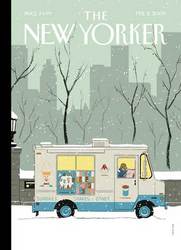
A cold wind blows across an empty urban landscape, agitating the slender trees that stand tenuously in the moss green and greenish-gray city. In “Adrian Tomine’s”:http://www.adrian-tomine.com/ cover for the February 2, 2009 issue of _The New Yorker_, the only source of warmth, ironically enough, comes from the inside of an ice-cream truck. The urge to launch into the worst in “dark and stormy night” writing has been suppressed: Light bathes the lone ice-cream salesman, who sits contentedly in his truck reading a rose-colored newspaper. He’s not calling it a day, and the winter has not erased the smile off the kiddie-cup face of the Ice-Cream Man gracing the side of the truck. “We got sundaes, shakes, and cones; we got sundaes, shakes, and cones…”
Tomine’s delicate linework and subtle coloring lend themselves well to the inherent incongruousness of selling ice-cream on a wintry day. It isn’t a clichéd form of comedy with a sad-sack salesman staring and shivering gloomily into the darkness. Tomine’s salesman waits for business, but not impatiently so. He’s snug in his earflap hat, scarf, and jacket. Besides the inherent incongruousness of this scene, there is also the innate optimism of such a commercial enterprise. If people, perhaps motivated by hunger or by childhood nostalgia, want ice-cream, they’ll buy ice-cream. But they’ll have to brave the snow to get it. When my grandmother, a native of much warmer climes, visited Hornsea, England in 1979, it was in the middle of a hard Yorkshire winter. The town was battered by bone-chilling North Sea winds. It didn’t matter. My father bought her a “99 Flake”:http://en.wikipedia.org/wiki/99_Flake ice-cream crowned with two half-size Cadbury chocolate bars. It was so good that she felt she deserved punishment or time in a mental asylum. “They should beat me with sticks,” she said.
It doesn’t matter if it is an odd thing to eat ice-cream in winter. Let’s all venture out into the snow and treat ourselves to a selection of sundaes, shakes, or cones. Happy times may be here again.
Category Archives: Sempé Fi
Sempé Fi (On Covers): Valley Forged
_Pollux writes_:
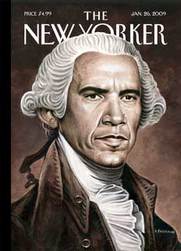
Obama looks good in a powdered wig. The head of Washingtonian hair sits easily and regally upon a head that bears a determined and presidential expression. One would think that the concept of dressing Obama in late eighteenth century clothing would produce an entirely jokey cover, but “Drew Friedman’s”:http://www.drewfriedmanart.com illustration for the January 26, 2009 issue, called “The First,” strikes me as being grave, entirely conscious of some time in the distant future when the cover will be a valued relic of times past. I see it being used in history classrooms, accompanied by exercise questions (“How do you think the artist feels about Obama?” “Why do you think he chose to depict Obama this way?”).
Friedman’s color tones are earthy, dark, and subdued, evoking the anfractuous mixture of the weight of history and even greater weight of future expectations. The portrait is photorealistic, and sober, evoking also the enormous pressures faced by our first president. Both Washington and Obama are “Firsts,” and Friedman’s use of only browns and blacks and whites is a nod to the breaking of racial barriers, and to the intersecting of countless identities and Americas: the Venn diagram of these United States of America. “Barry Blitt’s Obama cover”:http://emdashes.com/2008/10/two-thoughts-on-the-subject-of.php encapsulates what many Americans feared Obama would be and do; Friedman’s captures what many hope Obama will be.
Friedman’s depiction of a periwigged Obama isn’t funny, and I’m glad that it isn’t funny.
Sempé Fi: A Column About New Yorker Covers (New!)
_Pollux writes:_
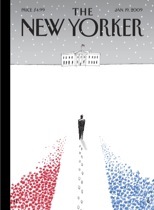
A lone man walks towards a White House constructed from a few thin, sketchy lines in “Guy Billout’s”:http://www.guybillout.com “inauguration cover” for the January 19, 2009 issue of _The New Yorker_. The lone man could be Obama, but is not immediately recognizable as the president-elect. The lone figure, I believe, represents Everyman, unprotected from the snow’s coldness. We are all walking towards the White House, which is set in a wintry landscape unencumbered by distractions, crowds, and TV cameras.
The Everyman walks straight towards his new home, through the fallen red-and-blue leaves of the autumnal election season, which is now over and done with. He walks away from the chaotic noise, a mixture of violence and optimism, of our two warring political parties, whose tendrils nevertheless trail him for as long as possible. He is an Amundsen in search of a new Pole across the Ross Ice Shelf of a new future, away from the simple dichotomy of red and blue.
The cover is more grim than hopeful, I think. What is certain is that the shoeprints in the snow lead towards the future down an unmarked pathway towards the White House door. The loneliness of power is apparent here, and Billout’s stark artistic style lends itself very effectively to this message.
Joan Walsh in Salon on Barry Blitt’s Obama Cover
Emily Gordon notes this passage in Salon today:
Still, at times Obama seemed to have the best of both worlds, politically: The self-confidence that comes from being raised (and loved, intimately, from Day One) by the white majority, while also being protected from any perceptible threat of racism by black and white supporters admirably determined to identify and crush it when it surfaced….
Historians may find that this double force field protected Obama; certainly, we saw it in the primaries, when anything that could be remotely perceived as a racial diss to Obama, by the Clintons, their supporters or the media, ignited a firestorm and damaging charges of racism against whomever slurred — or simply slipped — in their treatment of the black Democratic candidate. I enjoyed the anti-racist media strikeforce when it hit Fox News for its idiotic “slips” labeling Barack and Michelle’s affectionate fist-bump a possible “terrorist” gesture, and describing Obama’s wife of 16 years as his “baby mama.” I liked it much less when it was directed at outlets I respect, like the New Yorker (or Salon). I still can’t believe the backlash against the New Yorker’s hilarious (in my opinion) fist-bump cover, sending up all the right wing’s dumbest, least believable slurs against Michelle and Barack Obama. His supporters howled with outrage, and his campaign bit back, too, with even Obama himself lamenting that the cartoon might be misunderstood by confused voters.
Spokespigeon: This Week, We’re Glad Not to Be Turkeys
Emdashes applauds the plentiful presence of pigeons on Harry Bliss’s cover this week!
Prior muckraking “Emdashes TNY/pigeon coverage”:http://emdashes.com/mt/mt-search.cgi?tag=pigeons&blog_id=2.
Shame on You, Barry Blitt!
Costing Obama the election “like that”:http://www.newyorker.com/online/covers/slideshow_blittcovers?slide=1&run=true#showHeader.
Cartoonist Liza Donnelly: “An Insider’s Perspective on the ‘New Yorker’ Cover”
Read Donnelly’s post on wowOwow about the much-discussed cover.
Letters to the Times About Barry Blitt’s Obama Cover
A few more perspectives, including that of Rich Harris from Brooklyn, who begins, “I am a black man and a Democrat, and I thought the New Yorker cartoon was very funny. It was not racist; rather, it was great satire. More important, I thought it was brave.” Here’s a tiny bit of reportage for you: Paul Morris texted me to say he couldn’t find a copy of The New Yorker anywhere he went today in Los Angeles. I’ve had a few conversations about the cover today at TypeCon, whose attendees are well versed in the power of words, images, humor, irony, iconography, and illustration. I’ll see if I can round up a few quotes, since I think you’d find them interesting. Smart, smart people here in Buffalo!
A Micro-History of Satire on New Yorker Covers
Today’s Daily Heller, the blog/e-blast by PRINT contributing editor and lead greyhound Steven Heller, addresses this week’s New Yorker cover (by Barry Blitt), which has been stirring up a little controversy. Why take things to such extremes? There’s a reason, as Steve writes:
This week’s New Yorker cover [pictured] by Barry Blitt is just that: A satirical commentary on all the slanderous rumors being dumped on Sen. Barack Obama.
Titled “The Politics of Fear,” the cover trenchantly attacks “the use of scare tactics and misinformation in the Presidential election to derail Barack Obama’s campaign,” according to a press release about the current issue.
But the Obama campaign (as well as that of Republican rival John McCain) slammed the cover as offensive[…]
…
In satire, however, context is everything–a delicate balance, to be sure. It must be pitch perfect, but not everyone need agree on whether it succeeds. Nonetheless, as a cover of The New Yorker, a magazine known for many covers, cartoons, and articles that “expose and discredit vice or folly,” it’s difficult to see this as anything other than what it is. And like the covers below, satire is designed to make readers question social, political, and cultural assumptions.
See the rest of Steve’s post for a handful of good examples from New Yorkers past. It was ever thus, or, as Carly Simon once sang, it’s coming around again. Election season is bound to produce a few more covers that jangle the carefully calibrated image making of both parties. Some may even twit the voters. We’ll live.
As for this the danger that a satirical image will instantaneously vaporize all life as we know it, not to mention the chances of our guy taking the White House, I’ll quote David Remnick out of context (he was talking with Folio, back in May, about the Democratic race): “The edifying parts of it I’m enjoying. The nonsense, the bullshit, the got-you things that mean nothing, are exhausting and meaningless, obviously.” Breathe: November’s still a few months away, and it’s going to be a bumpy ride.
The Times Magazine’s Stunning Covers
Martin Schneider writes:
I just stumbled on this attractive page, which features a handful of thoughtful, arresting New York Times Magazine covers. Beautiful stuff!