
Jonathan Taylor, who previously revisited John McPhee on New York City’s greenmarkets and strongly suggested that the city install skybridges, writes:
If it’s really the end of an era for Wall Street, it will also be the end of a perennial New Yorker trope.
Recently subsumed brokerage Merrill Lynch, a metonym for Wall Street (itself a metonym!), was for decades an absurdly frequent subject of New Yorker Talk pieces and cartoons, which exhibited an inexhaustible fascination with the length and euphony of its name in its various iterations, particularly “Merrill Lynch, Pierce Fenner & Beane.”
Should that not be “Merrill, Lynch, Pierce….”? It should not, and an amusing December 27, 1947, Talk piece, “Fine Point,” settled it. The erroneous placement of a comma where it didn’t belong had led to a “warm discussion” among magazine proofreaders. (Most likely it was in a September 13, 1947, cartoon, in which a woman asks her investment counselor, “When you say Merrill, Lynch, Pierce, Fenner and Beane recommend a certain stock, do you mean it’s unanimous or just a simple majority?”)
“The situation set us to worrying,” wrote Talk, “and since, with us, to worry is to act, we sent a man downtown to investigate.” This man soon enough got co-founder (or “lead-off man,” as it was put) Charles Merrill on the horn. Merrill told him that when he and Edmund Lynch founded Merrill Lynch & Co. in 1914, they simply took after the ethereal example of J.P. Morgan affiliates (Morgan Grenfell, Drexel Morgan & Co.) that had no need for the workaday comma.
And in the discreet banking world, it seems that it can be wiser not to tip one’s hand punctuationally. “Fine Point” goes on to explain that when Merrill Lynch & Co. merged with another firm in 1940, there was a New York law forbidding a partnership from including a dead person in its name. This was initially thought to mean that the new company could not retain Lynch, who had died in 1938, in its name. But another law did permit the name of a firm to be a component of a name of a partnership; some syntactically wise lawyers surmised that, without a comma, “Merrill Lynch” could be construed as the name of a firm, rather than simply the names of two partners. “Otherwise, Merrill Lynch, Pierce, Fenner & Beane would be called something else today, maybe Chuck,” the mag quipped.
The next name change, to Merrill Lynch, Pierce, Fenner & Smith, prompted another investigation, in the February 15, 1958, issue. It was a small loss to the culture: “The explosive, easily rhymed climax provided by ‘Beane’ has long been a boon to writers of songs and gags.” A year later a 1959 piece titled “& Beane?” looked in on the departed partner, Alph Beane, who had co-founded a new firm, J.R. Williston & Beane Inc.
I wondered if Beane had perhaps shown superhuman prudence in bailing out of Merrill Lynch a whole half century before Merrill’s demise. But his 1994 Times obit notes, “In the fall of 1963, Williston & Beane began to have financial difficulties when it failed to meet capital requirements at the New York Stock Exchange and the American Stock Exchange after the bankruptcy of a client, the Allied Crude Vegetable Oil and Refining Company, which was unable to meet margin calls on soybean and cottonseed futures clients”; it was absorbed by another brokerage.
Category Archives: The Catbird Seat: Friends & Guests
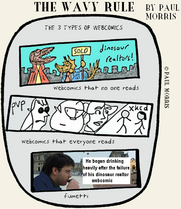
The Wavy Rule, a Daily Comic by Paul Morris: Frozen Movies
Would Will Eisner, who coined the phrase “sequential art” to describe comics, include fumetti? Paging Scott McCloud! (And click to enlarge!)
More by Paul Morris: “The Wavy Rule” archive; “Arnjuice,” a wistful, funny webcomic; a smorgasbord at Flickr; and beautifully off-kilter cartoon collections for sale (and free download) at Lulu.
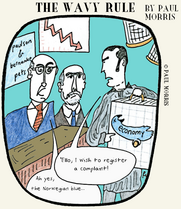
The Wavy Rule, a Daily Comic by Paul Morris: …Something Completely Different
Paul writes about today’s cartoon:
Is it just me, or is the American public not angry enough about this whole bailout? What we need is an “Eric Praline-like”:http://en.wikipedia.org/wiki/Eric_Praline character, high-pitched and indignant, to go before the President, or Congress, or both, and ask what in bleedin’ hell is going on: “Look, it’s people like you what cause unrest.” “A letter to America attributed to John Cleese”:http://blog.tmcnet.com/blog/rich-tehrani/personal/john-cleeses-letter-to-america.html is now considered to be apocryphal, but nevertheless makes interesting reading. As a “Sarvik.com article”:http://www.sarvik.com called “Between Iraq and a Hard Place” has pointed out, “since the bank rescue package will not include assistance for The People, and because society at large will demand assistance for them as well, bigger government or/and higher taxes to stimulate the system through public works are inevitable in one form or another. Increased taxation is the domain of Democrats, and that’s why they will ultimately win the 2008 Presidential election. The Republicans won’t want to confuse their reputation by being forced to create another New deal administration, as it will make it extremely difficult in future to campaign on a platform of conservatism and small government.”
Also, check out Cleese’s “official site!”:http://www.thejohncleese.com/ And click on the cartoon to enlarge it!
More by Paul Morris: “The Wavy Rule” archive; “Arnjuice,” a wistful, funny webcomic; a smorgasbord at Flickr; and beautifully off-kilter cartoon collections for sale (and free download) at Lulu.
The Wavy Rule, a Daily Comic by Paul Morris: Potato Chip Politics
In today’s comic, Paul considers the tasty, salty angle of the McCain-Obama debate. Click the drawing to enlarge! (And anticipate the munchies.)

More by Paul Morris: “The Wavy Rule” archive; “Arnjuice,” a wistful, funny webcomic; a smorgasbord at Flickr; and beautifully off-kilter cartoon collections for sale (and free download) at Lulu.
Forget Jet-Paks: We Demand More Skybridges for New York
Jonathan Taylor writes:
A few weeks ago, a friend and I were admiring a skyscraper in lower Manhattan, the American International Building at 70 Pine Street. Its tower—well described as an Art Deco hypodermic needle—is so thin and set back that it’s hard to look at from street level, but the almost parodically Deco style of its lobby can be seen despite the security guards posted to ward off idle venturers. A few weeks later, after the rescue of American International Group, I confirmed my guess that the building is the company’s headquarters (the Federal Reserve Bank of New York is conveniently nearby) but learned that it hasn’t always been. It was completed in 1932 as Sixty Wall Tower, known also as the Cities Service building, because it was the headquarters of oil company Cities Service Co. until the company moved to Tulsa, Oklahoma, in 1974. (I remember from growing up in Tulsa the ubiquity of the name “Cities Service,” probably as where a lot of kids’ dads worked. A relatively literal-minded child, I was perplexed by the company name’s stubborn failure to make clear to me what kind of company it was. Cities Service later became Citgo, now owned by the government of Venezuela.)
Frequently noted about the Cities Service building is the fact that it originally had eight “double-decker” elevators that served the floors above 28, two floors at a time, saving on elevator shafts and maximizing rentable floor space. In the April 30, 1932, issue of The New Yorker, E.B. White wrote a Talk piece about these new Otis elevators. White’s description of the system’s logic made it crystal clear, only after making it painfully clear that I should have been more confused by it than I thought I was:
People seem to think that to get into a double-decker, you have to walk either up a flight of stairs or down a flight. This isn’t so. The Cities Service building has two street entrance levels (on account of the way the land slopes off), and no matter whether you enter downstairs or upstairs, there will be four elevators that will make the even stops and four that will make the odd stops. No walking. In other words, when the double-deckers are at the starting position, their upper decks are being loaded with people coming in from one street, their lower decks with people coming from another street; four will stop ODD/EVEN and four EVEN/ODD.
The double-decker system was phased out in the building in the 1960s, according to this 1998 Times article. Among the buildings that today use double-deckers is the Citigroup Center in Midtown, itself the subject of a gripping May 29, 1995, New Yorker article by Joe Morgenstern (department: “City Perils”) about the discovery of a structural defect that might have caused it to collapse in a major hurricane, and the secret, after-hours work undertaken to correct it.
White ended his Talk piece on the elevators by noting, a bit sourly, that Sixty Wall Tower “isn’t in Wall Street, and can’t even be seen from Wall Street,” which is one block away. But the name stems from another of the building’s gewgaws, even more interesting from the point of view of that wonderful topic, the futurism of the past. The tower was joined to another belonging to Cities Service, at 60 Wall Street, by a connecting bridge on the 16th floor, allowing it to lay claim to that address. The bridge is now gone, but in that age, when the city was rapidly levitating upward in a skyscraper-building race, such bridges might well have seemed to be the logical wave of the future. In light of what seems to be the omnipotence of real estate values in the city’s economy, it’s still hard to believe that someone hasn’t found a way to profit from turning more corridors of air space into rights of way. That dream—and a hint of the obstacles to it—can be found in another Talk piece, of October 21, 1933, about the city’s taxation and regulation of such bridges (then numbering about 100, according to the article). They required the approval of the Board of Estimate, the Borough President, the Fire Department, and the Municipal Art Commission.
Somewhere in there (the piece is not clear) was the crucial say-so of “Edward Libaire, Assistant Engineer of the Division of Franchises” and “the city’s bridge expert for twenty-eight years.” Libaire rejected a proposal for another skybridge between the Cities Service tower and 60 Wall Street, on the second-story level, arguing that it would “hide too much of the sky.” But despite his stern standards for bridges that “won’t shut off too much light and that people will admire,” Libaire “pictures New York in 1983 with block-square skyscrapers connected with bridges that form great aerial highways.”
Now that New York City’s revenue base is being threatened by the financial crisis, perhaps Mayor Bloomberg would like to take a new look at skybridges. The Talk piece says that at that time—during the original Great Depression—”Nearly $400,000 of the yearly income of the city is from its tax on bridges between buildings.” (That’s $6.7 million in today’s dollars, according the federal government’s own “inflation calculator”:http://data.bls.gov/cgi-bin/cpicalc.pl.)
By the way, the Sun in January carried this update on the state of skybridges in the city today.
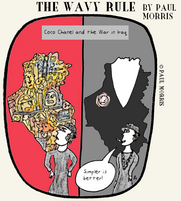
The Wavy Rule, a Daily Comic by Paul Morris: Intelligent Design
Today’s installment is reminiscent of an old Might magazine article about the importance of graphic designers in international affairs. The only thing I remember about it was that the solution for Northern Ireland involved use of Photoshop’s gradient feature on the embattled border. Click to enlarge!
More by Paul Morris: “The Wavy Rule” archive; “Arnjuice,” a wistful, funny webcomic; a smorgasbord at Flickr; and beautifully off-kilter cartoon collections for sale (and free download) at Lulu.
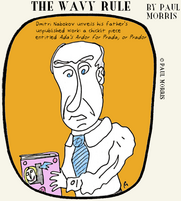
The Wavy Rule, a Daily Comic by Paul Morris: Sole Authorship
_Today’s entry puts me in the mind of John Hodgman’s failed palindromes: “Tow a what? Thaw!” Similarly, egret, neo tickle? Click to enlarge!_
More by Paul Morris: “The Wavy Rule” archive; “Arnjuice,” a wistful, funny webcomic; a smorgasbord at Flickr; and beautifully off-kilter cartoon collections for sale (and free download) at Lulu.
The Wavy Rule, a Daily Comic by Paul Morris: Horrorshow
The other day on Letterman, Chris Rock called Alaska “The Road Warrior with snow.” Today Paul adds chellovecks and moloko to the vast expanses of Alaska. Click to enlarge!

More by Paul Morris: “The Wavy Rule” archive; “Arnjuice,” a wistful, funny webcomic; a smorgasbord at Flickr; and beautifully off-kilter cartoon collections for sale (and free download) at Lulu.
The Wavy Rule, a Daily Comic by Paul Morris: Seward’s Icebox
Impressed by Philip Gourevitch’s recent piece on Alaskan politics that examined the role of Ted Stevens in finagling congressional pork and earmarks, Paul dedicates today’s edition to the origins of the state. Click to enlarge!

More by Paul Morris: “The Wavy Rule” archive; “Arnjuice,” a wistful, funny webcomic; a smorgasbord at Flickr; and beautifully off-kilter cartoon collections for sale (and free download) at Lulu.
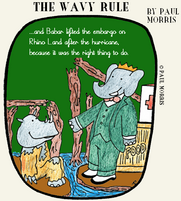
The Wavy Rule, a Daily Comic by Paul Morris: Celesteville, Texas
Paul writes: Adam Gopnik’s “Freeing the Elephants” is a fascinating analysis of the Babar children’s books. Is Babar a symbol of French colonialism or “a self-conscious comedy about the French colonial imagination,” as Gopnik argues?
The destruction wrought by Hurricane Ike in the Caribbean has reignited the debate over American trade sanctions on Cuba. According to one report, “Cuba says Ike and Gustav caused US$5 million damage this month, but the embargo has been far more damaging, adding up to US$93 billion over nearly five decades.”
More by Paul Morris: “The Wavy Rule” archive; “Arnjuice,” a wistful, funny webcomic; a smorgasbord at Flickr; and beautifully off-kilter cartoon collections for sale (and free download) at Lulu.