
For much of the summer, Emdashes’ summer interns–Sarah Arkebauer, Taylor House, and Adam Shoemaker–have explored the multifarious, multimedia, and at times mellifluous blogs and podcasts at newyorker.com.
While this (combined, two-week) report from Adam and Sarah is the last from their internship, it’s certainly not the last you’ll hear from these talented people. Readers, look forward to more analysis from and news of them in months to come. Sarah, Taylor, and Adam, it’s been a true pleasure working with you, and I’m looking forward to more of your words and your thoughts.
Adam Shoemaker:
Last week in Interesting Times, George Packer analyzed John McCain and proposed that the Arizona senator lives an existence of constant tension between ambition and principle. When the tension relaxes, so does the principle, until the politician recovers his grasp of a moral center through “a searing period of repentance that ends in a renewed commitment to do what is right regardless of the consequences.”
This week in his blog subtitled “Notes on politics, mostly,” Hendrik Hertzberg also considers circularity and the timely term “palindrone” after a reader reminded him that in Ancient Greek, “the word ‘Palin’ means, more or less, ‘backwards’…in the sense of reversing direction.” For those afflicted by “Palinopsia,” Hertzberg recommends a radical palinectomy, and refers readers to Dr. Donald Fagen. I just hope this doesn’t have adverse effects on the National Association of Lutheran Interim Pastors, a good lot, no doubt.
Continuing with the theme of reversals, Hertzberg suggests that the sustained attention lately paid to the McCain campaign is due in large part to convention scheduling: “If the order of this year’s Conventions had been reversed, we would now be looking at a very different set of story lines. The final, reverberating impression left by the Conventions would not have been Sarah Palin’s everygal charm but Barack Obama’s stirring specifics delivered to a cheering throng of eighty thousand under the lights.”
Earlier, Hertzberg reminded us that Sarah Palin’s line, “I told Congress, ‘Thanks but no thanks’ for that bridge to nowhere up in Alaska” is “an absurd lie.” Moving from dublicity to wordcraft, Hertzberg was no happier with Mitt Romney’s convention speech, in which the former governor lamented the current atmosphere in Washington, which is apparently way too liberal for his taste. In this post, Hertzberg may be documenting the birth of something truly horrendous: the cut-and-paste political speech. Though maybe that train has already left the station.
Sasha Frere-Jones laments the passing (from Union Square) of his favorite street band, and rejoices in Jay Smooth’s debunking of hipster rap (as might we all, I suspect). He’s somewhere in the middle on the death of the broadcast music video: he notes the utter pointlessness of today’s Video Music Awards, but also remembers the genre’s glory days.
Last week, Frere-Jones was excited for the New Yorker Festival’s dance party kick-off, which he has been hosting for a new years now. I’m excited, too, particularly as it’s set to be hosted by Megasoid, friend of Lazer Sword, of “Blap To The Future Megamix” fame. Yes. Frere-Jones’ organology lessons continued with an entry on the Roland TB-303 synthesizer. See previous posts on the Tenori-On and Auto-Tune. It’s for this education that I continue to be a devoted reader of the blog, despite the discovery that Frere-Jones recently compared the language of my new home to Cialis spam.
I had the chance to engage in my own nostalgic retrogression when I listened to Blake Eskin’s interview with Adam Gopnik on the New Yorker Out Loud podcast. Gopnick wrote an article in this week’s New Yorker on Babar the Elephant. Turns out the beloved pachyderm is not beloved by all, with some seeing the books as a justification for colonialism and an apology for the westernizing policies of the French in Africa; that dapper green suit might not have been so innocent after all.
Gopnik gives a spirited defense and explains why Jean de Brunhoff’s story, despite its traumatic moments and questionable political innuendos, remains a wonderful tale for children and a witty, self-questioning piece for all.
In the previous edition of the podcast, Ariel Levy stopped by to talk about her article on Cindy McCain. Highlights include a look into the darker side of the McCain and Hensley families, Levy’s thoughts on the role of the First Lady, and Cindy McCain’s secret desire for duct tape. A good listen all around.
Finally, we hear from Andy Borowitz over at the Borowitz Report that Sarah Palin has adopted a new technique for her ABC interview: the Governor of Alaska is bringing a Magic Eight Ball along with her. I can think of at least one more special interest group that’s now pulling for McCain. Maybe they can build it right into the press-room podium.
Sarah Arkebauer
On an archived Fiction Podcast Edwidge Danticat discusses Junot Diaz’s “How to Date a Brown Girl (Black Girl, White Girl, or Halfie),” a provocative yet charming how-to guide. It’s scandalizing and poignant, and the post-reading discussion is not to be missed.
I was pretty thrilled to see Alex Ross reference my home state in his article on Karlheinz Stockton in The Rest Is Noise. He later posted a good quip from Bill O’Reilly, and an interesting treatise, replete with links, on his proposed “World Atonality Day.”
Meanwhile, at the Book Bench, there is news of a Booker Prize surprise, and the Bookspotters find a lost math book, and Augusten Burroughs’ “Running with Scissors.” I also really enjoyed the vision of what being the British Poet Laureate would entail, and the post that includes a link to the blog “Librarians Against Palin.”
Goings On had plenty to say about Sarah Palin as well. First came a disturbing report by Andrea K. Scott on Palin’s treatment of Wasilla’s Historical Museum workers, which was followed by an interesting post by Scott on the Met’s new director that includes a Palin jab. In non-Palin-related events, Scott also wrote up news on political ice cream and financially grim music.
I attended public elementary and middle school during the 1990s-2000s, and have witnessed “Garfield”-related motivational posters that seem to be an obligatory part of modern American education. Despite–or perhaps because of–this, I love reading the online comic strip “Garfield Minus Garfield,” which, as the name would suggest, prints real Garfield comic strips with the title character airbrushed out. I was thoroughly amused, then, by the interview between Dan Walsh, the creator of “Garfield Minus Garfield” and Zachary Kanin at The Cartoon Lounge. Kanin also continues the sandwich duel with the twelfth (cliff-hanging) thirteenth, fourteenth, and fifteenth installments. Farley Katz also posted a turgid review of Bangkok Dangerous.
My favorite piece, though, was a flippant and funny ode to E. E. Cummings, by Drew Dernavich. It makes me yearn for the puddle-wonderful days of springtime.
Editor’s note: The proper capitalization of Cummings’s name is one of my favorite pedantic poodles. See here for a thorough, and historically sound, explanation.
Previous intern roundups: the September 5 report; the August 29 report; the August 22 report; the August 15 report; the August 8 report; the August 1 report; the July 25 report; the July 18 report; the July 11 report.
Category Archives: The Catbird Seat: Friends & Guests



The Wavy Rule, a Daily Comic by Paul Morris: Plewd Awakening
In today’s installment, Paul pays tribute to Mort Walker (whose “Beetle Bailey” was fleetingly mentioned in this 2003 Talk of the Town by Andy Borowitz). Click to enlarge!
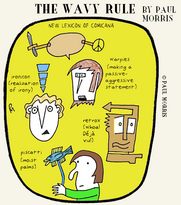
Paul adds: Back in 1980, Mort Walker, of “Beetle Bailey” fame, wrote a book called Comicana, a set of international symbols and names denoting the various visual devices frequently used by cartoonists. For example, the sweat droplets that fly out of a character’s head Walker called “plewds,” the clouds of dust emanating from a runner’s feet are “briffits,” and my all-time favorite: “grawlixes,” that bubble of violent symbols indicating that a cartoon character is cussing up a storm. This Wavy Rule is in honor of Walker’s creation. Also, check out this article on the Lexicon by Stacy Conradt.
More by Paul Morris: “The Wavy Rule” archive; “Arnjuice,” a wistful, funny webcomic; a smorgasbord at Flickr; and beautifully off-kilter cartoon collections for sale (and free download) at Lulu.
The Wavy Rule, a Daily Comic by Paul Morris: Self Expression
Today’s installment is particularly delicious and cunning. Don’t forget that the spontaneity drills begin at 3 p.m. today sharp. Click to enlarge!

More by Paul Morris: “The Wavy Rule” archive; “Arnjuice,” a wistful, funny webcomic; a smorgasbord at Flickr; and beautifully off-kilter cartoon collections for sale (and free download) at Lulu.
The Wavy Rule, a Daily Comic by Paul Morris: Prince Fielder
About today’s installment, Paul writes:
Claudia Roth Pierpont’s profile on Machiavelli in the latest issue of The New Yorker explores the man and his reputation. Has his reputation for cruelty been justified? What would Machiavelli have made of the current state of American politics?

More by Paul Morris: “The Wavy Rule” archive; “Arnjuice,” a wistful, funny webcomic; a smorgasbord at Flickr; and beautifully off-kilter cartoon collections for sale (and free download) at Lulu.
The Wavy Rule, a Daily Comic by Paul Morris: Open Quote
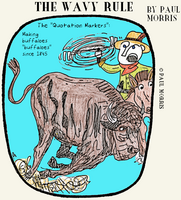
Oh no! Another instance of “buffalo buffalo”! (Kind of.) Never fear—we welcome them! And “them”! Click to enlarge.
More by Paul Morris: “The Wavy Rule” archive; “Arnjuice,” a wistful, funny webcomic; a smorgasbord at Flickr; and beautifully off-kilter cartoon collections for sale (and free download) at Lulu.
The Wavy Rule, a Daily Comic by Paul Morris: Allen Wrench
Here are Paul’s thoughts on today’s installment. (And here is David Denby’s review of Vicky Cristina Barcelona.) As always, click to enlarge.
Will women vote for John McCain because his running mate is a woman? (McCain’s matrimonial mate is also a woman.) That is the question. I was hoping that for once, we’d have a dignified election about the issues, but it doesn’t look it’s going to come to pass, what with lipstick on a pig, mooseburgers, and hockey moms. We haven’t changed all that much from the unsophisticated days of “Tippecanoe and Tyler too.” So much for “change.”

More by Paul Morris: “The Wavy Rule” archive; “Arnjuice,” a wistful, funny webcomic; a smorgasbord at Flickr; and beautifully off-kilter cartoon collections for sale (and free download) at Lulu.
The Wavy Rule, a Daily Comic by Paul Morris: Get a MoveOn.org!
Today’s installment reminds me of the supermarket scene in the movie American Splendor, about Harvey Pekar. As always, click to enlarge!

More by Paul Morris: “The Wavy Rule” archive; “Arnjuice,” a wistful, funny webcomic; a smorgasbord at Flickr; and beautifully off-kilter cartoon collections for sale (and free download) at Lulu.
The Wavy Rule, a Daily Comic by Paul Morris: Palin’s Drome
In today’s “Wavy Rule,” Paul continues his wine labels series with a kind of northern wine we’d rather not be drinking come November. Click to enlarge!

Paul adds: Like most of America, I had no idea Wasilla ever existed before it became a name uttered by thousands of pundits, voters, orators, and average people in the street. The Wikipedia article on the town has seen a lot of activity recently. And I don’t mean the article on the Sarmatian god of the same name. Let’s face it: it’s a small town, no matter how the Republicans spin it. And there’s nothing wrong with small towns. The United States is dotted with small towns, from Stovepipe Wells, California, to Iceboro, Maine. But saying that running a small town qualifies one to run a country is something of a stretch. That wouldn’t even be so bad if the corollary of that argument wasn’t always added: that Obama is less qualified or experienced because he’s never been an “executive.” The implication is that an “executive” is necessarily of a higher rank than a “legislator” no matter what, even if that executive is the mayor of a small Alaskan town and the legislator is a United States Senator.
The official website for the town of Wasilla has added a section called Questions & Answers Concerning Former Mayor Palin. The only actual question on the page, and on the bottom of it, is “What are the duties of the Mayor of Wasilla?” If you click on that, you are taken to “Document Central.” Click where it says “City Documents–Recently Requested–Former Mayor Palin,” and again on the bottom of the page, is a link to a PDF document titled “What are the duties of the Mayor of Wasilla?”
That document is three pages long. A description of the mayor’s actual duties fill up one of those pages. A description of the mayor’s salary is on page 3. If someone can send me a document listing the duties of a U.S. Senator, I’d be happy to compare the two.
More by Paul Morris: “The Wavy Rule” archive; “Arnjuice,” a wistful, funny webcomic; a smorgasbord at Flickr; and beautifully off-kilter cartoon collections for sale (and free download) at Lulu.
The Wavy Rule, a Daily Comic by Paul Morris: Collider!
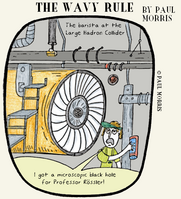
Here’s Paul on today’s “Wavy Rule”:
Well, they’re going to switch it on, officially unveiling the thing on October 21, 2008. If you happen to have read Dan Brown’s Angels and Demons, you already know about the Large Hadron Collider–which does in fact exist, and was first built by Mary Magdalene after she was exiled from Jerusalem after being outmaneuvered by Saints Peter and Paul in an early example of ruthless office politics. It lies near Geneva, Switzerland.
Rössler isn’t some German-sounding name I invented out of multi-particled air. He’s a real German scientist named Dr. Otto E. Rössler who has theorized that if the Large Hadron Collider creates micro-black holes–which is a scary possibility–they could destroy the Earth by the next time the Olympics come around. Sorry, London. Sorry, Earth.
More by Paul Morris: “The Wavy Rule” archive; “Arnjuice,” a wistful, funny webcomic; a smorgasbord at Flickr; and beautifully off-kilter cartoon collections for sale (and free download) at Lulu.
Intern Roundup: Denver-Minnesota-Wasilla Edition
Each Friday, the Emdashes summer interns bring us the news from the ultimate Rossosphere: the blogs and podcasts at newyorker.com. Here’s this week’s report.
Sarah Arkebauer
In the Fiction Podcast I chose for this week, E.L. Doctorow reads John O’Hara’s short story “Graven Image.” The story showcases both old-world glamour and prejudice and leaves the reader with plenty to ponder, and Doctorow’s discussion with Fiction Editor Deborah Treisman following the reading is particularly interesting.
In the sporadically updated The Rest is Noise, Alex Ross provides a link to his New Yorker article on the evolution of the classical concert.
Though I’ve been hearing more than enough about Sarah Palin these past few days, The Book Bench offers a snapshot of her views on book censorship. The blog also published another Bookspotting, and a wonderful piece on a new collection of teenage diary excerpts.
Goings On posted the latest information on Haley Joel Osment’s career—he’s to star in the upcoming production of David Mamet’s American Buffalo on Broadway. It will be interesting to see how he makes the transition, both from child actor to adult actor, and from film to stage. Much of the rest of the Goings On this week was devoted to material relating to the Republican Convention. There is a reprint of an interview with Chaka Khan after she performed at the 2000 Republican Convention, and a soundtrack of Alaskan music in two parts—in honor of Sarah Palin.
The Cartoon Lounge also had a bit of a convention-centered approach to its posts this week. First, Zachary Kanin posted a humorous treatise on vice-presidential responsibilities, which was soon followed by Drew Dernavich’s equally funny take on vice-presidential relationships. The blog also published the tenth and eleventh installments of the Sandwich Duel. Although this duel has been taking place nearly all summer, I am amazed at how fresh the material stays. On another note, one of my favorite features on The Cartoon Lounge is the Q&A series they post with different cartoonists, and this week’s interview with Perez Hilton does not disappoint.
Adam Shoemaker
George Packer went to Denver last week, and writes about the experience in Interesting Times. He sees Barack Obama’s speech as tremendously successful, but also Reaganesque in its invocation of optimism and hope. Packer’s observation that “the parties have traded places” is not a cynical one—rather, he marvels at the ability of a truly great politician, now as then, to draw enormous crowds of ordinary people to a political event.
Hendrik Hertzberg also enjoyed the speech—and over at his blog
“Notes on Politics, Mostly,” he calls it the best acceptance speech he’s ever heard. Much of his post is a reminiscence about other great speeches from the past and the constraints placed on a nominee’s acceptance that keep most of those speeches from rising to the airy heights. He also notes the “distinct lack of ugliness in the criticisms of McCain and the Republicans” at the convention. I can’t wait to read his comments on Palin’s speech night in Minneapolis. [Boy howdy, yes! —Ed.]
This week Sasha Frere-Jones posted a concert video of “Those Darlins,” a Tennessee band with a song whose riff he can’t get out of his head—”a script for any successful Labor Day weekend.” This line got me thinking about the sad dearth of non-Christmas holiday songs–but perhaps Labor Day is just as much about those songs we don’t have to sing.
At the New Yorker Out Loud, Matt Dellinger interviews Steve Coll, who wrote an article on General David Petraeus for this week’s issue of The New Yorker. Coll discusses the strategy behind Petraeus’s surge and how difficult it has been to keep military strategy and political partisanship separate. The general wants nothing to do with the latter, as he made clear to journalists inquiring into a possible vice-presidential tap by McCain. Coll also talks about Petraeus’s next step: taking command of forces in Afghanistan and Pakistan.
Over at the Borowitz Report, Andy Borowitz gives us Levi Johnston’s Convention Diary. While Bristol Palin’s betrothed might lack the journalistic credentials of George Packer and Hendrik Hertzberg, his belligerent “coverage” does help give us some insight as to why John McCain’s relationship with the media has been so strained of late.
Previous intern roundups: the August 29 report; the August 22 report; the August 15 report; the August 8 report; the August 1 report; the July 25 report; the July 18 report; the July 11 report.