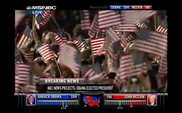
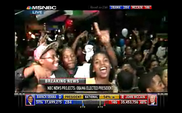
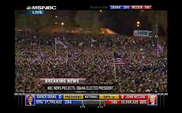
As the long night wore on, I became increasingly dependent on my streaming MSNBC. I took a bunch of screen captures, which I thought I would share here. (I’m sure I’m not the only one doing this.)


Category Archives: The Squib Report
Now Is the Moment to Recognize an Unsung Heroine
Hillary.
I mean, wow.
She was as good as her word, and then some. There’s something almost novelistic about the position she found herself in. A figure of such polarization, loathed by the right wing and even loathed among plenty of Obama supporters for a brief period (now over, one hopes!), obliged to support her rival, about whom she surely had and perhaps still has profound doubts, in a situation that lent itself to scurrilous speculation (she wants to run in 2012!), leading to a triumphant outcome in which her own contributions proved to be scandalously underemphasized—that’s some weighty stuff, right there.
You have to feel for her. She deserves the unmitigated thanks of every Obama supporter. One always knew that her support for the liberal project was unquestioned, and she proved that in every way one could possibly want every single day for the last few months. She is a champ.
So what is Hillary’s fate, now? I hope it is Senate Majority Leader, if she wants that role; I assume she does. I do think that she has the mind, nerve, DNA of a legislator right down to her very core; freed from the burdens of perennially preparing for her next presidential run, I fully expect her to fulfill the greatness that everyone knows her capable of.
David Remnick “said”:http://emdashes.com/2008/11/remnick-the-conservative-era-i.php that the Obama-Clinton battle of spring 2008 “is something we’re going to be talking about and thinking about for a long, long time.” I think that’s absolutely correct. My favorite moment of that race was Super Tuesday, February 5, when New York and a host of other states took to the ballot box, and all of New York City was pitched on the razor’s edge, unable to decide between the two candidates, a dynamic captured to perfection by Seth’s flippable “Eustace Tilley cover”:http://theispot.net/arttalk/seth/sethcover.jpg, which came out a couple of days before.
Two Reminiscences on the Subject of Our New President-Elect
It’s now nearly 7 am in Austria. I’ve been up all night. And what a night.
I have supported Barack Obama for president ever since he announced his candidacy, in early 2007. There were times when I saw the rationale for this or that other candidate, but my preference was always Obama, never had a doubt.
On November 7, 2005, I attended a “taping”:http://www.thedailyshow.com/video/index.jhtml?videoId=129775&title=barack-obama of _The Daily Show,_ and the guest was the new junior senator from Illinois, Barack Obama. I was really stoked to see him. I went with some Austrian friends, who now insist that I was gushing all about Obama even then, telling them to “watch this guy… he could really go places,” and all that. I don’t remember being so effusive, but apparently I was.
But, as you will see if you watch the video, Senate Majority Leader Bill Frist interfered with my one chance to see a future president up close by calling an emergency vote that would keep Obama in Washington, D.C., for the day. He appeared via live video hookup, and that was neat too, but … well, I wish I had seen him for real. Maybe I will someday.
At that time I was very intrigued by Obama but still had no real reason to place undue hope in him. About a year later, David Remnick conducted an interview with Obama, and a “recording”:http://www.newyorker.com/archive/2006/10/30/061030on_onlineonly04 of the interview appeared on _The New Yorker_ website.
I can remember like it was yesterday driving late one night from New York City to my home in Westchester County, and listening to that interview on the way. The interview ended a few moments after I reached the garage, and I remember idling in the darkness to listen to the end, the way NPR always says you do. And I remember thinking, _Wow. This guy is something else._
I date my serious interest in Obama to that interview. In the turbulent years since, I’ve confronted plenty of Obama skeptics who want to know why I support Obama so thoroughly, in the face of a scanty resume and elusive rhetoric that seems to shirk the bone.
And I always say the same thing: _I admire his cast of mind, I admire the way he thinks._ I want a president who tries to confront as many sides of a problem as possible and forge the best possible answer that the political conditions permit, and Obama is the closest to that I’ve ever seen. And everything Obama has done and said since has tended to support that conclusion.
I never thought it would happen, and I always knew it would happen, at the same time. The next few years are going to be ones to remember.
The 1932 Election Changed Everything–Almost Everything, Anyway
I’m in the mood for a “realigning election”:http://en.wikipedia.org/wiki/Realigning_election, aren’t you? They’re almost as rare as “Halley’s Comet”:http://en.wikipedia.org/wiki/Halley%27s_Comet, so we should be on the lookout for one in the event it comes by. We haven’t had one since 1932, you know.
This led to an obvious thought. In 2008 _The New Yorker_ has covered the election very closely; there have been innumerable articles touching on “Barack Obama”:http://www.newyorker.com/talk/comment/2008/10/13/081013taco_talk_editors, “John McCain”:http://www.newyorker.com/talk/comment/2008/05/26/080526taco_talk_toobin, “Sarah Palin”:http://www.newyorker.com/reporting/2008/09/22/080922fa_fact_gourevitch, “Joe Biden”:http://www.newyorker.com/reporting/2008/10/20/081020fa_fact_lizza, and “Hillary Clinton”:http://www.newyorker.com/talk/comment/2008/06/23/080623taco_talk_hertzberg. There have been covers, blog entries, podcasts, and cartoons.
(And today the magazine’s website is offering a massive amount of coverage, including stuff from “James Surowiecki”:http://www.newyorker.com/online/blogs/jamessurowiecki/2008/11/the-permanent-c.html, “Hendrik Hertzberg”:http://www.newyorker.com/online/blogs/hendrikhertzberg/2008/11/defamation.html, “Lizzie Widdicombe”:http://www.newyorker.com/online/blogs/tny/2008/11/on-the-bus.html, and a very timely Election Day edition of “Book Bench” dedicated to the act of “reading”:http://www.newyorker.com/online/blogs/books/2008/11/other-stories.html while waiting to vote. Really, they’re “flooding the zone”:http://www.newyorker.com/search/query?keyword=election%20day%202008&sort=publishDateSort%20desc,%20score%20desc&queryType=nonparsed.)
Nobody could fairly complain that _The New Yorker_ has stinted on election coverage this year.
So let’s look at the last realigning election! What did _The New Yorker_ do then? Surely not a cover, that wasn’t the way they did things. That’s fine. But a tart, expectant entry in the Talk of the Town? Perhaps a cartoon expressing relief? That seems certain.
Not if you judge by the issues around Election Day, it isn’t. Election Day in 1932 fell on “November 8”:http://en.wikipedia.org/wiki/United_States_presidential_election,_1932. _The New Yorker_ had issues dated November 5 and 12.
The only sign of Franklin Delano Roosevelt and his wife Eleanor in either of those issues appears to be on a single page dedicated to a satirical newspaper called “The Blotz” and written by Frank Sullivan—so saith the Search Archive.
“The Blotz” is difficult to summarize; it looks pretty funny, actually, but most of the humor is simply lost on us. There’s a box on the top that has “OUR PLATFORM: Deutschland Über Alles” in it; there’s an item making fun of the many Roosevelts all over the country who will presumably be clogging the ballot box for FDR. There’s a little pictorial representation of “Governor Roosevelt” in which he resembles the Cryptkeeper from _Tales from the Crypt_.
Ah, humor. It reminds me of when I yank out an issue of _Punch_ to peruse, and similarly fail to get any of the jokes.
In any case, it’s safe to say that the 2008 version of _TNY_ outstrips its 1932 counterpart. So much for realignment; times change. Hurrah!
Hertzberg and Toobin on Final Pre-Election “Campaign Trail”
Just under the wire, Dorothy Wickenden and her insightful colleagues have contributed their last (I assume) “edition”:http://www.newyorker.com/online/2008/11/03/081030on_audio_campaign of the “Campaign Trail” podcast before the bulk of the votes are cast tomorrow (absentee voters, of which I am one, still have about a week to get their ballots in). It’s an unusually loose session, and a lot of fun: it emerges that the trio has a common history at _The New Republic_ during the Reagan-Bush years. (Hertzberg was editor, Wickenden managing editor, and Toobin frequent contributor.)
Which leaves us with a question: Wickenden closes out the podcast with a reference to a post-election episode of the podcast—I should hope so!—but what is the fate of the series once the “campaign” part of the title ceases to apply? Will it revert to a more mellow podcast devoted to politics in general, or will they pack it up until late 2011? (Or perhaps late 2010, for the midterms.) I could see merit in either decision (while selfishly contending that the process of laying down the foundations of the post-Bush era demands as much, if not more, attention by our nation’s podcasters). We’ll find out soon enough!
Does Garry Wills on Nixon Lend Insight into Obama’s Mojo? Indeed!
For those of you who have OD’d on political commentary and yet crave more—my Google Reader is dry as a bone!!—The New York Review of Books has assembled its “usual cast of smarties”:http://www.nybooks.com/articles/22017 to weigh in on Indecision ’08.
Seems a good a place as any to mention the best book on politics I have ever read, _Nixon Agonistes: The Crisis of the Self-Made Man,_ by Garry Wills. For those of you preemptively weary of Watergate and the twitchy Nixon of the second term, fear not: the book was written in 1969, before all of that.
I particularly recommend chapter 6, “The Hero,” which is a defense of Nixon’s old boss, Dwight Eisenhower. The chapter is a compelling brief for the political virtues of charisma, shrewdness, and moderation; much to my astonishment, it (the chapter) is available in full at “Google Books”:http://books.google.com/books?id=5cVKKLSC788C&printsec=frontcover&dq=nixon+agonistes&ei=aaULSd-8HZbMzQTvxvTsAw#PPA115,M1. (Actually, looking at it again, it’s probably necessary to read the previous chapter, “Checkers,” too; it’s also very good.)
This recommendation does not arise purely by chance. You see, I see a lot of Barack Obama in Wills’s description of Eisenhower, which could be a very good sign indeed. Wills emphasized Ike’s uncanny ability to win political battles deftly, with a minimum of overt conflict. What the pundits and the pols sometimes forget about politics is that winning isn’t the only thing; one must win _well,_ win and leave the other players involved devoid of rancor. I think Obama has this quality.
I was reminded of this trait of Obama’s during that brief interlude about a week after the Republican convention, when McCain, riding a wave of Palin-mania, managed to eke his way into the lead. Ever the optimist, I made two bets that week, one with a McCain supporter and another with a nervous Obama supporter, on the premise that Obama’s good times were far from over. There were many such bets to be made at that moment.
We forget it now, but there was ample discussion to the effect that McCain’s momentum had definitively established that Obama was too recessive, was not sufficiently capable of attack, and—naturally—should have chosen Hillary Clinton to be his VP. In one of his two-handers with John McWhorter that made 2008 such a delight, perpetual Obama skeptic Glenn Loury “expressed this view”:http://bloggingheads.tv/diavlogs/14432 (start at about 29 minutes in) on a bloggingheads.tv “diavlog” recorded on September 14.
Loury made reference to the “knife fight” Obama had suddenly found himself in and observed that the Clintons would surely be mighty helpful in such a context. A few moments later, Loury used the words “elegant, articulate, intelligent” to describe Obama and generally left behind the impression that Obama might be too much of a Nancy boy for big-time politics.
Allow me expand on that: the person Loury was describing in such terms had very recently waged a six-month battle with the accepted heir apparent to the Democratic nomination—a battle that ended, of course, in his own triumph. It was this person that Loury could profess to describe as somehow weak or lacking steel or nerve.
It is useful in politics to win knife fights; it is even more useful in politics to emerge from tense confrontations with one’s adversaries and not leave all of the other players feeling as if a knife fight has just occurred. To describe a political … _warrior_ like Obama in such terms is ridiculous; it’s like saying that Greg Maddux displayed too much finesse to be a “really” effective pitcher. Yes, the Clintons often win knife fights—do they engage in anything else? How about someone who can play the Jedi mind trick on an adversary and leave nobody thirsting for blood?
My view of Obama’s deftness with regard to avoiding traditional political battles—that’s straight _Nixon Agonistes,_ chapter 6. If you read it, you might even recognize a shrewd Hawaiian-born pol between the lines.
David Foster Wallace: The Biography
Jason Kottke called the recent _Rolling Stone_ “profile”:http://www.rollingstone.com/news/story/23638511/the_lost_years__last_days_of_david_foster_wallace/print of David Foster Wallace “as close to a biography of David Foster Wallace as you’ll get,” and I think that’s exactly right.
Since that post nearly two weeks ago, I had a transatlantic flight and the article was not online in full, so I bought the issue of _Rolling Stone_ at the airport. Not only is the article, by David Lipsky, the closest thing to a biography we will get (until we get one), but it’s so thorough that it’s difficult to imagine what additional substance a book-length version of same would provide.
According to “Jason,”:http://www.kottke.org/08/10/the-lost-years-and-last-days-of-david-foster-wallace _RS_ just made the full version available online; do yourself a favor and check it out.
“With ‘Gesture’ You Know Where You Stand. But ‘Nuance’?”
Don’t look now, but James Wolcott’s been on fire lately. This “meditation”:http://www.vanityfair.com/online/wolcott/2008/10/over-at-tpm-david-kurtz.html on hellish gridlock under a President McCain is brilliant, right up to the last deliciously _weltschmerz_-soaked line. And this “reminiscence”:http://www.vanityfair.com/online/wolcott/2008/10/sheila-omalley-at-the-sheila.html of Pauline Kael’s connection to Barry Levinson’s _Diner_ really gets me where I live. I spent my college years inhaling as many of Kael’s words as I could get my hands on, and _Diner,_ which came out when I was 12, was the sort of quirky “how can this be a classic when TBS plays it every weekend?” gem that impressed me a lot during the same period. I didn’t know that she rescued the movie; more people should.
Why Do People Talk so Much about the Bradley Effect?
Ever since Barack Obama failed to win the New Hampshire primary (for reasons probably having little to do with people lying to pollsters), the media just cannot get enough of the Bradley effect. (For a cogent explanation of why the Bradley effect has been on the endangered species list since about 1991, and why it probably didn’t even happen to Tom Bradley himself, in the mayoral race of Los Angeles for 1982, see “here”:http://www.onthemedia.org/transcripts/2008/10/24/04.)
The Bradley effect is an attempt to measure the existence of hidden racism among the electorate. People are racists but cloak their views before a judgmental pollster, goes the theory. It’s worth pointing out that the phenomenon itself requires a special combination of circumstances. If you make a line chart of “racism in society over time,” where it starts out at 100% (everyone is always racist) and it slopes diagonally downward to 0% (nobody knows what racism is), the Bradley effect would only obtain when you have a bunch of racists but the racists aren’t really in charge of the discourse. In other words, too much racism in the society and nobody’s embarrassed about expressing it; too little racism and it doesn’t get expressed. You have to have a whole bunch of racists who are feeling a bit sheepish. In a way, it’s not surprising that the window for the Bradley effect is always a fleeting one.
My opinion is that for a subject of a poll misrepresent what candidate he or she supports to an anonymous pollster who possesses no power to alter the subject’s life … well, you have got to be talking about some serious shame/embarrassment. In other words, not wanting to vote for the black guy isn’t a potent enough cocktail of shame and embarrassment to induce the lie. You have to be supporting … pretty much a Klansman or a Nazi to elicit it.
At this point, I’d like to bring in two men, “David Duke”:http://en.wikipedia.org/wiki/David_Duke and “Jörg Haider”:http://en.wikipedia.org/wiki/J%C3%B6rg_Haider.
I hear a lot about the Bradley effect, but I rarely hear anyone mention David Duke. David Duke was a former Grand Wizard of the Ku Klux Klan who participated in a runoff election in the Republican primary for the gubernatorial race in Louisiana in 1991. A man named Edwin Edwards beat Duke pretty solidly, it turned out, but there were a few weeks there in which that outcome did not seem ensured, and in that period you heard a lot about white racists lying to pollsters. To be frank, it’s the last time (barring the possible exception of Harold Ford’s 2006 Senate run) that people talked about this subject at all in the United States. Here’s _The New York Times,_ after Duke “got beat”:http://query.nytimes.com/gst/fullpage.html?res=9D0CEFD91F3AF93BA25752C1A967958260:
Although the prospect of a large “hidden vote” for David Duke received a lot of speculation from poll takers and commentators in the weeks before Louisiana’s runoff election for governor, a hidden vote did not materialize in Edwin W. Edwards’s victory over Mr. Duke.
A hidden vote could have occurred if some voters were not willing to disclose their preferences to poll takers. In Mr. Duke’s past attempts at public office, his support was stronger than some polls had predicted, making some poll takers wary about simply using their standard methods in the runoff.
They seemed to take the effect pretty darn seriously, even if it didn’t manifest.
Between 1991 and 2008, you didn’t hear much about the Bradley effect in the United States. But you did hear about it (albeit not by that name) quite a bit in Austria, a country that featured the most successful radical right-wing politician in Europe: Jörg Haider.
By chance, Haider died in car crash a couple of weeks ago. In the 1990s, he led the Freedom Party of Austria to a series of very successful showings, finally entering a coalition government in 2000. Before Haider, the FPÖ was kind of a forgotten little right-wing party where the former Nazis would hang out; not a big deal. Haider changed all that, gradually building it up to nearly 30% of the vote and generally freaking a lot of liberals out, both inside and outside of Austria. Also, Haider would occasionally say flattering things about the Third Reich, which would get him into trouble.
And in Austria, you heard constantly about how polls were underrepresenting his support. I’m not an expert, but well-informed Austrians assure me that the electoral tallies tended to outstrip his support in polls.
In Austria, support for the Nazis is a crime punishable by “incarceration”:http://en.wikipedia.org/wiki/David_Irving; it’s a serious business, and the social sanctions against it are high—maybe not as high as here, but still very high. As with the KKK, perhaps, you don’t just casually admit to any anonymous caller that you are into supporting crypto-Nazis in Austria. Haider was deft enough a politician to blur his own Nazi ties (I myself think they were somewhat overstated)—but the whiff of social sanction was never far from him.
So that’s my thesis. if it’s just mild distaste for the black candidate, you’re not going to go and _change the candidate you support_ to a pollster—that’s the threshold we’re discussing here. You might not admit the racism on the phone, but you’ll say you support the other guy because of his tax policies. Only for a candidate who is synonymous with evil are you going to cloak your views.
Personally, I think that the Duke and Haider cases constitute almost a death blow to the Bradley effect if you think through their implications; in one of the two cases, it didn’t even exist! The media want to keep interest in the race high, so they have incentives to dismiss countervailing examples like David Duke. But that doesn’t mean we should believe them.
In the Future, All Campaigns Will Be Conducted in Twitter
On the heels of the stupendous “success”:http://twemes.com/nyfest of our New Yorker Festival Twitter “experiment”:http://emdashes.com/2008/09/twitter-your-way-through-the-f.php, I still found myself wondering what the point of the service really is—the similar function on “Facebook”:http://www.gravity7.com/blog/media/uploaded_images/fbook_feed-707592.jpg has the virtue of being integrated into pages that people will consult in the course of other activities.
But then in the course of just a few days, Twitter popped up in probably the two most attention-getting presidential campaign stories of the moment. It turns out that Michele Bachmann (the Minnesota representative who announced a desire to investigate “anti-American” members of Congress) and Ashley Todd (the McCain worker who faked the politically motivated attack by an Obama supporter) used their Twitter accounts just before they became notorious. In both cases their tweets actually bear on the reasons for their eventual fame.
In retrospect, Bachmann’s optimistic “tweet”:http://twitter.com/MicheleBachmann a few days ago that she would soon be appearing on _Hardball_, where she made her unfortunate remarks, is almost touching: she had no way of knowing that appearing on the show would undo her career. And Todd intentionally used Twitter to lay the “groundwork”:http://www.thesmokinggun.com/archive/years/2008/1023083twitter1.html for her hoax, indicating that she was hunting for a Bank America “on the wrong side of Pittsburgh,” complete with helpfully racist conception of what constitutes the right side of that fine town. How odd. Does William Ayers have a Twitter feed? (“Watching Bears game w/ BHO, planning violent overthrow of TPTB, LOL.”) Does Levi Johnston?