
1. On September 23, Kevin Drum at the _Mother Jones_ website wrote a “post”:http://www.motherjones.com/kevin-drum/2008/09/obama_and_ayers.html about conservative efforts to find evidence of deep ties between Barack Obama and William Ayers, the former Weatherman who committed several serious terrorist acts in the early 1970s. The point of Drum’s post was that those efforts had turned up virtually nothing. As most potential voters know, John McCain has since attempted to make the relationship between Ayers and Obama a central theme of the election campaign.
When I first read Drum’s post, I had a revelation, which is that _the underlying truth always matters._ It seems to be true that Obama is not close to William Ayers, which, if it is important to you to prove that the two men have a close relationship, is a serious problem.
But more to the point, it also seems clear that, whatever one thinks of Obama, he is not an especially “radical” thinker, apparently has never shown the slightest interest in using violence to further his goals, and doesn’t subscribe to the antiestablishment antipathy of Ayers or his former pastor Jeremiah Wright.
Again, the underlying reality matters: In much the same way that Obama is not a 1960s-era radical who has shown any interest in blowing up buildings for political reasons, Obama is also not a box turtle. Ads that set out to prove that Obama is such a radical or box turtle are equally likely to fail—because the underlying premise is moot.
Speaking of Barry Blitt’s now notorious “fist jab” cover, Art Spiegelman said something related to this at the New Yorker Festival; I mentioned it in my “writeup”:http://emdashes.com/2008/10/new-yorker-festival-art-spiege.php of the event. He said that it took the whole country two news cycles to realize that … Obama is not a radical. This fact lies at the core of the sneaky brilliance of the cover.
The underlying truth matters. The cover, and the decision to run the cover, both stem from an understanding of Obama’s nature as patently not very radical, and that may be why the slow, slow fuse of the cover was so effective, and (in the end) so much less worthy of contempt.
2. Yesterday Daniel Radosh put up a very insightful “post”:http://www.radosh.net/archive/002512.html about the potential misuse of satire once it is “liberated” from its original context.
To back up a moment, most of us are familiar with the occasional phenomenon of satirical news stories from _The Onion_ or some other source popping up in the press as “legitimate news stories”:http://en.wikipedia.org/wiki/The_Onion#The_Onion_taken_seriously. Also at the Festival, Stephen Colbert alluded to a similar incident in which a website dedicated to defending Tom Delay incorporated a clip from _The Colbert Report_ in which Colbert “defended” Delay. (Thanks to Rachel Sklar’s comprehensive “account”:http://www.huffingtonpost.com/2008/10/05/stephen-colbert-at-the-em_n_132019.html of that event, which helped me pin down my memory.)
One of the premises of the original debate around the Blitt cover was that _New Yorker_ readers or really anyone seeing the cover with the familiar “New Yorker” lettering would be very unlikely to regard the drawing as a smear against Obama; others, presumably fearful of future Republican attacks, contended that the image was so loaded that its power might well exceed the borders of that _New Yorker_ frame.
True to his fellow satirists, Radosh disclaims any responsibility on the part of the satirist for the unintended uses of his or her work and simultaneously takes the position that such uses are unlikely anyway. (I stress I’m not slamming him for this; this stuff is tricky.) In the post yesterday, Radosh brought to our notice a fascinating counterpoint to the Blitt cover.
You see, it turns out that those horribly “racist” “Obama Bucks”:http://thinkprogress.org/2008/10/16/obama-bucks/ (scare quotes are necessary, I’m afraid) started out as a liberal satire of Republican excesses—a distant shadow of the Blitt cover, one might say—and then got widely reported as an _example_ of those excesses. Remarkably, Diane Fedele, a Republican Party official in California who found the image and decided to use it in a newsletter, has been obliged to “resign”:http://www.salon.com/wires/ap/2008/10/23/D940B6OO0_obama_illustration/index.html her post.
I’m not sure that Fedele’s credulity or ill intent, however defined, really makes the original satire any better or worse; from where I sit, it still looks pretty crude to me, if undeniably potent. Maybe it all reflects poorly on Republicans, that a satire of their excesses could be regarded by friend and foe alike as legitimate examples of same; I don’t know.
But as for Blitt’s cover, it is a reminder that the existence of the frame matters, and quality matters too. I’m guessing that Blitt is a more experienced practitioner of visual satire than the creator of those Obama Bucks, and that experience may be the element that prevented the image from actually harming people, instead sparking a discussion about whether it might harm people.
Category Archives: The Squib Report
American Writers to Emulate Nobel Chief’s Splendid Humanity (Not)
I’ve been moving some my books around this week, some of which are by David Foster Wallace and others of which are by recent Nobelists, among them Doris Lessing, Naguib Mahfouz, Orhan Pamuk, J.M. Coetzee. Every time I handled one, I would think about the Nobel, and I would think about Horace Engdahl, who is the top member of the award jury. And I realized that something about Engdahl’s “rebuke to American writers”:http://www.breitbart.com/article.php?id=D93H89QO0&show_article=1 last month was still nagging at me (even though I have already “weighed in”:http://emdashes.com/2008/10/score-it-literary-magazine-1-s.php), and I think I finally recognized what it was.
What bothers me, I realized, was the timing, indeed the appalling lack of sensitivity implied by the timing. Wallace committed suicide on September 12; Engdahl made his comments on September 30. His take on American letters may or may not have merit; less ambiguous is the fact that American letters had lost a particularly bright light just 18 days earlier.
The astonishing thing is that (as far as I saw) there was little connection made between Wallace’s suicide and Engdahl’s comment in the media. Did anyone even notice that these two events sit fairly uncomfortably aside one another? I’m not saying Wallace was headed for Nobel status; far from it, he wasn’t that kind of writer. But Engdahl even went so far as to say that American writers are “too sensitive to trends in their own mass culture,” an observation that could easily be taken as a veiled reference to Wallace—and yet the sentiment that perhaps Wallace’s death made this an awkward moment to point fingers at America’s literary deficiencies went relatively unexpressed.
As sometimes happens, the United States gets treated differently. A hypothetical: if one of Indonesia’s top young writers were to perish in a plane crash, say, and two weeks later the head of the Nobel committee were to single out Indonesia for having an immature literary culture, the ensuing embarrassment might well be substantial enough that the self-appointed critic would be obliged to step down from the position. Less dramatically, people would make that connection very quickly and consider the speaker insensitive. But Americans are not accorded that kind of tact these days.
Hey, Someone Left These Big Shoes Behind!
It’s been a couple of days since Emily’s farewell post, and I realized I hadn’t said anything about it yet. Most immediately I want to thank everyone for their words of kindness, interest, and support, they are much appreciated. It is our hope that every single Emdashes reader remains; quixotic perhaps, nevertheless so.
In the four years she has been writing about _The New Yorker,_ first at Blogspot and then at her own URL, Emily communicated enthusiasm and erudition in a way that never seemed hasty or sloppy; years of editorial experience make that possible, and only high standards and interest and passion allow for that sort of experience to accrue. The frame that makes an Emdashes post an Emdashes post is her creation, and that isn’t going anywhere soon.
Luckily, she has somehow assembled a small team of people willing to carry her vision beyond her everyday involvement. With the help of Paul Morris, Benjamin Chambers, and a few others, I am confident that we can continue regular posts much in the same way as you are accustomed. My voice here, while mine, owed more than a tad to Emily’s example, and I hope the experience of reading Emdashes remains much the same.
_The New Yorker_ is such a vast subject that it allows for a good range of interest. I’ve stated before that I’m probably more of a William Shawn person, whereas Emily might lean toward Harold Ross a bit more. I don’t have the fluency in art and design that Emily has, so I focus more on the themes and the ideas and the writing. My nominal lot here was to man the Complete New Yorker DVD archive, so of necessity my posts have been more about the past than Emily’s; to her credit, she consistently encouraged me to stray from that bailiwick, an offer I took up with enthusiasm.
A logistical note: In the last 18 months family concerns have made my life a good deal more nomadic; I am splitting my time between the New York City area and rural Austria, as Emily mentioned. It’s trite to say so, but for people of my age (late 30s) the miracle of the Internet never really loses its power to astonish. Suffice it to say that transit is transit and jet lag is jet lag; beyond that, location is moot, and we’ll try hard to make sure you never notice such disruptions. (To add to the general feeling of instability, I bought my first-ever Mac yesterday, so even a project as prosaic as selecting a word to copy is something of a challenge at the moment. Wish me luck!)
With the help of the rest of the Emdashes team, I will attempt to provide you with something diverting every weekday; most days we will succeed; some days we won’t. But the commitment to covering _The New Yorker_ in all its glory, warts and all, come what may, insert cliche here—that remains intact.
Emily herself won’t ever be very far off; after only two years I count her as a close friend; we are in contact on a daily basis and I know she still thinks a great deal about the site. There will be occasions when she steps in; what is important is that the necessity to do so every day, or even every week, subside. I’m sure everyone connected to Emdashes wishes her great success in her new role at _Print_ (indeed, is sure of it!). In the meantime, we will continue to fulfill the project she started; we hope you stay along for the ride.
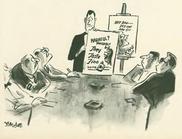
The “Mad Men” Files: It’s Toasted
Today’s installment is courtesy of Frank Modell in the February 13, 1960, issue. Shades of the very first episode, in which Don Draper teaches the tobacco executives to reassure their addicted customers. “Smoke your cigarette,” he says. “You still have to get where you’re going.” That’s some evil stuff right there.
Request to Readers Fluent in Japanese
A Japanese magazine called Courrier Japon printed a photograph that I took of David Remnick during the New Yorker Conference in May. It appears in the October 2008 issue. The article is written by likely Englishman documented Irishman Trevor Butterworth.
I can’t read Japanese. Perhaps someone who can could have a look at the text and give us a very brief indication of its contents? We’d appreciate it!
Update: In a comment, the author himself writes in to explain that it is a Financial Times article in translation. Here is the original, it is well worth a look! It is that rare combination of informational and witty that only Irish journalists laboring for the FT ever attain with regularity. The original photo, by Lorena Ros, is far superior to mine.
The “Mad Men” Files: Introduction
“That story was good enough for The New Yorker. And don’t act like those magazines do everything on merit.”
—Pete Campbell, Mad Men, season 1, episode 5 (“5G”)
As is often the case with really good TV shows, that line only improves with context.
I’m watching Season 1 of Mad Men, enjoying it very much. I take little notes as I watch (“Volkswagen Lemon ad, year?”), minor matters I can look up on Wikipedia and, more to the point, The Complete New Yorker.
Doesn’t it seem likely that Matthew Weiner, the creator of the show, owns a copy of The Complete New Yorker? I bet he’s worn Disc 5 (1957-1964) down to the nub. I expect to do the same.
It’s difficult to think of a show that better lends itself to CNY supplement. Based on a few preliminary searches, the CNY yield on terms like “advertising” for that era is too rich to be covered in a single post, so I’ll add occasional posts over the next few weeks. The ad man really does appear to have been an object of especial interest at that time, and the CNY reflects that. I hope you’ll … tune in.
Here’s a starter, a Dana Fradon cartoon from the October 1, 1960, issue, a commentary on the literary ambitions of the gang at Sterling Cooper (an alternate title for the episode quoted above might have been “All the Sad Young Literary Men”). Enjoy.

You Know This Already, But Ian Parker Nailed It
Martin Schneider writes:
What do you think of the notion that Ian Parker’s Profile of Alec Baldwin may be the most successful Profile of recent years? It’s been cited all over the place, and everyone seems delighted with it. I think it’s penetrated an unusually wide audience for New Yorker fare, and since it’s kind of awesome, that’s a good thing. Am I wrong on this? Are there any other contenders? What are they?
Dick Cavett: The Intellectual’s TV Sensation of Yore
Recently I’ve been watching some old episodes of The Dick Cavett Show on DVD. (By the bye, if you get the chance, do absolutely see the one with Orson Welles.)
For some reason, watching it made me think quite strongly of The New Yorker—what struck me was that The New Yorker never had as close a correlative on television as Dick Cavett. Cavett was The New Yorker in television form, if you will. (Anyone have any other candidates?)
It seemed to me that Cavett was a celebrity too close to the actual TNY demographic to ignore for long, and sure enough, he was the subject of a Profile by L. E. Sissman in the May 6, 1972 issue.
I don’t have much to say about the article, which amply met my expectations. Reading about the (let’s face it) somewhat dilettantish Nebraska native and Yale grad who was never any great success as an actor or comedian—well, he makes one of the more improbable television sensations. And yet he was talented, and his notoriety was entirely deserved. I suppose that most talk show hosts are generally hybrid talents whom you can’t quite picture attaining stupendous success in any other pursuit.
The Profile does have one very striking feature: it comes with a kind of artist’s notebook by Charles Saxon, who incidentally also executed hundreds of cartoons over more than four decades. The eleven-page article features twelve pleasing sketches of some behind-the-scenes activities at the offices of The Dick Cavett Show, an unshowy way of adding value and verve to the piece. A fine idea.
Two other points: one of the staff members of the show is described as having a “a Walter Ulbricht beard,” the almost aggressive obscurity of which I (more than thirty-five years later) found hilarious. Turns out Ulbricht was a politician from East Germany with a wholly unexceptional goatee.
The other thing is that one of the guests on the workday described was … James Brown! Holy moly.
“You Got Your Batman in My Borges!” Nils Runeberg Lives!
On the self-promotion tip, I have a brief article over at metaphilm.com about how The Dark Knight seems to appropriate some plot elements from the Jorge Luis Borges story “Three Versions of Judas.” The similarity seemed very strong to me, and yet I haven’t seen it mentioned anywhere despite many Google searches. Enjoy!
Man Loses Dog: A Metropolis Mourns
Chris Russo, known to many as “Mad Dog,” is leaving the tri-state-area sports behemoth WFAN, a move that brings the 19-year run of the afternoon sports radio talk show “Mike and the Mad Dog” to a sudden end. Right this minute, on the very last installment of the show, Mike (Francesa) is fielding a seemingly endless string of calls attesting to an importance that can only accrue in 330-minute installments five times a week over many years. I count myself as a fan.
Nick Paumgarten wrote about the curiously addictive duo in 2004; writing for ESPN.com’s “Page 2” in the spring of 2006, Bill Simmons also captured the singular appeal of the show.