
At the Washington Monthly website, Kevin Drum once raised the question of the (relatively) recent New York discovery of the taco (here is our contribution); now he is investigating a regional linguistic quirk: why is it that Angelenos are the only American city dwellers (save those living in Toronto/Buffalo, apparently) who habitually refer to local thoroughfares as “the 5,” “the 405,” “the 10”? Here in New York, you take “95” to get to Connecticut and “87” to get upstate and “287” to get across Westchester and so on.
(A friend of mine may have cracked the case, by the way. In Drum’s third post on the subject, he asks why the prevailing academic explanation—scale of traffic system—does not also obtain in New York City, which also has a high number of highways. Answer: in New York, if you say “the 1” or “the 3,” you’re probably referring to a subway.)
I called up my trusty Complete New Yorker, with the sneaky hope that some prescient gem about the “prepended the” would be contained therein. I found nothing about this definite article business. But I found gems nonetheless.
For some reason they are concentrated in the year 1966. That year, in the October 1 issue, the magazine ran “The Ultimate City,” a Profile on Los Angeles by Christopher Rand. Let’s start with that beguiling Steinberg art, a clear precursor to the famous “View of the World from Ninth Avenue” cover, only from the Los Angeles perspective—and ten years earlier. I zoom out to present the page layout (click to enlarge):

Dedicated as the Profile is to the futuricity of the city, many of the statements therein lend themselves to hindsight evaluation, and the recent spike in gas prices make 2008 an especially good year to excavate it. In dogged, unfussy, even mundane fashion, Rand hits on the main infrastructural features/challenges/problems of Los Angeles you would expect a typical educated representative from the east coast to notice: cars, water, earthquakes, brush fires, freeways, smog. He gets them all.
Rand mentions that the fashionable term for suburbs in the area is “slurbs” (60). Did this term stick? Does anyone say this? Does anyone remember people saying this? Much later (104), Rand writes two sentences that are suggestive from the vantage point of the energy-drained present day. “One wonders what would happen if gas and tire rationing struck L.A. now, as they did at the time of Pearl Harbor.” Indeed, one does wonder. And then: “As for mass transit, it is now talked of as if the city were serious about it.” Surely the skepticism in that sentence is built-in. But having never visited Los Angeles, I leave it to natives to debate whether 1966 was or was not the year the city finally got serious about the subway and bus system.
On page 109 the article mentions “sigalerts,” which term I had only first seen in one of the Washington Monthly posts. I had not realized that the term was so entrenched. In any case, it dates from no later than 1966. For anyone interested in the development of Los Angeles, Rand’s article is a fascinating and essential snapshot.
A few months earlier, in the June 11 issue, The New Yorker ran a cartoon, by Whitney Darrow Jr., with only glancing resonance to Drum’s “Highway Linguistics” series. Here it is (again, clicking makes big):

Category Archives: The Squib Report
Ballyhoo at the Return of “The Campaign Trail” (For Me, Anyway)
Hooray, the Campaign Trail podcast is back! For some reason, the July 11 podcast never loaaed into my iTunes until yesterday, when I also downloaded the July 18 edition, which means that I’d been waiting since June 26 for more of Dorothy Wickenden and the gang. For my money, The Campaign Trail and the Washington Week audio feed are the only two weekly-ish political podcasts worth the trouble. The (belated) double dip was welcome indeed.
So after a week in which we heard way too much about the cover of the magazine, let us now praise The New Yorker‘s indefatigable, entertaining, and, at this stage, well-nigh overlooked political team, including but not limited to Hendrik Hertzberg, John Cassidy, George Packer, Jeffrey Toobin, Elizabeth Kolbert, and, of course, Ryan Lizza, who only wrote (in the very same issue!) that great article on Barack Obama that the whole political blogosphere recognized as outstanding.
I wrote way back in 2007 that “one of the rewards of election years is the certainty of … Lemann-esque articles” in The New Yorker, and Lizza’s was just the kind of thing I meant. (Nicholas Lemann wrote terrific articles on Al Gore and George W. Bush during the 2000 campaign.)
Which reminds me: I got to see Lizza interview Rahm Emanuel at the New Yorker Conference. I didn’t document it at the time, alas, but his reportorial chops were very in evidence that day. Lizza had the only interview of the conference that was newsworthy, and he knew it. He treated it as an opportunity to elicit new information, and he kept the pressure on Emanuel, and—what do you know, he committed news. By all means watch the video—you can see him trying to squeeze the most out of his allotted twenty minutes, doggedly refusing to let Emanuel off the hook. And remaining affable throughout.

The New Yorker Guide to Today’s China
I was intrigued by Emily’s observation a couple of weeks back that The New Yorker has been covering China so assiduously in recent months.
That got my devious little mind into gear. I looked into it, and she sure isn’t making it up. There have been a bunch of articles covering China since the start of the year, and the good news is, most of them are available online.
With only about three weeks until the start of the Beijing Olympics, we provide a handy list. (I’ll update this periodically.)
Evan Osnos, “The Boxing Rebellion,” February 4, 2008
Peter Schjeldahl, “Gunpowder Plots,” February 25, 2008
Peter Hessler, “The Wonder Years,” March 31, 2008
Jonathan Franzen, “The Way of the Puffin,” April 21, 2008
Paul Goldberger, “Situation Terminal,” April 21, 2008
Evan Osnos, “Crazy English,” April 28, 2008
Yiyun Li, “A Man Like Him,” May 12, 2008
Peter Hessler, “After the Earthquake,” May 19, 2008
James Surowiecki, “The Free-Trade Paradox,” May 26, 2008
Paul Goldberger, “Out of the Blocks,” June 2, 2008
Pankaj Mishra, “Tiananmen’s Wake,” June 30, 2008
Paul Goldberger, “Forbidden Cities,” June 30, 2008
Alex Ross, “Symphony of Millions,” July 7, 2008
Patricia Marx, “Buy Shanghai!,” July 21, 2008
Evan Osnos, “Angry Youth,” July 28, 2008
David Remnick, “The Olympian,” August 4, 2008
Did I miss any? Be sure to let us know!
Speedboat: Jen Fain Is the Written Thing
I read Renata Adler’s 1976 novel Speedboat last week. I found it a fascinating testament to…
…and right about there is where my difficulties began.
I had originally wanted to write that the book, while brilliant, is not a novel, at least not a novel with recognizable characters embroiled in a plot that’s resolved in some fashion, but after reading a bit of the critical commentary about it, I realized that this reaction is unoriginal and not so interesting. So what is there to say?
It’s not that Speedboat is simply dated. It is dated, very dated, but the book is also good, an unmitigated pleasure to read. Lots of books are dated in much more ordinary ways that make them difficult to read or enjoy today. Speedboat isn’t like that.
Perhaps this is the notion I’m groping for: A book like Speedboat couldn’t be published today in this form, much less receive the rapturous critical reaction it seems to have received in 1976. To use a medical metaphor, Speedboat is a diagnosis of the ’60s that cannot escape also being a symptom of the ’60s.
I don’t mean to offend. It’s a nifty book; it’s rare that one can say one has read a novel in which there is a pleasure to be found on virtually every page. But the techniques involved are so out of fashion that I’m not sure an editor would let it pass his or her desk in its published form. A novel consisting of a series of penetrating and thinly connected observations in which no plot point can be said to occur? It sounds like a hard sell, today.
Maybe we’re the poorer for it. Maybe their fashions were better than our fashions. Maybe I’m a terrible conservative when it comes to plot.
OK, that’s the meat of my reaction. A few odds and ends about the paperback edition I was reading, pictured below, found at the $0.48 bin at the Strand.
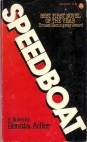
On the back is a picture of Adler by Richard Avedon, and underneath it says, in big red letters (hilariously, in my view): “JEN FAIN IS THE REAL THING.” Then underneath, in regular type, there are the words, “She is beautiful, hip, brilliant. She had been everywhere, done everything, known everyone.” And so on from there. It’s not that any of that is inaccurate, exactly, but it does create expectations the book isn’t designed to meet.
At the end of the book are a few pages of advertisement for other writers carried by the Popular Library imprint. One page touts Anne Tyler (spelled correctly), followed by a blurb from People: “To read a novel by Ann [sic] Tyler is to fall in love.” (Who’s that?) On the next page, we learn that a writer named Dorothy Dunnett “could teach Scheherazade a thing or two about suspense, pace, and invention.” And the page after that it says that “no other modern writer is more gifted a storyteller than Helen Van Slyke.”
Why is dated hype is so much funnier than other kinds?
It’s Peter J. Boyer Day: Whither Brian Williams?
How extraordinary that Emily chose this evening to post about Peter J. Boyer. I, too, listened to that podcast today, and I, too, enjoyed it.
I found one aspect of the interview puzzling. The subject of the article is the phenomenon of Keith Olbermann as an outlet for liberal rage, and what that phenomenon is doing to MSNBC and, by extension, NBC News. In no way do I mean it as a criticism of Boyer or The New Yorker to wonder how it was that the name “Brian Williams” wasn’t mentioned once in the podcast.
I like Williams–I think he’s my “favorite” anchor–but, as a category, that has about as much meaning these days as a preference for Ann Landers over Dear Abby. But it’s a curious testimony to … the newfound irrelevance of anchors? the ineffectual tenure of Williams himself? I’m not sure.
I went back and looked at the article. Sure enough, there’s plenty of stuff about Brokaw, the “hall monitor” of the sprawl—the entire story is structured as the battle between Olbermann and Brokaw for the very soul of NBC News—but just a few bland references to Williams.
I guess Williams has a tough job; he’s angling for attention smack in the middle of a gaggle of on-air personalities that, on all of those recent primary election nights anyway, included Brokaw, Olbermann, Chris Matthews, Tim Russert, Chuck Todd, and who knows who else. I admire Williams’s stated commitment to making NBC News more “transparent”; perhaps, in the rush for Keith’s ratings, that directive has not gotten the attention it ought; such, anyway, appears to be Boyer’s thesis. Or maybe for all of Williams’s persuasive suavity, he’s not so good at being the center of attention—odd trait, for an anchorman.
Agree? Disagree? Post a comment!
Political Dispatch from the Distant Past: Two Weeks Ago
I know that, more than a week now since Hillary Clinton threw her support behind Barack Obama, it may seem odd to draw attention to her speech of four days earlier, but Hendrik Hertzberg’s expansive thoughts on the subject on his blog are required reading for anyone looking for a final wrapup of that crazy, long primary.
The animus directed toward Clinton that night had as much to do with expectations as anything else; if the networks had been primed to say, “This night is about Hillary and her supporters; the concessions come later” before the fact, there would have been no outcry at all. In that sense, that night’s mismatch of expectation and outcome stands as a microcosm of her campaign.
Libretto: Oratorio for Spin and Ten Flacks
Alex Ross is right. This compilation of news footage, compiled by the dogged geniuses at Talking Points Memo, is sublime. (It’s a lengthy series of clips of Bush administration officials, mostly, explaining why Scott McClellan’s book has come as such a doggone surprise to them.) As Ross notes, the compilation is diabolically edited in such a way as to maximize the musique concrète quotient of the speech acts. Which of course also has the effect of dramatically boosting the perceived inanity and desperation of the speech acts.
In an effort to help out, I have charted out a kind of score or perhaps libretto of the major themes of the piece, in the event that anyone wants to mount a production at the Met someday. Peter Gelb, call me.
Even without the Harry Partch angle, the mere fact of Ari Fleischer ruminating about how he is all “heartbroken” makes my very heart sing.
Full text after the jump.
Oratorio for Spin and Ten Flacks
“Anger”
“Shock”
“Confusion”
“Out of the loop”
“Out of the loop”
“He shouldn’t have been in those loops”
“He wouldn’t have been”
“He wasn’t in the meetings”
“Was he at the meetings?”
“Frankly I don’t recall Scott being at a lot of those meetings”
“I was there”
“I saw it”
“I saw it a lot more than Scott did in fact”
“I think his view is limited”
“He didn’t have the right access”
“What was said behind closed doors”
“Puzzled”
“Puzzled”
“Puzzled”
“Puzzled”
“Puzzled”
“Puzzled”
“Puzzling”
“Puzzlement”
“Puzzled”
“Perplexing”
“Perplexing”
“Puzzling”
“Scratching their heads”
“Scratching their heads”
“Scratching my head”
“Scratching our heads”
“Baffling”
“Bewildered”
“Shocked and surprised”
“Shocked and saddened”
“Shocked
“Surprised”
“Disappointed”
“All of the above, maybe?”
“It’s kind of hard to make head or tails of it”
“It’s kind of out of left field”
“Surprised”
“Puzzled”
“Puzzled”
“Puzzled”
“Puzzling”
“Puzzling”
“Puzzling”
“Puzzling”
“Puzzled”
“Puzzled”
“Puzzled”
“A book that doesn’t make sense”
“Make no sense”
“Something is wrong”
“Smething doesn’t add up”
“It doesn’t match”
“It doesn’t match”
“It doesn’t match”
“It doesn’t match”
“It doesn’t match”
“It doesn’t add up”
“I can’t figure it out”
“We were so surprised”
“Not just puzzled”
“Puzzled and surprised and disappointed and saddened”
“Saddened by it”
“I thought his heart was in it”
“I’m heartbroken”
“I just don’t understand it”
“It’s so hard to understand”
“I still don’t understand”
“I still can’t understand”
“It’s just too hard to understand”
“I am stumped”
“I am really stumped”
“I just am so stumped”
“I’m stumped and I’m stunned”
“You said you were stumped”
“I’m still stumped”
“That’s what leaves me kinda heartbroken”
“It’s so horribly unfair”
“I feel like crying”
“This is heartbreaking to me”
“I find this whole thing heartbreaking”
“Heartbroken”
“So heartbreaking”
“This doesn’t sound like the Scott McClellan folks knew”
“This is not the Scott we knew”
“This is not the Scott we knew”
“This is not the Scott we knew”
“This is not the Scott McClellan we knew”
“This is not the Scott McClellan I’ve known for a long time”
“It’s a different Scott”
“Maybe this is a new Scott”
“Maybe this is a new Scott”
“Almost like a out-of-body experience”
“Scott’s words don’t even sound like Scott”
“This doesn’t sound like Scott”
“This doesn’t sound like Scott”
“What did Scott sound like?”
“You’d know how Scott sounds”
“Scott’s a soft-spoken person”
“Scott was known for sitting quietly”
“Sounds like somebody else”
“Sounds like a left-wing blogger”
“Scott uses the very same words as the far left uses”
“Moveon dot org”
“The John Kerry campaign”
“The DNC”
“Even Dan Rather during the 2004 campaign”
“Did you have a ghostwriter?”
“The editor tweaked the content”
“Tweaked it?”
“That’s the way Scott put it to me”
“The publisher didn’t hold a gun to Scott’s head”
“He held a checkbook”
“I don’t know”
“I don’t know”
“His disgruntlement”
“Sad and disgruntled”
“Scott, we now know, is disgruntled”
“Disgruntled”
“He was not a happy camper”
“Disgruntled employees”
“Disgruntled”
“Sitting on the front porch swinging in Crawford with Scott”
“Didn’t sound like he thought he was ever going to sit on that swing”
“Total crap”
“Total crap”
“Total crap”
“Scott uses these very inflammatory words like shading the truth”
“Total crap”
“I actually don’t care”
“I’m more concerned with American Idol”
“I care more about American Idol”
“Need any brownies or anything?”
Flashback: Nancy Pelosi Channels Bob Mankoff
I’m glad to see Nancy Pelosi get her due. Her detractors, who have at times been legion, never seem to notice that the Democrats have had an unusual streak of good fortune since she assumed the leadership of the House. She’s the first woman to reach the second slot in the line of succession; a Wikipedia list of “women who have been in the United States presidential line of succession” makes for interesting and inspiring reading.
The New Republic article I’ve linked to above is a salutary reminder of a seminal moment in Pelosi’s tenure: the brilliant job she and Harry Reid (and Josh Marshall) did fending off George Bush’s attempts to reform/kill off Social Security. Atrios recalls a terrific anecdote, new to me, which occurred at a critical moment in that fight, when the Democrats refused to be bullied into offering up their own plan to reform/kill off Social Security in the name of appearing “reasonable.” Asked when the Democrats “were going to release a rival plan,” Pelosi responded, “Never. Is never good enough for you?”—which will surely remind many New Yorker readers of this Bob Mankoff classic.
“Campaign Trail” Podcasts Continue to Rock
For months now, Dorothy Wickenden has done a masterful job on the “Campaign Trail” podcasts engaging with the magazine’s talented political staff. They have been an undiluted source of pleasure in this exhilarating, maddening primary.
The latest installment, dated May 15, is one of the best yet. All three correspondents (George Packer, Ryan Lizza, and Hendrik Hertzberg) took part—I’d like to make known my desire that this happen as often as possible, as it worked so well this week. The three fellows grapple with McCain’s “2013” speech, with fascinating results. They don’t agree—indeed, they have wildly divergent reactions to McCain and his bid to recast himself as a moderate conservative. That may not sound very exciting, but I really liked how thoroughly undoctrinaire everyone’s contributions were, it made for a very lively discussion.
Plus Packer gave away the big surprise ending to the summer (spoiler alert—we attack Iran!). Wickenden seemed startled by that one, as was I!
New Yorker Conference Is Visual: Final Wrapup with Pictures
Martin Schneider writes:
The curious are invited to have a look at our Flickr set with photos from the New Yorker Conference:
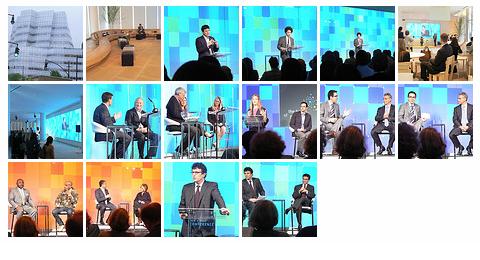
I don’t have anything deep to say about the conference (although plenty of other people had deep thoughts to share). It was an exhilarating and exhausting experience, watching so much intelligent discourse in such a compressed manner. I salute the planners for enabling even a congenital wallflower such as myself to enter into the thrum of community over the two days.
I asked a fair number of people to assess this year’s event alongside its 2007 predecessor. There was some feeling that last year featured bigger names (Arianna Huffington, Barry Diller et al.) but that this year had more speakers. The duration allotted to each panelist decreased in the name of increasing the number of overall panelists. And, of course, the event was extended by a day. I definitely got the sense that the audience members were satisfied with the direction that The New Yorker had chosen to take the event. (Myself, I have no objection whatsoever to including speakers on the model of Paco Underhill or Jane McGonigal, highly esteemed experts in narrow, specialized fields.)
After the conference, I realized that the program exhorted participants not to take pictures. If anyone has a problem with these pictures being posted here, by all means write me and I will subject myself to the comfy pillow torture (and take the pictures down).