

Triple Star: Typography’s Asterism

_Pollux writes_:
You don’t see the asterism very much. Three asterisks in a triangular or linear formation, the asterism is used in typography to indicate minor breaks or subchapters in a text.
Printers sometimes use it to call attention to a passage that follows, as explained in the fascinating book by Alexander and Nicholas Humez called _On the Dot: the Speck that Changed the World_. A terminal punctuation character, the asterism can be seen at the end of chapters, but also at the end of verses or stories.
Also known as a triple asterisk, the asterism had some other functions in past centuries.
According to Richard Taruskin in his _Oxford History of Western Music_, the asterism was used to denote an omission of some kind in 19th century typography. If the name of an author was unknown, for example, an asterism was used in place of the name.
19th century Russian music critic César Antonovich Cui used an asterism as his nom de plume (Taruskin, 311). This was because Cui had a day job that prohibited him from journalistic activities: Cui was a Russian army officer and wrote treatises on fortresses and fortifications.
How do you type the asterism? Only certain fonts support the Unicode character for the asterism, which is U+2042. According to this “site”:http://www.fileformat.info/info/unicode/char/2042/fontsupport.htm, the fonts that support the asterism include Arial Unicode MS, Cardo, DejaVu Sans, and Linux Libertine.
If you’re using Microsoft Word, click on “Insert” and then “Symbol.” In the “Font” drop-down, change the font to Arial Unicode MS. The asterism will show up under the “General Punctuation” subset, but you can also find it by typing “2042” in the character code window. Click on “Insert” or you can use the shortcut key of 2042, Alt + X. Watch it appear! Your subchapter will thank you for it.
So there’s more to the asterism than just a pile of asterisks. Its appearance seems to me a cry for love and attention. So beautiful, and so ignored. Write a “letter”:http://emdashes.com/2010/07/so-you-love-punctuation-write.php to an asterism (it may get directed to the ghost of Cui) here.
Since We’re Obsessed With Punctuation at the Moment
…or, to be frank, always, we’d like to note this Slashdot story about the war between the sarcasm symbols. Yes, the sarcasm symbols. It sounds like a dirty fight for a low form of humor, but still, it’s correct that punctuation controversies should be in the news, at the top of the hour, above the fold (if not the fray).
–Emily Gordon
Daily Comic: Air Quotes
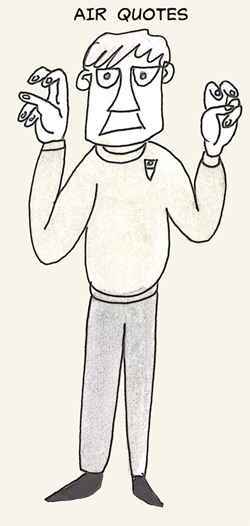
“Contest”: Write a letter to a punctuation mark. “Deadline”: August 15.
Daily Comic: Air Semicolon

There is a contest; the contest involves writing a letter to a punctuation mark. There is a deadline; it is August 15.
Daily Comic: Air Colon
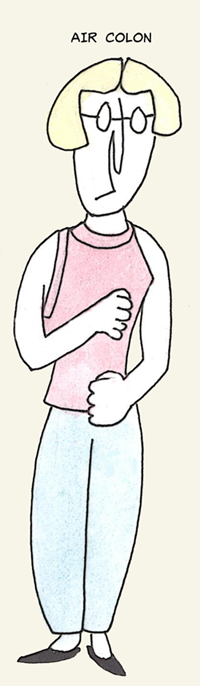
Contest: Write a letter to a punctuation mark. Deadline: August 15.
Daily Comic: Air Parentheses
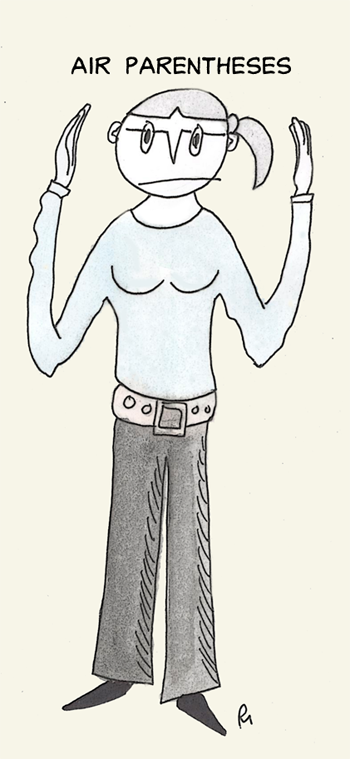
(Contest: Write a letter to a punctuation mark. Deadline: August 15.)
Bloggingheads-ganza: The Intentional Idiocy of Byron York
Martin Schneider writes:
A few days ago Timothy Noah of Slate and conservative writer Byron York engaged in a Bloggingheads.tv “diavlog,” as they are called.
What to do when you are an “intelligent” conservative confronted with the proposition that FOX News is essentially a bunch of partisan liars whose work cannot be taken seriously? I don’t know—that’s not my problem. Byron York doesn’t handle it a whole lot better:
Here’s my little recap:
York: The New York Times is afraid of the power of FOX News and conservative talk radio, so it compensates for that power by forcing inflammatory to remain in a “freak show” zone of non-mainstream stories.
Noah: Couldn’t it just be that FOX News sucks?
York: Oh, no, not at all! There are terrific stories that FOX is reporting all the time that the Times ignores. For example, some NASA official said something nice about Muslims—and Obama maybe sort of agreed with him! Why is this not a major story in the New York Times??
Noah: Uh, why is that a story? Wouldn’t it be a story if a NASA official said something mean about Muslims?
York: I don’t know, it seemed like a pretty smoking story to me.
What my little dramedy above cannot express is the sheer number of boring seconds York, in his slow-talking way, dedicates to this utter non-story. Anything better than actually own up to the mendacious ways of FOX News.
A few minutes later, York mentions a silly comment on JournoList by Spencer Ackerman to the effect that, in the wake of the Rev. Wright problems Obama was facing in early 2008, that liberals should just pick conservatives at random and accuse them of racism. Noah says, basically, “Well okay, but it’s not like he acted on it.” York’s response to this is priceless, right at the 34-minute mark: “Well, people on the right believe that they have been accused of racism, on a number of occasions!” Really! Conservatives feel that they have been accused of racism…. why is that, do you think?
To this, Noah says, rather deliciously, that you’ve got a few things going on there, the original question was whether Ackerman did anything—he didn’t—and anyway muddying the issue is that, basically, conservatives do a lot of racist things. So there’s that. See for yourself:
The obtuseness on display here is fairly staggering. The coalition that makes up the Republican Party is structured around reaction to the Civil Rights Movement. That’s just Politics 101. If York thinks that racism is distributed equally across the political spectrum, he’s not qualified to write about politics for a living, period. So my conclusion is that he is lying.
One last thing. Towards the end they’re discussing the unemployment benefits extension that the Republicans blocked last week. I think nothing can describe current conservative obtuseness with respect to important policy issues than York’s insistance, with the country facing serious unemployment problems and possibly a double dip recession, that there’s a serious risk in creating a “dole” and making unemployment a permanent condition for many Americans.
That’s right: You can talk to conservatives all you want about the miseries of unemployment and the benefits of softening those miseries—conservatives aren’t interested in that! It’s much too satisfying to wag a scolding finger and imply that some minor negative externalities outweigh that positive good. That’s as good as conservatives get—Byron York is probably a nice guy, and he’s not dumb. He’s about as good as it gets, quite seriously. And he cannot be made to care about treating unemployed people well.
Noah is terrific again in just not buying into any of York’s nonsense. Noah admits that some studies have shown a small effect of the type York has mentioned. York says, Well, shouldn’t that be taken into account? And Noah says, No, it shouldn’t!
James Sturm’s Online Hiatus: Essential Online Reading
Martin Schneider writes:
I just stumbled on James Sturm’s experiment on Slate involving staying off the Internet for a few weeks and seeing what happens.
The results have been marvelous, witty, wise, insightful, hilarious, and resonant—it’s one of the best things I’ve seen in weeks. I think just about everyone would find a point of access here; that’s one of the great things about it. I’m going to embed a few of my favorite panels and then leave you to read it.
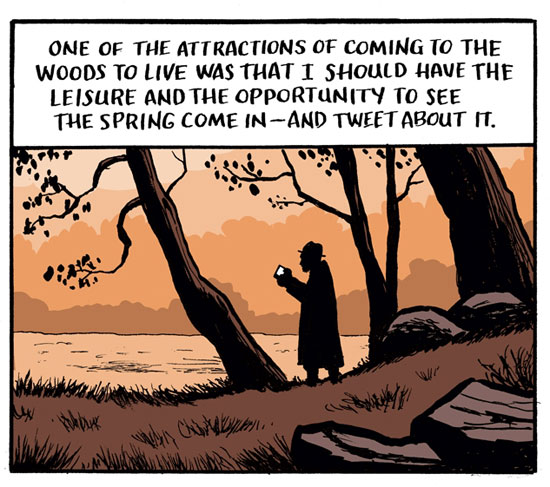
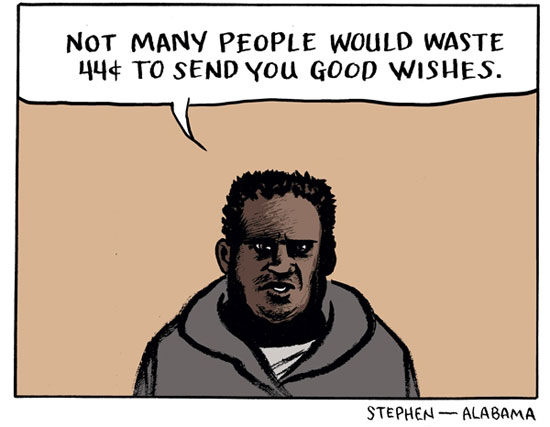
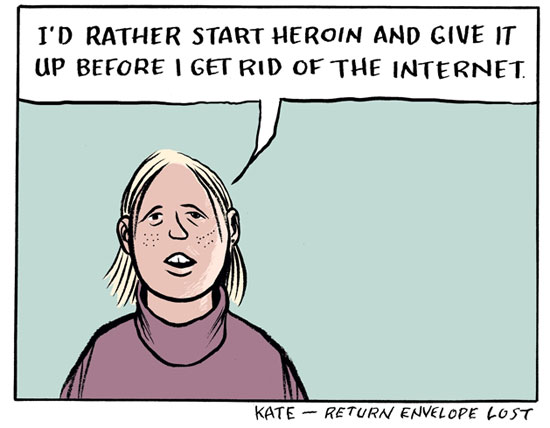
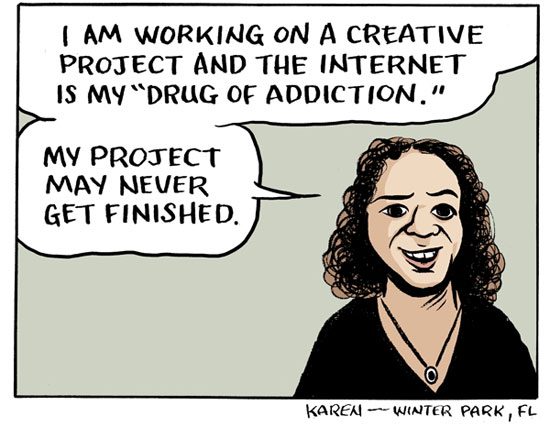
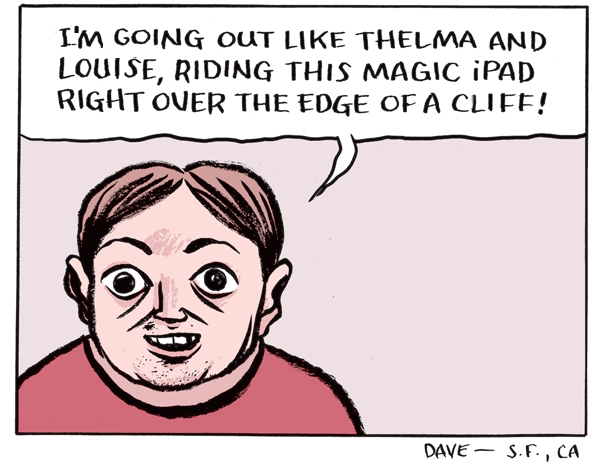
There are eight installments; this is the first.
The New Republic: Web 2.0 Fail
Martin Schneider writes:
During the World Cup, The New Republic had a pretty cool blog dedicated to the tournament, as they had in 2006. It was a fun, eclectic blog, and I enjoyed it a lot. I even wrote a post about Luke Dempsey’s brilliant found poem.
There were a few times I wanted to chime in a comment or two, as I often do elsewhere in the blogosphere. Much to my surprise, the site demanded that I log in before posting—not with my www.tnr.com account username—which would be fine—but with my New Republic magazine subscription account username.
That’s right: if you want to write “first!” in a TNR blog comment thread, you’re going to have to buy 20 issues of the magazine. For the record, the page they send you to is here.
Does that business model remind you of anything? The year 2000, maybe?*
======
*I’m sorry if this is coming off as harsh, but it’s really meant as tough love. I know it’s a bad environment for magazines right now. But TNR pays really well-qualified people to blog for them, and those blogs are pretty awesome, and stuff like this just ensures that the money, time, and energy spent developing those blogs will not attract permanent users.**
** Could it be a browser issue? A cookie issue?