
“Copacabana. There’s music in the word.”
—Paul Henreid, Now, Voyager (1942)
Monthly Archives: August 2005
We got fs-ssssteam heat
“Some colleagues, objecting on grounds of anthropomorphism, will undoubtedly insist that I go too far when I suggest that high humidity acts on our inner life in the same manner as a wrathful mother.”
—Tom the analyst in Donald Antrim’s The Verificationist
(8.01.05 issue) Son of “Son of Kong”
Since I continue not to have 8.08, how convenient that I’m still reading 8.01! Standouts: Sasha Frere-Jones’s jaunty, groovy essay on d.j.s Diplo and Marlboro, in which he manages to fold in the relevant (and considerable) cross-cultural music history as easily as if he were swirling dulce de leche into melting ice cream. Sorta funny that copy (I’m assuming) insists on sentences like “When ‘Planet Rock’ and Miami bass records reached Rio, in the mid-nineteen-eighties…” If it were anything but the nineteen eighties, Frere-Jones wouldn’t be writing about it, would he? Oh well, it’s a swell piece, and I’m going to do my best to Eustace Google me a few of these sound clips. Legal ones, yes, sure. But even without the sound the story sings. Nice music writing, this.
And John Cassidy on Grover Norquist (“As we talked in his cluttered office…he paced back and forth, opening and closing his briefcase, rearranging books on his shelves, moving pens and papers around on his desk, and, finally, bending down to pick up bits of dust”) and stings-like-a-bee Nancy Franklin (“And there’s the inevitable thinky college man…”), of course. Not to mention David Sedaris’ startling revelations about the ants in his pants. But just because there are lots of sexy rock stars around, don’t overlook Steven Shapin’s sprightly, pleasantly Trilliny review of Tom Standage’s A History of the World in 6 Glasses. The whole story is taut and juicy as a ripe peach, but I liked “We’re all ‘drinking men,’ because we’re all mainly squishy bags of water.” That has a slightly Benchley note to it, too. Put this man on staff! Oh, they can’t; he teaches at Harvard. Well, I’m sure they can spare him.
Does that emdashes like everything? some might say, throwing up their hands as if doing a foreshortened Wave. As it happens, I do not. Two things I did not particularly like in this issue: Jeffrey Toobin on John Roberts, gay rights cases, and the Solomon Amendment, which seemed inadequate to the scope of the subject; this is a riveting issue with plenty of eloquent spokespeople, but Toobin could’ve fooled me. It could be that Annals of Law is just supposed to chronicle a narrow range of developments in the field, but surely if these cases have the potential to be civil rights landmarks, Toobin could get a little more excited about civil rights?
And Anthony Lane—oh, Anthony Lane, have you lost your air conditioning? This review of Last Days, The Edukators, and 9 Songs is rather snappish, and I think you must come to accept that there are generations below yours that enjoy both great cinema and their own pop culture. They might well be interested in a Gus Van Sant movie loosely about Kurt Cobain even if they, ahem, “smell like stewed tea.” It’s not only “Kurt Cobain groupies” who’ll be reading about and maybe even lining up for Last Days, it’s a good deal of Generation X (we hate the name too), a sizeable group. Stop worrying about whether Kirsten Dunst knows how to roll a joint and why the youth listen to music that “sounds like a cow giving birth in a wind tunnel.” You don’t have to hang with the emo boys to feel the thing through the alienating noise (music, style, slang, hero-icons) that makes the characters love and need it. Isn’t that a constant through all these generations of film? I suggest this with all respect.
More scratch-and-sniff “Good Work!”s: Jonathan Rosen’s consideration of Henry Roth and his big bad block is full of little stars and curvy brackets (what my ninth-grade algebra teacher used to call “Bob Hopes”—draw one and you’ll see) from my pen. Not to mention a genuine phonetic chiasmus: “The Roth mythology suggests that, having turned his back on writing, he immediately buries himself alive in menial work and rural Maine.” (Even better when you remember that the abbreviation for Maine is ME.)
From Talk, Nick Paumgarten’s “Bag Check” is nicely pitched and practically poetic, and it’s impressive that he has another good one in the same section; Adam Green artfully stretches a tiny factlet into a charming piece (I keep laughing at “One night, after hours of leaving messages on answering machines, being asked to call back later, and getting trapped in long conversations with lonely radicals in the Midwest…”); and Lauren Collins neatly twists a welcome sinister hook onto the end of an otherwise benign story about Deep Roy, the man who plays all the Oompa-Loompas in Charlie and the Chocolate Factory.
Harry Bliss’s “Son of Kong” cover is just right, not only for all heatstroked readers but for jittery New Yorkers who would indeed cheer for a benevolent ape standing taller than the Chrysler Building, if he were blasting us with cool water. A fine idea, to fill the sky with a furry relief-giver like the firefighters in the Mermaid Parade with their lavish squirts on the grateful crowd. (It’s you who’s making that sentence dirty, not me.) Anyway, it’s a soothing image, and it makes me wonder if city officials shouldn’t stage celebratory events in the subways and sky from time to time. Well, do you want to flinch every time you see a low-flying plane or hear a beep from a phone in the train, forevermore? I didn’t think so.
By the way, if you’re living in the past as I am, here’s the indispensable Greg’s TOC from the week under discussion. Handy when the mailman loses his way. Could my magazine be burning in a warehouse somewhere? I was wearing a Chicago shirt today.
Lulu Eightball is the greatest
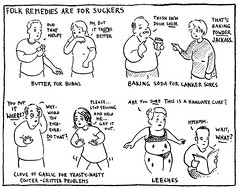
It is very important that you read this comic by Emily Flake (you can already see the initial attraction) right now. Don’t worry, most of them are PG-13. Here are the archives from the Baltimore City Paper. And here’s a handy Best of Lulu Eightball, compiled by crown prince of hippo painters El Rey Del Art, who tipped me off to the wonders of the Flake and calls Eightball “my new favorite comic.” Which, for him, is really saying something. I am so pleased about this. The above comic is a good companion to John Colapinto’s recent leech story, too.
Update: I’ve read nearly all the archives now and need art methadone. Since Flake reminds me a little of classic Lynda Barry, I think it’s time for Girls and Boys and Big Ideas. Ah. That’s better. Now more Flake, please. Wait—there’s a book. I can already feel the shakes subsiding. You’d buy it, too, if you knew what was good for you.
Update update: I just noticed this interview with E.F. in the City Paper. So:
CP: So why do you draw yourself like the Pillsbury Doughboy’s indie-rock girlfriend?
EF: What? Oh, God, maybe I kind of am the Pillsbury Doughboy’s indie-rock girlfriend. That’s kind of fucked-up, that might be true. Well, the drawing style doesn’t really lend itself to making anyone look attractive. And I think it’s funnier—well, somebody wrote in once saying more or less that he hated my cartoons because everything was kind of sad, that it wasn’t a real go-getter’s cartoon. And the only thing I could think was, How would it be funny if it was?
The Renaissance man with two brains

There will be plenty to say once Shopgirl comes out in the fall—I’ll even try to swing a press pass so I can report back to you sooner—but for now it seems best to collect the available data into one post and say: Ecce Homo! Ecce Danes! I’m sure that’s not proper Latin. Corrections from Bostonians and smartypants relatives are welcome. Anyway, here is the official site, where you can watch the trailer; here it is on IMDb, which, while not my favorite movie resource, is my daily helpmeet. This is the poster.
Furthermore, Steve Martin has, of course, been talking about both the movie and the book. Meghan Daum interviewed him for the May Believer; the whole text is on AlterNet, which has a stern no-reproduction policy and which I sense (probably erroneously) I shouldn’t piss off, but there are tons of questions about Shopgirl in both its forms, not to mention Martin’s non-obvious inspiration for his Shouts & Murmurs pieces and a bit about his Osama riff in the March 5th New Yorker. (Randomly: someone’s nutty compatability chart for Osama and Martin.)
And from a little About.com interview with Martin in 2003:
For “Shopgirlâ€, how did you get into the mind of a young girl?
You know, it’s a tough question to answer because the answer is really just experience. Talking to people. I’m this age, I’ve lived a lot.But you got into her mind.
Well, that’s from listening and asking. It’s not conscious, the listening and asking. It’s when you go to write something like that that you realize, “I remember this, I know this.†You’re surprised at what you know. Let’s put it that way.You once said the writer was taking over the actor.
Well, I’m having a lot of fun re-writing this “Pink Panther†script and working on it, let’s say. So I guess that’s writing. But it’s also going to result in a movie. I don’t know, my career’s all over the place now because I had this terrible thing happen to me. I had a hit with “Bringing Down the House.†Everything was so fine. I had time on my hands, and occasionally I’d do a movie. Then suddenly I have a hit and a lot of demands and offers, and suddenly your head is kind of reeling about what to do.Is there another play in the works?
No, there’s not another play. There’s nothing sophisticated in the pipeline at this point right now.Why did you write “Shopgirl†as a novel first? [!]
Well, I never thought it was going to be a screenplay, that’s why. I had a story to tell as a novel and I told it. I never thought it could be a screenplay. Then I started thinking about it even two years afterwards, the scenes started coming into my head. I thought the images were lovely. Then your mind starts working at night a little bit and then one day, you pick up your computer and you start typing.What are the major differences between the film and the novel?
Well, in the book there is very little dialogue and in a movie there is only dialogue. You can’t go inside a character’s head like you can in a book. So, I discovered one thing. The character Ray Porter in the book is much more sympathetic than in the movie. Because in the book you can go inside his head and see what he’s thinking, and why he does certain things and how he justifies certain things. How he comes to conclude certain things. In the movie, he just does them and they look a little harsh sometimes. I think I could be wrong. When the movie’s over, it’s a whole different animal.Did you pick out Claire Danes for that part?
Yes, she’s been fabulous. I can’t believe her emotional intelligence at her age, 24. We’re two weeks from finishing the movie, so it won’t be ready to be seen for six months.
Do you still have time for your music?
Playing the banjo? Yes. I play almost every day, or try to. Sometimes I get together with friends. It’s hard. I play with Billy Connelly. There are a few of us. We’ve played before. Kevin Nealon plays the banjo.
Is this how you thought your career would pan out? Are you blown away by it?
Yes, I am. When I first did my standup act…And you think you’re over. 2003 and I’m still here.
Two years later, I’m ready for Shopgirl, and while the trailer makes me a wee bit nervous (Jason Schwartzman, styled as he appears to be here, is a laughable rival for Martin at any age—I know he’s supposed to be a lost soul, but this is going too far), I liked the book a lot. I would post my Newsday review of it, but I can’t find it in the pile o’ clips. Anyway, I liked it, and I’m always willing to give adaptations a try on their own terms; as the columnists at The Nation like to say shortly before press time, conclusion TK. In the Believer interview Martin says, “Because you don’t know if it’s the corniest thing in the world until you put it out there in the world.” That’s pretty much my motto.

(8.08.05 issue) Wait a minute, Mr. Postman!

Know what? I don’t have this week’s magazine yet. Although it’s Wednesday in Brooklyn, it may as well be Monday in Manitoba. For the meantime, let’s content ourselves with the table of contents. I, for one, am most excited about Adam Kirsch on Theodore Roethke and James Wright. I met Adam recently at a reading I guest-hosted and was extremely impressed by his poem about soldiers’ bodies being shipped home. Remarkably powerful. He’s a nice guy, too. Of course I’ll rush to read the piece on Edmund Wilson by Louis Menand (they’ve posted Wilson’s 1945 Reporter at Large “Notes on London at the End of a War” to go along with it). The bloggos are all blogging about the Ken Auletta tale of Katie Couric and Diane Sawyer’s fight to the death (there’s an accompanying online Q. & A.). Jack Handey’s “What I’d Say to the Martians” is already amusing me on another frame of Firefox. And who among us who follows the Jonathans would miss Jonathan Franzen’s essay “My Bird Problem”? Let us wait then, you and I, Canadians and honorary Canadians, Sri Lankans and honorary Sri Lankans, Martians and honorary Martians.
Golden tickets: Wilsey in August
Forget Willy Wonka for the moment. The treats are all going to be at these Sean Wilsey readings, starting tonight. And yes, at last, I will be posting my Wilsey interview. It’s a doozy—check back for it soon! There are even photos. In the meantime, go to Housing Works tonight. If you bring your skateboard, I bet he’ll autograph it.
Wednesday, August 3
New York, NY
with Jeannette Walls, author of The Glass Castle
Liberal Arts for Air America Radio
Housing Works Used Book Café
126 Crosby St.
(212) 334-3324
8:00 p.m.
That one’ll be crowded. Get there early!
Thursday, August 4
Brooklyn, NY
with Curtis Sittenfeld, author of Prep
BookCourt
163 Court St.
(718) 875-3677
8:00 p.m.
Friday, August 12
East Hampton, NY
with A.M. Homes
Book Hampton
20 Main St.
8:00 p.m.
Wednesday, August 24
New York, NY
with Todd Pruzan and John Hodgman
McNally Robinson Booksellers
50 Prince St.
(212) 274-1160
7:00 p.m.
So What Do You Do to Write a Winning Caption, Jan Richardson?
Jan Richardson, whose killer caption for Victoria Roberts’ Man in a Fishbowl drawing was a recent big winner, spoke to me the other day from Ridgeland, Mississippi. She was terrific—funny, smart (with a Ph.D. in microbiology, she knows a few things about small life forms), and psyched. Not to mention a focused contestant who makes Rosie the Riveter look like a somnambulist. The million-dollar caption: “He’s the cutest little thing, and when you get tired of him you just flush him down the toilet.” Read on.
How does it feel to win the contest?
I’m very excited about the whole thing.
[Sounds of kids underfoot] Do your kids know you won?
My three kids know about the contest. My 7-year-old was waiting to see about the top three; she went to check the mail and came running back—she’s the oldest of the three—”Mom, Mom, The New Yorker‘s here!”
Are you a lifelong subscriber?
No, I would say five or six years; I’m 41. I started subscribing after the Tina Brown era. I kind of imagined that I didn’t like the magazine until I got a subscription. My mother gave it to me—she’s a native Long Islander.
What do you read first?
Now I read the back page first! I read the cartoons and I love the nonfiction. I have to say that some of the short stories and poems I enjoy, but I don’t always understand.
You’re not alone. Who’s your favorite cartoonist?
Victoria Roberts, now. I love her. Roz Chast. I’ve loved Roz since college, actually; I would say she has to be my favorite. Of course, Victoria is now my new favorite! I was kind of hoping she would call me. One of my friends in town is Marshall Ramsey, a political cartoonist or editorial cartoonist—he’s someone to talk to in the cartoon world.
Is this the first contest you entered?
No, I think it’s the fourth. It occurred to me when I was going to my college reunion, traveling without my family. I was looking at the [blank] cartoon and I thought, I can do this…you know, I want to win this contest. I ran into a friend in the bookstore who encouraged me, and every week I submitted a caption. Actually, I thought I might win two weeks in a row!
They probably wouldn’t let you. What were some of your other captions?
The first one I entered was the one where the woman was talking to the six. It was something like, “My mom was a nine and my dad was a three‗basic genetics. For the clown date one, I had, “I think you misled the dating service when you said you were balding and had short red hair.â€
That’s funny! Do you know any clowns?
I know a clown. And my dad—he’s a professional magician, so he’s not really a clown at all. He’s actually a professor, but now he’s a professional magician. He’s a mentalist, which is recreating, or pretending to read, people’s minds—giving the illusion of reading people’s minds, all using tricks you can come up with. It’s a thoughtful kind of magic.
Does your clown friend have trouble dating?
Actually, he’s got a lovely wife and her name is Tiny. That’s her real name!
What was your thought process for the Victoria Roberts caption?
When I looked at the cartoon I tried to come up with all the aspects of it; I tried to incorporate the whole cartoon into the little caption. I look at the details. For instance, for the clown, I noticed her glass wasn’t drunk from and his was—she probably didn’t know him. The wine was sitting there, but she wasn’t gonna stay. She was leaving money.
Did someone from the magazine call to say you won?
No, I haven’t heard from The New Yorker yet. [Note: No doubt she has by now; I talked to her just after the results were printed.] I looked online on Monday and that’s how I found out.
What do you do?
I take care of the kids mostly; I have a Ph.D. in microbiology, and I work at a Montessori school a little bit.
Did you look at other cartoons in the magazine for inspiration?
I looked at the ones that had won, to get a feel for what they would want. The other ones I look at, absolutely. My husband’s a psychiatrist, and I always laugh at the ones that have something to do with psychiatry.
What was his reaction to your caption?
I consider myself a feminist, but not at all angry. More of a humorist. I had a few women express uncertainty about [the caption], but a lot thought it was really funny. And my husband was very, very proud. I keep insisting that really, it’s not personal.
Other Emdashes caption-contest interviews:
- Robert Gray, winner #106 (“Have you considered writing this story in the third monkey rather than the first monkey?”)
- David Kempler, winner #100 (“Don’t tell Noah about the vasectomy.â€)
- David Wilkner, winner #99 (“I’d like to get your arrow count down.â€)
- Carl Gable, winner #40 (“Hmm. What rhymes with layoffs?â€)
- T.C. Boyle, winner #29 (“And in this section it appears that you have not only alienated voters but actually infected them, too.”)
- Adam Szymkowicz (“Shut up, Bob, everyone knows your parrot’s a clip-on”), winner #27, and cartoonist Drew Dernavich interview each other in three parts: One, Clip-On Parrots and Doppelgangers; Two, Adam and Drew, Pt. Two; Three, Clip-On Parrots’ Revenge
- Evan Butterfield, winner #15 (“Well, it’s a lovely gesture, but I still think we should start seeing other people.”)
- Roy Futterman, winner #1 (“More important, however, is what I learned about myself.”)
Have you heard?

Overheard in New York continues, day after day, to be brilliant. It’s the best wikipedia I can think of to describe exactly what living as a New Yorker constantly jammed into close quarters with other New Yorkers is like, via the inane and insane and witty and alarming conversations happening on every subway and every corner as we speak. It should be required reading for anyone trying to write fiction or screenplays about New York, in particular. Or trying to govern it. It would be seriously foolish not to read it if you have any interest in how this city functions and the language it functions in. A few recent examples of the city’s contributions to Michael Malice’s sincerely malicious, yet just as sincerely humble and grateful, project (MM’s heds omitted; you can go snicker or grimace at them on the site itself):
Man: Oh, man! Where have you been all my life?…Can I borrow your lighter?
Woman: Oh, thank goodness. I was like, “I’m flattered, but gay.”—57th & 5th
Girl #1: Oh my god there’s too many people in this elevator! There’s only supposed to be 10 people!
Girl #2: It’s OK, I’m skinny. In my own reality I’m actually only half a person.—Hotel Gansevoort, 9th Avenue
Black chick: Yeah, I broke my sister’s knee with a baseball bat.
White chick: Wow, me and my sister had some bad fights but yours top all our fights. You must really hate each other.
Black chick: No, I did it out of love.
White chick: What do you mean?
Black chick: My sister’s in the Army Reserve. They called her unit up to go to Iraq. I hit her on purpose so she wouldn’t have to go. I had to hit her twice to make sure her knee was broken.—Tillary Street, Downtown Brooklyn
There is a Buddha statue on the counter.
Teen girl #1: Wow, she has weird nipples.
Teen girl #2: I think it’s a guy.
Teen boy: That’s Gandhi. Duh.—99 cent store, Hylan Boulevard
Dad on cell: So did they give me a credit?…What? It just says “from the New York Times” and not “from Jesse McKinley of the New York Times“?
—18th Street between 5th & 6th
Guy: You know how, like, with alcohol they require ID for proof of age? They should really do that with bikinis also.
—Great Lawn, Central Park
Guy: What book is that?
Girl: The new Harry Potter; it’s the 6th of his 7 years at school.
Guy: 7? Shit. If that author was smart, she would have made high school 10 years.
Girl: Huh?
Guy: Yeah. And that bitch was homeless when she wrote those books.—F train
August weeks like these make Melville mindsets inevitable. Recall:
Whenever I find myself growing grim about the mouth; whenever it is a damp, drizzly November in my soul; whenever I find myself involuntarily pausing before coffin warehouses, and bringing up the rear of every funeral I meet; and especially whenever my hypos get such an upper hand of me, that it requires a strong moral principle to prevent me from deliberately stepping into the street, and methodically knocking people’s hats off—then, I account it high time to get to sea as soon as I can. This is my substitute for pistol and ball. With a philosophical flourish Cato throws himself upon his sword; I quietly take to the ship.
No need to knock off hats, or kneecaps for that matter. Take to the spiteful/generous refuge of Overheard instead. Overheard, c’est nous. Someday, we’ll all see ourselves quoted there. In fact, it brings the city together. There’s a lot of profanity, true. We’re good at that.
Update: Esteemed emdashes reader Julia S. reminds me that Overheard co-creators Malice and S. Morgan Friedman were on the Brian Lehrer show not long ago. Did WNYC turn into Howard Stern for an hour? Let’s find out. Here’s Malice: “If you’re a girl who goes to NYU, and you’re on your cell phone—I always walk in step right behind her, because I know it’s going to be gold.”
Bar Gossip [painting, Brent Morrison]

Jerry Marcus, “Trudy” creator and New Yorker artist


Here’s a story about Marcus in the Danbury News-Times, by Susan Tuz:
Jerry Marcus made up his mind to become a cartoonist after scratching his first drawings on the sidewalks of Brooklyn as a child.
“I always wanted to be a cartoonist,” Marcus told The News-Times in a 1972 interview. “Even when I was little. I sold my first cartoon at 13 to a Brooklyn bank and the year before that won a cartoon contest sponsored by a New York newspaper.”
Marcus, who went on to syndicate a daily comic about a put-upon housewife named Trudy, died on July 22 in Waterbury Hospital following a long illness. He was 81 years old.
“Trudy” appeared internationally, distributed by King Features Syndicate. She was called “Estelle” in France and “Maria” in Italy, but in every language Trudy was a young housewife with a dry wit.
Marcus said Trudy recalled his strong-willed mother. His father died when he was 3, and his mother, while suffering from crippling arthritis, raised four children in a cold-water flat in Brooklyn.
“Trudy,” a daily single panel that debuted in 1963, is distributed to more than 75 newspapers.
After serving in the Navy during World War II, where he saw action as a Seabee in the Philippines, Marcus attended the Cartoonists and Illustrators School in New York City. He began submitting magazine cartoons in 1947 and made his first professional sale to “Argosy” magazine, eventually supporting himself with free-lance work for magazines and trade journals.
Cartoons by Marcus appeared in the Saturday Evening Post and The New Yorker magazine, Look, McCall’s and the Ladies’ Home Journal.
“Dad was world-renowned,” said Marcus’ daughter, Jeremia Beucheimaier. “We’d travel around the world when I was growing up. We’d go to Denmark and Holland and he was like a superstar there. His cartoons run today poster-size in subway stations in Tokyo. He did a series for the Tokyo subway system five years ago.”
Later in his career, Marcus became interested in acting, and joined the Screen Actors Guild in 1970. He was an extra in the movie Exodus and had a bit part in Loving with Eva Marie Saint and George Segal. He did a number of commercials for major brands like McDonald’s, Rice Chex and Timex.
But his main source of income was always his cartoons.
“Jerry and I would take the train into New York City every week in the 1960s through the 1980s making the rounds. That was when cartoonists went into the city to see editors. We’d see up to 25 in a day,” recalled cartoonist Joseph Farris, who lives in Bethel. “A groups of us would go: Dana Fradon, Orlando Busino, Lee Lorenz, Jerry and me. It was a rough business. The odds were against you. Editors would see several thousand cartoons a week and they’d buy maybe 20 or 25.” [Click on links above for NYer cartoons by Farris, Fradon, and Lorenz.]
Marcus lived in Ridgefield at that time. In later years, he would move to Danbury and then to Waterbury for medical reasons.
“We stood out in Ridgefield,” Buecheimaier recalled. “Dad would drive around in his Cord, a classic car from the 1930s that had been totally refurbished. It wasn’t the norm. As I look back on it, I’m grateful that I had such interesting and unique parents but at the time, as a kid, I just wanted us to fit in.”
Marcus had a roster of well-known cartoonists for friends. A group met at Nick’s restaurant in Danbury for years, eventually moving the meeting to Bethel restaurants. For the past several years, they have met weekly at Plain Jane’s in Bethel.
“Jerry Marcus was an artist with a great natural sense of humor,” said long-time friend and fellow cartoonist Orlando Busino. “He was a true friend and we’ll miss him very much.”
Among Marcus’ many fans were comedian Jackie Gleason, presidential adviser Bernard Baruch and presidents Dwight Eisenhower and John Kennedy, who had Marcus original cartoons hung in the White House.
Marcus is survived by his daughters Jeremia Buecheimaier of Brookfield and Julie Marcus of Phoenicia, N.Y., two sons, Julius Marcus of Westport and Gary Marcus of Palm Beach, Fla., and three grandchildren, Alex, Philip and Bridget Buecheimaier.
Contributions may be made in his memory to The Ridgefield Library.
Editor and Publisher adds:
It was Marcus who suggested the last name of Bailey for the title character in “Beetle Bailey” by Mort Walker of King. Saturday Evening Post cartoon editor John Bailey had published some of the early work of Marcus and Walker.
Marcus’s wife, the radio broadcaster Delphine Marcus, died in May; she had a fascinating life, too. (There’s a photo here.) Her mother’s name was Estelle, which suggests it was the inspiration for Trudy’s French alias. A bit more about Marcus’s White House presence and his life in Connecticut, from the Ridgefield Press:
In 1960, Gary Powers’ U-2 spy plane flight was shot down over Russia and Premier Nikita Krushchev cancelled a summit meeting. Soon after, President Eisenhower made a speech in Portugal that began, “Have any of you seen that recent cartoon that said: ‘The next speaker needs all the introduction he can get?” The cartoon was by Jerry Marcus, and thereafter it hung in the White House, the first of two to be so honored. The other, which appeared just after John-John Kennedy was born, showed two guards outside an otherwise darkened White House, with a single brightly-lit window. “It’s probably the 2 o’clock feeding,” one guard says. Since 1947, Jerry Marcus’s gag cartoons have appeared in every major magazine, from The New Yorker to the Paris Match. While most successful cartoonists stick to either magazine gags or newspaper strips, Mr. Marcus is unusual: he’s been successful at both…. He came to Ridgefield in 1956 and worked here more than 40 years before moving to Danbury. He often appears with fellow cartoonists in programs at schools and libraries in the area, and hundreds of his cartoons have appeared in The Press, especially during the 1960s and 1970s
when his work ran weekly.
Jerry Marcus drawings [Cartoon Bank] [Update: the first drawing above is from The New Yorker (the September 23, 1991, issue); the third is not.]
Jerry Marcus, 1924-2005 [The Comics Reporter, via The Great Curve]
Comic creator: Jerry Marcus [Comiclopedia]
Trudy [About and archives, King Features Syndicate; also from King, a longer bio of Marcus.]