Monthly Archives: June 2007

Gopnik, City Dogs: Schine On, You Crazy Diamond

Sewell Chan writes in City Room, the New York Times‘s Metro blog:

“May I say, I’ve never known such a well-behaved group of dogs at a literary reading,” Adam Gopnik, the author and New Yorker writer, said this afternoon after the novelist Cathleen Schine read from her latest book, “The New Yorkers.”
Ms. Schine’s audience was unusual: about 80 humans and about half as many dogs, who had gathered in the courtyard of the Museum of the City of New York. There were a few yelps, barks and howls, but otherwise the audience was rather subdued.

Mr. Gopnik, who has written about his children’s experiences in Paris and New York, compared the outlook of dogs and children. “For dogs and for children, New York is their nature, not their culture,” he said, adding: “The improbability, the impossibility of New York is never something that strikes dogs or children. To them it is simply the jungle, the forest where they live.” Cont’d.

It’s an odd coincidence in a month of odd coincidences: just yesterday, I found my copy of Schine’s terrific novel The Evolution of Jane in a box of books, and set it aside to mail to my dear young cousin Jane, herself an exceptionally evolved creature. I interviewed Schine (who is, as you surely know, the former wife of David Denby) when Evolution came out, and she was a lot of fun to talk to. Someday I’ll have more of my clips up, but it will require quite a bit of scanning stamina.

6.11.07 & 6.18.07 Issue: Happy “Four,” Miranda July!

What to read in last week’s issue before you let the recycling algore-ithm turn it to colorful pulp? Every Monday, we at Emdashes—archive maven Martin Schneider, intrepid intern John Bucher, and I—review the issue’s high points.
GOAT has a fine Bruce Davidson sixties-era photograph of a sinuous black man leaning on a Chevrolet, his son clutching his leg—a captivating contrast of masculine and feminine.
My prurient thanks, also, to Adrian Tomine for his world-be-damned cover girl on a double-decker New York sightseeing bus, her nose in what can only be (given the paperback’s telltale stripes on a clean white field) the classic Little, Brown edition of J.D. Salinger’s The Catcher in the Rye. Sigh. —JB
This has come up in the comments, but I really liked D. T. Max’s piece on the Ransom Archive. If it whetted your appetite, check out Ted Bishop’s Riding with Rilke, a travel book by a motorcycling literary scholar in which it serves as the destination—just don’t go in expecting a lot of Rilke. I also enjoyed Miranda July’s cunning tale “Roy Spivey.” I notice that the New Yorker lists “armpits” as one of the few (seven) keywords associated with the piece—possibly a New Yorker first! —MCS
I think I knocked the wind out of myself with my panicky post about finishing the double summer fiction issue a week too soon. I’ve got a few more picks to round out my rant, but in the meantime, I’ll quote an ad from the issue in question, to set the mood for this week: “Nothing relaxes like cocktail piano…nothing!” —EG

Tina Brown: “Blondes Are More Interesting, It Seems”

They sure are when they come in the form of such accomplished women as Lesley Stahl and Tina Brown. Last night I ventured to the Union Square B&N to witness a “chat” between Stahl and the former New Yorker editor; the latter is, of course, promoting her incipient blockbuster, The Diana Chronicles (currently #7 on Amazon). This being Brown’s first book ever, not to mention her first book signing ever, it made for quite a heady event.
As the rain came down, in between wincing at the overamplified Pat Metheny music and pouncing on a slew of 48-cent Penguins at the Strand stall (I collect them), I had the good fortune to enjoy a solid hour of intelligent, delicious repartee about, like it or not, like her or not, one of the most fascinating figures of our time: Princess Diana.
I would not have been quick to grant Diana such a grand appellation, but Brown quite simply won me over. For her part, Stahl had clearly done her homework, found the subject matter riveting, and betrayed every sign of wanting to have a ball. “Should I keep dishing?” she kept asking the audience. “I should?” Normally I disavow the dishy, but her enthusiasm was infectious—dish on!

tina2.JPG

tina1.JPG


Stahl called Brown’s book “an autopsy of the monarchy under Queen Elizabeth,” and it’s easy to see why. Having worked at the Tatler during Diana’s formative first years as Princess, and having written one of the most important pieces of the Diana canon, “The Mouse That Roared,” for Vanity Fair in 1985, shortly after taking over the editorship there, Tina might well be the most qualified person in the world to discourse on the subject. If the book is half as engaging as last night’s chat, it’s going to be the best beach book in years.

During the Q. & A., someone asked Brown to draw out the parallels between Diana and Hillary Clinton. To her credit, Brown demurred—while acknowledging that both women contain compelling contradictions (“You know, blondes are more interesting, it seems,” she hazarded impishly), the chasm between the senator with the voracious intellect and the scarcely lettered socialite remains too gaping to ignore.

When Brown signed my copy of the book (see above), I told her what an effective advocate for the book she is. Apparently, she took my words to heart: When I got home and switched on the TV, what’s the first thing I see? Brown entertainingly explaining Diana to Anderson Cooper. [And last night, she was on Charlie Rose. —Ed.] You’re welcome!

—Martin Schneider

So How Many People Enter the Cartoon Caption Contest, Anyway?

Sure, it’s been answered before. But has it been answered with decimal points? When I was reading John’s interview with brand-new contest winner Richard Hine (whose girlfriend is the novelist Amanda Filipacchi, whom I met many moons ago in my other lifetime; I’ll never stop being startled by these coincidences), I wondered anew how many people send in caption entries every week. I’ve heard a few numbers batted around, and I knew it was a few thousand.
Being a Nation-trained fact checker and print journalist packed to the brim with integrity, however, I couldn’t let that kind of imprecision stand. So I went right to the source: cartoon editor Bob Mankoff. His reply was satisfyingly complex: “Through the first 100 caption contests there have been 672,361 entries. So that comes out to an average of 6,723.61 entries per contest. I always find that .61 entry quite funny but incomplete.”
So there you have it: Richard Hine had a lot of competition, and so do you, brave caption-contest entrant. Good luck! If you’re feeling stung by weeks of rejection, soothe yourself by putting a few new spins on a 1933 Thurber cartoon with the irrepressible Radosh gang. I actually think Thurber would have enjoyed reading these.

Lawrence Wright: “They Envy Us, But Even More, They Are Disappointed In Us”

Last Wednesday, Emily and I had the rare privilege of attending the second of two performances of Lawrence Wright’s My Trip to Al-Qaeda at Town Hall. I don’t know if any more performances are forthcoming, but I certainly hope so. Look out for it.
Directed by Gregory Mosher, My Trip to Al-Qaeda takes place in an approximation of Wright’s own office, complete with large, uncommented-upon Afghan rug. The few books whose covers we can glean from our seats seem well chosen, if the goal is not to project any particular “meaning.” Nicely played, Mosher. Wright, whose previous acting experience is (according to the program) limited to a high school production of Our Town, has a nice scholarly presence. He may have picked up a thing or two from Denzel Washington on the set of The Siege, a movie he wrote.
That’s right: Wright wrote the movie we all became intensely curious about after September 11, that movie that, according to Wright, became the top-rented movie after the hijacking attacks, giving him the grim distinction of becoming “the first profiteer in the war on terror.” Wright makes sure we understand the ways in which The Siege both was and was not prescient before beginning his narrative proper.
Over seven sections, Wright fills in his complex sketch of the Middle East as we now know it, as we now need to know it. The Middle East of Wright’s presentation is screwed up enough to elicit empathy, and if the United States doesn’t always come off looking so great either, does that make it an exercise in “root causes” or “blame America first”? To Wright’s credit, it never feels like the latter.
Difficult to summarize easily, My Trip to Al-Qaeda, which moves from Egypt to Saudi Arabia to Afghanistan, forces on the reviewer a strategy of revealing isolated points. Wright describes the formative experiences (torture) that turned Abu Musab al-Zarqawi “from a surgeon into a butcher”; the shockingly Pyongyang existence that is the everyday life of a woman or girl in the region; the importance of Naif in the story of Osama Bin Laden and his impressive uncle; the ego boost that destroying an empire (the U.S.S.R.) will provide to an angry band of Afghan guerrillas; and the charnel house that is the masculine side of the region’s psyche—although possibly for not all that much longer.
I won’t soon forget the minute or two of the Al-Qaeda training video that Wright shows.
No such story would be complete—not in 2007, anyway—without reference to witless harassment from the federal authorities soon after the author’s return, nor to chilling factoids emphasizing our current lack of preparedness. Since September 11, the number of Arabic speakers on staff at the CIA has decreased by two, to six.
This is effectively one of The New Yorker‘s finest reportorial pieces in recent years come to life. Parts of the performance are gut-wrenching, parts are hair-raising, but overall, “thought-provoking” is the most apt term.
Afterward, David Remnick came out and asked a few thoughtful questions and led a brief Q. & A., during which Wright indulged his hopeful side, noting that foreign-born Muslims are treated far better in the United States than in Europe and that the Palestinians clearly are ready for a peace treaty with Israel, which might reduce the all-consuming resentment in the region.
Note: For a taste of My Trip to Al-Qaeda, check out this brief clip, obligingly provided by The New Yorker. (By the way, Wright is now “off-book.”)
—Martin Schneider

O Caption! My Caption! Winner #98 Speaks

Due to popular demand, the New Yorker Cartoon Caption Contest interviews are back! Hardworking Canadian intern John Bucher interviews a brand-new member of a truly select group.
CIMG1995comp.JPG
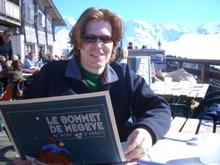
Richard Hine, on the bridge to somewhere


Congratulations to New York’s own Richard Hine (above) for winning Cartoon Caption Contest #98—a P.C. Vey drawing of a man gazing into a wall through a telescope—with the line, “When you’re finished here, Spencer, we’ll need you on the bridge-to-nowhere project.” I asked Richard to address some critical questions for Emdashes readers. —JB
What, for you, goes into writing a caption? I’ve tried the contest (always with miserable results), and I’ve come to feel it is, in many ways, a mental exercise—of identifying an idea related to the drawing, but not an immediately obvious one. Do you have a method?
The short answer is: Yes, but I would hate to give away trade secrets. The long answer is: First, I look at the cartoon online, before my magazine arrives. This, I feel, gives me a crucial head start on other captioneers. I stare at the screen, bite my bottom lip, and shake my head slowly. “Don’t waste your time,” I tell myself, “this one’s impossible.” When my magazine arrives, I look again, searching for details I missed the first time. “Maybe,” I tell myself, “just maybe.” Then, I start making a list of ideas for a few minutes. When I feel confident enough, I test them on my girlfriend. She usually tells me they are lame. So I immediately stop and try and do other things, like write a novel. I come back to my caption list once or twice during the next few days, just to see if I have any other brainwaves. There have been too many weeks when I’ve sent what I thought was my best caption too early in the week, only to come up with something far superior on a Thursday afternoon. I don’t know what other people do, but I only ever enter one caption per week, so once I have a favorite, I try writing it a few different ways and only send it when I feel it’s just right. This method, is of course, 100 percent guaranteed to fail 99 percent of the time.
Your caption has two features that are uncommon among the winners so far—length (fourteen words) and a reference to current events. Brevity, of course, is the soul of wit, and current events have a way of seeming try-hard. Why does this one work?
I was a finalist once before, in contest #82, with a fairly long caption. Of course, I lost out to a shorter, snappier, more crowd-pleasing line. But the experience of being a finalist emboldened me. These days, I allow myself to flex my long caption muscles more and more. Of course, I’ve nothing against short captions. I still send in a short one from time to time. In regard to current events, even though I’ve spent most of my career working for Time and The Wall Street Journal, I usually avoid referencing news items, as they seem not to work well in this contest. But in the case of this P.C. Vey cartoon, I went crazy and broke all my own rules! I not only abandoned my previously described method, I brought in current events, too. As soon as I looked at the cartoon I realized it had “time-wasting” written all over it—both in what it depicted and in its potential to suck up hours of my own time. Through sheer force of will, I made myself come up with a caption quickly and send it in immediately. I figured the “bridge-to-nowhere” concept summed up the reality of corporate thumb-twiddling pretty well, even if not everyone was familiar with the current-events angle.
I’m sensing an emerging time-wasting theme. What, for you, occasions a leap into the ephemera of non-work? What is your most enduring diversion, other than the caption contest? And what gets you back?
Each day, I wake up striving for the ideal balance between productivity and procrastination. I left the corporate world a few months ago, so my definition of “work” and “non-work” has shifted. I’ve finished my first novel and, while hunting for an agent, have started another. I write every day. I also do freelance and consulting projects. My girlfriend, Amanda Filipacchi, actually gets paid to write her novels, so we take advantage of the flexibility we have to travel when we can. On a daily basis, my standard forms of procrastination include: watching The Daily Show and The Colbert Report online, reading news and blogs on Huffington Post and rearranging my Netflix queue. And working out, of course. I plan on doing a lot of that soon.
What’s been your favorite New Yorker cartoon in recent memory?
One of my favorites was actually another caption-contest winner. It was also a P.C. Vey cartoon: two men are looking through a door at an arm sticking up through quicksand and one says to the other: “Of course, the current tenant will be gone before the first of the month.” I don’t think I entered the contest that particular week, but I would not have stood a chance against that line!
If you were convalescing in hospital, what public figure, past or present, would you want in the bed beside yours?
Sir Laurence Olivier would probably have some great stories to tell and if he ran out of anecdotes, I’d just ask him to quote Shakespeare.
Picture the two of you in a cartoon frame. You’re lying back, and your broken leg is suspended in traction. Sir Laurence, his mouth open, inclines himself to you. What’s the caption?
“Should I have said ‘good luck’ instead?”
***

Other Emdashes caption-contest interviews:

  • Robert Gray, winner #106 (“Have you considered writing this story in the third monkey rather than the first monkey?”)
  • David Kempler, winner #100 (“Don’t tell Noah about the vasectomy.”)
  • David Wilkner, winner #99 (“I’d like to get your arrow count down.”)
  • Carl Gable, winner #40 (“Hmm. What rhymes with layoffs?”)
  • T.C. Boyle, winner #29 (“And in this section it appears that you have not only alienated voters but actually infected them, too.”)
  • Adam Szymkowicz (“Shut up, Bob, everyone knows your parrot’s a clip-on”), winner #27, and cartoonist Drew Dernavich interview each other in three parts: One, Clip-On Parrots and Doppelgangers; Two, Adam and Drew, Pt. Two; Three, Clip-On Parrots’ Revenge
  • Evan Butterfield, winner #15 (“Well, it’s a lovely gesture, but I still think we should start seeing other people.”)
  • Jan Richardson, winner #8 (“He’s the cutest little thing, and when you get tired of him you just flush him down the toilet.”)
  • Roy Futterman, winner #1 (“More important, however, is what I learned about myself.”)

Yes, We Have No Bananas

I was looking for an old cartoon from the magazine’s first decades to illustrate this post, when I realized that what I was thinking of was a little guy playing a huge piano in an enormous room, singing “I like coffee, I like tea, I like the girls and the girls like me!” This cartoon is from memory, but I will look it up on the Cartoon Bank and get the precise wording and drawing for you, assuming it’s there, of course—you can’t be 100 percent sure with those early ones. Why is that, Bob Mankoff? I’m just curious; I’m sure it has something to do with scanning, or copyright, or touchy ghosts. (Update: It’s there!) In the process of looking for the bananas-song cartoon, which as I mentioned doesn’t exist, I found this funny Leo Cullum cartoon that makes reference to “The Banana Boat Song,” which, as you’ll recall, was the full text for another cartoon (by Danny Shanahan) and another post. Will the circle be unbroken? By and by, Lord, by and by.
But the point of the hed in the first place is to say: No Pick of the Issue, or POTI, as we refer to it here at Emdashes HQ, this week, due to the alarmingly finishable double issue. Tune in next Monday for the Best in Show, since my recent writeup wasn’t an official POTI, just the result of a mild case of sunstroke, a bout of ennui, my personal tallyman, and the long tail end of an ailment “involving the eye, the ear, the nose, and throat,” as Adelaide would say.
In the meantime, what have we got for you? Another Cartoon Caption Contest Interview, a favorite feature of some of you, returning in glorious form under the canny supervision of summer intern John Bucher. Look for it later today, and enjoy! If you’re a contest winner who hasn’t been made famous(er) yet, please contact us. We’re standing by. Or we’ll contact you. Stand by.

Breaking: Summer Fiction Issue Not Nearly Long or Difficult Enough to Last 2 Weeks

It’s Thursday, and I’m finished. The issue is spent. I am at sea without an issue to paddle with—I’m almost Paddle-to-the-Sea! Fiction editors, this is the best you could do? Let half a dozen rich and juicy stories about doomed ne’er-do-wells on Hawaii beaches and toothy movie stars on planes and wild Dominican daughters and ghostly girls and physics—and a dessert plate of petits fours of poignant movie stories that have only wet my whistle—slip down my gullet like so many fresh oysters, and I’m supposed to be set till next Monday? No. I am done, and bereft, like that Inconvenient Truth polar bear with no ice floe in sight. And mixing metaphors like a fruitcake (examples abound above). You see what this is doing to me?
Of course, there were the other articles. And they were alarmingly quick treats, too, and moving (Edwidge Danticat) and fascinating yet troubling (the nicely titled “Final Destination”; I still don’t understand why this guy won’t put these incredible archives online), and other stuff I’ll get into later; lord knows I’ve got time. I need another dense Middle East piece to make me feel better informed and appropriately challenged yet alarmed anew about my inadequate knowledge of the issues’ intricacies, and determined to go back to that NYRB primer I’ve dipped into less than I should have in the past ten years. With more than a week to go, I need something that would take a day or two to work on. I mean it; I miss it!
I guess this is what the new fiction podcasts are for, to ease the shakes, although curiously the word “podcast” (and please correct me if I’m wrong) hasn’t actually appeared in the magazine to advertise the podcasts, or maybe the type is just extra-small. In any case, I’ll be diverted by some of your multimedia gewgaws, fiction editors. (This savvy Canadian law professor would recommend I do so, I think.) But don’t think I’ll forget that you’ve made an issue that, while meaty and delicious as a Second Avenue Deli brisket sandwich, R.I.P. deli and cud-chewing brisket source, is not time-consuming enough for the time in which I have to consume it.
Here’s a funny fact: I think I may be Danticat’s first publisher. She had a pared-down, urgent poem called “Saw Fish Soup” in The Columbia Review when I was editor, and I still remember it.

To Everybody at Town Hall Last Night for “My Trip to Al-Qaeda”

I was the one who couldn’t stop coughing, though I tried to time my coughs to outbursts of laughter and onscreen gunfire. I’m not the TB guy, I promise.
Other than that, it was a stirring event, maybe something like Al Gore’s slide show would be like in person plus an attractively decorated set, but Wright has a significantly more engaging stage presence, stern and beseeching at once. I think Martin, who accompanied me, will post a review, since we both took notes but I believe his were more legible. Steer clear of Lawrence Wright’s CIA contacts, Nosey Parker New York Times!

The Many Faces of Tony Soprano: Pre-Views From a Socialist Theorist

Whatever the topic at hand, Scott McLemee can be relied on to smarten up the conversation, and here he delivers once again:

Half a century before “The Sopranos” hit its stride, the Caribbean historian and theorist C.L.R. James recorded some penetrating thoughts on the gangster — or, more precisely, the gangster film — as symbol and proxy for the deepest tensions in American society. His insights are worth revising now, while saying farewell to one of the richest works of popular culture ever created.

James treats the cinematic gangsters of yesteryear as radical individualists – their crimes, however violent, being a kind of Romantic refusal of social authority. But the extraordinary power of “The Sopranos” has often come from its portrayal of an almost seamless continuum between normality and monstrosity. Perhaps the most emblematic moment in this regard came in the episode entitled “College,” early in show’s first year. We watch Tony, the proud and loving father, take his firstborn, Meadow, off to spend a day at the campus of one of her prospective colleges. Along the way, he notices a mobster who had informed to the government and gone into the witness protection program. Tony tracks the man down and strangles him to death.
At the college he sees an inscription from Hawthorne that reads, “No man … can wear one face to himself and another to the multitude, without finally getting bewildered as to which one may be true.” Earlier, we have seen Tony answer Meadow’s question about whether he is a member of the Mafia by admitting that, well, he does make a little money from illegal gambling, but no, he isn’t a gangster. So the quotation from Hawthorne points to one source of Tony’s constant anxiety. But it also underscores part of the audience’s experience – an ambivalence that only grows more intense as “The Sopranos” unfolds. Cont’d.