
Here’s a useful take on Hendrik Hertzberg’s sound Comment about the Larry Craig debacle (debacle of misappropriated police resources and legislative energy, that is); if you’ve seen any good takes on Hertzberg’s piece, please post them in the comments.
I just started reading How Starbucks Saved My Life, so I’ll write about it when I’m done. For context, here’s today’s New York Times profile, with a photo slide show, of Michael Gates Gill, the self-sufficient and contented man, well-respected barista at a Starbucks store, son of Brendan Gill, and former ad executive, in approximately that order. As a rule, I don’t like Starbucks that much, but I’m touched.
Christopher Hayes praises my friend Katha Pollitt’s new book, Learning to Drive: “A few of the personal essays in this book appeared in the New Yorker, but there’s some wonderful new stuff as well, including an absolutely spot-on hilarious chapter about a Marxist study group she used to belong to. As always, Pollitt writes like a dream.”
I’m reading it now, and I’m planning to buy it for half a dozen others. It should be required reading for every humanist, capitalist, true lover, skeptic, feminist, deep thinker, and humor appreciator this side of the exosphere. You’ll remember the New Yorker essays “Webstalker” and “Learning to Drive”; they’re in there, all right, and so are a whole bunch of other pieces you’ll be delighted to discover.
Cartoon news: This blogger has some caption-contest suggestions; cartoon editor Bob Mankoff comments on a cartoon controversy.
A nice reflection on what makes good readings so good; the writer recalls readings by John Hodgman, Marisha Pessl, and Sean Wilsey, among others.
This piece about ideas of privacy includes this story: “In another well-known case, The New Yorker magazine was sued by a hermit whose privacy was shattered when a James Thurber story disclosed that many years before he had been a famous child prodigy.”
Finally, remember the Talk of the Town by Lauren Collins about Barbara Hillary, the 75-year-old woman who wanted to be the first African-American woman to reach the North Pole? She did it!
Monthly Archives: September 2007
Vista del Mondo (Or: Steinberg in Italian)
A couple of weeks ago I mentioned seeing a Viennese version of Saul Steinberg’s incomparable cover “View of the World From Ninth Avenue.” A reader named Jennie posted in the comments that she owns a shirt picturing the same sort of witty vista, only for Florence. She was good enough to send us a snapshot so that we could show it to you.
Here it is!
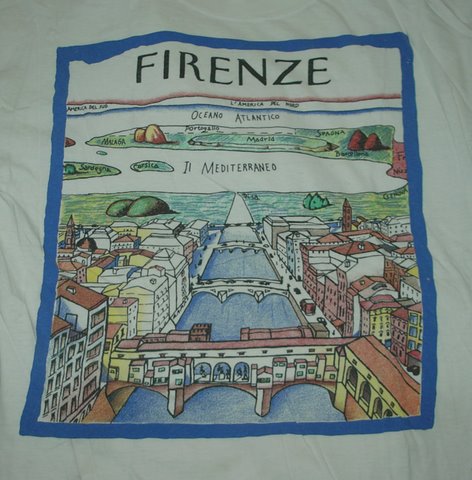
Jennie relates that the shirt “inspired me a few years later to make one of my own: A View of the World From Ancient Rome. The artwork can’t compare, of course, even with the knockoffs, but it was fun.” Alas, she doesn’t have that shirt anymore. We still appreciate the contribution—thanks!
Needless to say, if any readers are aware of similar appropriations, we’d love to hear about it. There must be versions of this for Chicago, Los Angeles, London, Paris, and who knows where else!
The one I want to see is Dubuque. —Martin Schneider
We’ve been neglecting the “X-Rea” category lately, I know, but if you’ve sent in a sighting of an Irvin-like face and haven’t seen it on the site, rest assured, we’ll be posting it with enthusiasm. For newcomers to this category, please be on the lookout for Irvinesque letters. They’re everywhere! —EG
John Seabrook Story Will Be a Movie, Plus Drinking Bees, Hitting Chickens, &c.
…thanks, Jason!
This will be a post of truncated sentences, since I have birthday cocktails to attend to. Here’s some more pre-festival excitement.
The headline says it all: Calvin Trillin always remembers his roots.
A cinematic, soulful photo essay about the Coney Island we’re about to lose.
Here’s a ruckus you’ll want to jump into one way or another. “Boy is everyone up in arms about Adam Gopnik’s New Yorker piece in this year’s food issue. Okay, by ‘everyone’ I mean anyone insulted by his just-this-side-of-snide implication that locavorism is a weird little fad practiced only by the privileged, nostalgic, and naive.” Read all about it! I loved that piece, by the way. Gopnik’s account of setting up a chicken hit and returning for his slaughtered fryer (I typed “pullet,” but that doesn’t seem right), only to find that the aghast farmer had misconstrued his request, is one of the drollest and most skilfully written in the issue, or several issues. (Judith Thurman’s stories of the mysteries within us is a very close second.) Really nicely done.
Princetonians drink bee juice.
The good citizens of Salon discuss Shouts and whether it’s funny. And whether women are funny (but that’s not much of a discussion—we all know they are).
Hey, art dept., it’s not too late to not overlook the considerable talent of this adorable man.
And look at some of the gorgeous work of the travel photographer Samantha Appleton, whose work has been in The New Yorker.
“Years of Inner Nunnitude”: Saunders on Letterman
One Good Move has video of George Saunders’s September 6 appearance on Letterman. I thought he was very entertaining. (The commenters at One Good Move seem a bit crabby, though.) You can assure yourself of precisely that manner of tomfoolery if you attend one of the many Saunders events in the coming weeks.
I love David Letterman, but I would never accuse him of being in the least highbrow. Perhaps Saunders will spark a trend! I’m sensing a good opportunity for a little reader participation.
Question: Steve Martin aside (he’s always the big outlier in such matters), can anyone think of other “serious” writers appearing on the show? I’m pondering who the least likely literary guest Letterman ever had might have been. (My brain just concocted a fleeting image of Beckett grimacing at Paul Shaffer.) Is there a good resource for checking past Letterman guests? If not, I’m sure our readers have plenty of mind-blowing anecdotal evidence to share.
As far as I’m concerned, we can consider the NBC show as part of this too. (Hat tip: The Millions and Paper Cuts.) —Martin Schneider
8.27.07 Issue: Uncle Sap and the Human Bomb
In which some or all of us review the most recent issue.
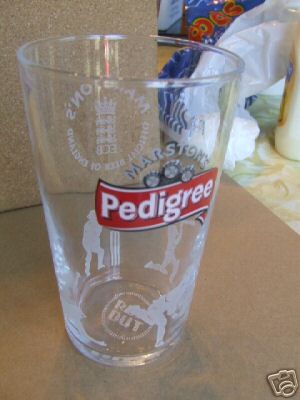
I spent a few days in London a couple of weeks ago, in which time I visited four pubs. How strange to see one of them, The Grapes, invoked in the first paragraph of John Lahr’s splendid Profile of Ian McKellen. Confession: I pilfered a pint glass from the joint. It says “Marston’s Pedigree” and has swell silhouettes of cricketers all along the bottom. When you have drained the glass, the words “RUN OUT” become visible on the bottom of the glass. Just too good to pass up. (I will gladly negotiate reparations with any representative from The Grapes who contacts me.)
I wish that Adam Gopnik’s Letter from France had been longer, and if that sounds like a compliment, that’s the idea. The last two paragraphs especially are required reading, in my view. There’s been a fairly sudden change of the guard throughout western Europe—Germany, France, and England have all ushered in new leaders in the last couple of years, two of them since early May. The New Yorker looked at Merkel in late 2005. I look forward to the Letter from London on Gordon Brown…before the year is out?
As political forces tug to and fro in Washington over Iraq, it was a mild shock to encounter, of all people, Scottish hawk Niall Ferguson and his counterfactuals at the back of the book, but I do admire his emphasis on economics, and the review was well worth reading.
I loved the snapshot of Antonioni and Monica Vitti, that goes along with Anthony Lane’s look back in which Antonioni reminds me of Paul Stewart’s Raymond, from Citizen Kane.
Finally, here’s more this week’s cover by Kara Walker, and more about this week’s (I think, but correct me if I’m wrong) caption contest winner. —Martin Schneider
Madeleine L’Engle, 1918-2007
From the Times obituary:
Madeleine L’Engle, who in writing more than 60 books, including childhood fables, religious meditations and science fiction, weaved emotional tapestries transcending genre and generation, died Thursday in Connecticut. She was 88.
Her death, of natural causes, was announced today by her publisher, Farrar, Straus and Giroux.
Ms. L’Engle … was best known for her children’s classic, “A Wrinkle in Time,†which won the John Newbery Award as the best children’s book of 1963. By 2004, it had sold more than 6 million copies, was in its 67th printing and was still selling 15,000 copies a year.
If you have access to the Complete New Yorker, this might be a good weekend to revisit Cynthia Zarin’s excellent April 12, 2004, Profile of this remarkable woman. She will be missed.—Martin Schneider
Parkerfest 2007: You Might As Well Live It Up
The 9th annual Parkerfest is upon us! (Note that it’s been around one year longer than the New Yorker Festival, with which it shares a weekend this year.) The Dorothy Parker Society celebrates its eponym with a speakeasy night, a walking tour, a Round Table lunch, music, readings, and more. Sign up for the Society’s newsletter, and you will be constantly up to date on all matters Parker-related.
Parkerfest 2007 will be held on October 4, 5, and 6, and will be joined by the Robert Benchley Society for a double-whammy party.
Thursday, Oct. 4
Dorothy Parker Reading, Mo Pitkin’s House of Satisfaction, 7-9 p.m.
Titled “The Potable Dorothy Parker” and co-produced by Celia Bressack and Stephanie Sellars, this is the second year in a row that this unique ensemble has presented Mrs. Parker’s work in the East Village. The address is 34 Avenue A, admission is a suggested $5.
Friday, Oct. 5
Cocktails at the Algonquin Hotel. 6-8 p.m. Meet in lobby. Cash bar.
Saturday, Oct. 6
Dorothy Parker-Robert Benchley Walking Tour. 11 a.m. meet in lobby. $15.
Lunch at the Round Table. 1:15 p.m. meet in lobby. Cash only.
Dorothy Parker-Robert Benchley Banquet. 6:30 p.m. Pete’s Tavern. 2-hour open bar and dinner. $50 per person. Cash only. RSVP
here (limited space available).
Dorothy Parker Bathtub Gin Ball. 10:00 p.m. The Bridge Cafe. 2-hour open bar and party. Ticket TBD per person. Cash only. RSVP
here (limited space available).
My father once attended a birthday party for Marcel Proust hosted by the Proust Society, and that was awfully festive, but this sounds like even more fun.
—Martin Schneider
Mainly About Comics and Artists, But Also Blondes, Books, Tennis Gods, and Bees
Several excellent New Yorker artists have been singled out for shows and profiles recently. I liked this passage from a piece about Anita Kunz:
The Canadian artist did her first magazine-cover illustration for a Toronto business magazine in 1979, but Kunz had her sights set on the New Yorker, currently the only wide-circulation publication that runs free-standing illustrated covers. Since her first effort in 1995, she’s had a dozen covers published in that magazine. Her most recent, “Three Visions†(“Girls Will Be Girlsâ€), which appeared on the July 30 issue, shows a trio of women sitting shoulder to shoulder on the New York subway. The first is completely shrouded in a burka; the second is a young woman in a crop-top, flip-flops, and another garment so short it’s impossible to tell whether it’s shorts or a skirt; the third is a nun wearing coke-bottle glasses with a large gold cross hanging from her neck.
“Based on their clothing,†says Kunz, “none of those women are physically free.†Kunz says she got about 40 letters in response to that painting. “I’ve had lots of reaction that baffles me,†she admits. “I’ve been called anti-woman, a racist, anti-Semitic, anti-American, you name it!â€
I may have mentioned this already, but the program of animation influenced by Saul Steinberg, at the Ottawa International Animation Festival this month, sounds absolutely amazing.
On September 27, longtime cartoonist Dana Fradon will speak at Western Connecticut State University. From the story in the Newtown Bee:
Among Mr Fradon’s most readily recognized cartoons is the uncaptioned scoreboard of a mythical “Realists vs Idealists” baseball game that shows the Idealists taking a drubbing from the Realists in the run counts for nearly every inning – yet the game total inexplicably shows the Idealists have prevailed by a 1-0 score. In another drawing of a crowned king addressing his royal cabinet, the monarch declares, “Gentlemen, the fact that all my horses and all my men couldn’t put Humpty together again simply proves to me that I must have more horses and more men.”
I just got an excellent tip: At Bookforum, there’s a lovely piece by Radhika Jones about Alex Ross’s book collection. Thank you, tipster!
Moreover, at Gary Panter’s groovy site, there’s a blog! Not only that, but a 29-point platform! #28: “Lower human population and increase frog, lizard and turtle populations. Snakes are on their own.” This also came from a tipster. It’s good to hear from you, neighbor.
There’s a terrific exchange between Nick Paumgarten and John Colapinto, all about the U.S. Open and the graceful Roger Federer, on newyorker.com. I hope there’ll be more of this sort of thing—Slate doesn’t own the format—and, of course, more YouTube.
Speaking of which, a few very brave people have been parsing poor Miss South Carolina, who herself may have lacked a map at a crucial juncture.
Scientists who study bees may be zeroing in on what’s wrong with the troubled colonies, and as the Knight Science Journalism Tracker points out, Elizabeth Kolbert got there first. If you didn’t hear Matt Dellinger’s audio interview with reporter-beekeeper Kolbert, listen to it now. There’s also a honey of a slide show. The hive really is bear-proof!
Speaking of Nature, check out this sneak preview of a global warming-related ad that’s running in the September 10 New Yorker.
Here’s an approving write-up of a Dana Goodyear reading.
The abstract of Judith Thurman’s story, from the food issue, about fasts and colonics (not online—hence the abstract) must be unique in the history of things Tilley, don’t you think? I can’t wait to read the piece—I’ve read most of the food issue, but we’re finishing up a grueling close at Print, and nearly everything else has been sacrificed. I have a friend who’s on a lemon-juice-and-maple-syrup fast; he’s three days in and is feeling a little strange. Here’s one loyal, academic New Yorker family’s reaction to Thurman’s adventure.
Finally, from a profile of illustrator Bruce Kleinsmith, a.k.a. Futzie Nutzle, this funny tale from ’70s New Yorker cartoonland:
After years of practice in the local fly-by-night papers, by the mid-’70s Nutzle’s mastery of his medium and a sequence of serendipitous introductions earned him his coveted spot in Rolling Stone. “That was my opportunity to really get sharp, because I knew I would be in the public eye,” he says.
But he’d been trying for ages, without success, to place his drawings in The New Yorker, which he calls “the pinnacle of cartooning—at least until 10 or 20 years ago.” Accustomed to inhabiting various seemingly incompatible worlds—hanging out with surfers, musicians, hippies, poets, drug dealers, manual laborers, artists and academics, but never belonging to any particular camp—he saw no contradiction between his outlaw lifestyle and his desire to be a part of the nation’s most prestigious mainstream magazine.
“When I went to New York in ’79 and met the New Yorker cartoonists—not all of them but some of them, over lunch—it was really interesting because they were into one-upmanship,” he remembers. “Cartoonists really are square, but these guys were ultrasquare, and they were looking for a one-liner that’s gonna crack up the whole table. We’re drinking martinis, and I think this was a Wednesday afternoon; they all go down to this bar after they’ve been critiqued at The New Yorker and they’re like little puppies with their ears back, but after a few martinis they’re really rollin’, and they’re chesty, and they’re comin’ up with all these one-liners.
“And I’m going, ‘Is this what it’s like? I can’t be an artist with The New Yorker, I can’t do this!’ I really liked some of those guys. Anyway, I pulled out this huge joint, from California, and I said, ‘Would any of you guys like to try this?’ And they looked at me like, ‘Oh my god, narcotics! Jesus Christ!’ It was like, ‘Holy shit, put that away!'”
Finally, he says, “they got me so mashed on martinis, they had me so whacked, they literally tied my briefcase to my wrist, because I had all my drawings in there, and I thought, I’m so mashed I’m gonna lose all this stuff if they don’t tie it to my arm. Man, those guys are too much. They were still slammin’ ’em down when I left the bar.”
Wood Heaves Darts of Disapproval at DeLillo. In Error?
Does anyone know when James Wood’s first New Yorker review will run? Those who haven’t read The Broken Estate or The Irresponsible Self lately might welcome Garth Risk Hallberg’s refresher course on Wood’s approach in the form of a thoughtful critique of Wood’s takedown of DeLillo’s ambitious novel Underworld. Hallberg insists that Wood’s just not getting it. I found the book a little starchy, but I expected that going in. None of which is to say that it failed to meet its goals, exactly. I remain agnostic on the subject. How did Underworld go over out there?
Either way, I find it cheering to see such fervent advocacy for an admittedly difficult novel. Hallberg clearly loves the big ambitious fiction of DeLillo, Thomas Pynchon, and David Foster Wallace, references “Jonathans Franzen and Lethem” (endearing him to us, anyway), and treats his adversary (Wood) with due respect: “The essays on Chekhov and Mann in The Broken Estate should be required reading for any novelist.” I really like the flow chart Hallberg provides of “Literary/Critical Conflicts of the Past Two Decades,” with its droll “Darts of Disapproval” and “Rings of Harmony.” How refreshing to see (for instance) n+1, Dale Peck, and Cynthia Ozick diagrammed so saucily and succinctly! —Martin Schneider

If This Was Made for You, You May Be Made For Me
Can you imagine an expertly edited, magnificently pared-down, eight-minute-long version of His Girl Friday with not a word of dialogue? That’s no impediment for those who know every breath, carnation, siren, sigh, innuendo, newsroom bell, typewriter report, bang, cry, groan, and cock of the eyebrow. Go watch it at Bad for the Glass, where I found it, and which adds the comment: “This experimental edit of the film removes every word, leaving in only sneezes and grunts and Cary Grant’s delightful laugh. Knowing the film’s plot, the rapid edits are intriguing in places. And this shortened version helps you actually pay closer attention to Hawks’ marvelous visual staging, even in a setbound film like ‘Friday.'” The editing is by Valentin Spirik. Bravo.