
You have until 5 p.m. today to get your manuscript to the 92nd St. Y for Antrim’s advanced fiction master class, which begins February 7 and continues for nine weeks. Not only will this class be scintillating and rewarding (you’re advanced—don’t you want to be in that room with all those other serious writers?), I have a hunch that it’ll be pretty damn entertaining. Hurry! I don’t want to hear any of your excuses!
Monthly Archives: January 2008
Eustace Tilley Contest: Could You Be the Next Rea Irvin?
Perhaps not, but it’s certainly worth a try. Click through to Boing Boing for details of the magazine’s new online competition, the results of which are sure to be a monocled, lepidopteran hoot.
The contest is being held on Flickr rather than newyorker.com; the image specs and rules appear there and also here. The group has 32 members so far, including me.
Over on Flog!, by the way, Fantagraphics maestro Eric Reynolds makes a sly reference in his report on the contest by heading his post “Johnny Ryan, are you reading?” I shall explain: Ryan, author of the singularly disgusting yet strangely mesmerizing Angry Youth Comix, included a nearsighted, um, awe-inducing character he called The New Yorker in a recent edition. I will append only three very tame panels from the storyline after the jump; pursue this further at your own risk.
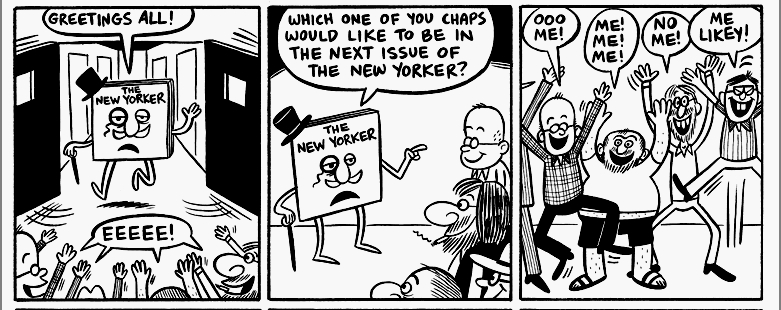
Click to enlarge; reprinted with permission. Caveat lector!
Brave, Lonely Dissents Are the Best Kind
I admit it. I’m an Obama man. I was psyched after Iowa, and I was dejected upon hearing the news of Hillary Clinton’s victory this morning (wrong time zone for prime time results). Several hours later, I see the positive side of Clinton’s comeback, and I find myself looking forward to the spirited few weeks of political combat to come.
Not many people saw Clinton’s strong showing yesterday coming, but I did want to salute Hendrik Hertzberg for being one of the very few people to get at least a small part of the story dead right, a mere day after the Iowa result, when the Obamania was at its freshest and most difficult to contravene.
I confess that when I listened to the last installment of the delightful New Yorker podcast “The Campaign Trail”—which usually features The New Yorker‘s Washington correspondent, Ryan Lizza, and executive editor, Dorothy Wickenden (they make a very good team), but the day after Iowa also included Hertzberg, the magazine’s chief political commentator—I made a dismissive clucking sound with my tongue upon hearing Hertzberg’s negative assessment of Obama’s prepared caucus-night speech and praise for Clinton’s “gracious” concession. Just as we learned not to be overhasty about writing any candidate off, we likewise shouldn’t read too much into what was likely a small part of Clinton’s comeback.
But the fact remains, that Hertzberg, both in the podcast and on his blog, may have foreseen Obama’s tendency to turn his movement into a hazy abstraction and Clinton’s newfound need to hunker down and show her more affable side. It’s already difficult to reconstruct how heretical that take seemed on Friday, and Hertzberg deserves credit for not letting the prevailing winds buffet him about.
I hope Hertzberg participates in the next podcast so he can crow over his prescience! (Which he surely won’t.)
—Martin Schneider
Update: I think Karl Rove might be a “Campaign Trail” podcast enthusiast. After Hillary won, his surprisingly trite (and, less surprisingly, racially coded) article in The Wall Street Journal made a similar observation:
And Mr. Obama, in his own way, is often as calculating as Mrs. Clinton. For example, he was the only candidate, Democratic or Republican, to use a teleprompter to deliver his Iowa and New Hampshire election-night speeches. It gave his speeches a quality and clarity that other candidates, speaking from notes or the heart, failed to achieve. But what he gained in polish, he lost in connection.
—MCS
The Best of the Best American Shorts (Hail the Wale!)
I know Martin’s been covering the New Yorker‘s many appearances in the “Best American Short Stories/Essays/&c.” series in rich and potent detail, but thanks to Leif Peng’s wonderful advertising-and-illustration-history site, Today’s Inspiration, we now have the definitive example—one that almost certainly trumps all others. Not only are these shorts incredibly fetching and versatile (like Raymond Carver, they come in longer versions, too), they’re made of corduroy.
As you may remember from a signature Ben McGrath Talk from about two years ago, perhaps the most delightful organization in New York City is the Corduroy Appreciation Club, for which I’m honored to say I serve not only as a member in good standing but as poet laureate. (My most recent presentation is not yet online, though it is lines on lines.)
Anyway, after the jump, behold the best American shorts to date. The mystical (to CAC members) date of 1 | 11, however, may yet reveal still better ones. It remains to be seen. Or felt. Entirely your choice.
Click to see at original size!

Benjamin Chambers on the “Best American Essays,” Pt. 2
Just before Christmas I published the comments of Benjamin Chambers, of the top-notch literary website The King’s English, as he daringly attempts to read every single New Yorker essay ever to be singled out in Houghton Mifflin’s “Best American Essays” series (which I first wrote about here). For his next feat, I suspect, he’ll try a record English Channel swim.
Take it away, Benjamin!
My next job was to tackle 1987, from the anthology edited by Annie Dillard: an easy list of only three essays. (One wonders if Dillard didn’t care for the stuff The New Yorker did; or if she felt obliged to go against the grain, figuring that it was better to take notice of material in other, lesser known venues; or—possibly?—The New Yorker itself was having an off year? It’s interesting that when Geoffrey Wolff edited the anthology the next year, he felt 10 NYer pieces were notable (though he didn’t select any for “best of” status). What’s odd about that, though, is that he included some very weak pieces, including one by Veronica Geng that’s actually fiction. (The Complete NYer‘s index lists Geng’s piece that way, too, but it’s not infallible, as for example when it inexplicably classifies as fiction Susan Sontag’s autobiographical essay, “Pilgrimage,” which appears on Dillard’s 1987 list.)
Actually, I cheated and started out my 1987 reading by jumping ahead to 1988 and reading Joan Didion’s “Letter from Los Angeles,†which starts out shapeless but pleasing, and then turns into an acute report on the writers’ strike that had just recently fizzled out. Given the strike that’s currently going on, it was particularly timely. Then I went back to 1987, and read E.J. Kahn Jr.’s delightful profile of Helen Suzman, who was for many years the only woman in the all-white House of Assembly of the Republic of South Africa, and an internationally known opponent of apartheid. I’d never heard of Suzman, and came away feeling great admiration for her feistiness. At the time, of course, she didn’t feel very successful—she’d spent years being the only voice in opposition—but again, to read the profile after the nearly bloodless end of apartheid gave it a special flavor. (This profile led me to Wikipedia, where I found a link to an article in the Telegraph from 2004, where she had some reservations about the way current politics are working out there, although none whatever about the abolition of apartheid.)
I’ve never had much use for Harold Brodkey’s work, but in truth I’ve not read much of him, so I approached “Reflections: Family†with qualified hopes. Unfortunately, they proved unfounded—as with E.J. Kahn’s “Hand to Hand†from 1988, the size of audience that could be interested in the piece would seem to be quite limited—in Brodkey’s case, to his own family, as the essay amounts to a collection of observations about their broad experiences and personalities. The piece’s charm would’ve grown in inverse proportion to its length. Kahn’s “Hand to Hand†records in excruciating detail the sinking of a U-Boat by a U.S. craft during World War II, the latter-day reunion of men on both sides of the battle. Though a promising premise, it feels more like a war story fit for other veterans of that war, rather than a general-interest piece—at least at this distance.
That’s curious about the Geng piece. I wonder if that choice elicited any commentary at the time? Anybody know?
—Martin Schneider
Previously: Chambers on the “Best American Essays,” Pt. 1
How to Read The New Yorker: An Illustrated Guide
Check out this gorgeous and useful entry by Heather Powazek Champ at The Magazineer, featuring elegant shots of the New Yorker pages in question. She writes:
A subscription to any weekly magazine is a commitment. If you subscribe to more than one, it’s even more important to ensure you stay on top of your consumption. I’ve developed the following process to ensure a timely yet comprehensive digestion of the beauty and wonder that is The New Yorker. Here’s my 10-step approach to the 7 January 2008 issue. (Read on.)
While I read the complete contents every week, or close to it, I certainly can’t (and don’t!) fault other people for doing less. (OK, I carp from time to time, but that’s only when my patience is really being tested.) This is a magazine, after all! It should be an illuminating diversion, not a chore.
Champ’s advice is similar to what I tell people who ask how to manage the overwhelmingness, as did my friend Stephen the other day (he got a subscription for Christmas). Skim the listings if you see live events in New York and the short movie reviews if you see movies anywhere; read Talk, Shouts, the cartoons if you like cartoons, the reviews of whatever interests you, and a long feature or Profile. I got an email from him just this morning, though, with this update: “actually, i’ve been meaning to write you to tell you that i DEVOURED the latest issue. like, read every article (almost). i’m LOVING it more than i expected.” So as you can see, it’s doable, even for busy actors, waiters, and other professionals!
Also, as I told Stephen, there’s nothing like it for total absorption on the subway, at the post office, in the tub, and on the internet. (Then, after you’ve recycled, you still have the DVD archives if a missed piece is haunting you like the Telltale Heart.) As Champ writes: “If managed correctly, the above process of consumption should take about a week. In fact, that’s what you should aim for lest you become ‘that’ subscriber who’s hopelessly behind.”
Amen to that. Thanks to Steve Heller for the tip!
The Raymond Carver Rights Debate
NPR has the story. From their web summary:
In 1981, Knopf published a collection of short stories by Raymond Carver called What We Talk About When We Talk About Love. The book was a critical success. Reviewers praised its minimalism and Carver’s spare style. It was, perhaps, more spare than Carver intended.
Carver’s editor was Gordon Lish, and since the author’s death in 1988 at the age of 50, scholars have discovered that Lish edited Carver’s stories heavily — some would say drastically. Lish cut description. He changed story endings. And in many cases, he eliminated more than half of what Carver had written.
Now Carver’s widow wants his readers to see the original stories. She’s pushing to have What We Talk About When We Talk About Love republished. [The] New Yorker magazine has printed one of those stories in its annual fiction issue. Knopf says it owns the rights — but to what?
I had a letter today from a young Carver fan who’s been feeling a little conflicted about his fandom now that he knows about Lish’s interventions. With his permission, I’ll add it to this post. Update: Here it is. This letter is from Matthew Wright, who discovered Carver as a teenager in a small town about three hours away from Yakima, Washington, a central Carver site.
I’m a 21-year-old who loved reading Carver in high school, which was only about 3.5 years ago. I bought two of his short story collections, “What We Talk About” and “Cathedral” and now, yesterday, in Life and Letters, I read “Rough Crossings, The Cutting of Raymond Carver,” and I don’t know what to think. Is this just now coming out? Did people know about this? Know that at first Carver wanted Lish to edit the fiction, but when he did (cut it by forty per cent), Carver said no way, don’t publish it? And then it was published anyway, into the story we now know as “What We Talk About When We Talk About Love.” It’s practically as much Lish’s story as is is Carver’s. Did you know about this? Did anyone? I feel cheated.
As for me, when I read “Beginners,” I was enormously relieved: I liked it, and I still liked Lish’s version. I’ve known a few celebrated writers whose grace, eloquence, and relevance can be credited almost entirely to their editors, but it’s clear to me that Carver isn’t one of them.
NPR’s David Gura interviewed David Remnick for the story, and it seems as though we have the answer to the question of who wrote the introduction to the Carver-Lish section. (Gura: “David Remnick, who edits The New Yorker, wrote an introduction to the piece.” Later: But read this post’s comments; the author/s may still be unrevealed. If you know one way or the other, won’t you write in? As you know, I won’t quote or name you without your permission.)
In the interview, Remnick says, “Writers are not Frankenstein monsters. They’re not idiot savants. Writing is really, really hard. And what Carver risked in every story is for everyone to see and to read and to feel.” He adds a bit later: “It’s my feeling that Carver learned something from Lish, and internalized something from Lish’s edits, and it helped him develop this aesthetic that we know as Raymond Carver’s style, which may be fuller and lusher in later stories and more spare and laconic in the middle stories, but nevertheless is a recognizable voice from beginning to end.”
Speaking of debates, I’m digging the lively, diverse discussion at City Room about the MetroCard’s needlessly flat design, a topic I’ve considered as well (on the stylish design-essay website A Brief Message). One of the card’s early promoters posts a clarifying comment, and it’s a rousing conversation all around.
Breaking: The New Yorker Cartoonists Have a Blog of Their Own
More later since I’m working, but this is very exciting news. Cartoonist and online cartoonist shepherd Mick Stevens will be the blog’s first “captain,” and it’ll rotate every month. Dare we hope that Roz Chast, Bruce Eric Kaplan, Eric Lewis, Drew Dernavich, Liza Donnelly, Gahan Wilson, the already very webby Emily Richards, Ed Koren, Matt Diffee, Harry Bliss, Marisa Acocella Marchetto, Charles Barsotti, Michael Crawford, and dear pal of Emdashes (and blogeuse extraordinaire) Carolita Johnson—not to mention scores more of our favorites—will be among the captains to come?
The New Yorker and Excel Work So Well Together
The Millions has just posted a really juicy spreadsheet that a teacher named Frank Kovarik sent in. It’s got basic information on every short story that has appeared in The New Yorker since 2003. I salute Kovarik for his industry and public-spiritedness! I also use Excel to make sense of The Complete New Yorker‘s vastness. Indeed, I think those two just might be the new PB&J, the new franks and beans, the new vodka and tonic. It’s possible I overstate.
I’m sure I’ll have more to say about this data, but I hope that Kovarik elucidates the meaning of the “Rating” column. I suspect it refers to his own personal opinion of the story, on a scale from 1 to 10. If that guess is correct, he sure doesn’t like Roberto Bolaño!
One aspect of this information that has already gotten some attention is the statistics on gender. Obviously, The Complete New Yorker permits comparison across eras, so that’s something I’d like to look into soon. —Martin Schneider
“Poetry’s a Little Swervier Now”: An Interview With Alice Quinn
There’s a short, good interview with Alice Quinn on the Poets & Writers website, in which she talks about her twenty years as The New Yorker‘s poetry editor, what she’ll do next, and her successor, Paul Muldoon. An excerpt (thanks to Ron Silliman for the link):
How did you feel about the appointment of Paul Muldoon as poetry editor?
It was really my dream to have him succeed me. David [Remnick] asked, “What would you think about Paul Muldoon?” and honestly, I almost did a jig. You lay a foundation and then you see that somebody you adore and admire is going to come and shore it up and further it, and that’s great.
Who do you perceive to be the audience for the New Yorker‘s poems?
I feel that New Yorker readers are people who were profoundly connected to poetry in childhood, adolescence, or college, who want to touch base with it and want to feel that they still can read poetry. The New Yorker gives poets access to an international audience of literarily eager people who are sampling poetry.
Also, R.I.P. Milt Dunnell, sports columnist for the Toronto Star, who won an A.J. Liebling Award from the Boxing Writers’ Association of America in 1997. He passed away last week at the age of 102. From the collegial and eloquent obituary in the Star:
The 1975 fight between Ali and Frazier in Manila – the Thrilla in Manila – was his all-time favourite sporting event. At the time, he began his column this way:
“Not since the big guns of nearby Corregidor, now rotting in the tropical sun, has there been such cannonading in this corner of the Pacific.”
It was the greatest fight he covered and Ali was the greatest athlete of the century in Dunnell’s view.
“In my opinion,” he once said, “Ali was one of the greatest salesmen and public relations personalities in the world.”
“After a training session, Ali would sit on the corner of the ring and talk for an hour. Most of it was b.s., but he would talk about world politics, fighting, about blacks in society … all those things … and he described himself as the world’s best-known citizen.”
But he didn’t know everything. If Dunnell was nearby and Ali didn’t have a stock answer for a technical or historical question, he would say, “I don’t know about that. Why don’t you ask Milt here?”
…
On one occasion, Stephen Brunt, a sports columnist for the Globe and Mail, recalled seeing Dunnell in action at a heavyweight fight between Mike Tyson and Michael Spinks in 1986.
“The bout ended quickly, but still it was past midnight and in the confusion at ringside there was shoving and jostling as the spectators pushed toward the ring and as the reporters tried to push their way out to the post-fight press conference.
“And somewhere, in the middle of it all, was Dunnell (only about 80 then), climbing over a table, fighting his way through the mob, to get the quote, to get the story, to get it back to his readers, to make the event real the next morning over somebody’s breakfast in Scarborough.
“Athletes aren’t the only heroes in sport,” concluded Brunt.