
The new blog on newyorker.com. The writers so far should be familiar to you from the more recent volumes of the print edition’s now nearly 83 years: Shauna Lyon, Andrea K. Scott, Ben Greenman, Russell Platt, Andrea Thompson, John Donohue, and, of course, Richard Brody. Will this also be a proving ground for young employees, interns, assistants, and fledgling Leo Careys of restaurant-review prose poetry? I hope so!
Monthly Archives: January 2008
Doesn’t This Law & Order Guy Look a Little Like David Remnick?
I know how this sounds, but I was watching a few minutes of that dreadful but hypnotic Taxi TV the other day, and there was a Law & Order promo on; the faces of a bunch of actors flashed by, and I could have sworn one of them was the jazz-appreciating editor himself. Once you really look at the guy (it’s got to be Jeremy Sisto as Detective Cyrus Lupo), it’s a little less doppelganger-y, but there’s something to it.
OK, enough silliness for today! (Here’s Remnick calming down Elizabeth Kolbert after a particularly dire climate-change report.)


This Just In: E.B. White Was Versatile
Yesterday, Bill Christensen of Technovelgy.com reported that the Russians have plans to construct a new space platform and have it in use by the year 2020. According to Christensen, there have been serious proposals for a “earth satellite vehicle program” as far back as the 1940s, but the first use of the term “space platform” may have appeared in E.B. White’s short story “The Morning of the Day They Did It,” published in the February 25, 1950, issue of The New Yorker. Christensen describes the story as “scary,” and, if I’m following my links correctly, elsewhere writes,
Absolutely first-rate story by White makes me think I completely misunderstood Stuart Little. A man who works on a Stratovideo plane in the nascent television industry writes the story of the end of the world. This story is so up-to-date you’ll whimper with fear by the end. Highly recommended.
Mercy! Well, I couldn’t resist an endorsement like that. I busted out The Complete New Yorker to have a look.
I won’t admit to whimpering, but the story is very well turned indeed. It’s got a few dated bits but not too many; Christensen has a point that it holds up well. (Good writing remains good writing.) It reminded me of nothing so much as 2001: A Space Odyssey, which I suppose is unavoidable. (If you’re wondering, Arthur C. Clarke‘s story “The Sentinel” was written a couple of years earlier but seems not to have been published right away.)
Just to enhance the mood, here’s a 1949 painting of a similar object by legendary fantasist Frank Tinsley:
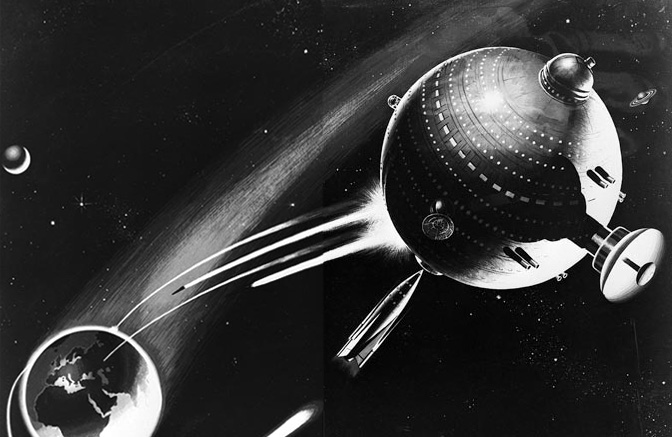
The story is full of imaginative touches—the Americans invent a pesticide that accidentally kills off all the birds and the bees (except for the whooping crane, for some reason), and all human beings have to get a special injection every three weeks in order to ward off the poisons now in the food. The story features a TV studio in outer space and a character named Major General Artemus T. Recoil.
And the United States does end up destroying the world, but you know what?
We meant well.
—Martin Schneider
Found in the Chapter Menu: The President’s Analyst
The President’s Analyst, written and directed by Theodore J. Flicker and starring James Coburn in the title role, was released in 1967—which fact is screamingly evident in virtually every frame. I saw a big chunk of it many years ago, and in my mind it’s always remained a mashup of Dick and I Love You, Alice B. Toklas! with a little bit of Skidoo thrown in. (We learned recently that David Denby is a big fan of Otto Preminger—I’d love to know what he makes of Skidoo.)
Let’s be frank: The President’s Analyst is kind of a mess. Its hallmark is the sort of hysterical puerility much better carried off some years later in The In-Laws. Watching the DVD (and enjoying the movie about as much as I had), Friend of Emdashes Jarrett noticed something odd: the people responsible for the DVD menu, rather than select some swirly go-go typeface, as seen in for instance the poster, went with a close approximation of Irvin. (In the poster, the title is set in the shape of an analyst’s couch, which is one of those “good” ideas better off relegated to the dustbin. You can see this idea carried over in the words “Scene Selection.”)
Jarrett kindly provided Emdashes with some screengrabs. Here they are:
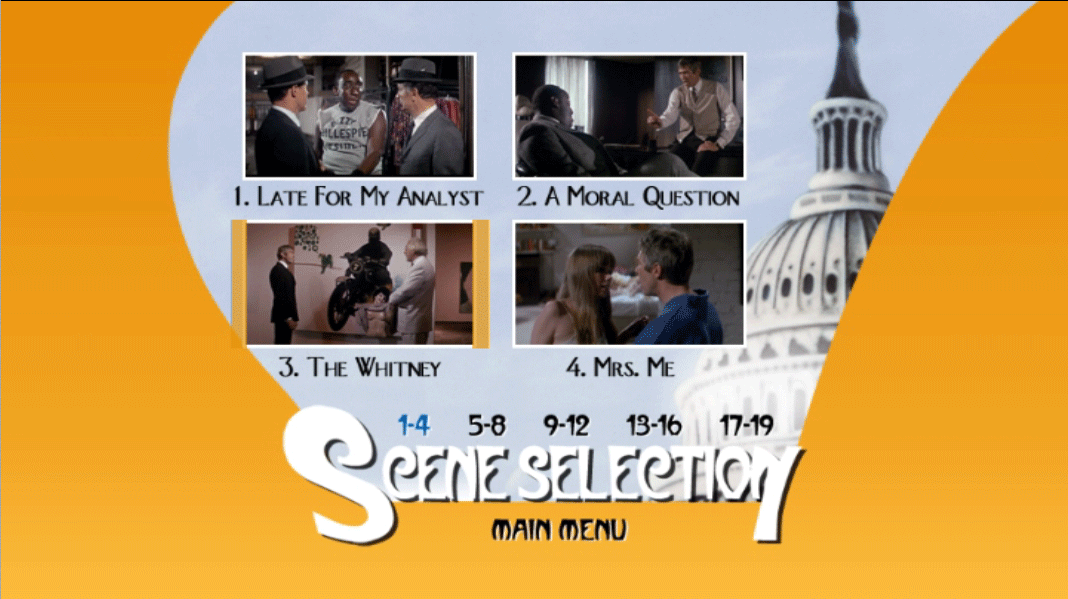

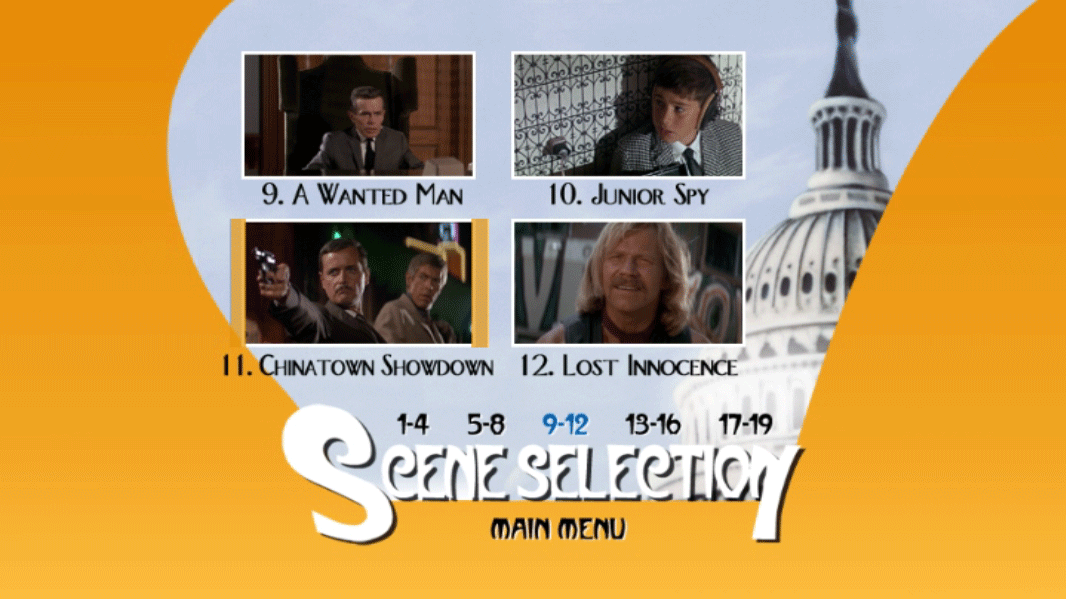


It’s not quite a perfect match, I don’t think, but it’s very close. Nice to see my distant relative Dwayne F. Schneider there in that final chapter. Oh, here’s that silly couch lettering:

And here’s a random still from the movie with Coburn jamming on some kind of gong:

Incidentally: what did The New Yorker make of the movie, anyway? Brendan Gill reviewed it in the January 6, 1968, issue. He didn’t like it either:
“The President’s Analyst” … has a fine idea for a comedy, which it wantonly tosses away…. From the moment the analyst turns up in a fright wig at a folk-rock party, the movie loses control of itself and pitches headlong into greater and greater exaggeration.
Exactly.
—Martin Schneider
Today Votes the Mitten: Will It Be Romney?
The “mitten” is, of course, Michigan, and today the Republicans there are participating in a primary election. In a welcome change of pace from the past couple of weeks, the media is not treating the contest as the most pivotal event ever to occur in western civilization.
Today the focus is on Mitt Romney, because he hasn’t won a big contest yet (he did win the Wyoming caucus, which hardly anyone noticed) and because his father George was governor of the state for much of the 1960s. It’s illuminating to read up on the New Yorker coverage of George Romney’s infamous 1967 slip that he had been “brainwashed” during a trip to Vietnam two years earlier, which sure did a number on his chances at a presidential bid the next year. Check out the last line of William Whitworth’s Comment from the September 23, 1967, issue:
It seems to us that, in their fascination with Governor Romney’s Vietnam ordeal, the newspapers have ignored something at least equally significant in this episode—that the debate over the war has reached a point at which a prominent moderate Republican seeking his party’s Presidential nomination has publicly declared that the United States should never have entered the war.
Doesn’t that sound like the kind of thing you would read today? Of course, thus far, Mitt has chosen not to emulate dear old dad; his position, as expressed in an April 2007 speech, is that “walking away from Iraq, or dividing it in parts and then walking away would present grave risks to America.”
As it happens, the very same issue has a Letter from Washington by Richard Rovere that also mentions Romney’s catastrophic utterance. It’s interesting to see Rovere grappling with a highly unpopular president and war—within six months, the country would see LBJ withdraw his reelection candidacy, and American forces taken by surprise in the Tet offensive. I don’t draw Iraq/Vietnam comparisons lightly, but the whole thing seems mighty familiar.
On another political topic, the polling debacle in New Hampshire a week ago got me thinking about that profession a bit. It must be bizarre for a politician to have some consultant come in and say, “White males hate your guts” or whatever. I fully expect to get a letter someday informing me that I really need to shore up my numbers among Hispanic professionals over 35.
The man who started it all is George Gallup, and The New Yorker‘s Russell Maloney, who seems to have been a real mainstay at the magazine back in the day—I’ve been running into his name a lot lately—did a bang-up Profile on him in 1940. It’s called “Black Beans and White Beans.” We learn that Gallup was apparently given to quoting Talleyrand to the effect that “the only thing wiser than anybody is everybody.” Paging James Surowiecki!
—Martin Schneider
If The New Yorker Isn’t Published on Paper, Put Me on an Ice Floe
There’s a video interview with David Remnick at BigThink.com; Women’s Wear Daily did a wrapup. In the interview, Remnick talks about (among other things) an intriguing lunch conversation he had with Roger Angell, and the future of print:
Remnick also spoke at length about the survival of newspapers. “I think newspapers are going to be with us in one form or another. They may just be completely on a screen. And if they’re not, I’m conservative enough to think that’s a gigantic tragedy….And all that said, I couldn’t care less if it’s no longer on paper. I mean, I have an atavistic affection for that, but even I at 49 see this as semiludicrous.”
But he contrasted his own predicament with that of newspaper editors, speculating: “The best technology so far for reading a 14,000-word piece might be that thing you roll up, shove into your bag and take with you on the train that you can’t with the Web. I don’t see many people reading long New Yorker pieces on a PDA in the subway, or on commuter trains or airplanes.” He added, “Now if you told me in 50 years The New Yorker won’t be on paper, I wouldn’t be shocked. I’d be sad, maybe. I don’t think that’s [going to be] the case but, again, prediction is the lowest form of human endeavor.”
By then I’ll be pretty old, anyway…oog. Say it ain’t so! Maybe that flexi-digital paper everyone’s trying to perfect—I guess I could live with that. Where are my smelling salts?
Speaking of newspapers and doom, from a story about the just-folded Cincinnati Post:
Greg Paeth, a talented and versatile reporter who’s worked a number of beats at both Posts since 1974, will turn 60 in August. What are his plans?
“My smart-ass answer is that I’m going to be devoting myself full-time to the New Yorker cartoon caption contest,” he said. “The real answer is I’m going to be job hunting. I don’t want to retire. I really want to do something. It’s a strange thing. On Tuesday or Wednesday (after the paper closes) you’re tempted to think of the stories you’re going to be working on, and all of a sudden you realize you’re not going to be doing that.”
Don’t lose heart, Greg! Start a blog about something you love, but make sure you sell ads from the get-go! Finally, in the L.A. City Beat, Chris Morris writes of Jonathan Gould, author of the October book Can’t Buy Me Love: The Beatles, Britain, and America (Harmony):
It has been left to Gould, a first-time author using secondary sources exclusively, to pen the most brainy and insightful Beatles history to date. The author, a trained drummer, has made the book his life’s work: Its first editor, The New Yorker’s William Shawn, died 15 years ago. His labor and sheer chutzpah have paid off in monumental fashion.
Which makes me think of that John Colapinto piece about Paul McCartney, “When I’m Sixty-Four.” Not yet online, but someday it will be. Before I’m sixty-four, I trust, and well before magazines aren’t printed on paper. Right? Yikes!
New Year’s New Yorker Short Story Resolution: Installment II
More dispatches from my short story resolution:
Kay Boyle, “Kroy Wen,†July 25, 1931
Plot: Movie mogul harrasses poor Italians on a cruise.
Noah Webster alert: “repine” means both to complain and to pine.
George Milburn, “The Apostate,†June 4, 1932
Plot: Rotarian learns there’s more to life than the club.
Just wait forty years: “longhairs”
Excellent term of endearment: “you mangy old son of a hoss thief”
Excellent term of abuse: “sourbelly”
Jerome Weidman, “Chutzbah,” February 29, 1936
Plot: Charming boy from the old neighborhood is a bit of a shyster.
Inscrutable reference: Anyone know what “Leevio” means?
Good question: Is this story anti-Semitic?
J.F. Powers, “Death of a Favourite,†July 1, 1950
Plot: Parish priests in Minnesota perform an exorcism on a very unlikely subject.
Worthy of note: Title is likely a Thomas Gray reference.
Hot quotation: “Then they were gone, and after a bit, when they did not return, I supposed they were out killing poultry on the open road.”
Daniel Fuchs, “The Golden West,†July 10, 1954
Plot: Hollywood people suffer during a garden party.
Censorious Shawn alert: “whatsis” used to denote female posterior.
Hot quotation: “Mrs. Ashton was an intensely serious person, and as she lunged and flung herself about, she clearly had no idea of the violent effect the game was having on her bosom.”
A crank would say: The Osterman Weekend without the machine guns. Or possibly L’Avventura on Benzedrine.
Best story: “Death of a Favouriteâ€
—Martin Schneider
Previously: Installment I
New Yorker Folks Among Nominees for National Book Critics Circle Awards
My former boss Laurie Muchnick has a detailed report on this year’s nominees for Bloomberg. Here’s the quick list of nominees from the end of her piece, with some boldface emphasis from me, and here’s the official site of the NBCC (of which I am a voting member):
Autobiography: Joshua Clark, “Heart Like Water: Surviving Katrina and Life in Its Disaster Zone” (Free Press); Edwidge Danticat, “Brother, I’m Dying” (Knopf); Joyce Carol Oates, “The Journal of Joyce Carol Oates, 1973-1982” (Ecco); Sara Paretsky, “Writing in an Age of Silence” (Verso); Anna Politkovskaya, “A Russian Diary: A Journalist’s Final Account of Life, Corruption and Death in Putin’s Russia” (Random House).
Nonfiction: Philip F. Gura, “American Transcendentalism: A History” (Farrar, Straus and Giroux); Daniel Walker Howe, “What Hath God Wrought: The Transformation of America 1815-1848” (Oxford University Press); Harriet A. Washington, “Medical Apartheid: The Dark History of Medical Experimentation on Black Americans from Colonial Times to the Present” (Doubleday); Tim Weiner, “Legacy of Ashes: The History of the CIA” (Doubleday); Alan Weisman, “The World Without Us” (Thomas Dunne Book/St. Martin’s Press).
Fiction: Vikram Chandra, “Sacred Games” (HarperCollins); Junot Diaz, “The Brief Wondrous Life of Oscar Wao” (Riverhead); Hisham Matar, “In the Country of Men” (Dial); Joyce Carol Oates, “The Gravedigger’s Daughter” (HarperCollins); Marianne Wiggins, “The Shadow Catcher” (Simon & Schuster).
Biography: Tim Jeal, “Stanley: The Impossible Life of Africa’s Greatest Explorer” (Yale University Press); Hermione Lee, “Edith Wharton” (Knopf); Arnold Rampersad, “Ralph Ellison” (Knopf); John Richardson, “A Life of Picasso: The Triumphant Years, 1917-1932” (Knopf); Claire Tomalin, “Thomas Hardy” (Penguin Press).
Poetry: Mary Jo Bang, “Elegy” (Graywolf); Matthea Harvey, “Modern Life” (Graywolf); Michael O’Brien, “Sleeping and Waking” (Flood); Tom Pickard, “ Ballad of Jamie Allan” (Flood); Tadeusz Rozewicz, “New Poems” (Archipelago).
Criticism: Joan Acocella, “Twenty-Eight Artists and Two Saints” (Pantheon); Julia Alvarez, “Once Upon a Quinceanera” (Viking); Susan Faludi, “The Terror Dream: Fear and Fantasy in Post-9/11 America” (Metropolitan); Ben Ratliff, “Coltrane: The Story of a Sound” (Farrar, Straus and Giroux); Alex Ross, “The Rest Is Noise: Listening to the Twentieth Century” (Farrar, Straus and Giroux).
My boldfacing here is on the quick, arbitrary side; of course, others on this list have published pieces, poems, or stories in The New Yorker over the years.
But Where’s “Missing a Piece of Your Pattern?”?
Because that’s my favorite New Yorker ad of all time. This ad-themed roundup on the L magazine blog (which I enjoy, and which should come up with a pithy new name that’s not so much like Blog About Town) is very entertaining, but it doesn’t take into account the very ungeriatric ads that have been popping up on the side margins in recent years. The Bubble Lounge, authors’ websites, CD warehouses, the Criterion Collection, TheaterMania, and what I think is a brand-new ad, one for the Scratch Lounge, a cat-scratch … lounge … that has an insanely (and I mean that in every possible way) cute cartoon—somewhat in the B. Kliban tradition—on it. Um, and I might buy one, actually.
Completely unrelated: I found these old letters to the editor of National Review (that’s the one and only William F. Buckley) pretty funny. It could just be lack of sleep, but I think you’ll agree.
Finally, here’s Ron “Galleycat” Hogan’s writeup of a recent event with Dave Eggers and Chimamanda Ngozi Adichie at the 92nd St. Y. I think I’m going to read What Is the What. I have some friends who’ve been harassing me about it for months and it’s got to stop. Besides, when all is said and done, I approve of Eggers. That sounds awfully prim, doesn’t it? Still, I approve of Eggers, and I approved this message.
How Much Do They Pay Her If Obama Wins?
In this political season, we note with interest that former New Yorker editor and recent Princess Diana memoirist has signed a deal with Doubleday to write a book about the Clintons. Her last book was called The Diana Chronicles; this one is tentatively titled The Clinton Chronicles. Judging from the title, we may have another Sue Grafton on our hands! (I’d certainly pay to read her Rick James Chronicles or Chuck Norris Chronicles.)
It’ll be interesting to see how this plays out. On the one hand, Brown was uniquely qualified to write a book about Diana, and she really came through on all levels. One doesn’t know if she has the same access to the Clinton story or even to what extent she is a political animal. However, The Diana Chronicles did prove that she has considerable talent in entertainingly synthesizing huge amounts of information on heavily covered (I almost wrote “chronicled”) subjects. And, as I noted in June, she’s already been giving Hillary Clinton a bit of thought.
—Martin Schneider