
Martin Schneider writes:
I love this picture:
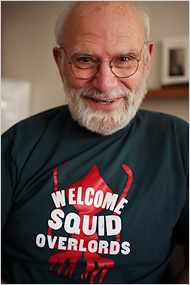
(Photo by Chester Higgins Jr., from “In Praise of Early Adapters,” The New York Times, March 9, 2008.)
Monthly Archives: March 2008
Tilley on the MTA, Thurber’s “Wood Duck,” and Picks of the Issues
Here’s an elegant appreciation of the subway-map-themed entry in the recent Eustace Tilley retooling challenge. Benjamin Kabak writes: “Drawn by flickr user panutfla [Alberto Forero], the Tilley subway map evokes New York and the subways in all its glory. It is the quintessential image for The New Yorker, and while he magazine didn’t honor the underground veins of the city by placing this image on the cover, it is by far one of the most New York-centric images from The New Yorker I’ve seen in a long time.”
There’s no other way to say this—just obey me, please: Listen to Jonathan Lethem reading James Thurber’s short story “The Wood Duck.”
Also, were you wondering where my Pick of the Issue column went? Well, thanks! Me too! It’ll be back soon, with several weeks of picks, since there are several weeks of New Yorkers on your kitchen table, anyway. Don’t worry, I’m not teasing you. I have a number of issues of various magazines in my apartment, and I’ll get to them eventually. Happy weekend!
Katha Pollitt and Ben Yagoda Tell It Like It Is
In the Washington Post, Katha Pollitt handily dismantles Charlotte Allen’s recent piece about dumb broads, “We Scream, We Swoon. How Dumb Can We Get?” And the editorial philosophy behind it, too.
And Ben Yagoda, who’s written books about (among other things) both New Yorker history and wily parts of speech and is therefore permanently OK in my book, asks in Slate, “But is it such a terrible thing that so many lying memoirists have been exposed? On the contrary: It’s evidence that the system works.” And he continues (internal link is mine): “In the wake of the Frey and now the Jones scandals, there’s been hand-wringing about the need for fact-checking—or lie-detector tests or something!—at publishing houses. But you’re never going to stop people from making stuff up.”
George Packer Successfully Attains Hyphenate-dom
Martin Schneider writes:
It’s difficult to contemplate George Packer’s first play, Betrayed, without using the word authenticity, which aspect does not exhaust its virtues. I went into the performance imagining that it might be something of a chore, but it was far from that. Derived from Packer’s lengthy article of the same name, which ran in the March 26, 2007, issue of The New Yorker, the play is about two Iraqis whose well-nigh bottomless idealism towards the occupying/liberating Americans is put to the test.
Americophiles from way back, Laith, a Shiite, and Adnan, a Sunni, start working as translators in the Green Zone only to find themselves in a remorseless no man’s land, blithely treated as potential suicide bombers by their well-meaning but ultimately apathetic employers and reviled as traitors by their neighbors outside the Green Zone.
Chief among the charms of the evening, play and production alike, is the nuanced portrait of the duo at its heart. Likeable and fundamentally apolitical, Laith and Adnan gamely put up with a welter of indignities from the Americans, most of whom (with one notable exception) are content to do their jobs and not entertain the consequences of the fear-driven system in which they are operating.
The betrayal of the title recalls the myopia we showed in letting Hungary twist in the wind in 1956—not to mention the empty promises of 1991 so vividly portrayed in David O. Russell’s Three Kings, a movie with a somewhat similar agenda to Betrayed. Packer is, of course, first and foremost a reporter, and he lends the material a depth of observational detail that no ordinary playwright can match.
In recent times we have seen Tim Robbins’ play Embedded, Brian DePalma’s movie Redacted, Robert Baer’s movie Uncovered … it’s easy to get mixed up. I hope the conflation of title confusion and outrage fatigue prevents no engaged theater devotee from seeing Betrayed. It runs until April 13, so there’s plenty of time, and tickets are as low as $25 in a small room in which even the last row is a decent seat.
We Endorse Adrian Tomine’s “Anachronistic, Nostalgic Personality”
Here’s a piece, in the Washington Post paper Express, that will have you liking Tomine all the more.
And Speaking of Fake Memoirs…
Buddy Holly’s widow is crying, waiting, hoping, and litigating that a new memoir by Peggy Sue (the very one), which Maria Elena Holly says is full of falsehoods, will fade away, and fast.
Fact-Checkers Are Always in Vogue
At least whenever there’s a new fake-memoir scandal or a general railing against “irresponsible bloggers,” which becomes a meaningless phrase as soon as veteran journalists and, ah, newsmen start blogging up a storm.
At other times, fact-checkers are often forgotten, underpaid, and/or belittled as comical Bartlebys, toiling by lamplight with poor eyesight and minimal glitz and celebrating minute victories like the ones chronicled in “Are You Completely Bald?,” a brilliant old New Republic story about the art and agony of fact-checking that’s a lot harder to find than you’d think (and I’ve tried!). Fact-checkers are fussy ghosts, invoked respectfully in their absence and mildly teased for their pedantic obsessions just out of hearing range.*
Except at a few good magazines, primarily The New Yorker, where fact-checking is considered such a vital necessity that only the most well-rounded and world-savvy applicants are interviewed (and I mean interviewed). There’s a reason the checkers there are routinely cited by those outraged about the crimes of too-inventive writers. All fact-checkers grumble, in my experience, but there’s less cause for it when they have steady jobs, salaries, benefits, lore (confess, who would you rather be in Bright Lights, Big City—Nameless Narrator as he wakes up cold and lonely on the friendless street after too much coke, or NN in the library amid the reference volumes, making courageous international phone calls, and paging through, say, Ian Frazier’s notes to verify an intricate New Yorker profile?) and the faith of the majority of the writers whose stories they verify and strengthen.
Speaking of which, Slate’s Daniel Engber has assembled a funny collection of revelations about other well-known autobiographies, past, present, and future. Also on Slate, newyorker.com editor Blake Eskin’s reflection on fake memoirist Misha Defonseca, who was not brought up by wolves as she escaped the Holocaust, is worth reading. If you want a rigorously researched and compelling book, read Eskin’s memoir/exposé A Life in Pieces, whose accounts and investigations are all the more electrifying and poignant for being absolutely true.
While we’re telling panicky book publishers how to conduct their increasingly imperiled business (although the news that people like reading books on paper is somewhat comforting), could we add a politely voiced plea for the return of the publishing-house copy editor? Forget about made-up facts for a moment—I just want most of the words to be spelled right.
*By the way, as a former fact-checker myself, I can assure you that many of them are in fact adorable, attractive, and socially ept.
Academia and The New Yorker: The Next Wave
Levi Fox, Gretchen Sund, and Caroline Altman, three enterprising undergraduates from the American Studies Program at the University of Virginia, have put up a stimulating suite investigating the unique status of The New Yorker as a “local” magazine with a decidedly “national” profile.
According to the editor’s introduction, the suite “examines the people who defined New Yorker humor in its early days and drove the magazine’s success” and takes a look at its formerly “elitist advertising policy.” They look at some of the analogues of The New Yorker, both at home (Vanity Fair, Saturday Evening Post, Collier’s) and abroad (Germany’s Simplicissimus, London’s Punch) . They also take a peek at a few memorable wartime covers.
Good work! I hope that all three of them become passionate Emdashes readers—if they aren’t already!
Note: Thanks for The Millions for including a link to this in his most recent “Curiosities” post. Emily kindly reminds me that it’s been sitting in the Rossosphere for ages! I thought it looked familiar.
Tonight! See Gahan Wilson, David Remnick, Hugh Hefner, Stephen Colbert, Francoise Mouly, Stan Lee, Roz Chast, and More All in One Place…
…at the IFC Center in New York at 323 Sixth Avenue at 8 p.m., in the new documentary Gahan Wilson: Born Dead, Still Weird, directed by Steven-Charles Jaffe.
If you love Wilson’s cartoons, covers, and comics for The New Yorker, Playboy, and countless other publications over the decades; or if you’ve always wondered how the cartoons get chosen for The New Yorker; or want to see Stephen Colbert at his most startlingly and movingly sincere, or dig custom skateboard decks, cats, ghosts, monsters, headless fish, or the Sag Harbor jitney; or love hearing celebrity comics gods talking about art, you must attend this screening. (Here’s still more temptation, from John Donohue on the Goings On blog.)
And here’s a serious treat—afterward there’s a Q & A with both Wilson and Jaffe. It’s $15 and, I assure you, very much worth it. Buy tickets here or call the box office at 212-924-7771. See you there!
Two New Staffers at The New Yorker: Kelefa Sanneh and Ariel Levy
The Observer has the story.