
Monthly Archives: September 2008

Read More Fiction: Tastes Great, and it’s Good for You!

It’s back-to-school time, so it seemed appropriate to link to an 81-book syllabus Donald Barthelme used to give out to his students. (It appears in the margins of a nice 2003 essay by Keith Moffett in The Believer about his experience of tackling the list.)
If that’s too much for you, then I recommend you read Barthelme’s hilarious and thought-provoking story “The School,” which appeared in the June 17, 1974, issue of The New Yorker. In the story, a grade school class keeps adopting living things that then die. Yet there’s enough uplift in the improbable, left-field ending to carry you through the rest of the school year. (Don’t cheat and read the capsule summary on TNY‘s website—it’s a spoiler.)
The story typifies what I love about Barthelme: his ability to explore serious topics with larky wit and surreal turns. Though I find him sometimes obscure, I vastly prefer his lightheartedness and unpredictability to the emotionally detached and/or humorless narrators who appear in contemporary TNY fiction with such regularity these days.
But evidently, reading TNY‘s fiction section is better for you than reading the nonfiction, at least when it comes to your social reasoning skills. Need proof? I quote from Liam Durcan’s Toronto Globe and Mail article from July, which I found courtesy of Jonathan Shipley’s blog, A Writer’s Desk:

In a recent study conducted by University of Toronto psychologists, subjects who read a short story in The New Yorker had higher scores on social reasoning tests than those who had read an essay from the same magazine. The researchers concluded that there was something in the experience of reading fiction that made the subjects more empathetic (or at least take a test more empathetically). The study provided some proof for what has often been intuitively argued: Fiction is, in some very important ways, good for us.

To read the rest of Durcan’s article, go here, but be prepared to fork over $4.95. If that’s too rich for your blood, there’s more detail here.
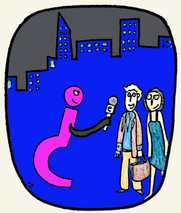
Upside-Down Question-Mark Contest: Now, You Choose the Winner!

Poll-Drawing-2.png
Update: The winners!
The ghost of James Murray, patron saint of the OED, hovers over us tremulously as we offer you our poll of finalists from Emdashes’ very own Upside-Down Question Mark Contest. Meanwhile, Pablo Neruda, who refused to use this form of punctuation, throws up his hands in a corner of that celestial Scribbler’s Green where all writers go–a place that all deceased literary critics are barred from entering. ¿Will this stop us? We say, respectfully but firmly: ¡no!
We offer you these names, hand-picked from an Emdashes orchard of more than 60 great entries, so thank you to all who submitted! The winner of this poll will win our grand prize, which, as you know, is either dinner for two at the Spanish, Mexican, Ecuadorian, Dominican, &c., restaurant of your choice, or, if you prefer, a beautiful copy of Neruda’s immortal The Book of Questions.
1. the qué mark–submitted by Liesl (our own Martin Schneider submitted a variation on this entry, but since he’s an editor and judge, he’s disqualified from prizewinning; sorry, Martin!)
2. splainu–submitted by John
3. quiggle–submitted by Carolita
4. interroverti–submitted by Nadine & Chris LaRoche
5. ¿nu?–submitted by Paul Shaw
6. Prask and Pre-Q–both submitted by J.D.
7. Askin–submitted by N.F.
We also want to offer you some etymological background and information on some of these entries. Note that ¿nu? reads the same right side up or upside down. (Turn over your computer–see?) “Splainu” derives from I Love Lucy, specifically from Ricky Ricardo’s “Lu-seee, you haf some splainu to do!” The venerable interroverti is derived from the Latin components “interrogo” and “verti/verto/versum,” meaning “to turn over,” “to turn about,” &c.
And here are the final eight–may the best mark-marker win, and watch out for those hanging ¿chads?

What should we name the upside-down question mark?
the qué mark
splainu
quiggle
interroverti
¿nu?
pre-Q
Prask
askin
  
pollcode.com free polls

New Yorker Announces Festival Schedule; Buy Tickets Friday!

The headline says it all; a full list of New Yorker Festival events, complete with times and locations, is now available at the Festival website.
I can’t improve on the wording they provide:
Tickets for The New Yorker Festival will go on sale at 12 noon E.T. on Friday, September 12th. For more information, click here.
We will be printing a version of the schedule ASAP.

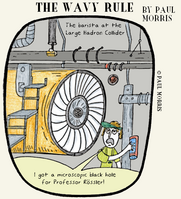
The Wavy Rule, a Daily Comic by Paul Morris: Collider!

Here’s Paul on today’s “Wavy Rule”:
Well, they’re going to switch it on, officially unveiling the thing on October 21, 2008. If you happen to have read Dan Brown’s Angels and Demons, you already know about the Large Hadron Collider–which does in fact exist, and was first built by Mary Magdalene after she was exiled from Jerusalem after being outmaneuvered by Saints Peter and Paul in an early example of ruthless office politics. It lies near Geneva, Switzerland.
Rössler isn’t some German-sounding name I invented out of multi-particled air. He’s a real German scientist named Dr. Otto E. Rössler who has theorized that if the Large Hadron Collider creates micro-black holes–which is a scary possibility–they could destroy the Earth by the next time the Olympics come around. Sorry, London. Sorry, Earth.
wavyrule_bypaulmorris_collider.png
More by Paul Morris: “The Wavy Rule” archive; “Arnjuice,” a wistful, funny webcomic; a smorgasbord at Flickr; and beautifully off-kilter cartoon collections for sale (and free download) at Lulu. wavyrule_bypaulmorris_collider.png

Dick Cavett: The Intellectual’s TV Sensation of Yore

Recently I’ve been watching some old episodes of The Dick Cavett Show on DVD. (By the bye, if you get the chance, do absolutely see the one with Orson Welles.)
For some reason, watching it made me think quite strongly of The New Yorker—what struck me was that The New Yorker never had as close a correlative on television as Dick Cavett. Cavett was The New Yorker in television form, if you will. (Anyone have any other candidates?)
It seemed to me that Cavett was a celebrity too close to the actual TNY demographic to ignore for long, and sure enough, he was the subject of a Profile by L. E. Sissman in the May 6, 1972 issue.
I don’t have much to say about the article, which amply met my expectations. Reading about the (let’s face it) somewhat dilettantish Nebraska native and Yale grad who was never any great success as an actor or comedian—well, he makes one of the more improbable television sensations. And yet he was talented, and his notoriety was entirely deserved. I suppose that most talk show hosts are generally hybrid talents whom you can’t quite picture attaining stupendous success in any other pursuit.
The Profile does have one very striking feature: it comes with a kind of artist’s notebook by Charles Saxon, who incidentally also executed hundreds of cartoons over more than four decades. The eleven-page article features twelve pleasing sketches of some behind-the-scenes activities at the offices of The Dick Cavett Show, an unshowy way of adding value and verve to the piece. A fine idea.
Two other points: one of the staff members of the show is described as having a “a Walter Ulbricht beard,” the almost aggressive obscurity of which I (more than thirty-five years later) found hilarious. Turns out Ulbricht was a politician from East Germany with a wholly unexceptional goatee.
The other thing is that one of the guests on the workday described was … James Brown! Holy moly.

Robert Giroux, 1914-2008

Robert Giroux is gone. We met at a party maybe ten years ago; we had both been editors of the Columbia Review while at school, so we compared notes–he said something funny about it that I can’t remember, but I do remember his graceful, easy manner and palpable intelligence. Christopher Lehmann-Haupt writes in the Times, “If the flamboyant Roger Straus presented the public face of Farrar, Straus & Giroux, presiding over the business end, Mr. Giroux made his mark on the inside, as editor in chief, shaping the house’s book list and establishing himself as the gold standard of literary taste.” What a palace of thought and beautiful design that man built.

Intern Roundup: Denver-Minnesota-Wasilla Edition

Each Friday, the Emdashes summer interns bring us the news from the ultimate Rossosphere: the blogs and podcasts at newyorker.com. Here’s this week’s report.
Sarah Arkebauer
In the Fiction Podcast I chose for this week, E.L. Doctorow reads John O’Hara’s short story “Graven Image.” The story showcases both old-world glamour and prejudice and leaves the reader with plenty to ponder, and Doctorow’s discussion with Fiction Editor Deborah Treisman following the reading is particularly interesting.
In the sporadically updated The Rest is Noise, Alex Ross provides a link to his New Yorker article on the evolution of the classical concert.
Though I’ve been hearing more than enough about Sarah Palin these past few days, The Book Bench offers a snapshot of her views on book censorship. The blog also published another Bookspotting, and a wonderful piece on a new collection of teenage diary excerpts.
Goings On posted the latest information on Haley Joel Osment’s career—he’s to star in the upcoming production of David Mamet’s American Buffalo on Broadway. It will be interesting to see how he makes the transition, both from child actor to adult actor, and from film to stage. Much of the rest of the Goings On this week was devoted to material relating to the Republican Convention. There is a reprint of an interview with Chaka Khan after she performed at the 2000 Republican Convention, and a soundtrack of Alaskan music in two parts—in honor of Sarah Palin.
The Cartoon Lounge also had a bit of a convention-centered approach to its posts this week. First, Zachary Kanin posted a humorous treatise on vice-presidential responsibilities, which was soon followed by Drew Dernavich’s equally funny take on vice-presidential relationships. The blog also published the tenth and eleventh installments of the Sandwich Duel. Although this duel has been taking place nearly all summer, I am amazed at how fresh the material stays. On another note, one of my favorite features on The Cartoon Lounge is the Q&A series they post with different cartoonists, and this week’s interview with Perez Hilton does not disappoint.
Adam Shoemaker
George Packer went to Denver last week, and writes about the experience in Interesting Times. He sees Barack Obama’s speech as tremendously successful, but also Reaganesque in its invocation of optimism and hope. Packer’s observation that “the parties have traded places” is not a cynical one—rather, he marvels at the ability of a truly great politician, now as then, to draw enormous crowds of ordinary people to a political event.
Hendrik Hertzberg also enjoyed the speech—and over at his blog
“Notes on Politics, Mostly,” he calls it the best acceptance speech he’s ever heard. Much of his post is a reminiscence about other great speeches from the past and the constraints placed on a nominee’s acceptance that keep most of those speeches from rising to the airy heights. He also notes the “distinct lack of ugliness in the criticisms of McCain and the Republicans” at the convention. I can’t wait to read his comments on Palin’s speech night in Minneapolis. [Boy howdy, yes! —Ed.]
This week Sasha Frere-Jones posted a concert video of “Those Darlins,” a Tennessee band with a song whose riff he can’t get out of his head—”a script for any successful Labor Day weekend.” This line got me thinking about the sad dearth of non-Christmas holiday songs–but perhaps Labor Day is just as much about those songs we don’t have to sing.
At the New Yorker Out Loud, Matt Dellinger interviews Steve Coll, who wrote an article on General David Petraeus for this week’s issue of The New Yorker. Coll discusses the strategy behind Petraeus’s surge and how difficult it has been to keep military strategy and political partisanship separate. The general wants nothing to do with the latter, as he made clear to journalists inquiring into a possible vice-presidential tap by McCain. Coll also talks about Petraeus’s next step: taking command of forces in Afghanistan and Pakistan.
Over at the Borowitz Report, Andy Borowitz gives us Levi Johnston’s Convention Diary. While Bristol Palin’s betrothed might lack the journalistic credentials of George Packer and Hendrik Hertzberg, his belligerent “coverage” does help give us some insight as to why John McCain’s relationship with the media has been so strained of late.
Previous intern roundups: the August 29 report; the August 22 report; the August 15 report; the August 8 report; the August 1 report; the July 25 report; the July 18 report; the July 11 report.

The Wavy Rule, a Daily Comic By Paul Morris: Trains, Cranes, and Koons-o-mobiles

In today’s “Wavy Rule,” Paul makes art about art about art. He writes:
Last year, the Los Angeles County Museum of Art began feasibility studies to build what is proposed to be a 161-foot-tall piece by Jeff Koons. It will be a train engine suspended from a crane. You can read all about it here; The New Yorker‘s Peter Schjeldahl reviewed Koons’ latest retrospective back in June, and Calvin Tomkins profiled him in 2007. (There was even a slide show to go with it.) Koons’ suspended locomotive is projected to be constructed by 2010-2011.
Is the sculpture a statement on Los Angeles’ lack of mass transit, as some bloggers have suggested? Is the sculpture some kind of giant sexual metaphor? Will this be a new L.A. landmark? Is this art?
I thank my friend Charlie for sending me the initial article on this project. Click to enlarge!
wavyrule_bypaulmorris_jeffkoons.png
More by Paul Morris: “The Wavy Rule” archive; “Arnjuice,” a wistful, funny webcomic; a smorgasbord at Flickr; and beautifully off-kilter cartoon collections for sale (and free download) at Lulu.