
_Martin Schneider writes:_
Take Paul Slansky’s 2008 “Campaign Quiz”:http://www.newyorker.com/humor/polls/slansky2008campaignquiz/01013sh_shouts_slansky, the “Shouts and Murmurs” from the new issue. You can submit your answers online and see how you did. (I got 17 out of 29 right. Surely someone can beat that!)
Monthly Archives: October 2008
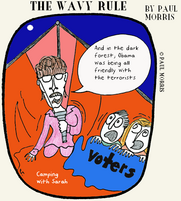
The Wavy Rule, a Daily Comic by Paul Morris: Campfire Campaign
_Yes, here comes the ugly season. Palin and McCain are invoking Rev. Jeremiah Wright and William Ayers (and Obama parries in kind with intimations of Charles Keating). Don’t you feel edified? Either way, click to enlarge!_
More by Paul Morris: “The Wavy Rule” archive; “Arnjuice,” a wistful, funny webcomic; a smorgasbord at Flickr; and beautifully off-kilter cartoon collections for sale (and free download) at Lulu.
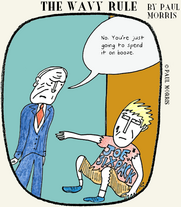
The Wavy Rule, a Daily Comic by Paul Morris: McCain and his Pseudopopulist Message
“As reported by _The Washington Post_”:http://blog.washingtonpost.com/the-trail/2008/06/12/mccains_tax_plan_aids_wealthy.html, “a detailed analysis of the candidates’ tax plans confirms one of Barack Obama’s top arguments against John McCain: the Arizona senator’s proposals would offer substantial benefits to wealthy Americans.” Click on the cartoon to enlarge (not yourself, obviously -the cartoon!)!
New Yorker Festival: Ryan Lizza, Hendrik Hertzberg, George Packer, Dorothy Wickenden
On Saturday afternoon the primary participants of _The New Yorker_’s delightful and “addictive”:http://emdashes.com/2008/09/i-think-i-need-the-campaign-tr.php “Campaign Trail” “podcast”:http://www.newyorker.com/online/podcasts/campaigntrail collected for a live version of same, sort of like when Monty Python did _The Secret Policeman’s Other Ball._ Ably guided by moderator Dorothy Wickenden, Ryan Lizza, Hendrik Hertzberg, and George Packer engaged in a spirited and relatively unepigrammatic discussion about the state of the 2008 campaign.
The most startling line of the session may have been Hertzberg’s image of McCain being reduced to “seeds and stems.” Later on, Lizza compared Palin’s impact on the McCain campaign to a fire on the deck of a ship that already had a large hole in the hull. With her adequate debate performance on Thursday, the fire has finally been put out, but the hole has yet to be addressed and will probably do the campaign in. Observing that Palin supplied the appearance of coherence without actually being coherent, Hertzberg and Lizza collaborated to come up with the Colbertian term _coherentishness_ to describe her performance.
Noting that the Democratic coalition this year will likely consist of the educated class, minorities, and young voters, Packer noted that some have begun to call Obama “George McGovern’s Revenge.” Packer fretted about the Democrats’ problems securing white working-class voters, while Hertzberg pointed out that unions still play a big role in the Democratic Party.
I have mixed feelings about all of this: white working-class voters play a talismanic role in American politics quite apart from their actual electoral importance, which has been decreasing over the years. In principle, if Dems can build a larger coalition without them, they should do so. And yet, and yet.
Packer did point out that it was union canvassers, not Obama campaign staffers, who were bringing the realities of McCain’s health care plan to voters. Unions still are that rare group with the ability to supply political education to a wide swath of society and the incentives to do it well.
On Obama’s famous equanimity, Lizza told an enlightening story that reassured beat reporters, hungry for stories of blowups or breakdowns, that the candidate was human after all. In Denver, when Obama was rehearsing his big convention speech, when he reached the section in which he invoked Dr. Martin Luther King, he choked up, stopped the speech, and had to leave the room.
Noting that about 80% of new registered voters who pick a party are Democrats, Lizza said mildly, “George Bush has not made the Republican Party cool for young people”—then, noticing the understatement, added, “This is the killing fields.”
Packer made a great point about Palin’s somewhat maddening speaking style (and I don’t mean all the _you betchas_). I had noticed that she favors passive constructions, but Packer zeroed in on something more fundamental: “The key is her syntax. There are no verbs in it. There are gerunds, there are participles, but no verbs. Identity politics is nouns—hockey moms.”
Lizza perceptively noted that “Sarah Palin is a phenomenon of a party in decline, a phenomenon of decadence.” Asked by an audience questioner how big a disappointment “liberals like me” are in for, Lizza joked, “Massive,” and Packer followed up with the nub: “The question is, is he FDR or Bill Clinton?” Indeed.

George Packer, Ryan Lizza, Hendrik Hertzberg, Dorothy Wickenden

Ryan Lizza, Hendrik Hertzberg
(photo credit: Debra Rothenberg/startraksphoto.com)
New Yorker Festival: Manil Suri, Yiyun Li, Sana Krasikov
Jonathan Taylor, who has written about Merrill Lynch, New York City’s greenmarkets, and skybridges for us, writes:
Friday’s “Writing About Home” fiction panel, with foreign-born, U.S.-based writers Manil Suri, Yiyun Li, and Sana Krasikov, was low-key and revelatory. I’ve been reading a lot of fine travel writing lately, and the topic appealed to me as a reversal of that activity: going somewhere else and writing about where you came from. Perhaps more important, it’s a reversal of the choices made: rather than going abroad for the purpose of writing, each of these writers were forced or decided to come to the United States for other reasons, and each in their way later turned, as adults here, to fiction writing. (Suri took writing up initially as a hobby; he is a mathematician, and his description of his writing life sounded distinctly methodical if not almost absurdly logical.)
Deputy fiction editor Cressida Leyshon’s questions gradually drew out the way each writer’s work, even though inevitably focused on this or that specific set of stories, skilfully engages the social “ripples” of historic cataclysms.
Suri’s The Death of Vishnu created a microcosm of Indian society within one apartment building. Li views China through what she described as the “villager-like” mentality Beijing’s residents still possess, in which “politics is like the weather.” And Krasikov noted her admiration for fiction in which the shadows of “what’s happening beyond the story” creates tension within it, such as Kazuo Ishiguro’s Remains of the Day or Isherwood’s Berlin Stories, where “we know now” the unspoken fates of their protagonists.
These historical earthquakes cause dislocations, not just geographical ones. In Krasikov’s stories, scientists and engineers from the former Soviet Union work as nannies or home health care aides—recalling a detail of Li’s “A Man Like Him,” in which a university professor disgraced in the Cultural Revolution is forced to become a school janitor. Each writer, interestingly, told with relish a story about being mistreated on returning to their home country. Suri humorously recounted the bureaucratic antics of an Indian bank teller. Krasikov described, with more outrage, being accused of shoplifting from a Moscow Sephora—and noted the blatant discrimination in Moscow against people of more obviously Caucasus origins. And Li observed that because she had two children, something forbidden to Chinese couples, she was universally assumed to be a nanny (and hence treated rudely).
The final audience questioner summed up the writers’ situation nicely—”to be both an insider and an outside observer”—and asked of each of them whether writing about his or her home country made them feel more “intimate” with it. The answers were appealingly direct and diverse: Krasikov said no, it “exacerbates distance.” For her, the process of digging deeper into former Soviet reality—which has of course changed unrecognizably since her family left in 1987—is a process of “discovering distance.” Suri’s experience was the opposite: he had long tried to leave India behind him, but when he took up writing, India forced itself on him as his subject, bringing him “closer” to it. And Li—who in response to an earlier question had said that she could no longer live with China, in the same way that, as an adult, she could no longer live with her mother—said that writing about China had not made her more “intimate” with it—just more “patient.”
In addition to Li’s “A Man Like Him,” two of Krasikov’s stories are available on the New Yorker website.
New Yorker Festival: Gary Shteyngart, Peter Carey, Hari Kunzru
The head of the _New Yorker_ fact-checking department, Peter Canby, moderated the “Discussion Among Writers” with Hari Kunzru, Peter Carey, and Gary Shteyngart, on the subject of “Outlaws.” It was a less freewheeling session than the one in the same space “an hour earlier”:http://emdashes.com/2008/10/new-yorker-festival-klam-leona.php. Canby’s questions tended to be feature lengthy quotations from the writers’ works. And there was less crosstalk, the responses conforming more to the two-minute time limits imposed on the likes of Sarah Palin the night before.
Speaking of whom, about midway through Carey mischievously inquired what Ms. Palin would make of one of Canby’s hifalutin questions. It must be said, though, that Canby’s method worked, as all three writers supplied informative and engaging answers and Shteyngart supplied enough humor in an hour to power the next ten Festivals in the event that “angry Ted Stevens”:http://www.youtube.com/watch?v=VEXJV2P2ZIw takes the Festival over.
Indeed, I’ll succumb to a temptation to turn over the bulk of this post to his quips. Describing his homeland Russia as still in a “pre-therapeutic” phase, he plans to “airlift eight thousand Park Slope social workers” to the vast country to bring it up to speed. Musing on the domesticated status of American writers, hostage to 401(k) plans and health care fees, he contrasted his lot with that of the Lost Generation: If the Spanish Civil War reasserted itself, unlike Hemingway “I’d only go if Iberia had a good frequent flyer plan…. I’m not flying coach to a war.”
An audience question about each writer’s favorite book elicited groans from the panel–but also revealing answers (well done, questioner!). Kunzru stated that the last novel that made an impression on him was Joan Didion’s _Play It as It Lays,_ so he now wants to migrate to California and wear a dress. Carey expressed an admiration for droll and dyspeptic Austrian novelist Thomas Bernhard, and Shteyngart professed to read Vladimir Nabokov’s _Pnin_ once a month.
One thing about these panels–you do come away with a solid impression of the participants. The Friday author sessions remain the ideal way to kick off the Festival weekend.
New Yorker Festival: Matthew Klam, Elmore Leonard, and Joyce Carol Oates
A little bit to my surprise, the “Discussion Among Writers” dedicated to “The Devil Within,” featuring Elmore Leonard, Joyce Carol Oates, and Matthew Klam and moderated by Daniel Zalewski, was a light, lively, and amusing affair, quite in contrast to the stated subject. The taciturn Leonard, who would have looked entirely at home whittling a garter snake out of a twig, was flanked by the admiring Oates and Klam—yes, the admiration flowed freely on this night.
Without ever dwelling on it or even stating it explicitly, all three panelists acknowledged to the desirability of complexity as well as the enduring power of the thriller genre. All three either disavowed the reality of “evil” or described it as yet another mundane by-product of human existence. Of his famous baddies, Leonard mused that he’ll think of one he’s creating “as a kid. He’s a bully, he’s a cheater. He doesn’t get along with very many people. And then I let him grow up.”
Happiest when his readers squirm, Klam offered, by way of Shalom Auslander, that “Light and Dark are buddies, and they hang out after work.” For her part, Oates, astonished at Klam’s glowing words about her book _Do With Me What You Will,_ insisted that she is more accustomed to the critical reception of her cat, who has shown little interest in her works.
Leonard showed the same kind of word-stingy pith he does in his books, observing that he doesn’t like to know too much about his characters, “just enough to make them talk.” I don’t remember if this was before or after Klam demanded that Zalewski fess up to drop-kicking puppies.
It was a session so loose, you’d have thought alcohol had helped it along.

Matthew Klam, Elmore Leonard, Joyce Carol Oates and Daniel Zalewski
(photo credit: Alex Oliveira/startraksphoto.com)
Let Buck Henry Usher You into Democracy!
I had not noticed that _The New Yorker_ is using the Festival as a platform to perform an important civic duty. On Saturday and Sunday, a rotating slate of well-known people and _New Yorker_ luminaries will be on hand to register any eligible citizen to vote. If you are a recalcitrant politico-phobe or know one you suspect might respond to the extra inducement of meeting a famous person, it’s all at the Festival HQ at at Metropolitan Pavilion, 125 West 18th Street (between Sixth and Seventh Avenues). Here’s the schedule.
**Saturday, October 4**
10 a.m., Raúl Esparza
10:30 a.m., Judith Thurman
11 a.m., Edie Falco and Susan Sarandon
11:30 a.m., Wes Craven
12 noon, Sherman Alexie
12:30 p.m., Alex Castellanos
2:30 p.m., Alex Ross
3 p.m., Senator Chuck Hagel
3:30 p.m., Susan Orlean
4 p.m., Sasha Frere-Jones
**Sunday, October 5**
10:30 a.m., Nick Paumgarten
11 a.m., Reverend Al Sharpton
11:30 a.m., Mark Singer
12:30 p.m., Art Spiegelman
1 p.m., Larissa MacFarquhar
1:30 p.m., Michael Specter
2 p.m., Lynda Barry
2:30 p.m., Steve Brodner
3 p.m., Tad Friend
3:30 p.m., Buck Henry
4 p.m., Karen O
I confess I’m considering having the Rev. Sharpton register me even though I’m already registered. But I won’t, because it’s probably illegal.
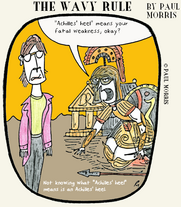
The Wavy Rule, a Daily Comic by Paul Morris: High Heeled Debate
Gwen Ifill asked Sarah Palin last night: “The conventional wisdom, Governor Palin, with you, is that your Achilles’ heel is that you lack experience… What is it really for you, Gov. Palin?” She did not answer the question with what she felt was her weakness. Instead, she gave one of her many pre-fabricated ra-ra, you-betcha responses (one of about six), while Biden actually answered the question. All throughout the debate, she gave variations on a term paper called “What America Means to Me”. What it lacked in substance and depth of knowledge, it made up for stage directions like “Smile here, wink there, etc. etc.”
A failure to answer a question regarding one’s failures or weaknesses is a failure in and of itself. It indicates either smugness or ignorance, or both. Do I feel that Biden would make a better Vice President? You’re darn tootin’!
Click on the cartoon to enlarge it!
Rename “The Cartoon Lounge,” By Tonight!
Our former intern Sarah Arkebauer writes:
The Cartoon Lounge has announced a contest in which they ask readers to rename the blog. Entries must be submitted by the end of today, October 3rd, and the result will be posted by the end of next week. More information can be found here.