Monthly Archives: October 2008

Somehow I Don’t Think Bill Kristol Will Be Joining Him

_Martin Schneider writes:_
Emdashes extends a hearty congratulations to the new Nobel Laureate in Economics, Paul Krugman! I saw Krugman speak once at the Society for Ethical Culture, at the height of the conservative attempt to privatize/kill Social Security in spring of 2005. It was a debate between Krugman and Cato Institute analyst Michael Tanner, with “Talking Points Memo”:http://www.talkingpointsmemo.com/ head honcho Joshua Micah Marshall supplying blogosphere context but in fact allying with Krugman. Krugman slayed Tanner easily, aided by Marshall’s input and Tanner’s incredibly disingenuous arguments.
Friend of Emdashes Jonathan Taylor caught a “reference”:http://economix.blogs.nytimes.com/2008/10/13/honoring-paul-krugman/ on the Edward L. Glaeser’s entry on today’s “Economix” blog on the _N.Y. Times_ website:

In his public role, Paul Krugman is often a polarizing figure, loved by millions but also intensely disliked by his political opponents. I still chuckle over an old New Yorker cartoon with one plutocrat saying to another that he gets some satisfaction from the fact that his vote will cancel out the vote of Paul Krugman.

Curiously, a search on “Krugman” in the Complete New Yorker archive does not find the hit; it’s a Charles Barsotti cartoon from the March 22, 2004, issue. You can view/purchase it “here”:http://www.cartoonbank.com/product_details.asp?sid=70283.
It’s about time he wrote something for _The New Yorker_!

Irving Berlin Weighs in on the Financial Crisis

Emily copies and pastes:
**When I Leave the World Behind**
I know a millionaire
Who’s burdened down with care
A load is on his mind
He’s thinking of the day
When he must pass away
And leave his wealth behind
I haven’t any gold
To leave when I grow old
Somehow it passed me by
I’m very poor but still
I’ll leave a precious will
When I must say good-bye
I’ll leave the sunshine to the flowers
I’ll leave the springtime to the trees
And to the old folks, I’ll leave the mem’ries
Of a baby upon their knees
I’ll leave the night time to the dreamers
I’ll leave the songbirds to the blind
I’ll leave the moon above
To those in love
When I leave the world behind
To every wrinkled face
I’ll leave a fireplace
To paint their fav’rite scene
Within the golden rays
Scenes of their childhood days
When they were sweet sixteen
I’ll leave them each a song
To sing the whole day long
As toward the end they plod
To ev’ry broken heart
With sorrow torn apart
I’ll leave the love of God
I’ll leave the sunshine to the flowers
I’ll leave the springtime to the trees
And to the old folks, I’ll leave the mem’ries
Of a baby upon their knees
I’ll leave the night time to the dreamers
I’ll leave the songbirds to the blind
I’ll leave the moon above
To those in love
When I leave the world behind
—Irving Berlin, 1915
(Treat: Hear the Singing Miamians do it in four-part barbershop harmony.)

Hey, Someone Left These Big Shoes Behind!

It’s been a couple of days since Emily’s farewell post, and I realized I hadn’t said anything about it yet. Most immediately I want to thank everyone for their words of kindness, interest, and support, they are much appreciated. It is our hope that every single Emdashes reader remains; quixotic perhaps, nevertheless so.
In the four years she has been writing about _The New Yorker,_ first at Blogspot and then at her own URL, Emily communicated enthusiasm and erudition in a way that never seemed hasty or sloppy; years of editorial experience make that possible, and only high standards and interest and passion allow for that sort of experience to accrue. The frame that makes an Emdashes post an Emdashes post is her creation, and that isn’t going anywhere soon.
Luckily, she has somehow assembled a small team of people willing to carry her vision beyond her everyday involvement. With the help of Paul Morris, Benjamin Chambers, and a few others, I am confident that we can continue regular posts much in the same way as you are accustomed. My voice here, while mine, owed more than a tad to Emily’s example, and I hope the experience of reading Emdashes remains much the same.
_The New Yorker_ is such a vast subject that it allows for a good range of interest. I’ve stated before that I’m probably more of a William Shawn person, whereas Emily might lean toward Harold Ross a bit more. I don’t have the fluency in art and design that Emily has, so I focus more on the themes and the ideas and the writing. My nominal lot here was to man the Complete New Yorker DVD archive, so of necessity my posts have been more about the past than Emily’s; to her credit, she consistently encouraged me to stray from that bailiwick, an offer I took up with enthusiasm.
A logistical note: In the last 18 months family concerns have made my life a good deal more nomadic; I am splitting my time between the New York City area and rural Austria, as Emily mentioned. It’s trite to say so, but for people of my age (late 30s) the miracle of the Internet never really loses its power to astonish. Suffice it to say that transit is transit and jet lag is jet lag; beyond that, location is moot, and we’ll try hard to make sure you never notice such disruptions. (To add to the general feeling of instability, I bought my first-ever Mac yesterday, so even a project as prosaic as selecting a word to copy is something of a challenge at the moment. Wish me luck!)
With the help of the rest of the Emdashes team, I will attempt to provide you with something diverting every weekday; most days we will succeed; some days we won’t. But the commitment to covering _The New Yorker_ in all its glory, warts and all, come what may, insert cliche here—that remains intact.
Emily herself won’t ever be very far off; after only two years I count her as a close friend; we are in contact on a daily basis and I know she still thinks a great deal about the site. There will be occasions when she steps in; what is important is that the necessity to do so every day, or even every week, subside. I’m sure everyone connected to Emdashes wishes her great success in her new role at _Print_ (indeed, is sure of it!). In the meantime, we will continue to fulfill the project she started; we hope you stay along for the ride.

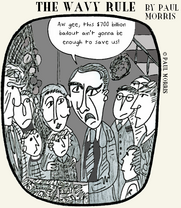
The Wavy Rule, a Daily Comic by Paul Morris: George Bailout

_The Depression began in 1929._ It’s a Wonderful Life _came out in 1946. If we get a movie as good as that in 2025, maybe it’ll all be worth it. (Here’s the “bank run”:http://www.youtube.com/watch?v=MJJN9qwhkkE scene.) Click to enlarge._
wavyrule_bypaulmorris_bailey.png
More by Paul Morris: “The Wavy Rule” archive; “Arnjuice,” a wistful, funny webcomic; a smorgasbord at Flickr; and beautifully off-kilter cartoon collections for sale (and free download) at Lulu.

New Yorker Festival Videos Already Online

_The New Yorker_ has put up several videos from the New Yorker Festival:
“Elizabeth Edwards”:http://link.brightcove.com/services/link/bcpid1827871374/bctid1846655477, hosted by Atul Gawande
“Political Humor,”:http://link.brightcove.com/services/link/bcpid1827871374/bctid1845377876 with Samantha Bee, Andy Borowitz, James Downey, John Oliver, and Allison Silverman, hosted by Susan Morrison
“If I Were Running This Campaign,”:http://link.brightcove.com/services/link/bcpid1827871374/bctid1840665660 with Donna Brazile, Alex Castellanos, Edward J. Rollins, and Joe Trippi, hosted by Jeffrey Toobin
“Young Shakespeareans,”:http://link.brightcove.com/services/link/bcpid1827871374/bctid1846620038 with Lauren Ambrose, Ethan Hawke, Kristen Johnson, Martha Plimpton, and Liev Schreiber, moderated by Adam Gopnik
And the Campaign Trail “podcast”:http://www.newyorker.com/online/2008/10/13/081013on_audio_campaign is featuring the audio of the “Campaign Trail” “Festival event”:http://emdashes.com/2008/10/new-yorker-festival-wickenden.php, with Ryan Lizza, George Packer, and Hendrik Hertzberg, moderated by Dorothy Wickenden

Express Your New Yorker Preferences!

In her “Shelf Life” column at the (Syracuse, NY) _Post-Standard,_ Laura T. Ryan wants to “know”:http://blog.syracuse.com/shelflife/2008/10/the_new_yorker_readers_whats_y.html what your favorite section of _The New Yorker_ is. Do indulge her, and tell her we sent you!

New Yorker Festival: Stephen Colbert is a Special Guy

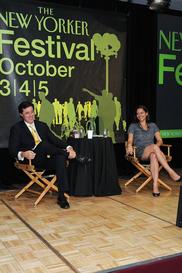
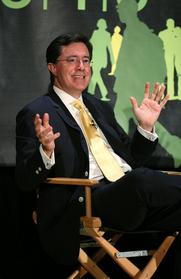
The Colbert event on Saturday night was likely to be the high point of the Festival, and certainly nothing that happened in the NYC Cathedral contradicts that. It was pretty great. Colbert and Jon Stewart hold a special place in urbane consciousness right now, and I hope they are able to maintain that status in an Obama presidency (knock wood). Colbert’s chops as an entertainer and as a kind of public moral authority (albeit skewed) are tough to beat right now. The love flowing from the audience in that room was considerable.
Looking at my notes, there is hardly anything that isn’t covered in Rachel Sklar’s exemplary and exhaustive account at _The Huffington Post_ so I’m going to “link you”:http://www.huffingtonpost.com/2008/10/05/stephen-colbert-at-the-em_n_132019.html to that! I concur on all particulars.
I have only one additional point to make about Colbert, and it’s a rather esoteric one. Seeing him in person drives home the extent to which Colbert is not only a product of the Chicago improvisational method but quite possibly its apotheosis as well. If you’ve spent any time at the Upright Citizens Brigade Theater and witnessed the improvisational concepts of “raising the stakes,” “finding the game of the scene,” and “promoting a yes-and ethic,” just about everything Colbert says—whether in character or out of it—will seem familiar and vital, in the very best sense.
I’m not an expert on improv, merely a consumer of it, but I venture that that’s part of the reason why he can conduct interviews so well _in character,_ he’s just the best improviser out there, and he’s raised the stakes in the best possible way (by getting a TV show, interviewing important people, running for president etc.).
Somewhere “Del Close”:http://en.wikipedia.org/wiki/Del_Close is smiling.
328F1D519132897385006.jpg
Stephen Colbert, Ariel Levy
328F1D8D1713289738E012.jpg
Stephen Colbert
(photo credit: Alex Oliveira/startraksphoto.com)

The End. And the Beginning.

I’m not ashamed to admit it’s been an emotional week. I covered the New Yorker Festival for the fourth year in a row (the first year, I reported on numerous events for Beatrice, whose editor, Ron Hogan, was one of the first believers in this site). As I sat in the audience for one excellent production after another–as you may have observed from my posts to our group Twitter feed experiment, I was particularly moved by the Town Hall on race and class and the beatific Lynda Barry–I also felt wrung out.
I’ve been an unshakeable admirer of The New Yorker since I first became aware of it on my parents’ coffee table, my grandparents’ bookshelves, and the walls around me. (I even published a poem about it once, when I was trying to combine journalism and poetry, a risky combination that my former Nation colleague Bruce Shapiro used to warn me about.) And I’ll always be dedicated to it: to promoting its contents, verbal and visual; to celebrating its staff and contributors, past and present; to reading it weekly, to providing it for others; to its standards, values, morals, traditions, and style. I’ve enjoyed writing about various aspects of the magazine and its contributors for other publications, including, of course, Print, of which I am now editor-in-chief and which deserves all my tender loving care. I’m also working on a book whose subjects include some vital and oft-overloked New Yorker players, so perhaps we’ll see that on our Kindles someday.
It’s hard not to be grandiose about something that has meant so much to me for nearly four years; after all, we’re just another blog in the hysterical hive that online reading has become. It surely means more to me than to anyone else that as of today, I am stepping down as the editor of the first publication I have ever created, art-directed, and overseen in its entirety from the first day of its existence.
Fortunately, I have some very good news, for me as well as for you. Martin Schneider has been writing for Emdashes, and doing double duty as part-time editor, for almost exactly two years. Especially considering that he has never seen a dime from his fine work for me (the site has never made a ha’penny), he’s been a consistent, sustaining, and invigorating presence both on Emdashes and, often from afar, in my life. He’s helped me bring in and shape the work of other writers and artists, and has long been a wonderful colllaborator in every way. He is a keen reader of The New Yorker as well, and has done many fascinating explorations into the Complete New Yorker archive; he’s a thorough and responsible reporter who’s worked at Brill’s Content, among other publications; he’s a serious reader of literature and history (and is now a university-press book editor for a living, so he gets to see some meaty stuff before we do); he’s a discerning consumer of pop culture, from music to comedy; he’s a bird-watcher; and he lives in a remote village in Austria, so he has an enviably healthy perspective on all things media and New York City.
So let’s welcome Martin as editor of Emdashes–which more than one wit has suggested we rename “M-Dashes,” or, in one case, “Mendashes”–and you’ll see me around. I’ll continue as publisher and tester of the remarkable patience of our brilliant site designers at House of Pretty in Chicago; I’ll enjoy the pleasure of editing Jon Michaud and Erin Overbey’s deliciously informative column “Ask the Librarians,” to which you should continue to submit your questions; and I’ll contribute occasionally when, as the Quakers say, I am moved to speak.
Till then, I remain yours, very truly. Thank you.

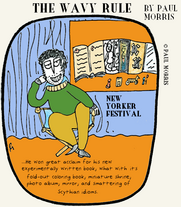
New Yorker Festival: Art Spiegelman’s Life is Comics 101

Art Spiegelman, denied cigarettes at the Ailey Citigroup Theater, had a pipe in tow but did not noticeably resort to it. Spiegelman’s brief was “Comics 101,” but his way of doing that was to delve into autobiography. This was as true in 1978, when _Breakdowns_ came out, as it is in 2008, when the remix of same is being published. In much of his work, Spiegelman presents himself as an overeducated and “fretting” neurotic urbanite (complete with “plewds”:http://emdashes.com/2008/09/the-wavy-rule-a-daily-comic-by-48.php), an image belied by the assured and witty lecturer on the stage Saturday afternoon.
As with “Alex Ross”:http://emdashes.com/2007/10/festival-alex-ross-will-get-yo.php explaining twentieth-century music at last year’s festival, Spiegelman knows so much about his chosen subject that it is difficult to think of a more qualified person to explain it (even though the field famously attracts completists and pedants). Spiegelman’s presentation of the history of comics hewed mostly to the standard landmarks (Rodolphe Töpffer, Winsor McCay, George Herriman, Charles Schulz, and so on) but perked up noticeably when he discussed the mindbending FDR-era misfire “Stardust: The Super Wizard” and the loopy LBJ years of Chester Gould’s _Dick Tracy_.
Spiegelman really liked Barry Blitt’s famous “fist jab” cover. In his view, Blitt was able to present that highly charged image in a way that resulted in its “toxins” being “removed. . . . like a vaccine.” The brilliance of the satire can be seen in the fact that it took the entire country two media cycles to arrive at the unavoidable conclusion that . . . Obama is not a radical. “That Obama cover was a real “Thomas Nast”:http://en.wikipedia.org/wiki/Thomas_Nast moment,” he said.
Spiegelman also showed some amusing covers that got rejected, like Bill Clinton facing a firing squad during the Year of Lewinsky. The running theme here was Spiegelman’s uncompromising tendency to push the avant-garde envelope whatever the circumstances. Interestingly, what appealed to him about his stint at _The New Yorker_ was the opportunity to meld low culture (his purview) with the loftier domans more usually associated with the magazine. With Spiegelman, elevating his beloved mongrel art form is always on his mind. (I suppose he views a movie version of _Maus_ as the opposite. Apparently he has had many offers to turn it into a film, and understandably has no interest.)
Spiegelman showed a “tribute”:http://www.newyorker.com/archive/2000/02/14/2000_02_14_061_TNY_LIBRY_000020205 to _Peanuts_ that appeared in the February 14, 2000, issue of _The New Yorker_ on the occasion of Schulz’s retirement. On the day that he died, Schulz called Spiegelman to tell him how much he liked the cartoon.
For all of his surface hand-wringing, the impression Spiegelman leaves behind is one of confidence, perhaps even egotism, albeit in an endearing form. To an audience questioner, he was quick to relate the recent rise of the graphic novel as an outgrowth of his own achievements (with some justification, of course), later commenting that “I didn’t go to art school. I had to invent postmodernism without knowing what it was.” That’s high self-regard, but in a modest package, or maybe it’s the other way around. In any case I’d gladly hear the man talk twice as long on the subject.