
_Pollux writes_:
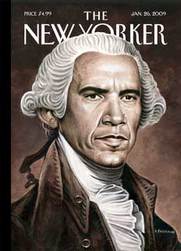
Obama looks good in a powdered wig. The head of Washingtonian hair sits easily and regally upon a head that bears a determined and presidential expression. One would think that the concept of dressing Obama in late eighteenth century clothing would produce an entirely jokey cover, but “Drew Friedman’s”:http://www.drewfriedmanart.com illustration for the January 26, 2009 issue, called “The First,” strikes me as being grave, entirely conscious of some time in the distant future when the cover will be a valued relic of times past. I see it being used in history classrooms, accompanied by exercise questions (“How do you think the artist feels about Obama?” “Why do you think he chose to depict Obama this way?”).
Friedman’s color tones are earthy, dark, and subdued, evoking the anfractuous mixture of the weight of history and even greater weight of future expectations. The portrait is photorealistic, and sober, evoking also the enormous pressures faced by our first president. Both Washington and Obama are “Firsts,” and Friedman’s use of only browns and blacks and whites is a nod to the breaking of racial barriers, and to the intersecting of countless identities and Americas: the Venn diagram of these United States of America. “Barry Blitt’s Obama cover”:http://emdashes.com/2008/10/two-thoughts-on-the-subject-of.php encapsulates what many Americans feared Obama would be and do; Friedman’s captures what many hope Obama will be.
Friedman’s depiction of a periwigged Obama isn’t funny, and I’m glad that it isn’t funny.
Monthly Archives: January 2009
The Wavy Rule, a Daily Comic by Pollux: Selling the Message
Click on the cartoon to enlarge it!
Read “The Wavy Rule” archive.
Exhibition: New Yorker Cartoons on Other People’s Money
Martin Schneider writes:
Check this out—I am really excited about an exhibition that starts at the J.P. Morgan Library in New York this Friday. It’s called “On the Money: Cartoons for The New Yorker” and it runs from January 23 through May 24. In the wake of the disastrous financial news of the last few months, someone had the brilliant idea of using New Yorker cartoons to illustrate attitudes about finance over the last several decades:
Celebrating the art of the cartoonist, “On the Money: Cartoons for The New Yorker” features approximately eighty original drawings by some of The New Yorker’s most talented and beloved artists who have tackled the theme of money and the many ways in which it defines us. Included in the show are drawings by such luminaries as Charles Barsotti, George Booth, Dana Fradon, Lee Lorenz, William Hamilton, and J. B. Handelsman. The exhibition is on view only at the Morgan.
The works are drawn entirely from the collection of Melvin R. Seiden, a longtime supporter of the Morgan, who has assembled one of the largest and most representative private selections of this art form which spans the history of The New Yorker. The Seiden collection of New Yorker cartoons, numbering nearly 1,500 sheets, complements the Morgan’s holdings in the history of satire and humor, which range from the Renaissance to the twentieth century. Following the great cartoonists of the eighteenth and nineteenth centuries—including James Gillray, H.K. Browne a.k.a. Phiz, and Honoré Daumier, in whose works the Morgan’s collection is particularly rich—the artists represented in this exhibition continue the thread of chronicling contemporary attitudes.
…
The drawings in “On the Money” include a selection of works from the magazine’s early years as well as contributions from cartoonists working during the 1970s, 1980s, and 1990s, when financial issues were among the dominant themes of many cartoons. Subjects such as politics, sex, inheritance, and real estate demonstrate the impact of money on individual lives, while the shared experience of recessions and booms provides inspiration for broader treatments of the theme. Finding humor in money and the economy has been a mainstay of New Yorker artists, and the cartoons continue to engage viewers.
The artistry of the works reveals the eloquent and efficient draftsmanship essential to a successful cartoon as well as the artists’ process of creating and revising an incisive, humorous vignette. The exhibition also delineates the critical role of the cartoon editor, whose work is essential to the reader’s enjoyment. A selection of cartoons that were improved by editorial recommendations is accompanied by equally amusing correspondence between editor and artist about achieving the perfect union between word and image. Also featured in the exhibition are photographic portraits by Anne Hall of many of the artists behind the cartoons.
The sample picture on the exhibition page (note the handwritten caption) is mouth-watering. I am so going to this!
The Wavy Rule, a Daily Comic by Pollux: Call for Action

Click on the cartoon to enlarge it!
Read “The Wavy Rule” archive.
Poems and Pints: Zapruder and Goodyear Reading
I knew that those Barnes and Noble author events were missing something, and now, thanks to the Lower Manhattan Cultural Council and the Poetry Society of America, I know what it is: beer.
Those two groups host a series of readings called Poems & Pints; the fourth installment is February 3. Appearing will be Dana Goodyear, senior editor and contributor at The New Yorker, and Matthew Zapruder, founder and editor-in-chief of Wave Books whose work has also appeared in The New Yorker.
The reading will be on Tuesday, February 3, at 6:30 pm at the Fraunces Tavern, Nichols Room, 54 Pearl Street (at Broad Street). Entry costs nothing! (Presumably the same is not true of the beers.)
—Martin Schneider
Quick Inauguration Links: Poetry, Bluegrass, and Jill Lepore
Emily Gordon writes:
We’re all in a whirlwind—or, in my case, a state of advanced humility barely distinguishable from a blue funk—after the inauguration’s pomp and stirring addresses, in plain speech, rhetoric, verse, and song. While you’re coming down from the high—or, in my case, shooting for neutral—here are some links to savor and explore.
Jill Lepore: “Our Better History,” an “In the News” post on newyorker.com about Obama’s inauguration speech today, and a long piece written before today, “Have Inaugural Addresses Been Getting Worse?“ Is there anything Jill Lepore can’t write about, I wonder? She is my current favorite contributor to the magazine. I’m reading her piece now on the possibly exaggerated death of newspapers, and while I might add a footnote about doomsaying bloggers’ mixed motives (Vanessa Grigoriadis has a good handle on the panicked retaliation of the “creative underclass,” many of whom were probably editors of their high school or college papers), I am, as ever, all admiration. Her sprightly, scholarly sentences brighten the pages, and she teaches, too. I’d read anything by her, and thanks to the editors’ ever more frequent inclusion of her pieces, I intend to.
All the newyorker.com inauguration coverage, which includes…
Various responses to the George Packer post (and Packer’s post-post) on the choice of Elizabeth Alexander as inaugural poet, including this one from Book Bench writer Jenna Krajeski.
Elizabeth was my teacher when I was a graduate student at NYU, and I was thrilled to see her at the podium, calm and dignified. At the Irish bar where my workmates and I watched the inauguration telecast, the crowd was as alert and contemplative during her poem as it was during the most solemn, lively, and challenging moments of the prayers and speeches, if that’s any indication of how a poem goes over with a populace that persists in believing it doesn’t like poetry, the same populace that delights in song lyrics, nursery rhymes, rhyming slogans, hip-hop, and so on and so forth. I did a quick look around the web for the printed poem, but ran out of time; let me know if you spot it anywhere. (Update: Here’s one; thanks, reader!)
If you haven’t read much of Alexander’s poetry, you can read some in The New Yorker; here (via Digital Edition) are “Autumn Passage,” “When,” and “Smile,” which is perhaps particularly riveting reading today.
Finally, remembering hopeful inaugurations past, here’s a terrific White House concert from 1980 to download for free. It’ll either make you happy, or keep you happy, I swear it. (Then, if you like, you can read Philip Hamburger on Jimmy Carter’s inauguration on your Digital Edition.) From Jesper Deleuran of the Facebook fan group “Doc Watson Rules!!!” (which you should join, since he does):
Here is a link to a site, where you, among other things can find this live recording from 1980, where president Jimmy Carter had invited Doc Watson and Bill Monroe to play on the lawn of the White House. It is possible to download the 16 tracks from the concert. First 6 with Doc, then 7 with Bill Monroe and his band, and last but not least 3 tunes where Doc and Bill play together alone. This is a must for a Doc Watson fan.
Happy inauguration day, all, and before tomorrow, let’s all start by doing something small to honor the service Obama spoke of so passionately. Vain musclemen who never seem to notice the mothers struggling up the subway stairs with bags and carriages, I’m looking at you. Right after I finish looking at me, of course.
“Sundry Sorts of Dry Goods”: The New Yorker & Early Newspapers
Jonathan Taylor writes:
Apropos of Jill Lepore’s new Critic at Large piece on early American newspapers, this topic was of particular interest to the New Yorker in its early days. One of the first instances of the once-frequent “That Was New York” department, in 1929, was about the New-York Gazette, founded in 1725 and “the first New York newspaper.” (I put this in quotes advisedly; who knows what revisions might have come to the historical record? “That Was New York” retailed a colorful story, since shown to be a fable, about why Staten Island is part of New York City and not New Jersey.)
Back to colonial newspapers: Later in 1929, a four-part series ran under the “That Was New York” banner, collecting “items from the press” from the Revolutionary period, replete with florid, character-assailing advertisements. However, these “clippings,” signed David Boehm, give no citations, and I confess to feeling completely uncertain as to whether they are a collection of real items, or the driest of parodies by Mr. Boehm. (Who, by the way, has no other New Yorker bylines; is he the same David Boehm who cowrote the 1931 opera-parody Broadway play “Sing High, Sing Low” with The New Yorker‘s Murdock Pemberton—perhaps also the David Boehm who collaborated on the screenplay of “Gold Diggers of 1933”?)
The Wavy Rule, a Daily Comic by Pollux: It Takes a Village

Click on the cartoon to enlarge it!
Read “The Wavy Rule” archive.
Sempé Fi: A Column About New Yorker Covers (New!)
_Pollux writes:_
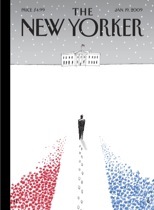
A lone man walks towards a White House constructed from a few thin, sketchy lines in “Guy Billout’s”:http://www.guybillout.com “inauguration cover” for the January 19, 2009 issue of _The New Yorker_. The lone man could be Obama, but is not immediately recognizable as the president-elect. The lone figure, I believe, represents Everyman, unprotected from the snow’s coldness. We are all walking towards the White House, which is set in a wintry landscape unencumbered by distractions, crowds, and TV cameras.
The Everyman walks straight towards his new home, through the fallen red-and-blue leaves of the autumnal election season, which is now over and done with. He walks away from the chaotic noise, a mixture of violence and optimism, of our two warring political parties, whose tendrils nevertheless trail him for as long as possible. He is an Amundsen in search of a new Pole across the Ross Ice Shelf of a new future, away from the simple dichotomy of red and blue.
The cover is more grim than hopeful, I think. What is certain is that the shoeprints in the snow lead towards the future down an unmarked pathway towards the White House door. The loneliness of power is apparent here, and Billout’s stark artistic style lends itself very effectively to this message.
The Wavy Rule, a Daily Comic by Pollux: Look, Teddy!
Click on the cartoon to enlarge it!
Read “The Wavy Rule” archive.