_Pollux writes_:
Everyone loves Rea Irvin, “including the good people at Filboid Studge.”:http://filboidstudge.blogspot.com/2009/02/life-drawing-sunday-35-rea-irvin.html
We are happy to see a new interest in Irvinian studies, and the site has a great gallery of artwork by the man who gave us Eustace Tilley, the New Yorker typeface, multitudinous New Yorker covers and cartoons, and “The Smythes.” Filboid Studge will be doing an ongoing series on Tilley, and we are looking forward to reading more, so that we may possibly add a new wing to the HQ of the organization co-founded by our very own “Emily,”:http://www.printmag.com/Article.aspx?ArticleSlug=Everybody_Loves_Rea_Irvin the Rea Irvin Institute of Research, not to be confused with the Rea Irvin Research Institute (splitters!). Filboid Studge’s Part One covers 1908 to 1914, so they have a few more decades to cover.
Monthly Archives: February 2009
The Heretofore Unknown Mad Men-New Yorker Connection
Emily Gordon writes:
Just as when I read a magazine, I read a magazine, when I watch a show, I watch a show. That usually means (since I don’t have cable) that I watch a whole season of something I’ve become interested in, old or new, and then watch the entirety of the special features and commentaries. If it’s good enough to watch the whole season, it’s good enough to see what its creators, set and costume designers, writers, and (sometimes) actors have to say about the process of making it.
Anyway, I’ve been glutting myself on season one of Mad Men lately, and partly as a way to stave off the inevitability of what I hear is a less sublime season two, I’ve been in full-time commentary and documentary mode; fortunately, the DVDs perfectly reflect the creators’ already obvious obsession with detail, and provide as much of it as anyone could want. (I haven’t even scratched the surface of the show’s online fan base, but it’s clear that they’re at least as consumed with historical perfection.)
One conclusion that I’ve drawn from season one’s commentaries is that many of the people involved in Mad Men, from Matthew Weiner to the set’s hairdressers to writer’s assistant/writer Robin Veith (she moved up, since Weiner seems to promote an apprentice system–I wonder how common that is?), would make terrific New Yorker fact checkers. Etch-a-Sketch wasn’t invented for a few more months? Can’t put it in the episode. Hydroponic apples? We didn’t have them yet–take them out of the supermarket scene. Character a little broke or dowdy and unlikely to wear the latest season in fashion? Put her in something from 1958. Nice touches, and the show is full of them–they’re what makes the show, and the actors say (and repeat many times through the commentaries) that the clothes, corsets, and hair creations do half the acting for them.
Part of the research the team does for every episode involves literature–magazines, books, ephemera, period flotsam–collected not just year by year, but month by month for the time the show’s covering. It’s impressive, and one gets the impression it’s blowing the cast’s minds to read Sex and the Single Girl and similar guides to being alive in the time of Helen Gurley Brown. And here’s Robin Veith on doing some of that research: “I read a lot of the New Yorkers from the period.”
So there you are: the DNA of Mad Men has The New Yorker as its cytosine. In honor of the show and of the recently departed John Updike, here’s a link to one of his Talk pieces (November 17, 1962), on “faces in Manhattan,” that some of the junior admen in the show–the ones obsessed with getting published in The Atlantic Monthly (as they quaintly refer to it)–would rush to read and sigh over. From the abstract: “Perhaps 15% of the faces–invariably male–bear some more or less purposefully shaped ornament of hair, & not more than 5% are marked by duelling scars, shaving nicks, or deeply dimpled chins. One out of three faces wears twin framed panes of glass in front of its eyes, and in one out of three of these the panes are tinted dark…”
The Wavy Rule, a Daily Comic by Pollux: Spiderwick Chronicle
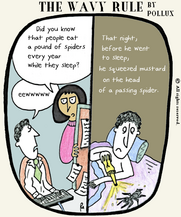
A joke inspired by my co-worker Artancy. Click on the cartoon to enlarge it!
Read “The Wavy Rule” archive.
Best of the 02.09-16.09 Issue: Updike, and Then Some
Martin Schneider writes:
This issue had a familiar fop on the cover. Candidates include Evan Osnos on African merchants in China, John McPhee on fact-checking, and George Packer on land values in Florida. Of course, one might execute an end-run around the whole question by selecting the Updike retrospective. As always—more to come.
Growing Up to Be Susan Sontag
Benjamin Chambers writes:
Over at The Millions, Anne K. Yoder has a humorous review of the recently-published opening volume of Susan Sontag’s journals.
For those interested in Sontag’s early development, I highly recommend her memoir, “Pilgrimage” (published in the December 21, 1987 issue of The New Yorker and curiously classified in the magazine’s index as “fiction”). In it, she describes how she and a friend arranged to meet Thomas Mann at his home while she was still in high school.
She burned brightly, early.
Wouldn’t You Like to See New Yorker Festival Videos on JetBlue?
Emily Gordon writes:
I flew JetBlue to Burlington, Vermont, this past weekend, and was pleased to get a chance to see for myself the airline’s much-discussed new Terminal 5, which was as clean, bright, and waggish (e.g. “OVERSIZE” in massive letters along a wall above the oversize luggage conveyor) as I’d hoped. As usual on JetBlue, I was as comfortable and amused as it’s possible to be in coach.
Although I was committed to reading printouts of Daniel Bergner’s riveting sexology investigation “What Do Women Want?”, Laura Miller’s review of Henry Alford’s How to Live: A Search for Wisdom From Old People and Diana “Stet” Athill’s Somewhere Towards the End, and a Harvard Business Review story about the curious assessment of women managers, I looked up at the little TV screen on the seat back in front of me (I’ve always loved that phrase) from time to time. Immediately, I noticed the signature colors of the New York Times‘ TimesTalks.
Indeed, the airline, the e-newspaper, and American Express have collaborated to invent “Times on Air,” which, as the airline’s press release says, is “the airline’s new in-flight video magazine of unique content from the newspaper’s TimesTalks events — its signature discussion series featuring journalists in conversation with today’s newsmakers and cultural leaders — along with articles and multimedia from NYTimes.com.”
This makes sense, I thought; plenty of people who take JetBlue flights either go to the TimesTalks in person or would if they lived somewhere that held them. Plenty of them would probably also watch TED videos on the seat-back in front of them. And plenty of them would surely watch New Yorker videos–from the New Yorker Festival, the New Yorker Conference, or some of the other new talks, readings, magic shows, and other stimulating entertainments the magazine is hosting or developing as we speak.
Don’t you think?? Wouldn’t you?
Reminder: Enter our Daniyal Mueenuddin Giveaway
Martin Schneider writes:
Yesterday we announced our book giveaway for Daniyal Mueenuddin’s In Other Rooms, Other Wonders. If you haven’t sent us an email yet, well—you should!
Here’s how: Drop us an email, subject line “NAWABDIN ELECTRICIAN” and include your name and full mailing address. We’ll accept all entries until 8:00 pm EST on Friday, February 13.
Daily Show Blasts O’Reilly for Ambushing Hertzberg and Others
Martin Schneider writes:
Anyone who remembers last December’s dustup between Bill O’Reilly of FOX News and New Yorker political commentator Hendrik Hertzberg will really, really enjoy this segment from last night’s Daily Show:
The Wavy Rule, a Daily Comic by Pollux: Supercommuter

Click on the cartoon to enlarge it!
Read “The Wavy Rule” archive.
The New Yorker on the Kindle: We Have Visuals
Martin Schneider writes:
One of the difficulties of writing about the Kindle is its scarcity: very few people have them, and the retailer that supplies them is virtual, so you can’t even try one in the store. (And they’re always sold out anyway.)
When we reported yesterday that The New Yorker had introduced its Kindle version, we were curious what it looks like. With a black-and-white display, you obviously wouldn’t get a pictorial reproduction of every page, as on The Complete New Yorker or The New Yorker Digital Edition, but what would you get?
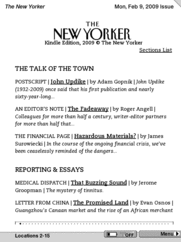
Well, now we know. Click on the thumbnail to have a look at the first page of The New Yorker, as seen on a Kindle 1.