
_Pollux writes_:
“Contemporary fiction in comics form” is how “Adrian Tomine”:http://www.adrian-tomine.com/ describes his work in his “fascinating interview”:http://www.creativereview.co.uk/crblog/qa-adrian-tomine/ with Simon Creasey, an interview complemented by illustrations rendered in Tomine’s unmistakable style. Tomine, besides “having created covers”:http://www.cartoonbank.com/search_results_category.asp?sitetype=1§ion=all&keyword=Tomine&advanced=0 for _The New Yorker_, has been prolific, fashioning comics in his _Optic Nerve_ series that are more than “just” comics, telling stories, as “Andrew D. Arnold puts it”:http://www.time.com/time/columnist/arnold/article/0,9565,286282,00.html, “that feel more like short exposures of ordinary people’s lives, rather than plot-heavy adventures or overt comedy.”
Monthly Archives: March 2009
The Wavy Rule, a Daily Comic by Pollux: Portrait of the Artist as a Young Shiznit
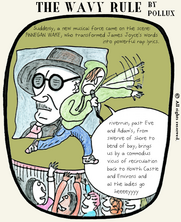
An Irish-themed joke for St. Patrick’s Day. Click on the cartoon to enlarge it!
Read “The Wavy Rule” archive.
Hark! and Attend the Song of the Twitscape
Martin Schneider writes:
The term “Twitscape” is an invention of Jon Stewart and his staff, and I hope it catches on! Anyone copyright it yet?
jzhang07 Finished Adam Gopnik’s Angels and Ages. A really good & fun book and reads like a 200 page New Yorker article.
(followed by….)
jasonjsiu @jzhang07 200 pages of the new yorker is not my idea of fun…
falameufilho wired magazine is like the new yorker and vanity fair mated and had a retarded son
doctorsreview “Travel is the sherbet between courses of reality” (from a cartoon by Victoria Roberts in The New Yorker) http://tiny.cc/sherbet
odeisel sometimes a cover is just a cover. Please stop overreacting to everything. The Michelle Obama New Yorker cover is fine. Christ
Thandelike if the new yorker mag goes under i will know the world has truly changed. damn those reluctant advertisers of canoes and cat bracelets
janetmock Once again surprised by a long ass profile in the New Yorker that I was initially not going to read; it was on writer-director Tony Gilroy
davidlebovitz If someone could come over and read the stack of New Yorkers on my coffee table, then summarize them for me, that’d be great.
(followed by….)
theveggiequeen @davidlebovitz Maybe you can get George Bush’s reader to it, now that he or she is out of a job. You want New Yorker Cliff Notes?
heidiharu “I want someone whose inner pain is totally hot,” Thank you, The New Yorker. [Hint]
melissagira I never thought of the place my parents lived when I was first born as “a run-down section of Boston.” Thanks, page 53 of the New Yorker.
martinjen Just read the new yorker and kinda wishing I was a Van Dyke.
ksauer7 Thank you, New Yorker, for your insight on similes. You’re as inconspicuous as a tarantula on a slice of angel-food cake.
April’s Book Club Book: George Orwell, Down and Out in Paris and London
Martin Schneider writes:
I mentioned recently that I am a bit of an Orwell junkie. So it with no small pleasure that I announce that, having decisively proven its worth with Richard Yates’s Revolutionary Road, the New Yorker Book Club now turns to Orwell’s terrific memoir of his days as a dishwasher in Paris and a hobo in England.
I must say, after Revolutionary Road, I was half-expecting the Club to continue with books that are currently in the public eye. This classics-minded selection immensely increases my enthusiasm for the project. Down and Out in Paris and London was probably one of the first “grown-up” books I ever read, but it has been a while. I’m looking forward to this!
Letters From Home: Steve Martin’s Stand, Emily Gould’s Address
Emily Gordon writes:
Notable in the news (as we say at Emdashes HQ, “old news is good news”):
Steve Martin Play Stirs School Controversy, reports the Times, and Martin is getting involved personally to defend the honor of his play, which is, of course, entirely honorable and replete with the exact sort of “adult content” to which teenagers should be exposed. On the other hand, the night that I saw Picasso at the Lapin Agile (in 1993 or so), the cabbie who was getting me to the show by curtain time–and we were rushing–got in a controversy of his own with another cabbie, and one of them (I can’t remember which now) leapt out at a red light, got a tire iron from his trunk, and started pounding on the other one’s car. Normally, I find cabbies to be extremely peaceful people, so it was memorable.
I hadn’t seen this Designing Magazines post about New Yorker DNA-sharing noble magazine Wigwag, which was edited by Lex Kaplen, art directed by Paul Davis, and contributed to by (for instance, and what a for instance) Nancy Franklin, but it’s really worth delving into the post and its ache-inducing images.
Emily Gould writes that the March 2, 2009, issue of The New Yorker (“Ryan Lizza’s Rahm Emanuel profile. Ariel Levy on Van Lesbians. Rebecca Mead making some opera lady interesting”) is “the best New Yorker of all time, pretty much,” and, being aware of the self-googling nature of us all these days, addresses Adam Gopnik directly.
The Wavy Rule, a Daily Comic by Pollux: Parliament of Fowls
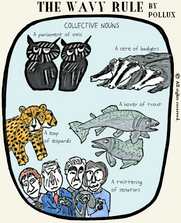
Who turned John McCain on to Twitter, I wonder? “Well, I’m just glad I could draw him again.”:http://emdashes.com/2008/11/the-wavy-rule-a-daily-comic-by-79.php
Click on the cartoon to enlarge it!
Read “The Wavy Rule” archive.
New Yorker Blog Roundup: 03.16.09
Martin Schneider writes:
(This content is taken directly from the left nav bar on the magazine’s website.)
George Packer wants liberals to put principles first (or second).
The Front Row: Novels we wish filmmakers would bring to the screen.
Steve Coll offers readers a biodegradable coffee mug.
James Surowiecki remembers the early nineties.
Evan Osnos on when boats collide.
News Desk: Mass famines, bad bishops.
Hendrik Hertzberg tentatively concludes that Americans love their (political) parties.
Sasha Frere-Jones is neither old nor grouchy, in case you were worried.
The Book Bench: Charlotte’s Web, John Wray on writing a book on the subway.
The Cartoon Lounge: Dispatches from SXSW.
Goings On: Pop music’s brain drain, Neil Young, the Flaming Lips.
Ask the Author: Submit a question to the editor of the Style Issue, Susan Morrison.
Best of the 03.16.09 Issue: You Go, Girl
Martin Schneider writes:
The Style Issue! Floc’h’s vision of multiple Michelle Obamas on the catwalk was on the cover. Features included Lauren Collins’s report on Bill Cunningham, Judith Thurman’s article on Yasmina Reza, and Ariel Levy’s look at Alber Elbaz.
Save the Date: New Yorker Summit, May 5
Martin Schneider writes:
In lieu of the regular New Yorker Conference that has taken place in early May the last two years, The New Yorker will be hosting a somewhat more urgent event befitting our nervous times. Called “The Next 100 Days,” the New Yorker Summit evokes FDR’s first 100 days in office in 1933, an implicit nod to the daunting challenges we face in 2009.
Quoth the magazine: “The New Yorker convenes today’s most prominent thinkers and decision-makers to address the unprecedented challenges facing the new Administration, and to detail their visions for the future, in discussion with New Yorker writers.”
Information:
May 5, 2009
Skirball Center for the Performing Arts, New York University
Speakers: Robert Shiller, Malcolm Gladwell, Richard Holbrooke, Geoffrey Canada, Neera Tanden, Howard Dean, Nassim N. Taleb
Tickets: $350 (on sale March 23, 2009)
More information to come in the March 30 issue.
Where Are They Nows: Where Are They Now?
Jonathan Taylor writes:
As previously posted, the new New Yorker includes a piece by Ron Chernow delving into the financial schemers of the past. Charles Ponzi was also the subject of a May 8, 1937, article called “The Rise of Mr. Ponzi,” that recapped the fraud, with special emphasis on how quickly it grew. (Aided, perhaps, by the Boston press, which “avoided mention of Ponzi’s scheme as carefully as if it had been an elevator accident in a department store.”) The reporter—the piece is signed “L.B.C.” but credited on the website to Russell Maloney—caught up with Signor Carlo Ponzi in Italy, where he had been deported, “unsuccessfully trying to finance publication” of a memoir by “selling shares in it”—with shareholders’ returns to be partially reinvested in the Italian national lottery.
Ponzi was “going to pieces” because his wife, still back in Boston, was divorcing him: “I’m going to hell, and I’m going to take a lot of people with me. To emphasize my attitude, you can say that I frequently get drunk.”
The article was filed under the “Where Are They Now?” Department, which seems to have run from 1936 to 1960, and includes follow-ups by James Thurber on Virginia O’Hanlon of “Is there a Santa Claus?” fame and on “the men who composed ‘Yes! We Have No Bananas,’ Irving Conn, and Frank Silver”; as well as articles checking on on former Vice-President (the hyphen is New Yorker style, you know) Henry A. Wallace, “Kaiser Wilhelm’s yacht, Meteor III, & its successive owners, 12 in number” (by Lillian Ross) and “Joe Knowles, the Nature Man, who in 1913 entered the wilderness of Maine, naked, to start a 2-month’s bare-knuckle fight against nature.”