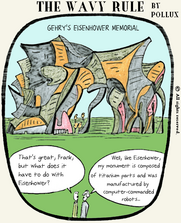
Gehry, “chosen to design the Eisenhower Memorial”:http://www.huffingtonpost.com/2009/04/01/frank-gehry-to-design-eis_n_181940.html, hasn’t released his design for it yet, but I’ve beaten him to the punch. Click on the cartoon to enlarge it!
Read “The Wavy Rule” archive.
Monthly Archives: April 2009
A Trivia–But Not Trivial–Matter: The Eustace Tilley Solution
_Pollux writes_:
The correct answer was Eustace Tilley.
It was the final round of the “Whatcom Literacy Council’s Trivia Bee”:http://www.americanchronicle.com/articles/yb/128436147 at Bellingham High School on April 3. Hundreds were in attendance. The question (What figure appears on the cover of _The New Yorker_?) broke the tie between two teams, the Bellingham Herald and the Community Food Co-op.
The Herald made themselves and us here at Emdashes by answering the question correctly and snatching victory from the hands of the Co-Op’s trivia team. _Veni vici Eustachium Tilleium_.
Mr. Tilley is only too happy to lend a hand to such causes (The Trivia Bee’s proceeds go to the Whatcom Literary Council).
Don’t forget Tilley’s face. He may help you achieve victory at a quiz bowl one day.
The Wavy Rule, a Daily Comic by Pollux: iPod Orb and Sceptre

Click on the cartoon to enlarge it!
Read “The Wavy Rule” archive.
Larkin on Larkin: “Again I Feel It Could Be Put A Little More Thrillingly!”
Jonathan Taylor writes:
Confidential to M.S. and anyone else looking for a “cracking” New Yorker–like bathtub reading experience, only British: check out John Shakespeare’s memoir in the Times Literary Supplement of that time in 1956 he sent Philip Larkin a draft of a profile he was writing on him. Oops! Shakespeare reprints the amazing correspondence: “I want to sound more guarded, more complex, more like a person who could possibly write a good poem.”
All You Need Is Love
Emily Gordon writes:
Don’t miss Nancy Frankin’s Talk this week about a transporting encounter with Paul McCartney–a ticket to ride, as it were. N.F. is no joke: she’s getting better all the time.
The Wavy Rule, a Daily Comic by Pollux: They May Take Our Tubes, But They’ll Never Take Our Freedom
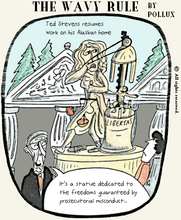
“The Stevens saga:”:http://emdashes.com/2008/10/the-wavy-rule-a-daily-comic-by-76.php at an end? Click on the cartoon to enlarge it!
Read “The Wavy Rule” archive.
Croissants, Bagels and the Ottomans: Stop It
Jonathan Taylor writes:
I suppose there’s great reason to think R.O. Blechman is being purposely playful with the phrase “most likely true,” but I’m still irked to see two most likely untrue food-history fancies, about the invention of the croissant and the bagel to commemorate battles against the Ottomans, reamplified in the Times today. Food historians have long doubted the croissant’s connection to the siege of Vienna, noting that known references to it emerged only centuries later. And the Forward recently noted, “Contrary to legend, the bagel was not created (in the shape of a stirrup) to commemorate the victory of Poland’s King Jan Sobieski over the Ottoman Turks in 1683. It was born much earlier in Krakow, Poland, as a competitor to the obwarzanek, a lean bread made of wheat flour and designed for Lent. In the 16th century and first half of the 17th, a ‘golden age for Poland’s Jews,’ the bajgiel became a staple in the national diet.”
Thank you.
PEN Picks: The 2009 World Voices Festival
Jonathan Taylor writes:
For the second year, I’m extremely honored to be hosting a PEN World Voices Festival event for the Austrian Cultural Forum April 30, this year on Franz Kafka and his newly retranslated novel Amerika: The Missing Person. But I’m excited about a lot of other events in this year’s festival, which runs from April 27 to May 3 and is, as usual, a major gathering of international writing genius. Below is the festival press release highlighting many of the events, preceded by a few picks of my own from the lineup (see the site for the full schedule and ticket and reservation details, which vary—many events are free):
- The pairing of Mark Kurlansky (Cod, Salt, The Basque History of the World) and Raja Shehadeh (Palestinian Walks) to address “how human constructs—industry, war—have marked our surroundings” (April 30) is inspired.
- I became acquainted with Horacio Castellanos Moya at my Thomas Bernhard event at last year’s festival. He’s as ensorcelling a talker as he is a writer, and an appropriately wily member of the panel titled “Where Truth Lies: A Conversation on the Art of Fiction,” May 2. It is “the first in a series of launch events for the new Center for Fiction in New York City (formerly the Mercantile Library Center for Fiction).”
- To the other side of the coin: “Is Nonfiction Literature?” I say yes—look how many of the events I’m picking are about nonfiction. This May 3 event relates tangentially to a hobbyhorse of mine. The activists promoting literature in translation in the U.S. are valiant and have a sufficiently arduous task just with regard to fictive “literature,” but it strikes me that there’s little talk of how much we’re also missing out on a world of knowledge, thought and expression conducted in other languages’ nonfiction.
- I know a lot of people whose eyes were permanently opened to the New York City history around them by Russell Shorto’s The Island at the Center of the World (haven’t read it, but feel like I’ve absorbed a lot via public radio interview osmosis). And the books of Dutch journalist Geert Mak have continually renewed my awareness of the visible marks of change and continuity etched the landscape of Europe, particularly his Jorwerd: The Death of the Village in Late Twentieth-Century Europe. I am definitely not missing their May 3 event with Ian Buruma, “Henry Hudson at 400: Amsterdam and New York City.”
Here’s the PEN press release with more highlights:
The Fifth Annual
PEN WORLD VOICES FESTIVAL
OF INTERNATIONAL LITERATURE
Evolution/Revolution
APRIL 27 to MAY 3, 2009
160 Writers from 40 countries in over 60 events
Laurie Anderson, Paul Auster, Muriel Barbery, Mark Z. Danielewski, Edwidge Danticat, Richard Ford, Neil Gaiman, Philip Gourevitch, David Grossman, Paul Krugman, Nam Le, Rick Moody, Walter Mosley, Péter Nádas, Michael Ondaatje, Richard North Patterson, Lou Reed, Salman Rushdie, Nawal El Saadawi, Hwang Sok-yong, George Soros, Colm TóibÃn, Adrian Tomine among this year’s participants.
www.pen.org/worldvoices
New York City, March 25, 2009 – Salman Rushdie and The PEN American Center today announce the program for the Fifth Annual World PEN Voices Festival of International Literature taking place this year Monday, April 27th through Sunday, May 3rd.
Salman Rushdie says, “I’m hugely proud to Chair this celebration of international literature, now in its fifth year and flourishing despite tough times in publishing and beyond. When it seems everything else is shutting down and closing up shop, the writers, editors, poets and playwrights of PEN are opening their arms again to welcome their colleagues from around the globe to New York City. We cannot begin to understand and appreciate the world if we do not read its literature and now, more than ever, PEN’s role in providing a platform for global literary discussion is vital.”
John Makinson, Chairman and CEO, Penguin Group, comments, “The breathtaking scope of the 2009 World Voices Festival is a defiant response to economic adversity, and so it should be. Freedom of expression is an absolute value and all of us – writers and readers, publishers and retailers – need to give it our vocal support in any climate. Penguin and PEN are natural partners. We share a global outlook, common values and a determination to showcase the world’s greatest writing. We are delighted, and honored, to be the premier sponsor of this year’s festival.”
Bringing together 160 established and emerging writers from 40 countries for conversations, panels, readings, and performances for one week in New York City, The PEN World Voices Festival is a truly international literary cultural exchange. Evolution/Revolution is this year’s Festival theme with events that consider how the world changes and how we change. 2009 is a year to mark significant anniversaries – from Galileo’s telescope (1609) to Darwin’s On the Origin of Species (1859), from the Cuban Revolution (1959) to the collapse of Communism across Eastern Europe (1989) and Tiananmen Square (1989) – and in this year’s Festival, writers from every hemisphere will consider the many meanings of change, in science and religion, art and politics, language, music and, of course, literature.
2009 Festival Highlights include:
• Evolution/Revolution Opening Night with internationally acclaimed writers reading in their original languages as their words are projected on screens behind them in English with Muriel Barbery (France), NarcÃs Comadira (Spain/Catalonia), Jose Dalisay (Philippines), Edwidge Danticat (US/Haiti), Péter Nádas (Hungary), Sergio RamÃrez (Nicaragua), Salman Rushdie (India/US), and Raja Shehadeh (Palestine).
• Economic Crisis and How to Deal With It with the world’s leading economic minds including Paul Krugman, George Soros, Senator Bill Bradley, Niall Ferguson, Nouriel Roubini, and Robin Wells.
• The Fourth Annual Arthur Miller Freedom to Write Lecture by Egyptian writer, activist, and one of the leading cultural and political voices of our times, Nawal El Saadawi. Previous lectures have been delivered by Orhan Pamuk, David Grossman and Umberto Eco.
• Conversations between some of the most intriguing and creative writers at work today: Muriel Barbery and Adam Gopnik; Mark Z. Danielewski and Rick Moody; Enrique Vila-Matas and Paul Auster; David Grossman and Leonard Lopate; Péter Nádas and Daniel Mendelsohn; and Richard Ford and Nam Le.
• The enormously popular PEN Cabaret, promising to be epic, with performances by music legends and cultural icons Lou Reed and Laurie Anderson, readings by Walter Mosley, Horacio Castellanos Moya, Mark Z. Danielewski, and Nick Laird, an adaptation of Jonathan Franzen’s New York piece from State by State featuring Parker Posey, James Franco, Peter Hirsch, Carrie Brownstein, and Sean Wilsey…and more!
• Three back-to-back sessions with the most innovative and cutting-edge graphic artists on the planet including Neil Gaiman, Yoshihiro Tatsumi, Adrian Tomine, Shaun Tan, David Polonsky, and Emmanuel Guibert (attend all 3 events for $25!)
• A celebration of the 20th anniversary of the original Pan-European Picnic when Austria and Hungary symbolically opened their border for a few hours and hundreds of East Germans flooded into Austria while guards stood idly by and history was made. This extraordinary open-air event at DUMBO’s Empire Fulton Ferry Park will feature the three essentials: music, food, and literature.
• Celebrations of the lives and work of playwright Harold Pinter, Sudanese author Tayeb Salih, Cuba’s Reinaldo Arenas and the Mallorcan poet Blai Bonet.
• Defiance: The Spirit of ’89 is an evening to celebrate the power of one person standing against tyranny — as iconically demonstrated by one unidentified man facing down a column of tanks at Tiananmen Square on June 5, 1989 — with Eszter Babarczy, Jose Dalisay, Nick Flynn, Sergio RamÃrez, Hwang Sok-yong, János Térey, and Paul Verhaeghen.
• A night of unabashed, old-fashioned storytelling from The Moth with Salwa Al Neimi, Jonathan Ames, Petina Gappah, László Garaczi, and Salman Rushdie.
• A star-studded Around the Globe adventure at the 92nd St Y featuring Bernardo Atxaga (Spain), Petina Gappah (Zimbabwe), Mariken Jongman (Netherlands), Michael Ondaatje (Sri Lanka/Canada), Daniel Sada (Mexico), Hwang Sok-yong (Korea), Antonio Tabucchi (Italy), and Colm TóibÃn (Ireland).
• Jazz: The Revolution of Beat — Four American writers, including legendary jazz critic Gary Giddins and American poet Bill Zavatsky, explore the birth and life of jazz and how it relates to the written word, with musical accompaniment by the Diane Moser Quintet.
• Henry Hudson at 400 Years: Amsterdam and New York City with Dutch authors Ian Buruma and Geert Mak joining US novelist Russell Shorto to celebrate and discuss the Dutch Influence on America and New York and vice versa.
PEN American Center is the largest of the 141 centers of International PEN, the world’s oldest human rights organization and the oldest international literary organization. International PEN was founded in 1921 to dispel national, ethnic, and racial hatreds and to promote understanding among all countries. PEN American Center, founded a year later, works to advance literature, to defend free expression, and to foster international literary fellowship. The fifth annual World Voices Festival for International Literature is chaired by Salman Rushdie and directed by Caro Llewellyn.
The PEN World Voices Festival is made possible by the generous support of many co-sponsors, partner organizations, cultural agencies, and individual donors. The Premier Sponsor for this year’s Festival is The Penguin Group, and Sponsors are Bloomberg, Borders, The Kaplen Foundation, LJK Literary Management, National Endowment for the Arts, Random House, Rodale and The Roger Smith Hotel.
Internationally acclaimed writer Michael Ondaatje, participating this year in his third World Voices Festival, considers the event “a great celebration as well as an essential discovery of writers around the world.” Join him and 159 other remarkable participants in New York City at the 2009 PEN World Voices Festival, April 27 – May 3.
For a full schedule of Festival events and a complete list of participating authors,
please go to www.pen.org/worldvoices
Sempé Fi (On Covers): Base of Operations
_Pollux writes_:
In the 13th century, when all of Europe’s cities were competing with one another to build taller and grander cathedrals, we find an interesting historical figure in the form of Henri de Dreux, Archbishop of Reims. Henri’s archrival was the Bishop of Amiens, and they were both ambitiously expanding and rebuilding their respective city’s cathedrals. Henri assured his place in posterity by adding his own image to one of the stained glass windows.
And he made sure that Reims Cathedral could be all that it could be: after completing an entry porch, he quickly had it demolished and then rebuilt when he learned that his rival’s entry porch was better. These kinds of things mattered. The entry porch was, after all, a point of access for worshipers into the main structure.
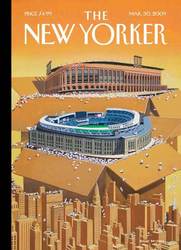
These days cities in America strive to build bigger and better stadiums and sports venues, “cathedrals of baseball” involving millions of dollars, much political maneuvering, and Barnum-like hoopla. And we have two such cathedrals depicted on the cover of _The New Yorker_ for the March 30, 2009 issue. The cover is called “Opening Day,” and the artist is “Bruce McCall”:http://en.wikipedia.org/wiki/Bruce_McCall, who has “a knack”:http://www.cartoonbank.com/search_results_category.asp?sitetype=1§ion=all&keyword=Bruce+McCall&advanced=0 for creating images that juxtapose reality with a touch of the surreal.
Baseball is of course not necessarily the religion of America. The religion of America is religion. However, in a way, baseball stadiums truly do function in the same manner as cathedrals, with the very geographic centrality of their locations within the city, their hallowed traditions, and their crowds of worshipers. And instead of stained glass windows depicting saints and bishops, you have 39-foot banners of Babe Ruth and Lou Gehrig in the Great Hall of the new Yankee Stadium.
Whether New Yorkers like it or not, they have recently received two brand-new stadiums. The new Yankee Stadium opened on April 3, 2009, and carries a price-tag of $1.5 billion. It’s sixty-three percent larger than the old Yankee Stadium, has improved sight lines from the seats, as well as a martini bar, art gallery, private luxury suites, and, according to the “Relocation Guide”:http://newyork.yankees.mlb.com/nyy/components/ballpark/New_Yankee_Stadium_Relocation_Guide.pdf, “more restrooms, including family-style restrooms … providing greater convenience and more choices for all fans.” April 3 also marked another occasion: the Mets played their first game at their new stadium, Citi Field, which carries a slightly more modest price tag ($850 million).
The stadiums have not been built without controversy or criticism. For one thing, the construction of the new Yankee Stadium entailed the annexation of much-needed parkland in the city, green areas that were snatched without the benefit of a public hearing or referendum. The high costs have also been an issue. As Rick Morrissey “rightly asks”:http://www.chicagotribune.com/sports/chi-04-morrissey-cubs-yankees-chapr04,0,95762.column, “Is anyone creeped out by the money spent on this place while the nation is in the middle of serious financial difficulties?”
In the meantime, Citi Field was built amidst a controversy over the naming rights to the park, with Citigroup’s plan to pay $20 million a year for naming rights, unbelievable in light of the fact that the company, burdened by financial woes, has received $45 billion in taxpayer funds (Two New York City Council members have suggested renaming the stadium “Citi/Taxpayer Field.”). That $20 million could of course go towards reopening a hospital or fixing the plumbing in a leaky, overcrowded school, but that would just be namby-pamby socialist thinking.
Bruce McCall’s cover gleams with the color of gold, while the city below, dwarfed by the two enormous stadiums, appears weak and fragile, an elaborate collection of brittle buildings almost washed out by the brightness of doubloons. McCall’s New York City is the color of sand, as if it were a sort of American Abu Simbel, dry and devoid of trees (377 mature oak trees were in fact sacrificed in order to build the new Yankee Stadium).
The city is lifeless and threatened by the sheer scale of its new prestige architecture. It is significant to note that Henri, the Archbishop of Reims, taxed the population so heavily that he provoked a revolt in 1233 in which his archiepiscopal palace was attacked and the pope and the King of France were forced to intervene to calm the situation down.
It’s also significant to note that Bruce McCall’s illustration depicts no cheering citizens, no crowds of appreciative fans and fanfare. The two behemoth-sized boxes have been plunked down as if from a stern celestial being amidst the diminutive skyscrapers of New York. There has no discussion, no dialogue. A messy form of precipitation in the form of foam peanuts drops from the boxes like dandruff from a giant’s scalp, littering the city with Styrofoam.
McCall’s book, _The Last Dream-o-Rama_, attacked and lampooned the Detroit auto industry by depicting the cars the city “forgot to build” during the boom years of the 1950s and 60s. Each page contains an automobile more ridiculous than the last. “The automobile was no longer just an appliance,” McCall “has remarked”:http://www.businessweek.com/magazine/content/01_46/b3757021.htm, “but a rolling boudoir, a metal mistress, a leather-clad dominatrix with great big pointed silver bumpers. And the industry’s leaders had the vision to follow the mob.”
I feel the same anger emanating from McCall’s “Opening Day” cover. The new stadiums are undoubtedly impressive and beautiful in their own way, as his satirical dream-cars are, but, like his Quizfire 5000 Jackpot, his Nixoneer Squelchchoramic or his 1954 Redscare Phantom Witchhunter, they seem to reek of materialism, crassness, excess, and pharaonic arrogance. The introduction to the Yankee Stadium Relocation Guide was entitled “A Fabled Stadium Inspires the Future”. Let’s hope that the future is inspired by more than that.
Lest You Worry About My Larceny…
Emily Gordon writes:
My “discovery” of an uncatalogued James Thurber drawing, reported in nonsensical detail on Wednesday, was, of course, an April Fool’s caper. The affectionate homage is Pollux‘s, the NYPL remains unviolated by our staff, Ohio is spared the dubious delight of its non-specialty Toledo Butterscotch Flan, and our affections for Thurber are eternal.