

Click on the cartoon to enlarge it!
Read “The Wavy Rule” archive.
Monthly Archives: April 2009
What Is the British Equivalent of The New Yorker?
Martin Schneider writes:
Happened to stumble upon Andrew Orlowski’s paean to Wired, in which he writes in passing, “In Britain we’ve never had the equivalent of a Harper’s or a New Yorker—something with a cracking 15,000-word article that you can read in the bath.” Is that true? What’s the closest periodical—glossy or otherwise—that can deliver such an Anglo-aquatic reading experience? The London Review of Books, perhaps? Any others?
New Yorker Blog Roundup: 04.03.09
Martin Schneider writes:
(This content is taken directly from the left nav bar on the magazine’s website.)
Evan Osnos says China is feeling superpowerful.
Steve Coll learns Pakistan has two Jon Stewart imitators.
James Surowiecki looks at the new unemployment numbers.
Hendrik Hertzberg says Israel’s election system can’t be blamed on proportional representation.
George Packer finds out that Ulysses S. Grant enjoyed spanking.
The Front Row: Did Roberto Saviano plagiarize parts of his book?
News Desk: The Queen can take it.
The Book Bench: What poetry does to the brain.
The Cartoon Lounge: Protect your home with string.
Sasha Frere-Jones talks with the remix artist Kutiman.
Goings On: The health risks of the rock-and-roll life.
The New Yorker’s Guilty Pleasure: Thurber, Adler, Kincaid All Wrote About Soaps
Jonathan Taylor writes:
On Wednesday, CBS announced the cancellation of soap opera “Guiding Light,” which began on radio in 1937, making it the “the longest-running scripted program in broadcasting history,” according to the Times (which also links to some original audio from the show’s radio days).
For whatever reason, soap operas have been a source of continual fascination for The New Yorker. They’ve probably pushed a few buttons about “culture,” and the “pop” variety thereof. I would give a lot to sit down on the sofa with Renata Adler and a box of wine on a 1972 afternoon for some proto-hatewatching. Maybe that’s not quite the right word, but in her “Unhappiness Enough, and Time,” Adler concluded: “There does not seem to be a single sense in which soap operas can be construed as an escapist form.” Also: “One thing about a work of art is that it ends.”
(The abstracter of this article didn’t seem to get into it: “Overall look at television soap opera” is the entire thing.)
James Thurber’s 1948 “Soapland” was a really overall (five-part!) look at the radio soaps. He investigated “the early pioneers in that field” and described their focus on “the plights and problems of small town characters stretched into endless sequences,” isolated from broader “social consciousness”; he focused on the writers of the soap stories, and then on the “players”; and Thurber wrapped up with a consideration of the “listening women” (the audience) and the future of soaps on…television.
Among the truly numerous Talk stories about soap operas: The 1975 final taping of NBC’s “How to Survive a Marriage” was covered. In 1978, Jamaica Kincaid attended the First International Soap Opera Exposition. Somewhat less sniffy is a 2001 piece (available online) about a real nurse who consulted for soaps, and had even appeared on “One Life to Live.”
Soaps have provided also fodder for fiction by S.J. Perelman and Constance Schraft.
Cartoons are a whole other story, I imagine….
Brace Yourself for Bruno, the New Yorker Way
Martin Schneider writes:
Sacha Baron Cohen’s new movie Bruno (or Brüno), featuring his “flamboyantly gay” Austrian fashion scenester character, is due out this summer. The recently released trailer starts with a barrage of pullquotes, one of the first of which is “Lavatorial!” and is credited to “Anthony Lane, The New Yorker” (it’s perfectly accurate).
Like any good fashionista, the trailer jokes that Borat is “so 2006.” But sadism-tinged guerrilla culture-war humor (no matter how brilliant) really does seem incredibly 2006, no? It’ll be interesting to see if squirming squares will play as well in the age of Obama, now that those squares are worried about their jobs, mortgages, retirement plans. Is it homophobia or parody of same? Ah, who can tell. If you missed it the first time around, George Saunders’s take on Borat was one of the sharpest.
I’m writing this from Austria, Bruno’s supposed homeland, where Joseph Fritzl pleaded guilty a couple of weeks ago. Bruno’s definitely a step up, PR-wise.
The Wavy Rule, a Daily Comic by Pollux: Kicking It G20 Style

Click on the cartoon to enlarge it!
Read “The Wavy Rule” archive.
Lost & Never-Seen Thurber Cartoon: An Emdashes Discovery
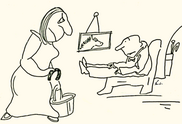
Emily Gordon writes:
We invite you to click on the Thurber cartoon above to see it enlarged. By doing so, you will have been the first people in more than fifty years to ever see this cartoon, which has been lost in time. Until now.
It so happens to be April Fool’s Day, when your co-workers lace your latte with laxatives and French schoolchildren attach paper fish to one another’s backs–when companies from Google to BBC Radio 4 run elaborate hoaxes on their sites and servers.
But this is not a tradition at Emdashes, which, as much as its staff enjoys a good joke now and again (and some of us not at all), is a serious site with serious New Yorker-centric goals. We don’t mess around with certain things.
So ignore for a second that it is the first of April, and focus your attention on this! Emdashes has the distinct honor of coming into possession of a heretofore unpublished drawing by New Yorker cartoonist and writer James Thurber. As you know, I am an ardent fan of another classic New Yorker artist, Rea Irvin, and have conducted various investigations concerning the life and work of the magazine’s first art director.
As sometimes happens during the course of research at the New York Public Library, I stumbled across gems that I did not expect to find. One of them was a rare first edition of S. J. Perelman’s Pillowbiters or Not–and the other was an original Thurber drawing that I had never seen in any published anthology or collection, online or otherwise.
The drawing, yellowed with age, is vintage Thurber, both in style and substance. It dates perhaps to the early 1940s. No caption was attached, but a caption is unnecessary. The cartoons that Dorothy Parker famously referred to as having the “semblance of unbaked cookies” are works of art, instant collectors’ items, and like, well, a plate of freshly baked cookies to the millions of Thurberphiles around the globe.
The New York Public Library will forgive me for what I did next: I smuggled the newly discovered Thurber “unbaked cookie” in a manila folder marked “non-smuggled items” and went straight to my apartment to devise a cunning plan.
To wit, in exactly two weeks, on April 15, 2009, we will be holding an Emdashes Thurber Festival at the Wollman Rink in New York’s Central Park. We will be making high-quality, limited edition facsimiles of this untitled Thurber drawing available for sale for the incredibly (under the circumstances) low price of $15 and will also be offering, in honor of Thurber’s origins, authentic Ohioan cuisine: Cincinnati Crumblers, Toledo Butterscotch Flan, and Cleveland Cork ‘n’ Beans. Please join us in this celebration of an invaluable find!
Update, April 3: There is, of course, no S. J. Perelman book called Pillowbiters or Not. There are (perhaps regrettably) no such Ohioan specialties as Cincinnati Crumblers, Toledo Butterscotch Flan, or Cleveland Cork ‘n’ Beans. We have no plans for an Emdashes Thurber Festival, since Columbus’s own Thurber House and Museum has all such celebratory events well and humorously in hand. There are, alas, no uncatalogued Thurber drawings that I know of, but if there were, you can bet everyone at Emdashes H.Q. would run to buy the freshly printed collection. (At least The 13 Clocks was recently reprinted by New York Review Books, a windfall applauded by our friends at the New Haven Review).
Most obviously, I would never take anything from the New York Public Library but a renewed resolution that I should really get back to Tristram Shandy. The drawing above is a fond Thurber homage by our own Pollux, resident cartoonist; the post above, also a close but detectable facsimile, is by Pollux as well. And that’s it for another April Fool’s Day! Three cheers for James Thurber, who is a continual inspiration and one of the world’s unmatchable greats.
And for a nearly Thurber-era New Yorker wavy-ruled infographic about April Fool’s–as the abstract describes it, “A list of recent quaint practical jokes and their outcome, as chronicled in the daily press”–get thee to 1929 and the Digital Reader. Enjoy! —E.G.
The Wavy Rule, a Daily Comic by Pollux: Ludificatio Calendarum Aprilium
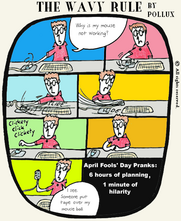
Click on the cartoon to enlarge it!
Read “The Wavy Rule” archive.