
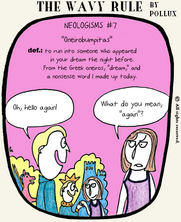
Click on the cartoon to enlarge it!
Read “The Wavy Rule” archive, and “order your Wavy Rule 2008 Anthology today!”:http://emdashes.com/2009/03/the-wavy-rule-anthology-now-fo.php
Monthly Archives: July 2009
Infinite Summer: Location 3158
Martin Schneider writes:
Note: I’m participating in Infinite Summer, the widespread Internet book project dedicated to reading David Foster Wallace’s Infinite Jest. For more information, consult my introduction. My strategy has been to avoid lengthy commentary but instead list quintessentially Wallacean vocabulary and note other oddities, including Kindle typos.
Pretty far behind (12%!), but that’s okay. I’ve got some airport time still ahead of me in the summer.
I really loved the 3 NOVEMBER Y.D.A.U. chapter with all the Big Buddy meetings.
location 2023: D.T. as a verb
location 2031: skallycaps
location 2038: Ewell’s room’s window’s air conditioner
location 2068: candidiatic
location 2078: Bröckengespenst, what is it with DFW and umlauts? Word does not take an umlaut!
location 2102: to in truth do this, flagrant split infinitive, nice
location 2114: His tone of his voice, eesh
location 2133: raggers
location 2151: specular
location 2189: uremic-hued
location 2192: locomotival
location 2193: pedalferrous
location 2201: teratogenic
location 2256: clear, typo (from original print edition)
location 2285: acutance
location 2324: ephebes
location 2381: semion
location 2391: zygomatics
location 2433: carminative
location 2475: woppsed-up towel
location 2510: sbetrayal, Kindle typo
location 2559: Steeply … used silent pauses as integral parts of his techniques of interface. James Fallows has shown a great interest in this aspect of interrogation.
location 2566: lume
location 2597: osteoporotically
location 2598: foot-work, Kindle error, taking syllabification hyphen to be in the word
location 2599: waist-level, unusual place for hyphen
location 2615: bow-biters
location 2659: E Unibus Pluram, title of DFW essay is jarring; has anyone suggested these kids are too erudite?
location 2686: ballet de se, apparently idiosyncratic French
location 2778: obtrudes
location 2848: guilloche
location 2871: stickery
location 2933: Mario’s joke is genuinely hilarious.
location 3011: murated
location 3015: why’s he’s, typo (from original print edition)
Sempé Fi (On Covers): Trafalgar Square
_Pollux writes_:
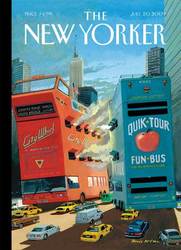
“Bruce McCall”:http://www.brucemccall.com/ loves cars. This much is clear from the way he depicts his vehicles, glorifying and exaggerating their form. His paintbrushes lovingly depict the details, producing cars that are more detailed than normal for a cartoon or _New Yorker_ cover. McCall is like a miniaturist adding decals to a 1/24 scale 1971 Ford Mustang Pro Street Car.
You don’t need to draw eyes and mouths on cars to give them a personality. McCall loves cars while at the same time lampooning the people who build them. As noted in my “last piece”:http://emdashes.com/2009/04/sempe-fi-on-covers-base-of-ope.php on a McCall cover, McCall attacked and lampooned the Detroit auto industry by depicting the cars the city “forgot to build” during the boom years of the 1950s and 60s in his book _The Last Dream-o-Rama_.
McCall’s new cover offers us a new vision of automobiles gone wild.
For his July 20, 2009 cover for _The New Yorker_, called “Tour Wars,” McCall depicts an array of cabs, a Porsche, a van, and two towering tourbuses. These tourbuses, engaged in a war of attrition as long as a tea clipper, exchange cannonfire as they drive past one another on their way to competing routes to Grant’s Tomb and 11th Avenue.
There is no contingent of marines or complement of pirates armed with grappling hooks on the decks of these massive earthbound galleons. The tourbuses’ hostility is completely automated and automatic. They fire because they sense an enemy nearby. It makes sense in their brains composed of crankshafts and sumps. One can’t even see the drivers or the tourists on these buses.
And tourists are the key to the castle here. With an ailing American economy, there are fewer tourists and more competition. In McCall’s satirical vision, the competition has become so fierce as to result in Cape St. Vincent-like engagements on the city streets. CityWhirl (“All Manhattan in 6 min.”) versus QuikTour (“101 Sights Per Block”): which of these will be the only company to offer the Hop On, Jump Off experience?
In real life, The Gray Line “offers”:http://www.newyorksightseeing.com/page.php?id=6 “48 hours of hop-on hop-off double-decker fun that includes the Downtown Loop, Uptown Loop, Brooklyn hop-on, hop off tours and a Night Tour. PLUS, admission to any THREE listed NYC attractions.” A Night Tour from another company claims “best-value double-decker sightseeing packages including major attractions and activities such as harbor cruises, museum visits, helicopter tours, shopping day trips and one-day escorted motorcoach tours to Boston, Washington, D.C. and Philadelphia & Amish Country.”
There is violence in McCall’s image, but it is not a violence of gore and tears. The whiff of grapeshot is evocative of heroic and romantic actions of yesteryear on the high seas rather than the horrors of our current engagements in the Middle East.
McCall’s two lumbering, mutually hostile buses are symbolic of an ailing company that is fighting to gain ground once again and find new strength. And the cars surrounding them, the Porsche, the Rolls, the taxis, and the van, do not flee the scene but remain part of it, inherently supportive of this tour-bus Trafalgar.
American Funnymen: John R. MacArthur’s Take on Thurber and Addams
_Pollux writes_:
Funny men aren’t necessarily happy men.
People who invited P.G. Wodehouse to dinner parties, expecting him to spout witticisms and throw bread rolls at the waitstaff, found him to be a very shy and very quiet man.
And the waggish S. J. Perelman was, according to his biographer Dorothy Herrmann, a “contained,” “testy, easily depressed man.” As the poet Hartley Coleridge once wrote, “And laughter oft is but an art / To drown the outcry of the heart.”
In this “_Harper’s Magazine_ article”:http://harpers.org/archive/2009/07/hbc-90005409, “John R. MacArthur”:http://en.wikipedia.org/wiki/John_R._MacArthur sees a gloomy side to “James Thurber”:http://www.thurberhouse.org/james/james.html as well. Thurber’s lugubriousness is confirmed by testimony from “Charles Van Doren”:http://en.wikipedia.org/wiki/Charles_Van_Doren, who recounts that Thurber once wept because he felt that he had been struck by blindness as punishment for lampooning “poor, weak people.” Hardly the person you want to liven up your cocktail party.
MacArthur considers “Charles Addams”:http://www.charlesaddams.com/, a man whom most associate with gloom and doom, a credible rival to Thurber as one of America’s foremost funnymen. Addams’ work was not oppressed by bitterness and coldness.
Upon visiting the “Charles Addams Foundation”:http://www.charlesaddams.com/index2.html, in Sagaponack, Long Island, MacArthur remarks that “Addams’s cartoons, displayed throughout the house among other memorabilia, were simply laugh-out-loud funny. And–odd for such overtly sinister humor–I didn’t feel bad, or mean-spirited, after I’d laughed.”
MacArthur finds more warmth in the macabre relationship between Morticia and Gomez than that between Thurber’s Mr. and Mrs. Mitty.
Indeed, Addams is underappreciated while the bitterness to Thurber’s humor has been underestimated. While Addams had his cartoon men and women exchanging potshots on relatively equal terms, Thurber’s humor is predictable in the sense that his women are always menacing, domineering figures.
I channeled this frigidity between the sexes when I created a “lost Thurber cartoon”:http://emdashes.com/2009/04/lost-thurber-drawing-discovere.php on April Fool’s Day. I depicted a large, mean-looking woman about to attach horseshoes to her milquetoast spouse’s feet, which I felt represented a classic Thurber cartoon.
Do I find Addams funny? Absolutely. Like “Rea Irvin”:http://www.printmag.com/Article.aspx?ArticleSlug=Everybody_Loves_Rea_Irvin, he deserves to be remembered for the full body of his work rather than only for a component of it.
Do I find Thurber funny? Yes, and he continues to inspire me and many others in different ways. I “speculated”:http://emdashes.com/2009/07/finger-pointing-the-future-and.php, for example, if Thurber would have used an iPhone to draw his unhappy couples. What would these drawings have looked like? If I ever get an iPhone, perhaps I’ll try my hand at creating more pseudo-Thurberian work.
Our culture owes a debt of gratitude to both men. In the hallways of that eternal pantheon of American humorists, whether these hallways ring laughter or with tears, there is plenty of room for both Addams and Thurber, and room for many more humorists of the present and future.
The Wavy Rule, a Daily Comic by Pollux: Work or Perk
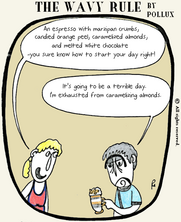
Click on the cartoon to enlarge it!
Read “The Wavy Rule” archive, and “order your Wavy Rule 2008 Anthology today!”:http://emdashes.com/2009/03/the-wavy-rule-anthology-now-fo.php
The Wavy Rule, a Daily Comic by Pollux: DisappointmentGuard
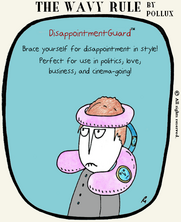
Click on the cartoon to enlarge it!
Read “The Wavy Rule” archive, and “order your Wavy Rule 2008 Anthology today!”:http://emdashes.com/2009/03/the-wavy-rule-anthology-now-fo.php
The Wavy Rule, a Daily Comic by Pollux: Slow-Moving Fruit Carts
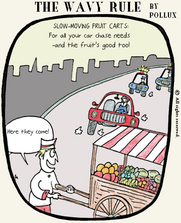
Click on the cartoon to enlarge it!
Read “The Wavy Rule” archive, and “order your Wavy Rule 2008 Anthology today!”:http://emdashes.com/2009/03/the-wavy-rule-anthology-now-fo.php
Palin’s Speech, the Founding Dads, and Hertzberg’s Hilarity
Emily Gordon writes:
So, my dad sent me this very funny–funny for nerds, which is us–link to the corrections to Sarah Palin’s speech by the Vanity Fair literary editor and the magazine’s copy and research departments. (Martin’s already noted it, because he’s quick on the draw that way.)
I sent it on to my dear friends and former employers at The Nation‘s copy department, as I am wont to do, and my fleet former boss, Roane Carey, now the magazine’s managing editor, wrote back with this quotable observation, which, with his permission, I quoth:
I can’t wait to read this, but I also thought parts of Hertzberg’s leader in the latest New Yorker were hilarious–comparing, in sober, reflective language, Palin’s resignation speech with that of the Founders: “And, indeed, her speech had echoes of the document signed in Philadelphia two hundred and thirty-three years and one day earlier.” Hertzberg cites Jefferson on political change, then quotes Palin (unintelligible, of course) on same. More fun than a barrel of monkeys.
I agree. And while I’m sure Hertzberg is as big a Dylanophile as anyone, I wonder if the Talk’s inspired epigraph originated with his boss, since I’ve heard he’s a low-key, Sunday sort of fan o’ Bob.
Hawks, Doves, Loons: Catch Them All in Our Midsummer Grab-Bag
Martin Schneider writes:
Mediaite points out that frequent target of criticism Seymour Hersh had the CIA story right well before anyone else did. This article is fascinating primarily for David Remnick’s candid and inspiring remarks about editing a reporter of Hersh’s caliber.
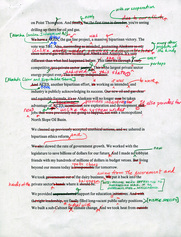
Vanity Fair redlines (actually red-, green-, and bluelines) Sarah Palin’s famously incoherent resignation address of July 3. I copyedit books for a living, so there’ll probably never be a moment of my waking life when this sort of image won’t stir my heartstrings to some extent:
It’s not too late to enter our big giveaway for Laura Jacobs’s new novel The Bird Catcher! Just email us a note, subject line “My favorite bird,” being sure to include your name, address, and … favorite bird, or retweet the relevant Jacobs-related Twitter message from @emdashes, and you’re entered! We’ve been loving the descriptions of the birds people like!
The Wavy Rule, a Daily Comic by Pollux: The Broken Asklepian
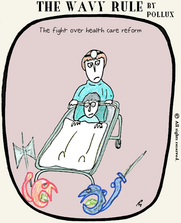
Click on the cartoon to enlarge it!
Read “The Wavy Rule” archive, and “order your Wavy Rule 2008 Anthology today!”:http://emdashes.com/2009/03/the-wavy-rule-anthology-now-fo.php