Martin Schneider writes:
A new issue of The New Yorker comes out tomorrow. A preview of its contents, adapted from the magazine’s press release:
In “The Kindest Cut,” Larissa MacFarquhar looks at the reasons that some people decide to donate organs to total strangers. “Does it seem crazy, giving something that precious to someone for whom you have no feeling, and whom, if you knew him, you might actually dislike?” she asks.
In “Cocksure,” Malcolm Gladwell looks at the concept of overconfidence and the role that it played in the recent economic crisis. “Wall Street is a conï¬dence game, in the strictest sense of that phrase,” he notes: a delicate balance must be maintained between inspiring others’ confidence in your firm and being delusionally self-assured.
In “Renaissance Man,” Rebecca Mead profiles the recently appointed director of the Metropolitan Museum of Art, Thomas Campbell. Although he is an expert in Renaissance tapestries and curated two successful and ambitious shows at the Met over the past ten years, “Campbell did not strike anyone as a director in the making” before his appointment last year, Mead writes.
In Comment, Jeffrey Toobin examines the significance of the questions posed and answers given at last week’s Supreme Court confirmation hearing for Sonia Sotomayor.
In the Financial Page, James Surowiecki explains how fiscal federalism stands in the way of reversing the economic downturn.
In Shouts & Murmurs, Andy Borowitz imagines Britney Spears’s diary entries during her conversion to Judaism.
Calvin Trillin recounts the story of the 2008 murder of three teenagers at an outdoor swimming hole in rural Michigan.
There is a late-night sketchbook by Barry Blitt.
Nicholas Lemann looks at the history of K.G.B. activity in America.
Joan Acocella traces Michael Jackson’s evolution as a dancer and recalls some of his most memorable moves.
Anthony Lane reviews Harry Potter and the Half-Blood Prince and In the Loop.
There is a short story by Kirstin Valdez Quade.
Monthly Archives: July 2009
Walter Cronkite, 1916-2009
Martin Schneider writes:
I think the people who do Emdashes are uniformly too young to remember Cronkite in the role that made him such a ubiquitously admired figure. Speaking for myself, to watch Dan Rather chafe so uncomfortably in the role he inherited was to witness the most palpable sign of Cronkite’s distinction.
Every year, on January 1, the New Year’s Concert, consisting mostly of waltz masterpieces, is broadcast worldwide from Vienna. I watch it most years. For as long as I can remember, Cronkite was the host for the American telecast, and he did a really good job every year. For someone who was supposed to represent “everyman” in some way, he did “high culture” awfully well too. In a way, he embodied the best of America, a sentiment I’m sure we’ll be hearing plenty of in the days to come.
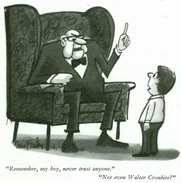
Judging from the archive, The New Yorker never really did a big Cronkite article. Perhaps I missed it. My guess is that he perhaps got very entrenched as a national icon a little too quickly, making a Profile almost irrelevant. As with Michael Jackson, The New Yorker generally approached Cronkite obliquely, in reviews, casuals, and cartoons.
Like this one:
Bliss on the Loose: Interview with New Yorker Artist Harry Bliss
_Pollux writes_:
_New Yorker_ artist “Harry Bliss”:http://www.harrybliss.com/ talks comics with Tim O’Shea in this “interview”:http://robot6.comicbookresources.com/2009/07/talking-comics-with-tim-harry-bliss/. Bliss discusses the creation and distribution of his new book, “_Luke on the Loose_”:http://www.amazon.com/Luke-Loose-Books-Harry-Bliss/dp/1935179004, part of Françoise Mouly’s “_Toon Books_ series.”:http://www.toon-books.com/
Bliss’s last _New Yorker_ cover “depicted”:http://emdashes.com/2009/04/sempe-fi-on-covers-hoppers-bea.php bunnies at a cocktail party. Luke, on the other hand, is a young boy whose interest in New York’s pigeons leads him on a chaos-filled journey through the city.
The Wavy Rule, a Daily Comic by Pollux: Mars Landing (?)
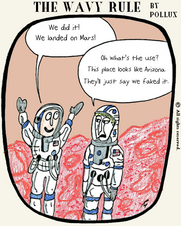
Click on the cartoon to enlarge it!
Read “The Wavy Rule” archive, and “order your Wavy Rule 2008 Anthology today!”:http://emdashes.com/2009/03/the-wavy-rule-anthology-now-fo.php
Book Giveaway: Laura Jacobs’s “The Bird Catcher”

Martin Schneider writes:
Emdashes is delighted to be giving away a copy of The Bird Catcher, the brand-new novel by Vanity Fair contributing editor Laura Jacobs, who’s also the author of the wonderful book Women About Town.
A true New York story, The Bird Catcher has received glowing notices in, among other publications, Booklist and Bookforum. That it’s about real birds as well as swooping and cawing city life and the nests and claws of love can only add to its appeal around these parts; as longtime readers know, both Emily and I have a lively interest in our enviably multicolored and befeathered counterparts. We salute them as vigorously as all of us Emdashers salute quality contemporary fiction.
In addition to the giveaway, we’re very pleased to present a lovely mini-essay from Jacobs herself on the subject of em dashes, below. My paying work is as a copy editor for academic publishers, so I’m fascinated by the interaction between authors and editors. I see one side of that dynamic, but always in a nonfiction context. I could never imagine intervening in a passionate, careful, heartfelt novel as boldly as I redline a study of Eastern European governance. So I understandably find Jacobs’s experiences with punctuation highly interesting. Let’s turn over the page before explaining how to enter our giveaway!
Em Dashes in The Bird Catcher
By Laura JacobsThe editing phase of a novel is quite different than the act of writing a novel, where you are daily pushing your plot forward even as you allow digressions to pull you into corners and shadows and glades. When you are writing, all energy is focused on driving to the finish line, even if the narrative is embedded with flashbacks (a good flashback will eventually rebound into the present). Em dashes, then, those linear bits of combustion, these cognitive bridges, work like spark plugs, synapses, in the story. The final manuscript of my second novel, The Bird Catcher (published in June by St. Martin’s Press), was loaded with em dashes.
But when it was time to go though and clean it up before showing it to prospective buyers, I found myself taking the em dashes out, rather ruthlessly. Much of the novel is thought—the memories and mental wanderings of my protagonist—and the em dashes suddenly looked too “writery” on the page. I told myself, people don’t think in em dashes. And yet I knew from experience that people do think in em dashes, or at least critics do. As a dance critic I rely greatly on the kinetic leap of the em dash—and the spotlight of white space it lands in. But in a novel, I asked myself, were the dashes too much of “telling” when I should be “showing”? In the spirit of postmodernism, even though The Bird Catcher is not postmodern, I removed the em dashes.
Imagine my surprise then, when months later I received the copy-edited manuscript from my publisher. Em dashes had been put back in almost every place I’d removed them, and they’d been introduced into places where commas had been before. I was, how shall I put it, freaked out. What should I do? Remove them a second time? Did the copy editor know something I didn’t know? I felt immobilized, unsure of how to proceed. I decided to consult the masters.
I pulled a recent translation of Leo Tolstoy’s Anna Karenina off the shelf, and also Edith Wharton’s The Age of Innocence. I saw that both books are full of em dashes. Tolstoy’s first em dash appears on the novel’s first page in the third paragraph, and many more follow in this chapter of marital agitation, in which Oblonsky is remembering the recent emotional moment when his wife confronted him with his adultery. Wharton’s first em dash comes on the third page of her novel, in a line of text from the opera Faust: “He loves me—he loves me not—he loves me!—” I’m not sure how the line is punctuated in Gounod’s libretto, but this is certainly how one would hear it, each exclamation floating in the air, a possibility. In fact, Wharton especially liked to end a line of conversation with an em dash, so attuned was she to the unspoken, the unspeakable, and the speechless. Well, if em dashes were good enough for these two writers, they were certainly good enough for me. I let them stand.
Here are the rules: There are two ways you can enter. One is to drop us an e-mail, with the subject line “My favorite bird”; include your favorite bird, your full name, and your mailing address in the body of the e-mail. The other way is to retweet our message about this contest on Twitter; our username is @emdashes, if you’re not already following us. Please mention your favorite bird in the tweet (ha), too. We’ll accept all entries until 8:00 p.m., Eastern Standard Time, on Friday, July 24, and then the Random Number Generator will deliver its negative verdict to every entrant save one. Good luck to all of you!
The Wavy Rule, a Daily Comic by Pollux: Politeness Patrol
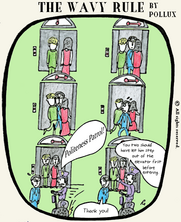
Click on the cartoon to enlarge it!
Read “The Wavy Rule” archive, and “order your Wavy Rule 2008 Anthology today!”:http://emdashes.com/2009/03/the-wavy-rule-anthology-now-fo.php
Finger Pointing: The Future and Fictional Past of New Yorker iPhone Art

_Pollux writes_:
If you’re an art collector on the go, Christie’s iPhone “application”:http://www.christies.com/on-the-go/iphone/ allows you to browse over their auctions in various categories. Christie’s may also soon be adding a live-bidding functionality to this iPhone app, according to “this article.”:http://www.telegraph.co.uk/scienceandtechnology/technology/apple/5836003/Christies-auction-house-launches-iPhone-app.html So if you’ve got an iPhone and a taste for fine art, then your needs will soon be met.
But what if you’re an artist on the go? Back in May, “Jorge Colombo”:http://www.jorgecolombo.com/ showed us the “possibilities”:http://emdashes.com/2009/05/of-pixels-and-pastels-new-york.php of the iPhone’s Brushes app and how it could be used to create a new form of digital art.
Colombo didn’t invent the format, but certainly provided a stimulus to those who want to create fine art but don’t want to be lugging easels or sketchpads around. The “iPhone Art Flickr group”:http://www.flickr.com/groups/brushes/ now has more than 5,000 individual art pieces. _The New Yorker_, keeping its sharp ears close to the ground, has now created a “regular blog”:http://www.newyorker.com/online/blogs/tny/finger-painting/ featuring Colombo’s iPhone-generated finger paintings, which include images of the Apollo Theatre, limo drivers, storefronts, and a musical performance.
This art isn’t just viewable on an iPhone or only online. The Flickr artists are working on the “challenges”:http://www.flickr.com/groups/brushes/discuss/72157621002801140/ of printing out their artwork. And, if you’d like to buy one of Jorge Colombo’s iPhone prints, you can find them for sale at “Jen Bekman’s gallery.”:http://www.20×200.com/aaa/jorge-colombo/
If only the iPhone had been around fifty years ago! I’ve been working on a time machine whose main function will simply be to drop iPhones from the sky onto the desks and drafting tables of _New Yorker_ artists Thurber, Steinberg, Arno, and Covarrubias.
I know this will cause severe alterations in our timeline, like leaving a Mentos wrapper at the scene of Julius Caesar’s assassination in 44 BC or a machine gun at the Battle of Gaugamela, but let’s assume that there exists what I’ve dubbed the Emdashes Traversable Wormhole. This shortcut through space and time will allow us to imagine some beautiful digital art created by artists from a non-digital age.
James Thurber with an iPhone: one wonders if he would have enjoyed using it. His failing eyesight would have certainly presented a problem, but the thought of creating art by means of an electric telephone would have tickled his fancy. Thurber’s intimidating female figures would have thundered their way onto the LCD screen and his dogs would have sniffled sadly as the lines of their bodies were summoned to life by means of Thurber’s trembling finger.
Saul Steinberg would have employed his iPhone Dropped from the Sky to create illustrations perhaps on the scale of his “_Gogol II_ sketch”:http://www.joniweyl.com/v2/description.asp_artistid=54&printid=1735&picid=1786.htm rather than on the scale of his famous, detailed “_View of the World from 9th Avenue_ cover.”:http://www.saulsteinbergfoundation.org/gallery_24_viewofworld.html Perhaps while waiting outside the Galerie Maeght in Paris in 1966, Steinberg may have created on his iPhone a quick sketch like his “_Two Women_ illustration.”:http://www.joniweyl.com/v2/description.asp_artistid=54&printid=1728&picid=1788.htm
In any case, I think Steinberg would have taken to the iPhone immediately. He used a wide variety of media with which to create his art, from rubber stamps to paper bags, and his art, as the “Saul Steinberg Foundation”:http://www.saulsteinbergfoundation.org/life_work.html states, “is about the ways artists make art. Steinberg did not represent what he saw; rather, he depicted people, places, and even numbers or words in styles borrowed from other art, high and low, past and present.”
Colombo’s iPhone-generated “_New Yorker_ cover”:http://www.cartoonbank.com/product_details_zoom.asp?mediaTypeID=2&sourceID=130809&title=New+Yorker+Cover+Print was less a literal depiction than an artist’s impression of city life. In the same way, Steinberg would have used his iPhone as a peripatetic periscope with which to interpret either himself as an artist, “the city in which he lived in”:http://www.saulsteinbergfoundation.org/gallery_22_cities.html, or the “way in which we communicate.”:http://www.saulsteinbergfoundation.org/gallery_09_graphicstandoff.html
Peter Arno is the _New Yorker_ artist whom I consider most likely to have used his iPhone to depict city scenes about him. Like Colombo, he would have sketched, perhaps in the application’s Rough Bristly Brush (the other options are Smooth Brush and Fine Bristly Brush), the limo and cab drivers, the automobiles and airplanes, the socialites and the New York policemen. You can check out his opus “here.”:http://cartoonbank.com/search/peter+arno
An explosion of color and geometry would have occurred once Miguel Covarrubias would have grabbed the phone I would have tossed at him from my time machine (my time machine looks exactly like a “Reliant Regal Supervan III”:http://commons.wikimedia.org/wiki/Category:Reliant_Regal). The Brushes User’s Guide provides the following tip: “When you start a painting, choose your palette of colors and paint a little blob on the canvas for each one. You can then quickly choose colors from your palette by tapping and holding on the blobs.”
I can picture Covarrubias now, quickly tapping away to create “caricatures”:http://www.animationarchive.org/2009/03/caricature-genius-of-miguel-covarrubias.html such as his Al Capone & Chief Justice Charles Evans Hughes; Clark Gable & Edward, Prince of Wales;
and Dr. Samuel Johnson & Alexander Woolcott.
A 1948 “article”:http://www.animationarchive.org/pics/amerart02z-big.jpg on Covarrubias writes of him that “the cold shape of Death was not a familiar in his pictures and he was not weighed down with the shackles of propaganda.” Covarrubias’ iPhone would have become warm with activity and color, unshackled by skulls and unadorned by hammers and sickles.
It’s colorful and interesting, this hypothetical time period of mine. In an alternate history of art and applications for the iPhone, we can see the possibilities of the future through the prism of a fictional past. My next project will involve getting Benjamin Franklin and Gandhi to sign up on Twitter.
The Future of Niche Readership: Ben Greenman Reports
“No teenager that I know of regularly reads a newspaper, as most do not have the time and cannot be bothered to read pages and pages of text while they could watch the news summarised on the internet or on TV.” So declared the 15-year-old Matthew Robson in a “story”:http://www.timesonline.co.uk/tol/news/uk/article6703399.ece in _The Times_ that examined teenager’s consumption (or rejection) of radio, the Internet, music (“they are very reluctant to pay for it”), directories, viral and outdoor marketing, cinema, and mobile phones.
But if publishers are nervously biting their nails after reading the pronouncements of this English teenager, our friends at _The New Yorker_ are a little more optimistic about the future of content and content consumption. Check out _New Yorker_ editor “Ben Greenman’s”:http://www.bengreenman.com/ “discussion”:http://www.mediabistro.com/galleycat/editors/new_yorker_editor_on_niche_readership_121520.asp on _The Times_ story, as well as his discussion on David Remnick’s theory on niche readership.
The Wavy Rule, a Daily Comic by Pollux: “Dysannumize”
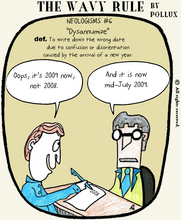
Click on the cartoon to enlarge it!
Read “The Wavy Rule” archive, and “order your Wavy Rule 2008 Anthology today!”:http://emdashes.com/2009/03/the-wavy-rule-anthology-now-fo.php
The Wavy Rule, a Daily Comic by Pollux: Bonds of Friendship
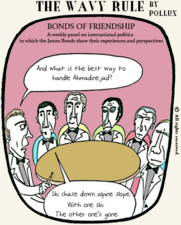
Click on the cartoon to enlarge it!
Read “The Wavy Rule” archive, and “order your Wavy Rule 2008 Anthology today!”:http://emdashes.com/2009/03/the-wavy-rule-anthology-now-fo.php