
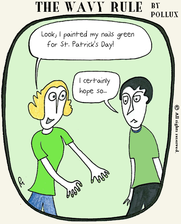
Click on the image for a detailed view!
Monthly Archives: March 2010
The Wavy Rule, a Daily Comic by Pollux: The Falklands War
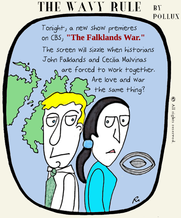
Click on the cartoon to enlarge it!
The Karl Kraus of Killeen? Roy Edroso Headed for Texas
Jonathan Taylor writes:
I’d call him the Wolcott of Williamsburg, but even better to note that anyone writing, on or off the Internet, would do well to aspire to be the Edroso of their environs. Roy Edroso of Alicublog and the Village Voice—profiler of Emdashes, tormentor of conservative bloggers who can’t keep up—announces the imminent shift of his operations to Texas, into the arms of a “girlfriend.” I’ll just pretend it’s Jerry Hall, in light of the way Edroso has lived the life of New York:
More to the point, New York has been my home. It hasn’t always been an easy place to live, but if I was ever bored it was my own fault. Here I’ve been chased by cops in the Tompkins Square riot, and heard Allen Ginsburg [Yeah, yeah, Ginsburg, schminzberg] read poetry there some days after (“Look, I’m wearing a tie — am I a yuppie?”); fretted with my Williamsburg neighbors as the ruins of the Twin Towers smoked on the horizon; walked over the Williamsburg Bridge during a blackout; spilled a giant thug’s beer in a basement after-hours, apologetically bought him a new one, and been rewarded with fat lines of coke; read poetry at St. Mark’s Church; played CBGB so many times I forgot it was a shrine; been advised by Jimmy Breslin on how to talk to cops, handed a flyer by Jean-Michel Basquiat, advised on my music career by Lieber and Stoller, given a tour of Terry Teachout’s art collection, yelled at by Hilly Kristal and several members of the NYPD. And at the Voice I held a desk next to Tom Robbins. Everywhere I met remarkable people, because this is one of the places they like to be, and saw and did remarkable things, because here they happen all the time.
Of course, New York is the most provincial city of all. So often it “dulls the mind and blunts the instrument” (PDF, and worth it) by convincing that it doesn’t. Like those fat lines, it gives a foolproof high by making you want only one thing—it. Edroso doesn’t say exactly where he’s going—giving pursuers a lot of ground to cover—but I’ll say the advantage of being anyplace that’s not “the capital of everywhere” is that the smart people, by definition, have to be interested in the wider world. They should be in the capital, too, yet so many aren’t—and, in truth, aren’t exactly too searching about the capital either.
But Edroso is right about the remarkable people and things, of course, because he is one. And you can tell he has made the most of his New York days, because he’s so cold-eyed about the city, he easily laps its suburban would-be ill-wishers.
Profile: Valerie Casey, Founder of The Designers Accord
For SXSW World, I wrote a profile of Valerie Casey, founder of The Designers Accord and keynote speaker at SXSW Interactive. The Designers Accord brings design thinking to sustainability with stunnning results.
The Wavy Rule, a Daily Comic by Pollux: Daylight Saving Time
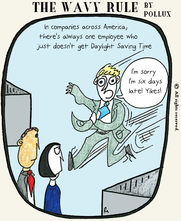
Click on the image for a detailed view!
R.I.P. John Kane, New Yorker Cartoonist, Ukulele Player, Mensch
Emily Gordon writes:
I was very sorry to hear from illustrator and cartoonist Derek Van Gieson that John Kane passed away a few days ago. John, a New Yorker cartoonist, was also a dedicated musician and devotee of that small instrument with a big heart, the ukulele. He sent me many ukulele links and had a YouTube channel dedicated to them; I’ll find it to link to, but right now, the thought makes me too sad.
Here’s Derek writing eloquently on what made John so special.
John may have been getting up there in age by the time I caught up with him, but he was more animated and on the ball than any twelve youngsters combined. He was always going out to exhibitions, learning about some new technology, or improving himself via activities like judo. One of his most recent passions was taking up the uke. He had five models last time I remember. He’d watch Youtube clips and learn from the masters. I know he drove Sam and Sid nuts with all of his uke talk as there was usually something happening in that realm that he was very enthusiastic about. After lunch we’d walk down to the subway and talk music shop or just shop about guitars. He always had a unique theory he was thinking about or a new way of experiencing something that he’d often share. More often than not, I’d come home from The New Yorker luncheons, thinking I was one of the luckiest bastards in the world to be in the court of these fascinating gentlemen. Eventually our friendship became quite solid and if I didn’t make it one tuesday for lunch, either John or Sid would get ahold of me to ask me what the hell happened. I can’t really express how much that meant to me.
But read the whole post. It really captures the person John was, and the person we will all miss whether we were friends, acquaintances (like me), or fans of John’s dynamic, lovable, slightly unhinged cartoons.
The Wavy Rule, a Daily Comic by Pollux: Winds of March
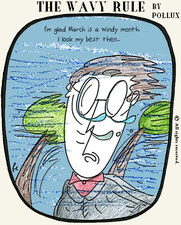
Click on the image for a detailed view!
Loosening Up With Alex Ross
Jonathan Taylor writes:
At the site of Britain’s Royal Philharmonic Society, you can read Alex Ross’s March 8 lecture, “Hold Your Applause: Inventing and Reinventing the Classical Concert.”
At the New Yorker site, you can read Ross’s 2008 piece on the subject, “Why So Serious?“.
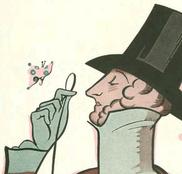
Winging It: What Species is Tilley’s Butterfly?
_Pollux writes_:
What species is Eustace Tilley’s butterfly?
Back in “May 2009”:http://emdashes.com/2009/05/sempe-fi-on-covers-forgotten-l.php I posited the suggestion that Tilley’s nameless butterfly, which to me symbolizes creative inspiration, is a
“Clouded Sulphur”:http://www.mariposasmexicanas.com/colias_philodice_eriphyle.htm, whose scientific name is _Colias philodice_. The Clouded Sulphur’s range includes New York. Is it possible Rea Irvin had a specific butterfly in mind?
Perhaps not. Tilley’s Butterfly, of course, is a symbol rather than a literal depiction of a specific butterfly species, but it’s fun to play the amateur lepidopterist.
What do you think?
At Emdashes we like to speculate and theorize about things like this. It gives us wings. If any professional lepidopterists are reading this, we’d also love for you to share your thoughts.
Cherished and Cursed: Louis Menand and Stephen J. Whitfield Discuss Salinger’s Catcher in the Rye
_Pollux writes_:
“But how so transparently charming a novel can also exercise a peculiar allure and even emit disturbing danger signals may serve as an entrée into post-war American culture…” So writes Stephen J. Whitfield on his landmark commentary on Salinger’s _The Catcher in the Rye_.
Stephen J. Whitfield’s article for the December 1997 issue of the _The New England Quarterly_, called “Cherished and Cursed: Toward a Social History of The Catcher in the Rye,” is considered one of the Journal’s most popular articles.
And, in light of Salinger’s recent passing, Louis Menand will be interviewing Whitfield in a “new podcast.”:http://www.mitpressjournals.org/page/podcasts
Read Whitfield’s fascinating article, listen to the podcast, and join the discussion today!