
Click on the image for a detailed view!
Monthly Archives: March 2010
The Wavy Rule, a Daily Comic by Pollux: Caveat Emptor
Click on the image for a detailed view!
Beat That: James Wood Investigates David Foster Wallace at the 92nd St. Y
Martin Schneider writes:
There is a fantastic event coming up at the 92nd Street Y this month—New Yorker literary critic James Wood does a “First Read” of David Foster Wallace’s adventurous, uneven, maddening, delightful, never-boring short story collection Brief Interviews with Hideous Men. The event is on Monday, March 22, at 8:15pm, and has a hipster-friendly pricing policy: $19 admission, but only $10 for those 35 and younger (ID will be checked, people, so no funny business).
I had the great pleasure of seeing Wood speak at the 2008 New Yorker Festival, and his intelligence, gentleness, and patience were extraordinary. As a longtime fan of Wallace, I’m genuinely excited to hear what Wood has to say about BIWHM (and by no means do I expect it to be entirely positive).
The announcement of this event induced me to discover that, in case you have not seen it already (I have not) and are a Netflix subscriber, John Krasinski’s 2009 adaptation of the collection is currently available to be streamed on Netflix.
Expect a writeup of the event after it happens! And meanwhile, here’s a lengthy account of the enthralling 92nd St. Y event with Frank Rich and Jane Mayer from last spring.
Eustace Tilley Squared — If You Know Where to Look
Martin Schneider writes:
As Pollux noted recently—and our friend Ben Bass posted too—there is a mind-blowing trick in the special four-Eustace 85th anniversary cover of last month. If you place the four covers in the proper two-by-two configuration, the outlines of the original classic Eustace cover can be discerned.
Now we have Adam Kempa’s excellent slider application, which allows you to find it without spreading (multiple copies of) the issue all over your living room floor.
I am endlessly impressed by such cleverness! Françoise Mouly, hats off to you! (A top hat, of course.)
Q: Where Is the U.S.’s Largest Abandoned Subway Tunnel?
A: _Jonathan Taylor writes:_
I was pained by Patricia Marx’s “shopping column on Brooklyn”:http://www.newyorker.com/online/blogs/goingson/2010/03/what-to-buy-in-brooklyn.html in the March 8 issue, but she was correct to highlight the thrilling “tours of the Atlantic Avenue Tunnel”:http://brooklynrail.net/proj_aatunnel.html (also the subject of a 1982 “Talk piece”:http://www.newyorker.com/archive/1982/11/01/1982_11_01_033_TNY_CARDS_000333539 by Bill McKibben).
But that didn’t prepare me for these pictures from a tour of “Cincinnati’s never-completed subway”:http://queencitydiscovery.blogspot.com/2009/03/cincinnati-subway.html (via “Lawyers, Guns & Money”:http://lefarkins.blogspot.com/2010/03/queen-city-subway.html)—they’re a must see.
The Wavy Rule, a Daily Comic by Pollux: Drummer Boy

Click on the image for a detailed view!
The Wavy Rule, a Daily Comic by Pollux: Oscar the Grouch
Click on the image for a detailed view!
Only in The New Yorker, Kids: The Tale of the Cunning Tailor
Jonathan Taylor writes:
At Close Read, Amy Davidson has the last word on the tall crop of Rahm Emanuel tales being told at various firesides:
Would the President’s advisers really take pride in striking a deal to open a new Guantánamo? It’s the sort of bargain a clever tailor in a fairy tale proposes to a bad elf.
Number of Appearances by The New Yorker in Harper’s Index: 2
Jonathan Taylor writes:
- Via the neatly searchable archive of the Harper’s Index, they are:
(Jan. 1993) Percentage of New Yorker articles since Tina Brown became editor whose first sentence includes a person’s name: 70
(July 1996) Chances that a cartoon in The New Yorker‘s Women’s Issue was drawn by a man: 5 in 6 - In the Times Book Review, Craig Seligman shares some (self-) revealing recollections of St. Clair McKelway, on the occasion of a new collection of McKelway’s New Yorker reporting.
- At the Edge of the American West, a historian’s reflection on Paul Krugman’s comments about studying economics versus studying history in the recent New Yorker Profile of him—with some spirited exchanges in the comments. Coincidentally, “Undercover Economist” Tim Harford’s latest column in the Financial Times illustrates the persistence of long-ago history in contemporary outcomes.
- Continuing on the history tangent, I was delighted to see Adam Cohen’s Times Editorial Observer appreciation of the BBC Radio 4 program (and podcast) “In Our Time,” in which Melvyn Bragg harries his academic guests into distilling great topics in civilization into their pithiest essence. (Will Self also wrote about “In Our Time” recently in the London Review of Books.) WNYC’s Laura Walker wrote a letter to the Times defending U.S. radio against the suggestion that it doesn’t host such erudite discussions. But Walker’s counterexamples are telling: All the topics are basically contemporary; none represents the undiluted interest in the past that “In Our Time” exhibits.
- I reviewed Country Driving, by Emdashes fave Peter Hessler, at Bookforum.com.
Sempé Fi: Winter Flapper
_Pollux writes_:
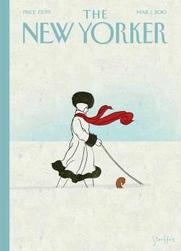
She’s knee-deep in a blanket of pure white snow. She’s out for a walk with her dog. Her faithful dog cannot be seen except for its tail. In fact, the dog is clearing a pathway for her as they make their way through the wintry landscape.
This is the scene depicted in “Brian Stauffer’s”:http://www.brianstauffer.com/bio.html cover for the March 1, 2010 issue of _The New Yorker_, called “Whiteout.”
A cold wind blows the woman’s scarf. She’s wrapped up tightly and stylishly in a fashion reminiscent of the 1920s. In fact, the entire cover evokes the 1920s covers for _Vogue_, which featured images of flappers and glamorous women in a minimal, Art Deco style. The focus of these _Vogue_ covers was on the clothes, on the style, and on the attitude of the Jazz Age. “This”:http://gsahcy2t2drawing.blogspot.com/2009/02/helen-dryden-american-vogue-cover-1922.html 1922 _Vogue_ cover, for example, by the artist Helen Dryden, shows another dog-walking scene, this time from the summer or spring.
With his use of clean inked lines, Stauffer has created a cover that appears both timeless and vintage. For all we know, we could be seeing a scene from the confident 1920s or a scene from these uncertain 2010s.
Stauffer’s young lady knows how to add a touch of glamour and color to the otherwise empty landscape. Her bright red scarf flaps in the wind as confidently as a naval flag. The charcoal-black fur trimmings give her a sense of elegance and sobriety.
Just because she’s out for a walk with her dog doesn’t mean she has to dress down.