
Tired of new writers? Hungering for more from some of the established greats? Then I’ve got good news for you: William Styron’s got a posthumous “collection of fiction”:http://www.observer.com/2008/media/posthumous-fiction-collection-william-styron-be-published-random-house coming out, which will include a chapter from an unfinished novel. Styron, who died in 2006, is best-known, of course, for “Sophie’s Choice”:http://tinyurl.com/6buy3f and “The Confessions of Nat Turner”:http://en.wikipedia.org/wiki/The_Confessions_of_Nat_Turner_%281967%29 (both controversial when they were published), as well as “Darkness Visible”:http://en.wikipedia.org/wiki/Darkness_Visible:_A_Memoir_of_Madness, his well-known memoir about his first struggle with major depression.
If you’re a fan, or interested in learning more, check out “his daughter’s memoir”:http://www.newyorker.com/reporting/2007/12/10/071210fa_fact_styron from the December 10, 2007 issue of The New Yorker, Styron’s own New Yorker “essay “:http://www.newyorker.com/archive/1995/09/18/1995_09_18_062_TNY_CARDS_000372118about about being misdiagnosed with syphillis when he was 19, “audio interviews”:http://wiredforbooks.org/williamstyron/ with the author from 1981 and 1982, or this hour-long “video appreciation”:http://www.charlierose.com/shows/2006/11/03/2/an-appreciation-of-author-william-styron of the author and his work that appeared on Charlie Rose.
Author Archives: Benjamin
You Say “Potato,” and I Say “Victuals”
Benjamin Chambers writes:
Fans of The New Yorker (TNY) “fiction podcast”:http://www.newyorker.com/online/podcasts/fiction may not have noticed, but when author “Mary Gaitskill”:http://www.newyorker.com/search/query?query=mary+gaitskill&queryType=nonparsed&submitbtn.x=0&submitbtn.y=0&submitbtn=Submit recorded her otherwise-excellent “reading”:http://www.newyorker.com/online/2008/06/09/080609on_audio_gaitskill of Vladimir Nabokov’s story, “Signs and Symbols” (or, as TNY’s first fiction editor, Katharine White, preferred for no very obvious reason, “Symbols and Signs”), Gaitskill mispronounced the word “victuals” by reading it as it’s spelled, rather than the correct way: vittles. I didn’t notice it myself, because I’ve always pronounced “victuals” the way Gaitskill does, thinking that “vittles” was just a hillbilly synonym, but otherwise unrelated. (Thanks to “Languagehat”:http://www.languagehat.com/archives/003174.php for setting me straight. When TNY asks me to read for their fiction podcast, I won’t make that gaffe!)
In a similar fashion, another corner of the blogosphere has been busy weighing the merits of “Jared Diamond’s piece “:http://www.newyorker.com/reporting/2008/04/21/080421fa_fact_diamond in the April 21st issue on the comparative value of exacting vengeance vs. the contemporary western justice system. The main post, by Rex (Alex Golub), is excellent, the following (lightly copyedited) segment in particular:
… Diamond fails to think anthropologically even if the people he discusses are stereotypically anthropological subjects. Anthropologists insist that culture is a force which has its own unique power to shape people’s lives and cannot be reduced to an effect of an underlying, deeper cause. So when Diamond remarks that pigs are valuable to highlanders because they (the highlanders) are “protein starved,” an anthropologist is not satisfied. This has probably been true of different places in different times in the highlands … and nutritional needs obviously affect human behavior, but so does culture.
Pigs are always valuable in culturally specific ways. When highlanders in PNG [Papua New Guinea] give pigs, do they exchange live pigs or pork? Who gets the piglets from the live pigs, and who gets the pork when it is eaten? These questions are deeply tied up in issues of nutrition, but they are also culturally structured. Equally, Diamond writes that in Nipa, fighters exhibit “unchecked” aggression, [but] then goes on to describe in detail the culturally specific ways in which they fight: rules regarding engagement (or non-engagement if you have relatives on the other side of the fight) and so forth. So in fact, while the human desire may be universal (and that’s a big ‘may’), so is the fact that it is always shaped and channeled in culturally specific forms. The more you know about people’s lives, the less easy it is to explain them wholly in terms of protein, geography, genetics and what have you.
Nicely put. Wade through the comments, too, if only to watch anthropology wonks in a dust-up. (Hope nobody ended up with a vendetta on their hands!)
Translations from the British (Harry Potter Edition)
Back in April, I posted about The New Yorker’s (TNY) recent propensity for publishing British fiction that (sometimes) requires translation, at least for those of us who grew up talking ’merican instead of the Queen’s English.
Little did I know at the time that the pleasure of doping out the lingo of our cousins across the pond had been systematically stolen from oodles of American readers of Harry Potter. That’s right: the U.S. editions of the Potter books (pre-2000, anyhow) were, um, bowdlerized (albeit unevenly) with the cooperation of the author, as Daniel Radosh reported in the September 20, 1999 issue of TNY.
Unfortunately, the complete version of Radosh’s “Talk of the Town” piece isn’t available online, so I urge those of you with the Complete New Yorker to check it out in its entirety. For the rest of you, here’s a taste:
In the American edition, “wonky” becomes “crooked”; “bobbles” turn into “puff balls”; and “barking mad” translates to “complete lunatic.” “Git,” “ickle,” and “nutters,” however, are left as they are. Why does Father Christmas become Santa Claus, and “bogey” become “booger,” but “budge up” not become “move over”?
Ah, well. Hard enough on the editors as it was, making sure they switched all the single quotation marks for double quotation marks, and vice versa.
Thurber’s Airedale and Other Dogs
Benjamin Chambers writes:
Bet you’ve always wanted to see a snapshot of the (James) Thurber family Airedale. Or cartoonist Charles Addams’ dog. Now you can, thanks to aterrier, a delightfully obsessive blog that tracks famous terriers. Don’t miss the entries on Tintin’s dog, Snowy, or news of a diary by Dorothy’s own Toto.
Richard Yates: Getting His Due at Last
Richard Yates, the toughest and least sentimental of American realists, has been getting a lot of good press lately, as his work is reissued, and it’s high time. After all, he died in 1992, too late to benefit from the attention. (This new appreciation for his work has already become absurd, though, almost before it’s begun. His excruciatingly depressing novel Revolutionary Road has just been made into a movie, starring Leonardo DiCaprio and Kate Winslet, that will be in theaters later this year.)
I’m a huge fan of Yates, mostly because I admire the heck out of Liars in Love, a story collection I recommend as the best introduction to his work. Reading those stories, it’s mystifying that Roger Angell should ever have written, as Richard Rayner reported in the L.A. Times, “It seems clearer and clearer to me that his kind of fiction is not what we’re looking for.”
Nine years after Yates’s death in 1992, though, his story “The Canal” was published in The New Yorker. I wonder if Angell liked it better than Yates’s previous work, or underwent a change of heart.
For a detailed summary of Yates’s sad, angry life and the great fiction it yielded, one can do no better than to read Stewart O’Nan’s passionate essay in The Boston Review. Don’t have time for it? Then I recommend Nick Fraser’s shorter overview, in The Guardian.
If those guys don’t make you want to read Yates, nothing will.
In the House of the Famous Writer: Two Stories by Muriel Spark
I’ve admired Muriel Spark ever since a friend recommended her 1981 novel, Loitering with Intent, which I know I found delightful, though I cannot, now, remember a word of it. But I found other work of hers less congenial, and neglected her until a few weeks ago, when Emily tipped me off to a fascinating 2006 piece by Philip Weiss in The New York Observer chronicling Spark’s relationship with The New Yorker.
The Observer post is actually the second of two, and they’re both worth reading. The first gives an opinionated, informative overview of Spark’s entire oeuvre and a few details of her life. From the second, we learn that Spark was in her most prolific period when she came to TNY‘s attention in the late 1950s, and soon published her most famous novel of all, The Prime of Miss Jean Brodie, in the October 14, 1961, issue. This was news to me, so I went back to my Complete New Yorker and found that, although it is not true, as Weiss claims, that the “entire issue†was devoted to Brodie, as with John Hersey’s Hiroshima in 1946, a significant portion of it was.
That TNY should devote so many pages to her work was a signal honor, and one she was accorded again when much of the May 16, 1970, issue was given over to her bizarre turnoff of a novel, The Driver’s Seat. (Wish I could’ve seen the hate mail for that!) Given this, I found it surprising that she wasn’t mentioned in Ben Yagoda’s About Town: The New Yorker and the World It Made. According to Weiss, she doesn’t appear in other books about TNY either, which is stranger still.
The Observer post led me to the first story Spark published in TNY, “The Ormolu Clock,†from September 17, 1960. A spare portrait of the struggle between the proprietors of two tourist hotels in Austria, the story is a minor but compact gem. The more successful proprietor, Frau Lublonitsch, is complex. Take, for example, the first portrait we get of her:
You could tell … that Frau Lublonitsch had built the whole thing up from nothing by her own wits and industry. But she worked pitiably hard. She did all the cooking. She supervised the household, and, without moving hurriedly, she sped into the running of the establishment like the maniac drivers from Vienna who tore along the highroad in front of her place. She scoured the huge pans herself, wielding her podgy arm round and round; clearly, she trusted none of the girls to do the job properly. She was not above sweeping the floor, feeding the pigs, and serving in the butcher’s shop, where she would patiently hold one after another great sausage under her customer’s nose for him to smell its quality. She did not sit down, except to take her dinner in the kitchen, from her rising at dawn to her retiring at one in the morning.
Compare the Frau, then, with her bedroom, glimpsed briefly by the narrator:
It was imperially magnificent. It was done in red and gold. I saw a canopied bed, built high, splendidly covered with a scarlet quilt. The pillows were piled up at the head—about four of them, very white. The bed head was deep dark wood, touched with gilt. A golden fringe hung from the canopy …
The floor of the bedroom was covered with a carpet of red that was probably crimson but that, against the scarlet of the bed, looked purple. On the walls on either side of the bed hung Turkish carpets whose background was an opulently dull, more ancient red—almost black where the canopy cast its shade.
What in the world, one wonders, is the stolid, monochromatic Frau doing with such a bedroom? It’s an odd juxtaposition, and all the more intriguing for being unexplained.
Strange though the Frau might be, however, “The Ormolu Clock†is firmly realistic, and appears downright bland next to “The House of the Famous Poet,†which appeared in TNY on April 2, 1966.
“House†starts out with its feet planted on terra firma:
In the summer of 1944, when it was nothing for trains from the provinces to be five or six hours late, I traveled to London on the night train from Edinburgh, which, at York, was already three hours late. There were ten people in the compartment, only two of whom I remember well, and for good reason.
Nothing could be more mundane than this: we know the season and the year, and that it’s wartime in Britain. The narrator continues on to describe the two passengers she “remembers well,†a soldier of simian aspect and a young woman named Elise who works as “a domestic helper and nursemaid†in a London house. Elise invites the narrator to stay, and the narrator accepts because “at that time I was in the way of thinking that the discovery of an educated servant girl was valuable and something to be gone deeper into. It had the element of experience—perhaps even of truth, and I believed, in those days, that truth is stranger than fiction.†In other words, the narrator deigns to accept Elise’s invitation because she sees her as a curiosity.
The mundane details pile up (and I don’t mean to suggest, by using the word “mundane,†that they are boring). They arrive at the house, there are V-1 sirens in the background, there’s “a half-empty marmalade jar, a pile of papers, and a dried-up ink bottle.†There’s also “a steel-canopied bed known as a Morrison shelterâ€, and there’s mention of her food rations. The narrator makes much of Elise’s exhaustion; Elise holds an impromptu party, and the narrator heavily underscores how weary everyone is, while gently reminding the reader that there is a war going on: she talks again about the V-1 sirens, and about a young woman who has spent weeks sleeping in an air raid shelter in the Underground.
She is about to leave the next morning when the soldier she met on the train unaccountably shows up, with “an enormous parcel.†He proposes to sell it to her in exchange for his train fare back to camp. When she asks what it is, he says,
“It’s an abstract funeral,†he explained…
He took it out and I examined it carefully, greatly comforted. It was very much the sort of thing I had wanted—rather more purple in parts than I would have liked, for I was not in favor of this color of mourning. Still, I thought I could tone it down a bit.
She packs the abstract funeral into her “holdall†and into her pockets, and she runs out the door for her cab, “with the rest of my funeral trailing behind me.â€
Whoa, Nelly! What’s become of the narrator’s belief that “truth is stranger than fictionâ€? Clearly, she no longer sees any necessary link between fiction and the world of fact. (Certainly, Spark did not. In a brief piece on the Brontës earlier that same year, Spark wrote, “… I believe that fiction should generally be considered a suspect witness (and if it is not stranger than truth, it ought to be) …â€)
After the conventional naturalism of the first three-fifths of the story, Spark’s turn into the surreal is nothing short of vertiginous. The problem is, it violates the implicit contract between the author and reader about what sort of story this is; in the hands of a lesser writer, it would be intolerable. I’m not entirely sure it’s acceptable in Spark’s hands, either, but she knows what she’s done is extraordinary, and so her narrator pivots toward the reader to say,
You will complain that I am withholding evidence. Indeed, you may wonder if there is any evidence at all. “An abstract funeral,†you will say, “is neither here nor there. It is only a notion. You cannot pack a notion into your bag. You cannot see the color of a notion.â€
You will insinuate that what I have just told you is pure fiction.
Insinuate it? I’d’ve told her that flat-out. From this point on, the story is no longer “pure fiction,†and we realize that it never was. It’s about an idea, a “notion†about notions—a meta-notion. On the train, the narrator meets the soldier again, learns that he makes these funerals “by hand,†and that both Elise and the famous poet have bought abstract funerals of their own. The soldier gets off the train, and after it leaves the station, mysteriously reappears.
“You again,†I said…
“No,†he said, “I got off at the last station. I’m only a notion of myself.â€
This is unbearably cute, and it’s the point where I find Spark’s insistence on calling attention to the artifice of her story most irritating. The problem with metafiction and allegory is that they tend to punish the reader. Metafictionists want to frustrate the reader’s conventional, time-worn expectations of plot and character; allegorical writers deform the materials of the tale they are telling in order to make didactic points. Both forms can be intriguing and even perfect for their subject matter, but such instances are exceptions, not the rule.
Still, Spark manages to pull the story out of the hole. The soldier leaves the narrator at last (after some banter about the need for an abstract funeral because one can’t report on one’s own), she throws the abstract funeral out the window, and we are returned, mostly, to the conventional naturalistic story we began with: “In the summer of 1944, a great many people were harshly and suddenly killed…†In fact, we soon learn that both Elise and the famous poet were killed in an air raid just hours after the narrator left the poet’s house, and suddenly their funerals are no longer abstract.
But there are still some odd turns left. For one thing, Spark’s narrator, whenever she is “enraged by the thought that Elise and the poet were killed outright,†invokes not the people who died, but the mundane details of the house. Why? Because “the angels of the Resurrection will invoke the dead man and the dead woman, but who will care to restore the fallen house of the famous poet if not myself? Who else will tell its story?†Spark’s conversion to Catholicism explains the angels, perhaps, but it does nothing to explain the narrator’s focus on the house’s “blue cracked bathroom, the bed on the floor, the caked ink bottle, the neglected garden, and the neat rows of books.â€
Why do those details matter so much? Because they keep the deaths of Elise and the poet from being entirely abstract, are proof that they lived? And why should their deaths matter, when the realistic premise of the entire story has been undermined, the narrator shown to be a puppet master as ruthless with her readers as she is with her characters?
Well, hold those questions a moment. Here’s the story’s last paragraph:
When I reflect how Elise and the poet were taken in—how they calmly allowed a well-meaning solder to sell them the notion of a funeral—I remind myself that one day I will accept, and so will you, an abstract funeral, and make no complaints.
The solider is, of course, the angel of death. He makes people’s funerals “by hand,†he comes and goes as he pleases (regardless of the laws of physics), and is only a “notion†until he becomes terrifyingly real, and the quotidian materials of everyday life—the cracked bathrooms, the dried-up inkwells—in which we invest so much of our emotional lives (as we see the narrator do when she visits the poet’s house) are all that we leave behind, poignant testimonies to our existence—so long as someone survives us who can bear witness. And with this finale, “The House of the Famous Poet†almost manages to have it both ways, to be both a meta-notion and a tragedy.
Or at least that’s how I see the story. I don’t pretend to fully understand it, and in this I’m not alone, for even Robert Henderson, the TNY editor who accepted the story for publication, described himself, according to the Observer, as “a little baffled as well as fascinated” by it. If you’re in the mood for a challenge, I recommend it. Me, I’m going to go re-read Loitering with Intent.
More Adventures in Advertising
Benjamin Chambers writes:
I love The Complete New Yorker, not least because tracking down one item will inevitably set me off on the trails of six other things. And then there are the unexpected surprises. For example, this ad for a Smith Corona word processor, from the October 9, 1989, issue of The New Yorker (click for a larger version):

Having just spent 10 hours at my computer, I simply had to laugh. Still, hindsight is always 20/20, though come to think of it, by 1989, I had put a heck of a lot of mileage on my Macintosh. Much harder to comprehend is this bizarre ad from the April 18, 1959, issue of TNY (click for larger version):
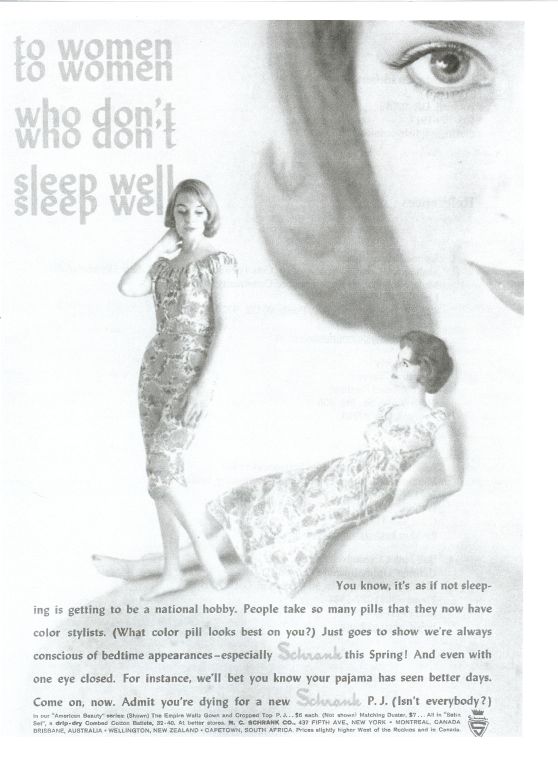
I should have reproduced it in color, but you can still get a sense of how strange a piece of copywriting it is. I’m always skeptical when people complain about things being “written by committee,” but this ad surely was. First, the thinking must have gone, we’ll bewitch bored readers with a headline evoking the double vision of the bleary-eyed sleepless; then we’ll joke about how many barbiturates they’re taking, appeal to their vanity, and then accuse them of wearing shabby PJs. If that won’t hook ’em, nothing will!
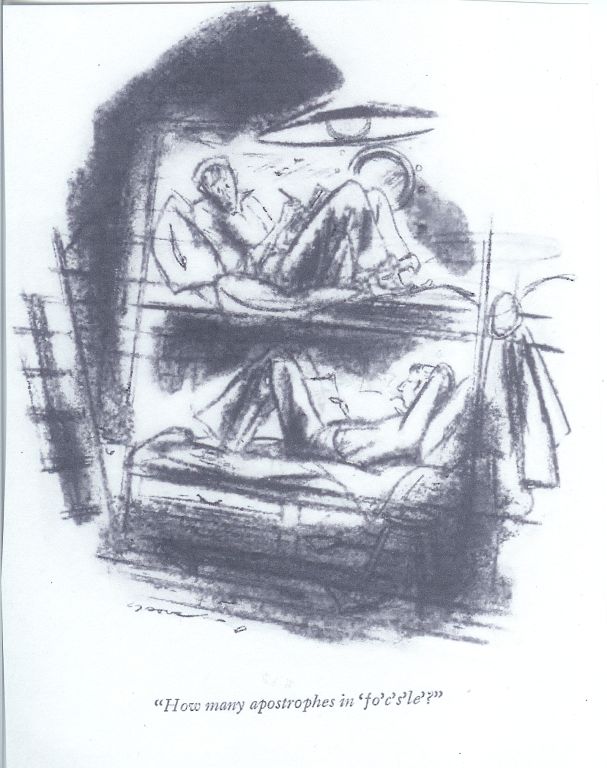
And, though it’s not advertising, I was equally entertained by the Leonard Dove cartoon below, from the May 25, 1935, issue. Only one of his many cartoons for TNY is available at The Cartoon Bank, and unfortunately this is not it. To enjoy a larger version, click here:
More Lorrie Moore and Louise Erdrich
Not too long ago, I raved about the podcast of Lorrie Moore’s story “Dance in America,” which was featured in April on the New Yorker website. Guess that was well timed, because The Collected Stories of Lorrie Moore has recently been published. If you’re late to the Lorrie Moore party (if that’s quite the right word for her hilarious but sad style), you should check out this excellent review.
Meanwhile, Louise Erdrich, who did a stellar job reading and discussing Moore’s story in the podcast, has also come out with a new novel, The Plague of Doves, which has gotten some intriguing reviews. You can read the first chapter at The New York Times or, of course, at TNY, where it first appeared as a story with the same title. I haven’t read either version yet, but I noticed the opening lines differ slightly.
In fact, it looks like all of Erdrich’s recent TNY stories made it into her new novel. Pluto, North Dakota, where Doves is set, was also the setting for her superb story “Demolition,” which I praised at length a couple of months ago, and one of the novel’s main characters is the subject of “The Reptile Garden,” one of the better stories TNY has published this year. That the latter should turn out to be part of The Plague of Doves didn’t surprise me, since it felt more like part of a novel than a short story, but “Demolition” worked so well on its own that I’m curious how Erdrich integrated it into something longer. Now I’ve just got to read the book….
Children Needn’t Be Bored This Sunday
For those of you who, like Ishmael, are suffering from a damp, drizzly November in your soul and require a strong moral principle to prevent you from deliberately stepping into the street and methodically knocking people’s hats off, I’ve got just the thing: this month’s fiction podcast from The New Yorker features a reading of Jean Stafford’s story “Children Are Bored on Sundays,” which appeared in the magazine in 1948.
I was surprised and pleased to see Stafford singled out. Although many of her stories have not dated well, she wrote some gems that have endured. I wouldn’t have chosen “Children,” but I can see why Als finds it emblematic of her work, as well as personally meaningful. Perhaps for the next podcast he’ll go with my own favorite, “In the Zoo.”
(By the way, I wonder why Als chose the story? I thought only fiction writers chose stories for the fiction podcast, but Als, a staff writer and theater critic for the magazine, isn’t a fiction writer, as far as I know. Maybe there’s a surprise in store for us.)
The Lap of Luxury (Hotels), Circa 1958
Benjamin Chambers writes:
One of the sweeter pleasures of paging through the Complete New Yorker is looking at the dated advertising, especially when a copywriter describes, with a flourish of trumpets, amenities we regard as either standard or puzzling.
For example, if you’d been looking for a quiet, upscale hotel in 1958, you’d have done well to choose The Tuscany on 39th Street. I know, because I came across an ad for it while reading a sweet-but-forgettable memoir by Grover Amen in the June 14 issue of that year. (I’ve displayed the ad here for your viewing convenience, much as The Tuscany’s staff would have turned down your bed at night.)

How could you beat a hotel that was the first in the world to have color TVs in every room? Plus, each room had FM and AC, and every guest could count on finding a phone extension in the bathroom: all items at least as breathtaking, apparently, as its rates.
So what else would you get for your money? A “catnap throw†(pillow), butler’s pantry (a small staging area in which to store plates, glassware, and silverware), and a “silent valet†(a rack on which to hang your clothes).
All part of a strategy, it would appear, to net readers of The New Yorker who wanted class, but who were new to travel. These small details imply that prospective guests will be waited on by their own staff of quiet, liveried servants. After all, if one’s room has a “butler’s pantry,†the butler it belongs to has to be there to count the silver, right?
Ah, innocence! Gone now, though I see hotels still advertise silent valets, so maybe we’re still suckers for promises of elegance. But the romance of travel has definitely waned. These days, hotels simply hand over the keys to the mini-bar and don’t even pretend that a genteel staff member will be there to serve you the contents.
Whither The Tuscany? The hotel is still extant, it appears, appropriately upgraded and still advertising a “chenille throw” fifty years later. Imagine all the people who’ve passed through there since (many no doubt loyal readers of The New Yorker).
O, if only those valets could speak!