Author Archives: Jonathan

Supreme Court Design Rules: Certiorari in Century, Please

Jonathan Taylor writes:
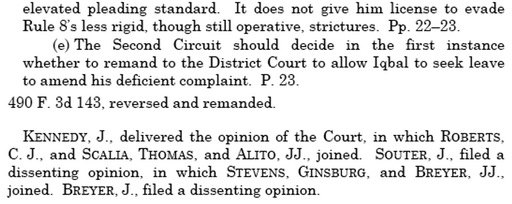
While we’re all talking about the Supreme Court: Anyone who has consulted an order or opinion on the Supreme Court’s site will know its attachment to the PDF, unsurprising given the format’s imperviousness to the vagaries of software. The staid, rather than stately, Century Schoolbook pages caged in one’s screen recall the defiance of David Souter amid the bells and whistles of Washington:
Opinion.png
Turns out the court has some pretty stringent views on typography, and on the crafty task of assembling petitions, briefs and replies into little “booklets” for the justices to curl up with. From the Rules of the Court (PDF, natch, or HTML here):

Rule 33. Document Preparation: Booklet Format; 8½- by 11-Inch Paper Format
1. Booklet Format:
(a) Except for a document expressly permitted by these Rules to be submitted on 8½- by 11-inch paper, see, e. g., Rules 21, 22, and 39, every document filed with the Court shall be prepared using using a standard typesetting process (e. g., hot metal, photocomposition, or computer typesetting) to produce text printed in typographic (as opposed to typewriter) characters. The process used must produce a clear, black image on white paper. The text must be reproduced with a clarity that equals or exceeds the output of a laser printer.
(b) The text of every booklet-format document, including any appendix thereto, shall be typeset in Century family (e.g., Century Expanded, New Century Schoolbook, or Century Schoolbook) 12-point type with 2-point or more leading between lines. Quotations in excess of 50 words shall be indented. The typeface of footnotes shall be 10-point or larger with 2-point or more leading between lines. The text of the document must appear on both sides of the page.
(c) Every booklet-format document shall be produced on paper that is opaque, unglazed, 6 1/8 by 9 1/4 inches in size, and not less than 60 pounds in weight, and shall have margins of at least three fourths of an inch on all sides. The text field, including footnotes, should be approximately 4 1/8 by 7 1/8 inches. The document shall be bound firmly in at least two places along the left margin (saddle stitch or perfect binding preferred) so as to permit easy opening, and no part of the text should be obscured by the binding. Spiral, plastic, metal, and string bindings may not be used. Copies of patent documents, except opinions, may be duplicated in such size as is necessary in a separate appendix.

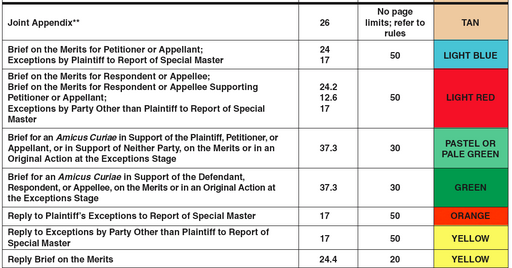
What’s more, there’s color-coded scheme for all those different types of supplications: your ordinary Petition for an Extraordinary Writ goes under a white cover, but a Brief for an Amicus Curiae in Support of the Defendant, Respondent, or Appellee, on the Merits or in an Original Action at the Exceptions Stage has got to be “dark green.” If you’re not sure what “light red” is, or you want to make sure your unglazed “tan” chapbook fairly screams “Brief Opposing a Motion to Dismiss or Affirm,” well, “The Clerk will furnish a color chart upon request”:
CourtColors.png
But note, it’s up to Counsel to “ensure that there is adequate contrast between the printing and the color of the cover.”
(In contrast, I’m a little surprised that, when it comes to adhering to word-count limits, “The person preparing the certificate may rely on the word count of the word-processing system used to prepare the document.” I wouldn’t want to test Clarence Thomas’s generosity with that rule.)
Via the promising site Typography for Lawyers, Ruth Anne Robbins, author of the manual (keep that Adobe Reader open) “Painting with Print,” suggests that the high court’s strictures might be necessary in light of lawyers’ slovenly word-processing habits. From the Journal of the Association of Legal Writing Directors, it’s a passionately footnoted plea for visually illiterate attorneys to wake up and smell the hot metal.

New Museum 90s Panel: Roseanne Profile as Decade’s Time Capsule

Jonathan Taylor writes:
Friday night’s “The 90s vs. The 90s” panel discussion was occupied for a long time on what, either at the time or in retrospect, was “dark” or “light” about the decade, in the words of the moderator, n+1‘s Mark Greif.
The purest vein of nostalgia for the 90s was expressed by Aaron Lake Smith, 25. To him, the “public conversation was more interesting,” because, in its weird way, it was addressing “the roots of capitalism”—why did Columbine happen; Ross Perot and the “giant sucking sound”; the Zapatistas—as opposed to the sham of, say, today’s torture “debate.” Scott Hamrah—once of Suck.com, a URL worth a thousand Q&A’s—was quick to knock down young Aaron’s rosy version, countering that the “conversation” was about O.J., not Subcomandante Marcos.
At a certain point, Marisa Meltzer suggested that the middle period of the 90s was a high point of sorts for the well-being of women, on an arc described between the Anita Hill testimony (1991) and the Lewinsky affair (1998, although Meltzer zeroed in on that year’s premiere of “Sex and the City” as the decade’s Altamont). As evidence of the good times, she cited the 1995 New Yorker profile of Roseanne Barr—”it’s like something beamed to you from some era you never lived through and never will again” she said, or something close thereto.
Quite so. The article is likely overshadowed in many memories by the foofaraw over Roseanne’s consulting-editorship of the 1996 “Women’s Issue.” But after all the talk about authenticity and shallowness, John Lahr’s profile of Roseanne, who might be the closest thing to America’s Bertolt Brecht, is a heartening reminder of the substance that can be created by spectacle.

Bad Markets, Good Art? A Bracing Debate at the NYPL

Jonathan Taylor writes:
On Tuesday I caught a panel discussion called “The Death of Boom Culture?” at the New York Public Library, that I think is worth watching or listening to online once it becomes available. It was a conversation that, precisely in the way the guests were talking past each other, was a fascinating gloss on its topic, or its occasion: this essay by Walter Benn Michaels in the January/February Bookforum. Benn suggests that over the last three decades of rising inequality, literary fiction and other arts have predominantly flattered the prevailing world-view of the economically ascendant, embroidering on safe historical topics (Toni Morrison stood in for this phenomenon) while obscuring the structures of contemporary injustice.
The animated exchanges with David Simon (of “The Wire”), Dale Peck and, especially, Susan Straight, demonstrated how everything Benn Michaels said could be totally right, as far as it went, yet be achingly incomplete. Between his dead-on assessment of the phantom “boom,” and the viewpoint of artists who affirm its devastating realities, there was an interesting obstacle to communication. When Simon or Straight referred to the specific experience they draw on in making art that does do for American society what Michaels wants it to do, he was quick to roll his eyes (he said at one point, “I’m rolling my eyes”) at what he saw as appeals to personal identity. Simon’s gestures to genre narrative, and an audience questioner’s reference to hip-hop culture, pointed to a less narrow view of actually consumed culture that could fit in with Benn Michaels’s polemic—if only he considered it.
That there was no ready set of common terms for talking unflinchingly about an unjust system that all the participants are a part of, is something of a fulfillment of Benn’s critique. But I left more interested in cracking a book of Straight’s to read about “the actual structure of American society.”

Le Clézio Joining PEN Festival Lineup

Jonathan Taylor writes:
An event featuring Jean-Marie Le Clézio, the 2008 Nobel laureate for literature, “in conversation with Adam Gopnik” April 24 at the 92nd St. Y, has been added to the PEN World Voices Schedule (here’s a link to my previous post with festival event picks).
It’s a shame that Le Clézio’s story “The Boy Who Had Never Seen the Sea,” which appeared in The New Yorker after his Nobel win, isn’t freely available online.
PEN press release below:
The PEN World Voices Festival is pleased to announce a very special
Pre-Festival event with Nobel Laureate Jean-Marie Gustave Le Clezio.
This will be Mr Le Clezio’s first major US appearance since being
awarded the Nobel for Literature.
Jean-Marie Gustave Le Clezio in conversation with Adam Gopnik.
Friday April 24 at 8pm
92nd St Y
1395 Lexington St
New York, NY
The 2008 Nobel Prize in Literature was awarded to French writer
Jean-Marie Gustave Le Clézio, the author of more than 40 works. The
Swedish Academy, in announcing the award, called Le Clézio an “author
of new departures, poetic adventure and sensual ecstasy, explorer of a
humanity beyond and below the reigning civilization.”
This event is made possible through the support of The Cultural
Services of the French Embassy and the 92nd St Y Unterberg Poetry
Center.
More information will be available on www.pen.org/worldvoices shortly,
and tickets will go on-sale later today through www.smarttix.com.

Larkin on Larkin: “Again I Feel It Could Be Put A Little More Thrillingly!”

Jonathan Taylor writes:
Confidential to M.S. and anyone else looking for a “cracking” New Yorker–like bathtub reading experience, only British: check out John Shakespeare’s memoir in the Times Literary Supplement of that time in 1956 he sent Philip Larkin a draft of a profile he was writing on him. Oops! Shakespeare reprints the amazing correspondence: “I want to sound more guarded, more complex, more like a person who could possibly write a good poem.”

Croissants, Bagels and the Ottomans: Stop It

Jonathan Taylor writes:
I suppose there’s great reason to think R.O. Blechman is being purposely playful with the phrase “most likely true,” but I’m still irked to see two most likely untrue food-history fancies, about the invention of the croissant and the bagel to commemorate battles against the Ottomans, reamplified in the Times today. Food historians have long doubted the croissant’s connection to the siege of Vienna, noting that known references to it emerged only centuries later. And the Forward recently noted, “Contrary to legend, the bagel was not created (in the shape of a stirrup) to commemorate the victory of Poland’s King Jan Sobieski over the Ottoman Turks in 1683. It was born much earlier in Krakow, Poland, as a competitor to the obwarzanek, a lean bread made of wheat flour and designed for Lent. In the 16th century and first half of the 17th, a ‘golden age for Poland’s Jews,’ the bajgiel became a staple in the national diet.”
Thank you.

PEN Picks: The 2009 World Voices Festival

Jonathan Taylor writes:
For the second year, I’m extremely honored to be hosting a PEN World Voices Festival event for the Austrian Cultural Forum April 30, this year on Franz Kafka and his newly retranslated novel Amerika: The Missing Person. But I’m excited about a lot of other events in this year’s festival, which runs from April 27 to May 3 and is, as usual, a major gathering of international writing genius. Below is the festival press release highlighting many of the events, preceded by a few picks of my own from the lineup (see the site for the full schedule and ticket and reservation details, which vary—many events are free):

  • The pairing of Mark Kurlansky (Cod, Salt, The Basque History of the World) and Raja Shehadeh (Palestinian Walks) to address “how human constructs—industry, war—have marked our surroundings” (April 30) is inspired.
  • I became acquainted with Horacio Castellanos Moya at my Thomas Bernhard event at last year’s festival. He’s as ensorcelling a talker as he is a writer, and an appropriately wily member of the panel titled “Where Truth Lies: A Conversation on the Art of Fiction,” May 2. It is “the first in a series of launch events for the new Center for Fiction in New York City (formerly the Mercantile Library Center for Fiction).”
  • To the other side of the coin: “Is Nonfiction Literature?” I say yes—look how many of the events I’m picking are about nonfiction. This May 3 event relates tangentially to a hobbyhorse of mine. The activists promoting literature in translation in the U.S. are valiant and have a sufficiently arduous task just with regard to fictive “literature,” but it strikes me that there’s little talk of how much we’re also missing out on a world of knowledge, thought and expression conducted in other languages’ nonfiction.
  • I know a lot of people whose eyes were permanently opened to the New York City history around them by Russell Shorto’s The Island at the Center of the World (haven’t read it, but feel like I’ve absorbed a lot via public radio interview osmosis). And the books of Dutch journalist Geert Mak have continually renewed my awareness of the visible marks of change and continuity etched the landscape of Europe, particularly his Jorwerd: The Death of the Village in Late Twentieth-Century Europe. I am definitely not missing their May 3 event with Ian Buruma, “Henry Hudson at 400: Amsterdam and New York City.”

Here’s the PEN press release with more highlights:
The Fifth Annual
PEN WORLD VOICES FESTIVAL
OF INTERNATIONAL LITERATURE
Evolution/Revolution
APRIL 27 to MAY 3, 2009
160 Writers from 40 countries in over 60 events
Laurie Anderson, Paul Auster, Muriel Barbery, Mark Z. Danielewski, Edwidge Danticat, Richard Ford, Neil Gaiman, Philip Gourevitch, David Grossman, Paul Krugman, Nam Le, Rick Moody, Walter Mosley, Péter Nádas, Michael Ondaatje, Richard North Patterson, Lou Reed, Salman Rushdie, Nawal El Saadawi, Hwang Sok-yong, George Soros, Colm Tóibín, Adrian Tomine among this year’s participants.
www.pen.org/worldvoices
New York City, March 25, 2009 – Salman Rushdie and The PEN American Center today announce the program for the Fifth Annual World PEN Voices Festival of International Literature taking place this year Monday, April 27th through Sunday, May 3rd.
Salman Rushdie says, “I’m hugely proud to Chair this celebration of international literature, now in its fifth year and flourishing despite tough times in publishing and beyond. When it seems everything else is shutting down and closing up shop, the writers, editors, poets and playwrights of PEN are opening their arms again to welcome their colleagues from around the globe to New York City. We cannot begin to understand and appreciate the world if we do not read its literature and now, more than ever, PEN’s role in providing a platform for global literary discussion is vital.”
John Makinson, Chairman and CEO, Penguin Group, comments, “The breathtaking scope of the 2009 World Voices Festival is a defiant response to economic adversity, and so it should be. Freedom of expression is an absolute value and all of us – writers and readers, publishers and retailers – need to give it our vocal support in any climate. Penguin and PEN are natural partners. We share a global outlook, common values and a determination to showcase the world’s greatest writing. We are delighted, and honored, to be the premier sponsor of this year’s festival.”
Bringing together 160 established and emerging writers from 40 countries for conversations, panels, readings, and performances for one week in New York City, The PEN World Voices Festival is a truly international literary cultural exchange. Evolution/Revolution is this year’s Festival theme with events that consider how the world changes and how we change. 2009 is a year to mark significant anniversaries – from Galileo’s telescope (1609) to Darwin’s On the Origin of Species (1859), from the Cuban Revolution (1959) to the collapse of Communism across Eastern Europe (1989) and Tiananmen Square (1989) – and in this year’s Festival, writers from every hemisphere will consider the many meanings of change, in science and religion, art and politics, language, music and, of course, literature.
2009 Festival Highlights include:
• Evolution/Revolution Opening Night with internationally acclaimed writers reading in their original languages as their words are projected on screens behind them in English with Muriel Barbery (France), Narcís Comadira (Spain/Catalonia), Jose Dalisay (Philippines), Edwidge Danticat (US/Haiti), Péter Nádas (Hungary), Sergio Ramírez (Nicaragua), Salman Rushdie (India/US), and Raja Shehadeh (Palestine).
• Economic Crisis and How to Deal With It with the world’s leading economic minds including Paul Krugman, George Soros, Senator Bill Bradley, Niall Ferguson, Nouriel Roubini, and Robin Wells.
• The Fourth Annual Arthur Miller Freedom to Write Lecture by Egyptian writer, activist, and one of the leading cultural and political voices of our times, Nawal El Saadawi. Previous lectures have been delivered by Orhan Pamuk, David Grossman and Umberto Eco.
• Conversations between some of the most intriguing and creative writers at work today: Muriel Barbery and Adam Gopnik; Mark Z. Danielewski and Rick Moody; Enrique Vila-Matas and Paul Auster; David Grossman and Leonard Lopate; Péter Nádas and Daniel Mendelsohn; and Richard Ford and Nam Le.
• The enormously popular PEN Cabaret, promising to be epic, with performances by music legends and cultural icons Lou Reed and Laurie Anderson, readings by Walter Mosley, Horacio Castellanos Moya, Mark Z. Danielewski, and Nick Laird, an adaptation of Jonathan Franzen’s New York piece from State by State featuring Parker Posey, James Franco, Peter Hirsch, Carrie Brownstein, and Sean Wilsey…and more!
• Three back-to-back sessions with the most innovative and cutting-edge graphic artists on the planet including Neil Gaiman, Yoshihiro Tatsumi, Adrian Tomine, Shaun Tan, David Polonsky, and Emmanuel Guibert (attend all 3 events for $25!)
• A celebration of the 20th anniversary of the original Pan-European Picnic when Austria and Hungary symbolically opened their border for a few hours and hundreds of East Germans flooded into Austria while guards stood idly by and history was made. This extraordinary open-air event at DUMBO’s Empire Fulton Ferry Park will feature the three essentials: music, food, and literature.
• Celebrations of the lives and work of playwright Harold Pinter, Sudanese author Tayeb Salih, Cuba’s Reinaldo Arenas and the Mallorcan poet Blai Bonet.
• Defiance: The Spirit of ’89 is an evening to celebrate the power of one person standing against tyranny — as iconically demonstrated by one unidentified man facing down a column of tanks at Tiananmen Square on June 5, 1989 — with Eszter Babarczy, Jose Dalisay, Nick Flynn, Sergio Ramírez, Hwang Sok-yong, János Térey, and Paul Verhaeghen.
• A night of unabashed, old-fashioned storytelling from The Moth with Salwa Al Neimi, Jonathan Ames, Petina Gappah, László Garaczi, and Salman Rushdie.
• A star-studded Around the Globe adventure at the 92nd St Y featuring Bernardo Atxaga (Spain), Petina Gappah (Zimbabwe), Mariken Jongman (Netherlands), Michael Ondaatje (Sri Lanka/Canada), Daniel Sada (Mexico), Hwang Sok-yong (Korea), Antonio Tabucchi (Italy), and Colm Tóibín (Ireland).
• Jazz: The Revolution of Beat — Four American writers, including legendary jazz critic Gary Giddins and American poet Bill Zavatsky, explore the birth and life of jazz and how it relates to the written word, with musical accompaniment by the Diane Moser Quintet.
• Henry Hudson at 400 Years: Amsterdam and New York City with Dutch authors Ian Buruma and Geert Mak joining US novelist Russell Shorto to celebrate and discuss the Dutch Influence on America and New York and vice versa.
PEN American Center is the largest of the 141 centers of International PEN, the world’s oldest human rights organization and the oldest international literary organization. International PEN was founded in 1921 to dispel national, ethnic, and racial hatreds and to promote understanding among all countries. PEN American Center, founded a year later, works to advance literature, to defend free expression, and to foster international literary fellowship. The fifth annual World Voices Festival for International Literature is chaired by Salman Rushdie and directed by Caro Llewellyn.
The PEN World Voices Festival is made possible by the generous support of many co-sponsors, partner organizations, cultural agencies, and individual donors. The Premier Sponsor for this year’s Festival is The Penguin Group, and Sponsors are Bloomberg, Borders, The Kaplen Foundation, LJK Literary Management, National Endowment for the Arts, Random House, Rodale and The Roger Smith Hotel.
Internationally acclaimed writer Michael Ondaatje, participating this year in his third World Voices Festival, considers the event “a great celebration as well as an essential discovery of writers around the world.” Join him and 159 other remarkable participants in New York City at the 2009 PEN World Voices Festival, April 27 – May 3.
For a full schedule of Festival events and a complete list of participating authors,
please go to www.pen.org/worldvoices
The New Yorker’s Guilty Pleasure: Thurber, Adler, Kincaid All Wrote About Soaps

Jonathan Taylor writes:
On Wednesday, CBS announced the cancellation of soap opera “Guiding Light,” which began on radio in 1937, making it the “the longest-running scripted program in broadcasting history,” according to the Times (which also links to some original audio from the show’s radio days).
For whatever reason, soap operas have been a source of continual fascination for The New Yorker. They’ve probably pushed a few buttons about “culture,” and the “pop” variety thereof. I would give a lot to sit down on the sofa with Renata Adler and a box of wine on a 1972 afternoon for some proto-hatewatching. Maybe that’s not quite the right word, but in her “Unhappiness Enough, and Time,” Adler concluded: “There does not seem to be a single sense in which soap operas can be construed as an escapist form.” Also: “One thing about a work of art is that it ends.”
(The abstracter of this article didn’t seem to get into it: “Overall look at television soap opera” is the entire thing.)
James Thurber’s 1948 “Soapland” was a really overall (five-part!) look at the radio soaps. He investigated “the early pioneers in that field” and described their focus on “the plights and problems of small town characters stretched into endless sequences,” isolated from broader “social consciousness”; he focused on the writers of the soap stories, and then on the “players”; and Thurber wrapped up with a consideration of the “listening women” (the audience) and the future of soaps on…television.
Among the truly numerous Talk stories about soap operas: The 1975 final taping of NBC’s “How to Survive a Marriage” was covered. In 1978, Jamaica Kincaid attended the First International Soap Opera Exposition. Somewhat less sniffy is a 2001 piece (available online) about a real nurse who consulted for soaps, and had even appeared on “One Life to Live.”
Soaps have provided also fodder for fiction by S.J. Perelman and Constance Schraft.
Cartoons are a whole other story, I imagine….

From the 5¢ Token to the $103 Monthly Unlimited: ‘The Subway Fare Problem’ in The New Yorker

Jonathan Taylor writes:
Although the one voted today really is the most shocking in recent memory, subway fare hikes are perpetual grist for New Yorkers’ mills—as seen in The New Yorker‘s own archives: from the 1927 two-cent hike proposal that went all the way to the Supreme Court, to the introduction of the $2 fare, subject of a 2003 Talk piece.