
How extraordinary that Emily chose this evening to post about Peter J. Boyer. I, too, listened to that podcast today, and I, too, enjoyed it.
I found one aspect of the interview puzzling. The subject of the article is the phenomenon of Keith Olbermann as an outlet for liberal rage, and what that phenomenon is doing to MSNBC and, by extension, NBC News. In no way do I mean it as a criticism of Boyer or The New Yorker to wonder how it was that the name “Brian Williams” wasn’t mentioned once in the podcast.
I like Williams–I think he’s my “favorite” anchor–but, as a category, that has about as much meaning these days as a preference for Ann Landers over Dear Abby. But it’s a curious testimony to … the newfound irrelevance of anchors? the ineffectual tenure of Williams himself? I’m not sure.
I went back and looked at the article. Sure enough, there’s plenty of stuff about Brokaw, the “hall monitor” of the sprawl—the entire story is structured as the battle between Olbermann and Brokaw for the very soul of NBC News—but just a few bland references to Williams.
I guess Williams has a tough job; he’s angling for attention smack in the middle of a gaggle of on-air personalities that, on all of those recent primary election nights anyway, included Brokaw, Olbermann, Chris Matthews, Tim Russert, Chuck Todd, and who knows who else. I admire Williams’s stated commitment to making NBC News more “transparent”; perhaps, in the rush for Keith’s ratings, that directive has not gotten the attention it ought; such, anyway, appears to be Boyer’s thesis. Or maybe for all of Williams’s persuasive suavity, he’s not so good at being the center of attention—odd trait, for an anchorman.
Agree? Disagree? Post a comment!
Category Archives: Hit Parade
Everybody Loves Rea Irvin
That’s the headline for a story by me in the hot-off-the-presses Print magazine, in a special issue on type. Ever wonder who was behind Eustace Tilley–and hundreds more iconic images and visual features (including the famed “Irvin type”)–in the first decades of The New Yorker? There’s so much more to say about this spectacular moment in graphic history, and particularly about what came before it, but this is a start. And it was incredibly fun to write. Since I had limited space to acknowledge the many people who provided documents and contacts for the story, I’ll give three grateful cheers here to cartoonist Liza Donnelly and to Dorothy Parker Society sagamore Kevin Fitzpatrick. They have both been incredibly generous with their resources and thoughts.
Very soon, we’ll run the contest I mentioned the other day. It’s a doozy! And I’ll tell you what our interns will be up to this summer, too. And if you haven’t heard about this, here’s some welcome news about two new Joseph Mitchell reissues, one of which has a new introduction by David Remnick. I can’t agree that Mitchell “is perhaps most remembered not for his writing, but for not writing,” but there’s never anything wrong with new readers for this peerless writer of New York’s proud populations, human, aqueous, and otherwise.
Introducing “The Wavy Rule,” a New Emdashes Comic by Paul Morris
We’re delighted to announce that Emdashes will be publishing a daily comic by friend and fellow New Yorker admirer Paul Morris, on themes typographical, historical, and technological, on personalities of all kinds, and, of course, on the magazine past and present. It’s called “The Wavy Rule” in honor of Rea Irvin‘s signature squiggly line.
Born in Beverley, England, Paul has a B.A. in History from UCLA and a Master’s in History from Brown University. Since 2006, he’s written and drawn a webcomic called “Arnjuice.” You can see more of his work on his Flickr page, and he has collections for sale at Lulu. He’s currently studying graphic design at the Art Institute of California, Los Angeles.
We’re so pleased to have him drawing for us–we think he’s a perfect addition to the crew. If there’s a New Yorker-related or other idea you’d like see Paul draw, please email us and we’ll pass it along for his consideration. After the jump, the first installment of “The Wavy Rule,” inspired by Paul Goldberger’s recent story “The Forbidden City,” about the makeover of Beijing.

Richard Yates: Getting His Due at Last
Richard Yates, the toughest and least sentimental of American realists, has been getting a lot of good press lately, as his work is reissued, and it’s high time. After all, he died in 1992, too late to benefit from the attention. (This new appreciation for his work has already become absurd, though, almost before it’s begun. His excruciatingly depressing novel Revolutionary Road has just been made into a movie, starring Leonardo DiCaprio and Kate Winslet, that will be in theaters later this year.)
I’m a huge fan of Yates, mostly because I admire the heck out of Liars in Love, a story collection I recommend as the best introduction to his work. Reading those stories, it’s mystifying that Roger Angell should ever have written, as Richard Rayner reported in the L.A. Times, “It seems clearer and clearer to me that his kind of fiction is not what we’re looking for.”
Nine years after Yates’s death in 1992, though, his story “The Canal” was published in The New Yorker. I wonder if Angell liked it better than Yates’s previous work, or underwent a change of heart.
For a detailed summary of Yates’s sad, angry life and the great fiction it yielded, one can do no better than to read Stewart O’Nan’s passionate essay in The Boston Review. Don’t have time for it? Then I recommend Nick Fraser’s shorter overview, in The Guardian.
If those guys don’t make you want to read Yates, nothing will.
Libretto: Oratorio for Spin and Ten Flacks
Alex Ross is right. This compilation of news footage, compiled by the dogged geniuses at Talking Points Memo, is sublime. (It’s a lengthy series of clips of Bush administration officials, mostly, explaining why Scott McClellan’s book has come as such a doggone surprise to them.) As Ross notes, the compilation is diabolically edited in such a way as to maximize the musique concrète quotient of the speech acts. Which of course also has the effect of dramatically boosting the perceived inanity and desperation of the speech acts.
In an effort to help out, I have charted out a kind of score or perhaps libretto of the major themes of the piece, in the event that anyone wants to mount a production at the Met someday. Peter Gelb, call me.
Even without the Harry Partch angle, the mere fact of Ari Fleischer ruminating about how he is all “heartbroken” makes my very heart sing.
Full text after the jump.
Oratorio for Spin and Ten Flacks
“Anger”
“Shock”
“Confusion”
“Out of the loop”
“Out of the loop”
“He shouldn’t have been in those loops”
“He wouldn’t have been”
“He wasn’t in the meetings”
“Was he at the meetings?”
“Frankly I don’t recall Scott being at a lot of those meetings”
“I was there”
“I saw it”
“I saw it a lot more than Scott did in fact”
“I think his view is limited”
“He didn’t have the right access”
“What was said behind closed doors”
“Puzzled”
“Puzzled”
“Puzzled”
“Puzzled”
“Puzzled”
“Puzzled”
“Puzzling”
“Puzzlement”
“Puzzled”
“Perplexing”
“Perplexing”
“Puzzling”
“Scratching their heads”
“Scratching their heads”
“Scratching my head”
“Scratching our heads”
“Baffling”
“Bewildered”
“Shocked and surprised”
“Shocked and saddened”
“Shocked
“Surprised”
“Disappointed”
“All of the above, maybe?”
“It’s kind of hard to make head or tails of it”
“It’s kind of out of left field”
“Surprised”
“Puzzled”
“Puzzled”
“Puzzled”
“Puzzling”
“Puzzling”
“Puzzling”
“Puzzling”
“Puzzled”
“Puzzled”
“Puzzled”
“A book that doesn’t make sense”
“Make no sense”
“Something is wrong”
“Smething doesn’t add up”
“It doesn’t match”
“It doesn’t match”
“It doesn’t match”
“It doesn’t match”
“It doesn’t match”
“It doesn’t add up”
“I can’t figure it out”
“We were so surprised”
“Not just puzzled”
“Puzzled and surprised and disappointed and saddened”
“Saddened by it”
“I thought his heart was in it”
“I’m heartbroken”
“I just don’t understand it”
“It’s so hard to understand”
“I still don’t understand”
“I still can’t understand”
“It’s just too hard to understand”
“I am stumped”
“I am really stumped”
“I just am so stumped”
“I’m stumped and I’m stunned”
“You said you were stumped”
“I’m still stumped”
“That’s what leaves me kinda heartbroken”
“It’s so horribly unfair”
“I feel like crying”
“This is heartbreaking to me”
“I find this whole thing heartbreaking”
“Heartbroken”
“So heartbreaking”
“This doesn’t sound like the Scott McClellan folks knew”
“This is not the Scott we knew”
“This is not the Scott we knew”
“This is not the Scott we knew”
“This is not the Scott McClellan we knew”
“This is not the Scott McClellan I’ve known for a long time”
“It’s a different Scott”
“Maybe this is a new Scott”
“Maybe this is a new Scott”
“Almost like a out-of-body experience”
“Scott’s words don’t even sound like Scott”
“This doesn’t sound like Scott”
“This doesn’t sound like Scott”
“What did Scott sound like?”
“You’d know how Scott sounds”
“Scott’s a soft-spoken person”
“Scott was known for sitting quietly”
“Sounds like somebody else”
“Sounds like a left-wing blogger”
“Scott uses the very same words as the far left uses”
“Moveon dot org”
“The John Kerry campaign”
“The DNC”
“Even Dan Rather during the 2004 campaign”
“Did you have a ghostwriter?”
“The editor tweaked the content”
“Tweaked it?”
“That’s the way Scott put it to me”
“The publisher didn’t hold a gun to Scott’s head”
“He held a checkbook”
“I don’t know”
“I don’t know”
“His disgruntlement”
“Sad and disgruntled”
“Scott, we now know, is disgruntled”
“Disgruntled”
“He was not a happy camper”
“Disgruntled employees”
“Disgruntled”
“Sitting on the front porch swinging in Crawford with Scott”
“Didn’t sound like he thought he was ever going to sit on that swing”
“Total crap”
“Total crap”
“Total crap”
“Scott uses these very inflammatory words like shading the truth”
“Total crap”
“I actually don’t care”
“I’m more concerned with American Idol”
“I care more about American Idol”
“Need any brownies or anything?”
Praise Be: America Extols Summer Fiction Issue
Martin Schneider writes:
I agree with the editors of America, the national Catholic weekly, that the most recent Fiction Issue may have represented a stealthy way of having a “Faith” issue in America’s most prestigious secular magazine. They note that “the magazine’s literary critic, James Wood, wrote a 4,000-word essay on the problem of theodicy, a term one does not often encounter in the pages of Eustace Tilley’s journal.”
America can cheer in recent hire Wood, then, because the guy has mentioned theodicy in five different articles so far! And, of course, the magazine does mention The Brothers Karamazov quite a lot, which is almost as good.
It will surely further cheer America that James Wolcott didn’t like all the wintry God stuff.
Myself, I have no objection to an emphasis on rabbinical or Jesuitical disquisition in the magazine. But June?
“Every Person in New York” Lad Also Fab New Yorker Cartoonist
Gawker and the Post are marveling at Jason Polan today; he wants to draw every person in New York. Who doesn’t? Anyway, it’s most important not to forget this about the energetic Polan: He drew one of what I believe is one of the Cartoon Bank’s best-selling New Yorker cartoons, to wit, “I usually do two hours of cardio and then four more of cardio and then two more of cardio.†It’s the sole cartoon of his that’s appeared in the magazine to date, but what a cartoon! I hope some pretty cash results from this new endeavor, and an extra-large fruit, nut, and vegetable stick, or whatever his whirling heart desires.
The New Yorker Conference Is Quotable: Day One
Martin spent the day yesterday flying down the heady waterslide that is the New Yorker Conference, where inventors, scientists, politicians, filmmakers, programmers, musicians, and others with an eye on the daunting/thrilling place that is the future talk with New Yorker editors and writers about their work. Now in its second year (it’s timed to go with the apparently now annual Innovators Issue), it’s a brainy mini-marathon, punctuated by sweeping visual effects (thanks in great part to Frank Gehry’s floaty IAC Building) and fancy snacks.
All of which I was sorry to miss this year, along with the strong and welcome sense that I had become smarter in a single day. Luckily for us, Martin got back from Austria just in time to attend, and is even now being walloped with more visionary ideas, but in the meantime, he’s collected some of the most memorable lines from the first set of conference conversations. Kottke has been blogging the conference as well (and made the magazine’s new Twitter feed), and we can look forward to hearing more from Martin soon. Will some of the talks be available later on video? As a low-tech guru once said, signs point to yes. —EG
“Malcolm Gladwell has a new book coming out next year. It has already sold two and a half trillion copies.” —David Remnick
“Imagine this enormous room filled with incredibly sweaty teenagers with teeth missing.” —Malcolm Gladwell
“Scouting combines are, for lack of a better word, a disaster.” —Malcolm Gladwell
“I don’t think anyone could look at the President of the United States and not conclude that we have a massive mismatch problem.” —Malcolm Gladwell
“Ninety-nine percent of what policemen do is relational—resolving disputes and so on. So why are all cops big beefy guys?” —Malcolm Gladwell
“More politicians should screw up more often.” —Gavin Newsom
“I was trying to figure out why I am speaking third today. I think I was the top choice of all the sports combines.” —Andy Stern
“Change is inevitable; progress is optional.” —Andy Stern
“S.E.I.U. had to go from a lapdog of a political party to a watchdog for its members.” —Andy Stern
“Originally ‘Workers of the world unite’ was an ideological formulation; now it is a practical one.” —Andy Stern
“I am a very bad caffeine metabolizer.” —Michael Specter
“Rapidity in genetics is higher than Moore’s Law.” —Michael Specter
“For geeks like me, sexual data repositories are heaven.” —Michael Specter
“Drugs on average only work on 40 percent of the people who take them.” —Linda Avey
“Earwax is, you know, breathtaking.” —Anne Wojcicki
“We used to think, ‘We’ll figure out the gene for breast cancer, we’ll figure out the gene for Parkinson’s, we’ll figure out the gene for why I talk too much.'” —Michael Specter
“Anyone here seen those old James Bond films? Well, you’re looking at Q—actually, Q’s boss.” —Eric Haseltine
“Intellipedia is the single greatest advancement in the intelligence community since 9/11, and it cost zero dollars and took eighteen months.” —Eric Haseltine
“In the Cold War, the NSA came to mirror the Soviet Union.” —Eric Haseltine
“You cannot kill an idea with a bullet. You have to kill it with a better idea.” —Eric Haseltine
“Intelligence isn’t neat gadgets. Intelligence is computers and math.” —Eric Haseltine
“We developed a robotic hand but it developed arthritis.” —Yoky Matsuoka
“I have Duncan Sheik to thank that in my house, ‘Some Enchanted Evening’ now segues into a song called ‘Totally Fucked.'” —Susan Morrison
“Rock and roll in musicals—it’s like seeing your grandmother in a hula hoop.” —Duncan Sheik
“Of all the continents in the world, the one with the most hybridized conditions is Africa.” —David Adjaye
“These are like the three coolest chefs you will ever see in your life.” —Bill Buford
“Twenty-five years in Switzerland is maybe enough.” —Daniel Humm
“If you don’t go nuts in the kitchen at least once a day, it’s not worth it.” —Marc Taxiera
“I always think when a new season comes—this is my favorite season.” —Daniel Humm
“I think New York has more than four seasons. It has like twelve seasons.” —Daniel Humm
“Cooking is the only profession I know where you get to act like a buffoon all day with your friends.” —David Chang
“I can tell a California cook from a New York cook any day of the week—they’re slower…. I’m calling out all of California, pretty much.” —David Chang
“This is why I became a writer—my grandmother sucked in the kitchen.” —Bill Buford
“Ten years ago everyone wanted to have an omelet.” —Bill Buford
“The Berlin Wall fell in 1989. It’s probably the most important economic event in any of our lifetimes.” —Michael Novogratz
“Ramen noodles is everyone’s friend during two-dollar-a-day week.” —Amy Smith
“The truth is, there are ingenious people everywhere.” —Amy Smith
“I found out that most of these divas, whether Italian or American, were attached to needlework.” —Francesco Vezzoli
Note: Certain quotations altered very slightly to make comprehension more seamless. Not that short-term memory is flawless anyway.
The Lap of Luxury (Hotels), Circa 1958
Benjamin Chambers writes:
One of the sweeter pleasures of paging through the Complete New Yorker is looking at the dated advertising, especially when a copywriter describes, with a flourish of trumpets, amenities we regard as either standard or puzzling.
For example, if you’d been looking for a quiet, upscale hotel in 1958, you’d have done well to choose The Tuscany on 39th Street. I know, because I came across an ad for it while reading a sweet-but-forgettable memoir by Grover Amen in the June 14 issue of that year. (I’ve displayed the ad here for your viewing convenience, much as The Tuscany’s staff would have turned down your bed at night.)
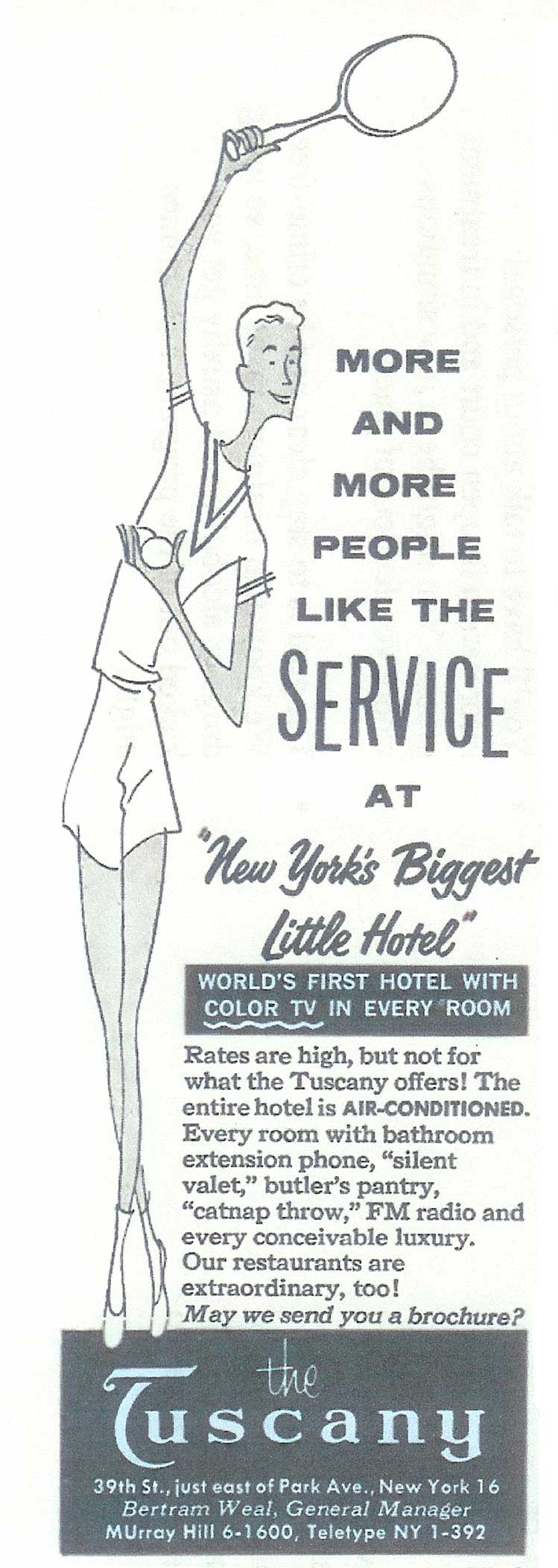
How could you beat a hotel that was the first in the world to have color TVs in every room? Plus, each room had FM and AC, and every guest could count on finding a phone extension in the bathroom: all items at least as breathtaking, apparently, as its rates.
So what else would you get for your money? A “catnap throw†(pillow), butler’s pantry (a small staging area in which to store plates, glassware, and silverware), and a “silent valet†(a rack on which to hang your clothes).
All part of a strategy, it would appear, to net readers of The New Yorker who wanted class, but who were new to travel. These small details imply that prospective guests will be waited on by their own staff of quiet, liveried servants. After all, if one’s room has a “butler’s pantry,†the butler it belongs to has to be there to count the silver, right?
Ah, innocence! Gone now, though I see hotels still advertise silent valets, so maybe we’re still suckers for promises of elegance. But the romance of travel has definitely waned. These days, hotels simply hand over the keys to the mini-bar and don’t even pretend that a genteel staff member will be there to serve you the contents.
Whither The Tuscany? The hotel is still extant, it appears, appropriately upgraded and still advertising a “chenille throw” fifty years later. Imagine all the people who’ve passed through there since (many no doubt loyal readers of The New Yorker).
O, if only those valets could speak!
Everything–Bagel–Is Illuminated
Emily Gordon writes:
What do you get for the man who has everything? Why, the everything bagel, of course, whose varicolored, multiflavored origin story Michael Schulman investigated in this week’s New Yorker. Founding father David Gussin, whom Schulman interviewed, was also just on the radio, talking to NPR about the triumph of miscellany and the inevitable controversy: Seth Godin remembers seeing the seedy-oniony rings of starch B.E., or Before Everything, which date Gussin sets at 1980.
I called Jerry, who’s been working at the uptown H&H since 1985, when he was a teenager with a summer job. When did everything begin? “I should know this, because I kinda helped it. Let me see–it was invented before we made it. I was a cashier, and customers kept requesting it. It took about a year to put it together. This was back in 1985, 1986, 1987…” I told him the date has been set at 1980. “That makes sense, because when I was working on the weekends in high school, I kept hearing about it, but I never had one. I kept getting requests–it has a very strong aroma–but people would say, ‘It’ll never sell. It’s a gimmick.’ It’s one of our best sellers.”
Want to play bagel God? Make some yourself, and have the satisfaction of saying, “You are my Everything.”