
Some months ago, an Emdashes reader in Grand Rapids, Mich., named Michael Zalewski (who isn’t related to editor Daniel, as far as he knows) wrote me this fascinating letter. I know at least one person who will find this very relevant indeed!
While on Cape Cod recently, I bought 1934 edition (second printing) of Alexander Woollcott’s While Rome Burns. Upon opening the book there were several New Yorker cartoons of Woollcott pasted to the inside of the book.
In addition, I found an envelope postmarked 4:30 p.m. 1933 Grand Cent. Annex N.Y. 14, addressed to John Stewart Mosher, Esq. of Philadelphia, Pa.
Inside the envelope was a letter on Alexander Woollcott stationery (more like memo pad—with address Four Hundred and Fifty East Fifty Second Street).
The letter is dated Oct. 3, 1933.
In type is following:
My dear Mr. Mosher:
I remember our meeting in the Cour Joffre.
I have just looked up “aestivating”. Thanks so much.
And it is signed in ink: A. Woollcott.
I am intrigued. Does this have any significance?
Sincere thanks.
Note: While the OED has no entry for “aestivating,” there is this definition for “æstivate, v.“: 1626 COCKERAM, Aestiuate, to summer in a place. 1742 BAILEY, Æstivate, to sojourn or lodge in a Place in Summertime. 1854 WOODWARD Mollusca (1856) 49 The mollusca..æ stivate, or fall into a summer sleep, when the heat is great. 1882 Pall Mall G. 1 Feb. 5 The snails of the equatorial region, though they do not hibernate, yet æstivate (if we may coin a word).” Update: I shared Zalewski’s letter with OED editor Jesse Sheidlower, who replied: “Oh, thanks for calling my attention to this. We do have evidence for (a)estivating now, and will likely add this when we revise the entry. What a great find, the letter!” I agree.
Category Archives: Letters & Challenges
A Reader Asks: What Was That Old New Yorker Story I Can’t Get Out of My Mind?
A learned reader who owns The Complete New Yorker was still unable to track down a story that’s haunting him. Can you help? We tried, too. No dice. Whoever writes in first with the correct answer, whatever it is, wins a copy of The New Gilded Age, in my opinion one freaking fantastic document of our times.
I read a New Yorker short story circa 1966 that has been haunting me ever since but have been unable to track down. All I remember (I think) is that it was about a summer romance in Brooklyn or some place like that, and it had a kicker of an ending in which it was revealed that the hero, who had been called by some more or less dashing name, was really named Howard. Then there was a sort of implication that the two lovers never saw each other again. In around 1979 I described this to Roger Angell, for whom it rang no bells. Then yesterday I was on a 9 1/2 hour flight from Rome and opened up NYer on DVD and searched consecutively for “summer,” “summer romance,” “Brooklyn,” etc., and looked at summaries for everything between 1960 and 1971, but had no luck. Do you have any suggestions?
Letters: Dan Clowes Makes the Contributor Transition
Fantagraphics honcho Eric Reynolds writes from Seattle:
Hey, I read on your blog about the transition from subject to contributor. Dan Clowes might be another: he was profiled by Tad Friend a few years ago, and has done some commissioned comic strips for the mag. Although he may have actually been a contributor before he was profiled, I’m not certain…
Who’s got the answer? I bet someone does! Here’s a linky sidebar on newyorker.com about Clowes and his work.
You Will Now Vote for The New Yorker to Win the Webby for Best Copy/Writing
Do it! Here’s how. True, you have to sign up, but it takes two seconds and it’s an adorable interface. Vote for a bunch of other things, too, of your choosing—or, if you prefer, of my choosing: various NPR and Guardian sites and podcasts, Threadless, Design Observer, Kinetic, The Office, The Museum of Kitschy Stitches, the Shortbus site, COLOURlovers, Beliefnet, Flickr, The School of Visual Arts, The Colbert Report, Salon, Moleskine, The Library of Congress, We Feel Fine, the Smithsonian Photography Initiative, the Poetry Foundation, &c. But this one isn’t optional! That’s how it’ll look when you’re done, after the jump (click to enlarge). Vote now; winners announced Tuesday, May 1, the same day as the National Magazine Awards—it’s a big, big day all around.
Update: Voting is now closed, but prayer, voodoo, and OCD tricks are certainly worth a try!
What Kind of Kook Has a Blog About The New Yorker?
Why, the kind with a mom like mine. From this morning’s mail (I like the idea of email coming in tidy, triumphant bursts throughout the day, like the old postal mail, rather than alarmingly incessantly):
I’ve been keeping the April 10 2006 New Yorker on my bedside table, because I like to contemplate the cover (people looking across city rooftops; each rooftop has a Scrabble tile on it). Switch to…yesterday. I had just finished reading George Packer’s scathing article in the current N. Yorker about our betrayal of Iraqi translators etc loyal to US forces. Then Packer appeared on Charlie Rose – same topic – and again on Terry Gross, ditto plus his thoughts on the Surge, troop withdrawal etc.
Switch back to…the April 10th ’06 issue. I idly glanced at the Index. Ha! a “Letter from Iraq,” by George Packer, titled “The Lesson of Tal Afar,” about Col. H.R. McMaster’s efforts a year ago to embed troops in an Iraqi community and “really listen to people,” rather than move in, shoot up the bad guys, and then leave. “Is it too late for the Administration to correct its course in Iraq?” asks the subtitle. Same Packer, same arguments, same frustrations, same war only worse – ALMOST EXACTLY A YEAR LATER! So now I have the Scrabble cover plus the vet cover on my table, for reference in the spring of ’08.
A Reader Asks: Why Leave Out Dawn Powell?
Europhile Bailey Alexander writes:
Cherie Emily,
My name is Bailey Alexander and my husband and I live in Paris with a second home in Malta, but still manage a business in Seattle, albeit long distance. I rarely go back to the States, but I love reading the blogs, like Wolcott’s, your own, Glenn Greenwald, and Daily Kos.
My point? Well, I’ve always been a fan of The New Yorker as well as Dorothy Parker, certo, but why the conspicuous absence of our/America’s greatest comedic writer, Dawn Powell? She was the real deal, where Dorothy was more of an “It” personality. Dorothy could do the quip, the perfect short story every now and then, but Dawn did the novel. The novel.
Gore Vidal and Hemingway always acknowledged her as our finest satire queen and give/gave her the due she deserves, but why don’t you? Your site could prove the perfect position to launch Powell from cult status to religion, n’est pas?
She was not celebrated by the publishers of her time because she didn’t write about the war, but rather chose to focus on women and men on the make in New York, mostly from the Midwest, basically, most of those that made New York happen, culturally. She was the original doyenne of Greenwich Village; her satire is unmatched by or rather only equaled by Evelyn Waugh, etc.
Just curious.
A fan.
Bailey Alexander
Send letters for publication to letters@emdashes.com. If you’d prefer to remain anonymous, please let me know. Emails to my personal account are never published without permission.
Remembering the Name of the Weschler One Sees
Emdashes reader Tom McDonald notes:
I was tickled to see a piece in praise of Lawrence Weschler’s 1982 book, Seeing is Forgetting the Name of the Thing One Sees: A Life of Contemporary Artist Robert Irwin, in The Stranger, Seattle’s alternative weekly. Maybe it was just a slow week for the Seattle art scene, I don’t know. My own copy of the book has a folded-up copy of the mid-to-late 1990s New Yorker “follow-up” article by LW on RI.
Love Conquers All*: Emdashes Readers’ Valentines for The New Yorker
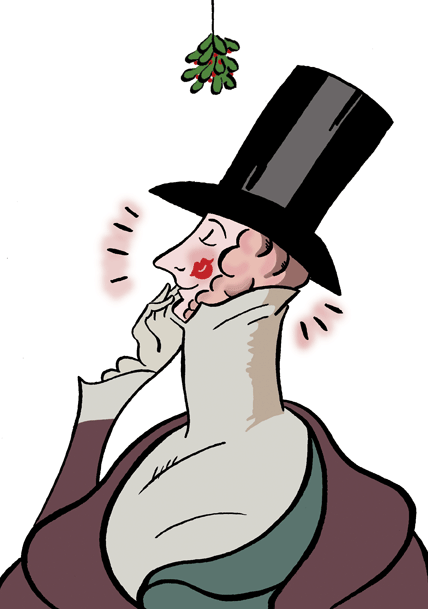
I asked some friends of Emdashes (whose abbreviation is not FOE) if they’d like to send some virtual valentines to a person, thing, or idea at The New Yorker. OK, that’s not completely true—I actually asked them to send a virtual holiday present back in December, but you know how these things go. So whether you hate Valentine’s Day or just sort of hate it, I hope this is a happy diversion, and I personally send kisses (and I’m told they’re quality) to every single one of you. Oh, and you’ll need to skip to the jump for the funny and gorgeous drawings by Patricia Storms; the first, while Christmas-themed, is eerily perfect for this week’s anniversary Tilley cover. Definitely click to enlarge!
Daniel Handler (Adverbs: A Novel, Lemony Snicket’s The End, &c.):
For Malcolm Gladwell: Three poems by Elizabeth Bishop, the first season of Golden Girls, a TRS-80 computer, a jar of dill pickles, and the results of a sociological study from the 1950s, with the expectation that he can find a life-guiding philosophical principle which governs all these specific items.
Mac Montandon (writer for Radar magazine and the author of the nonfiction book Jetpack Dreams, to be published by Da Capo Press in 2008):
1. Weekly assignments for Nick Paumgarten, Mark Singer, and Dana Goodyear.
2. A few more kids for Adam Gopnik—the better to generate story ideas.
3. A standing invitation for Ian Frazier to stop by any time and entertain me and my family with wonderful, witty tales.
4. The opportunity for David Remnick to reconsider that Silence of the City book idea.
5. Comma quotas for all!
Jesse Thorn (host, The Sound of Young America):
I would like to send Roger Angell season tickets to the Red Sox and an elixir of eternal life.
Carolita Johnson (Newyorkette and New Yorker cartoonist):
1. I’d send a beautifully tender, juicy, crackly-skinned, roasted chicken to Gary Shteyngart, with whom I had fun eating and talking about food at the Gin and Books party!
2. To Adam Gopnik, Microsoft Word’s Random Metaphor Check (as soon as it becomes available).
3. And to Orhan Pamuk, I’d send a chill pill after reading “My Father’s Suitcase”! I’ll throw in a self-flagellatory whip (one-time use only, because I do so like him).
A fan who prefers to remain anonymous has $500
for humorist Patricia Marx.
David Marc Fischer (proprietor of Blog About Town and frequent loser of the Cartoon Caption Contest):
1. To Sasha Frere-Jones: A crate of heart-shaped rockist crackers.
2. To Emily Gordon: The return of Elk Candy. [Yes, please! —Ed.]
3. To Zachary Kanin (gatekeeper of the Cartoon Caption Contest): Whatever he wants, capische?
John Bucher (New Yorker Comment and, if all goes well, brand-new Emdashes intern):
1. Backup batteries for Rik Hertzberg’s common-sense Taser.
2. A ride on an icebreaker ship (or the biggest dump truck in the world) for John McPhee.
3. A spot for Elizabeth Kolbert in the VP’s next shooting party.
4. For Malcolm Gladwell: a Golden Ticket and a tour of the factory.
Patricia Storms (freelance cartoonist and illustrator living in Toronto, who’s illustrating a children’s book for Scholastic Canada and a humor book for Chronicle Books, both out fall 2007; a book of her cartoons about Valentine’s Day will be out in February 2008 from Red Rock Press):
1. This may sound sappy, but I’d love to give Eustace Tilley a big fat kiss as a thank-you for delighting me with such a stellar magazine. I’m feeling especially mushy about The New Yorker this year, because after many years of my reading my mom’s used New Yorker copies, she finally decided to give me a year’s subscription as a Christmas present. What the hell took you so long, ma? (Kidding, I’m kidding.)
2. And in the spirit of the season, even though I tease poor Franzie mercilessly in my cartoons, I’d like to give good ol’ Jonathan Franzen, contributor to The New Yorker and lover of all things Charlie Brownish, a hug. I think he needs it.

∗ Love Conquers All is a 1922 book by Robert Benchley that you can read in full here.
A Reader Writes: Can It Be a Coincidence?
Ed O’Connell of Martha’s Vineyard asks this provocative question:
I’m a New Yorker reader of limited tenure with a question that may expose an embarrassing degree of naivete and/or paranoia but, of course, I’m compelled to ask: is there an inside joke at the magazine about using the same unusual word in different articles throughout any one issue? For example, in the 1/29/07 issue, Schjeldahl on the Art World and Denby on Current Cinema both use the fairly unusual word “deracinated.” I have noticed this in past issues from time to time with other unusual words and have wondered if this is the work of a playful editor or merely coincidence. Thanks in advance for any insight.
It goes without saying that no one on the magazine’s staff would ever declare this to be true on the record, even if such twins were planned; after all, word repetitions are one of the things copy departments try to prevent. (In the brief and surreal, though existentially crucial, period in which I freelanced at Lucky, searching for “reps”—multiple instances of “ladylike” and “foxy,” most likely—was one of my oddly enjoyable tasks.)
Still…things like this, bets and dares and japes, have been known to occur in the magazine world. Perhaps there will be an update. Wait and see.
Send letters to the editor to letters@emdashes.com. As always, nothing is published without permission, so rest easy, paranoiacs.
Walken Away With the Answer to the Squib Report Challenge
As you know, yesterday Martin “Between the Squibs” Schneider posed a tricky trivia question presented by The Complete New Yorker. Luckily, he also has the solution. Read on.
It’s time for the answer to yesterday’s Christopher Walken challenge. John Lindsay was the mayor, LBJ was the president, and one of the Talk of the Town items was about Schrafft’s. A different world. The date was March 12, 1966. The issue included a review of a new play, The Lion in Winter. The critic, John McCarten, called a certain Christopher Walken “persuasive” as Philip of France. Walken would later win the Clarence Derwent Award for most promising male actor. Unbeknownst to the voters of the Clarence Derwent Award, this citation would eventually lead to a spike in demands for increased quantities of cowbell.
If you go by the search archive, the first mention of Walken happened in 1992—twenty-six years off! Well, nobody said it was perfect.