Category Archives: Letters & Challenges

A Storied Presidency: the Other Bailout

Inspired by Obama’s win, I checked the index of the Complete New Yorker for items in the “Fiction” category that contained the word “president.” I got 167 hits, and I’ve been happily reading ever since. This is the second of a series on the results. The first one is here.

***

When the big credit crunch came to a head this fall, you might have heard occasional mention of the other bailout, that of the savings and loans in the late 1980s. If you want a brief, totally inaccurate primer on that event, you can do no better than Garrison Keillor’s “How the Savings and Loans Were Saved.” (Digital Edition link here.)
Huns invade Chicago, and President Bush (the First) nearly fails to act, with no political consequences: “… a major American city was in the hands of rapacious brutes, but, on the other hand, exit polling at shopping malls showed that people thought he was handling it O.K.”
Throughout, Keillor lampoons the terms that must have been used in the press to describe Bush’s lack of response: e.g., he appears “concerned but relaxed and definitely chins-up and in charge”, or he appears “burdened but still strong, upbeat but not glib … confident and in charge but not beleaguered or vulnerable or damp under the arms, the way Jimmy Carter was.”
Bush is always vacationing: playing badminton in Aspen, croquet at the White House, tennis and fishing in Kennebunkport. Meanwhile, the barbarians

made their squalid camps in the streets and took over the savings-and-loan offices,” where “they broke out all the windows and covered them with sheepskins, they squatted in the offices around campfires built from teak and mahogany desks and armoires, eating half-cooked collie haunches and platters of cat brains and drinking gallons of after-shave.

They demand a ransom of “three chests of gold and silver, six thousand silk garments, miscellaneous mirrors and skins and beads, three thousand pounds of oregano, and a hundred and sixty-six billion dollars in cash.”
Eventually, of course, Bush agrees to their primary demand.

The President decided not to interfere with the takeover attempts in the savings-and-loan industry and to pay the hundred and sixty-six billion dollars, not as a ransom of any type but as ordinary government support, plain and simple, absolutely nothing irregular about it, and the Huns and the Vandals rode away, carrying their treasure with them …

Absolutely no similarity, there, of course, to the credit crisis … or is there? This Robert Weber cartoon, from the July 18, 1983 issue (a few years, granted, before the S&Ls began to fail) sure sounds familiar:
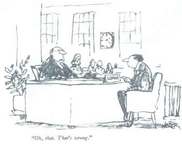
thatswrong.jpg
What’s more, this Weber cartoon from the February 22, 1988 issue weirdly presages the crazed loan practices typical of the mortgage industry up until a few months ago.
But in the austere light of the credit crisis, perhaps you’ll find this Vahan Shirvanian cartoon from the May 17, 1969 issue a comforting reminder of better times:
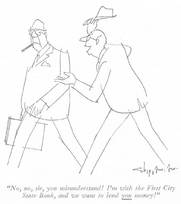
lendYOU$$$.jpg

¿Winners? We’ve Got Winners! And Coming Soon, a New Contest!

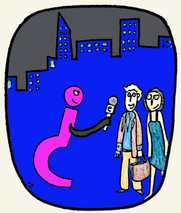
Winner of the upside-question-mark naming contest!
Paul Morris, who also drew the triumphant illustration above, writes:
In a village of La Mancha, the name of which we have no desire to call to mind, a lone upside-down question mark polishes off his newly granted escutcheon. He had been invited to appear at the royal palace at Aranjuez the night before. There, he had jostled with his worthy and eminent rivals: second-place winner The Qué Mark, submitted by Liesl Schillinger, and third-place winner Quiggle, proposed by Carolita Johnson.
With a sultry clickety-clack of Sevillean castanets, the strumming of veteran vihuelas, and the Mediterranean thumping on the adufe, the upside-down question mark received his name: Interroverti, proposed by Nadine and Chris LaRoche. The Spanish kings smiled gracefully at their faithful servant, who was treated to a glass of sherry and a display of fireworks that illuminated the Tajo on the hot September night. Interroverti’s rivals were also bedecked with medals hammered from fine silver and cinnabar from the mines of Almadén.
The newly named punctuation mark will now sit proudly on his lean hack, and tilt at grammatical windmills with lance and buckler.
We here at Emdashes would like to thank all who submitted entries to our contest, and we invite you all to participate in our upcoming contest, to be announced soon. It, too, has a punctuation theme!
And, as before, there will be prizes. For their winning entry in this contest, Nadine and Chris LaRoche will enjoy either dinner for two at the Spanish, Mexican, Ecuadorian, Dominican, &c., restaurant of their choice, or a beautiful copy of Pablo Neruda’s immortal The Book of Questions. Nadine and Chris, let us know your choice, and we’ll get it to you by something faster than the existential-pony express.

Upside-Down Question-Mark Contest: Now, You Choose the Winner!

Poll-Drawing-2.png
Update: The winners!
The ghost of James Murray, patron saint of the OED, hovers over us tremulously as we offer you our poll of finalists from Emdashes’ very own Upside-Down Question Mark Contest. Meanwhile, Pablo Neruda, who refused to use this form of punctuation, throws up his hands in a corner of that celestial Scribbler’s Green where all writers go–a place that all deceased literary critics are barred from entering. ¿Will this stop us? We say, respectfully but firmly: ¡no!
We offer you these names, hand-picked from an Emdashes orchard of more than 60 great entries, so thank you to all who submitted! The winner of this poll will win our grand prize, which, as you know, is either dinner for two at the Spanish, Mexican, Ecuadorian, Dominican, &c., restaurant of your choice, or, if you prefer, a beautiful copy of Neruda’s immortal The Book of Questions.
1. the qué mark–submitted by Liesl (our own Martin Schneider submitted a variation on this entry, but since he’s an editor and judge, he’s disqualified from prizewinning; sorry, Martin!)
2. splainu–submitted by John
3. quiggle–submitted by Carolita
4. interroverti–submitted by Nadine & Chris LaRoche
5. ¿nu?–submitted by Paul Shaw
6. Prask and Pre-Q–both submitted by J.D.
7. Askin–submitted by N.F.
We also want to offer you some etymological background and information on some of these entries. Note that ¿nu? reads the same right side up or upside down. (Turn over your computer–see?) “Splainu” derives from I Love Lucy, specifically from Ricky Ricardo’s “Lu-seee, you haf some splainu to do!” The venerable interroverti is derived from the Latin components “interrogo” and “verti/verto/versum,” meaning “to turn over,” “to turn about,” &c.
And here are the final eight–may the best mark-marker win, and watch out for those hanging ¿chads?

What should we name the upside-down question mark?
the qué mark
splainu
quiggle
interroverti
¿nu?
pre-Q
Prask
askin
  
pollcode.com free polls

Quizás, Quizás, Quizás: We Asked. You Named. Someone Wins! But Wait!

Thanks to all the witty, literate, and punctuationally minded people who entered our upside-down question mark naming contest, which was a great success: We got more than 60 entries, and we’re still tallying up our picks.
In fact, we’re at a bit of an impasse. So we thought we’d create a poll, with the Emdashes crew’s absolute favorite entries, and let you determine the ultimate winner. In the spirit of the Democratic Convention’s forest of ticker tape, your voice will be heard! Have a great Labor Day, and watch this space for the opportunity to vote well before November–and for something we can all believe in: giving mysterious marks a (satisfying) name of their own.

Exciting Emdashes Contest! ¿What Should We Call the Upside-Down Question Mark?

NorudasA.png
NorudasB.png
NorudasC.png
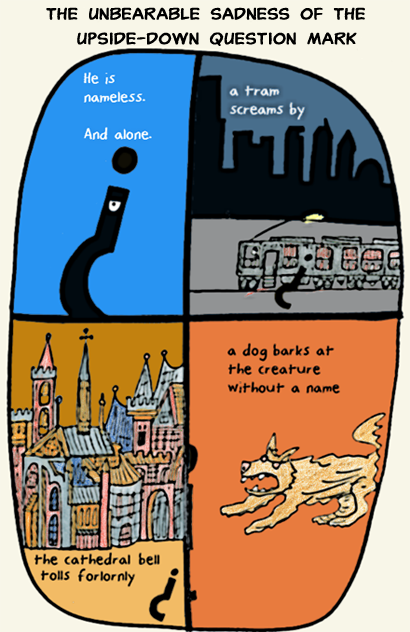
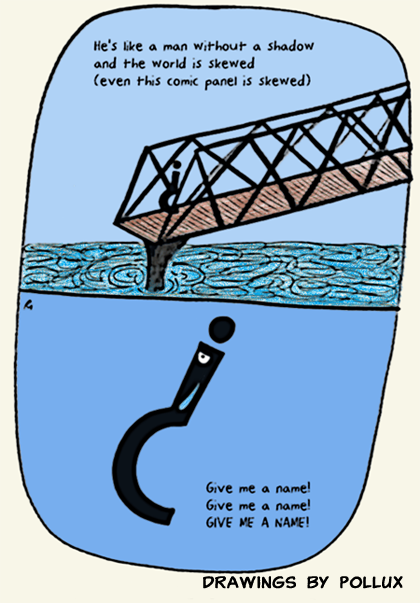
Above: A haunting dramatization of the dilemma in question. Click to enlarge.
The other day, Pollux, our “Wavy Rule” staff cartoonist, and I were questioning some punctuation: namely, the upside-down, Spanish-style question mark. After consulting friend and lettering expert Paul Shaw–who reports that “Bringhurst just calls it an inverted question mark, no special name”–we decided it was a real scandal that this character dare not speak its name. (Parenthetically, I wonder when the nameless mark will become a standard part of the computer keyboard, especially in America, where Spanish is rápidamente becoming our dual language?) So we decided to sponsor a contest. Paul wrote everything from here on–and, of course, drew the searing cartoon above.
You’ve seen it before. It stands on the west end of elegant Castilian questions: ¿Adónde vas? ¿Cuando llegarás? ¿Quien eres tú?
Ah, the upside-down question mark! Its limited range lends this punctuation mark a certain romantic air, its elegant curve bent and shaped by the same winds that propelled caravels and galleons on treasure runs across the ocean sea, its use first legislated in 1754 by a second edition of the volume Ortografía, issued by Spain’s Royal Academy.
You can make one yourself: hold your Alt key down, hit the number-lock key, and then type the numbers “168.” [On a Mac, just type option + shift + ?. –Ed.] There, you see it? It stands nobly, and a little sadly, on your computer screen–like a single tear on the face of a father who’s walking his daughter down the aisle of a church, or like a grandee who has been reduced to complete penury but who still points to his ancient coat of arms on the wall.
A noble punctuation mark, to be sure, but deficient in one regard: it lacks a name. “Upside-down question mark” is purely descriptive. Its Spanish name is equally lacking in punch: “signo de apertura de interrogación invertido.”
Now’s your chance to make history. Name this punctuation mark. Give it a name both euphonious and appropriate. Earn everlasting glory. Win a prize–dinner for two at the Spanish, Mexican, Ecuadorian, Dominican, &c., restaurant of your choice, or, if you prefer, a beautiful copy of Pablo Neruda’s immortal The Book of Questions. Emdashes wants to hear your best ideas, so post them in the comments or, if you’re shy (as so many of you are, we know and sympathize), just email us. All entries are due by August 25, no question about it. We are very much looking forward to your submissions. At TypeCon last week, I got two impressive entries from genuine maniac typophiles; I’ll post them in the comments as soon as things get rolling. The very best of luck to you, and andale!
And if you’d like to see more drawings by Pollux, check out “The Wavy Rule” archive.

Coming Monday: A Contest! Emdashes Interns! And More.

The holiday weekend sparkles in the near distance, but I’m really excited about Monday. Not only is it the day I go see Kabluey at Cinema Village, it’s also the day I’ll have the pleasure of introducing you to our Emdashes summer interns: Sarah Arkebauer, Taylor House, and Adam Shoemaker. They’ll be contributing in many ways beginning next week, and you’ll see right away why we selected them: They’re remarkable people, and talented as can be.
Also on Monday, we have a contest. The first of more. In cartoon form. My heart is racing as I type. It is. Get ready to be tickled, and if you’ve misplaced your thinking cap, time to dust it off (there’s no unmixing these metaphors)–your creative time has come.
Happy weekend, and while I’m away, enjoy further installments of Paul Morris’s Emdashes comic “The Wavy Rule,” which will continue daily over the holiday weekend. Even Gawker can’t say that.
Update: PRINT is closing an issue, so I introduced the interns on Tuesday, and will run the contest shortly. Old media still wins!

Benjamin Chambers on the “Best American Essays,” Pt. 2

Just before Christmas I published the comments of Benjamin Chambers, of the top-notch literary website The King’s English, as he daringly attempts to read every single New Yorker essay ever to be singled out in Houghton Mifflin’s “Best American Essays” series (which I first wrote about here). For his next feat, I suspect, he’ll try a record English Channel swim.

Take it away, Benjamin!

My next job was to tackle 1987, from the anthology edited by Annie Dillard: an easy list of only three essays. (One wonders if Dillard didn’t care for the stuff The New Yorker did; or if she felt obliged to go against the grain, figuring that it was better to take notice of material in other, lesser known venues; or—possibly?—The New Yorker itself was having an off year? It’s interesting that when Geoffrey Wolff edited the anthology the next year, he felt 10 NYer pieces were notable (though he didn’t select any for “best of” status). What’s odd about that, though, is that he included some very weak pieces, including one by Veronica Geng that’s actually fiction. (The Complete NYer‘s index lists Geng’s piece that way, too, but it’s not infallible, as for example when it inexplicably classifies as fiction Susan Sontag’s autobiographical essay, “Pilgrimage,” which appears on Dillard’s 1987 list.)

Actually, I cheated and started out my 1987 reading by jumping ahead to 1988 and reading Joan Didion’s “Letter from Los Angeles,” which starts out shapeless but pleasing, and then turns into an acute report on the writers’ strike that had just recently fizzled out. Given the strike that’s currently going on, it was particularly timely. Then I went back to 1987, and read E.J. Kahn Jr.’s delightful profile of Helen Suzman, who was for many years the only woman in the all-white House of Assembly of the Republic of South Africa, and an internationally known opponent of apartheid. I’d never heard of Suzman, and came away feeling great admiration for her feistiness. At the time, of course, she didn’t feel very successful—she’d spent years being the only voice in opposition—but again, to read the profile after the nearly bloodless end of apartheid gave it a special flavor. (This profile led me to Wikipedia, where I found a link to an article in the Telegraph from 2004, where she had some reservations about the way current politics are working out there, although none whatever about the abolition of apartheid.)

I’ve never had much use for Harold Brodkey’s work, but in truth I’ve not read much of him, so I approached “Reflections: Family” with qualified hopes. Unfortunately, they proved unfounded—as with E.J. Kahn’s “Hand to Hand” from 1988, the size of audience that could be interested in the piece would seem to be quite limited—in Brodkey’s case, to his own family, as the essay amounts to a collection of observations about their broad experiences and personalities. The piece’s charm would’ve grown in inverse proportion to its length. Kahn’s “Hand to Hand” records in excruciating detail the sinking of a U-Boat by a U.S. craft during World War II, the latter-day reunion of men on both sides of the battle. Though a promising premise, it feels more like a war story fit for other veterans of that war, rather than a general-interest piece—at least at this distance.

That’s curious about the Geng piece. I wonder if that choice elicited any commentary at the time? Anybody know?

—Martin Schneider

Previously: Chambers on the “Best American Essays,” Pt. 1

A Reader Writes: Why No Byline on the Raymond Carver Intro?

So asks Emdashes reader Bill Amstutz; Dean Olsher noticed it, too. Ah, but what is “authorship,” really, anyway? As Olsher speculates:

The decision to write anonymously here seems especially freighted, less a mere throwback to the Shawn years and having something more to do with the nature of Lish’s initially invisible and essential influence.

On the other hand, maybe everyone was just anxious to get out the door for the holiday, and the crucial line was dropped. As if that would ever happen. Here’s the piece in question, and don’t forget the nifty slide show and a very illuminating demonstration of the lishian pen, not to mention the strikethrough tag (or “strike-through,” in the New Yorker stylebook), which is finally put to good use here.

I wonder if Art Winslow, who is what I think about when I think about Lish (well, also those poems that Lish failed to accept for the Quarterly when I was an undergraduate, but I bear him no ill will; they were utterly [there’s a joke for you Columbians] wrong for the magazine), will be weighing in on the latest Carver carve-up at the Huffington Post. Art?

Benjamin Chambers on the “Best American” Essays, Pt. 1

Benjamin Chambers, of the splendid literary website The King’s English, has thus far proven to be the ideal reader of the Squib Report if not this entire blog. After I posted exhaustive lists of the Best American essays and short stories according to Houghton Mifflin (in which there are still gaps—by all means submit missing years if you have them!), he not only provided us with the data for two years in the essay list but also decided that he would read all of the listed essays. Benjamin: I admire your dedication! Judging from your industriousness, you’ll have no trouble finishing off the list.
Here is his first update on his reading progress. We look forward to the next installments!

The reading’s going well. Slowly, but well…. I was fascinated to learn the story behind Joe Bob Briggs (Trillin), enjoyed Berton Roueche’s “Marble Stories,” and Pfaff’s “Dimensions of Terror,” but nearly foundered on Anthony Bailey’s “Good Little Vessel.” (One of those “interminable” ones for which the NYer gets such a bad rap.) I had just completed Frances FitzGerald’s “Memoirs of the Reagan Era,” which was an interesting adjunct to Joan Didion’s collection, Political Fictions, when—as often happens with these NYer reading expeditions—I got sidetracked to something not on the list: FitzGerald’s two-parter on the Rajneeshee, who built one of the stranger latter-day communes here in Oregon, where I live. Of them all so far, the one I found most deeply compelling was Vicki Hearne’s essay on language, though I admit it’s sometimes a little hard to follow….

Thanks again for posting this list—it’s really inspired me to go back to the Complete NYer and make use of it. Of course it’s difficult to poke around in it for long without finding something of interest, but having a definite reading plan makes it seem more purposeful.

You’re welcome! Inspiring people to delve into the CNY is pretty much the only purpose of the Squib Report! Stay tuned for more reports from Benjamin. —Martin Schneider

Notes on Nudism, in Verse, and We Answer a Baseball Question

In my inbox today, this note from my old friend Sandy McCroskey, who can’t resist shedding his garments when the sun is out (and who can blame him?). I’d pointed out the skin-baring angle in that daughter-marrying hoax, to wit, that hoaxster “[John] Ordover is a science-fiction editor with a prankish history and an interest in urban nudism.”

Yeah, but as noted here, the average age of nudists is, alas, increasing.

Also, I don’t see how some of the people out on the nude beach can let themselves go so badly. (I’m not talking about a little plumpness or inevitable signs of age.)

We just had a book grab, and I was delighted to find uncorrected proofs of the new collection by your former teacher the late lamented Kenneth Koch, On the Edge: Collected Long Poems—because I knew that inside I would find “Ko, or A Season on Earth,” which contains a passage that I’ve always remembered very vividly but have never been able to find online. It begins:

Meanwhile in Kansas there was taking place
A great upheaval. High school girls refused
To wear their clothes to school, and every place
In Kansas male observers were amused
To see the naked girls, who, lacking grace,
Were young, with bodies time had not abused,
And therefore made the wheatfields fresher areas
And streets and barns as well. No matter where he is

A man is cheered to see a naked girl—
Milking a cow, or standing in a streetcar,
Opening a filing cabinet, brushing a curl
Back from her eyes while driving in a neat car
Through Wichita in the summer—like the pearl
Inside the oyster, she makes it a complete car.

We get a diversity of letters at letters@emdashes.com, and here’s another recent one:

For years I’ve seen Ebbetts/Ebbets Field referred to, but there seems to be no agreement on how to spell it. With one “t” or two?

Can you help?

We aim to please. I asked meat aficionado and sports-uniform maven Paul Lukas to guest-edit this reply. Here’s what he says:

Ebbets Field was named after Brooklyn Dodgers owner Charles Ebbets—two bees, one tee.

And there you have it. No question too big or small, folks!