The world of Emily Gordons is an honorable guild of creative workers, with only a few exceptions–and those exceptions get a free pass because they’re undergraduates and, lord knows, we would have made awful fools of ourselves if we had been online then. (By “we,” I mean “me.”) Notable Emily Gordons include the polymathically brilliant Emily Gordon, writer of Gynomite! and, among many other things, a licensed therapist who gives me platinum advice for free. And for more than a decade, I’ve been following the writing career of Emily Fox Gordon, whose beautifully crafted essays, fiction, and book-length nonfiction are a pleasure to read. Now she’s working on a new novel, and, speaking for all Emily Gordons, we are very excited to read it. –Emily Gordon
Category Archives: Little Words
Since We’re Obsessed With Punctuation at the Moment
…or, to be frank, always, we’d like to note this Slashdot story about the war between the sarcasm symbols. Yes, the sarcasm symbols. It sounds like a dirty fight for a low form of humor, but still, it’s correct that punctuation controversies should be in the news, at the top of the hour, above the fold (if not the fray).
–Emily Gordon
The Sport in Which Nothing Happens
Jonathan Taylor writes:
I skipped the usual World Cup back-and-forth over American distaste for soccer, but for those who like to point to soccer’s scoreless ties and whatnot: According to the Wall Street Journal, the average NFL game has an average of 11 minutes of play (compared with 67 minutes of “players standing around”).
(via Felix Salmon’s Counterparties)
On His Radio Show, Jonathan Schwartz Suggests a Renata Adler Set
_Emily writes_:
…Pitch Dark and Speedboat, in one volume, with an updated cover design (my suggestion). I think it’s a terrific idea. I’d buy it.
“Color-Shifting 100” Just Doesn’t Have the Same Ring
Martin Schneider writes:
Oh, dear. The U.S. Mint is up to its tricks again, issuing a brand-new, butt-ugly $100 bill. However, it is adorable how proud they are of their counterfeit-stymieing features:
I really hope some smart band writes a song called “Bell in the Inkwell.”
“Man, Gatsby Is So Intense When He Stares at That Light”
Martin just introduced me to Kate Beaton’s fantastic strip “Hark, a Vagrant.” This one–I should say, this bunch–is about The Great Gatsby. –E.G.
A Prediction Worth Taking Note Of: Marginal Revolution, Indeed
Jonathan Taylor writes:
Tyler Cowen writes:
In the longer run I expect “annotated” books will be available for full public review, though Kindle-like technologies. You’ll be reading Rousseau’s Social Contract and be able to call up the five most popular sets of annotations, the three most popular condensations, J.K. Rowling’s nomination for “favorite page,” a YouTube of Harold Bloom gushing about it, and so on.
Barack Obama Looking at Awesome Things
A set of, ah, news photos of the President you’ll savor. (Along with this illuminating background.) Thanks to the always inspiring Rosscott for the link! –E.G.
Shivery Books Need New Jackets
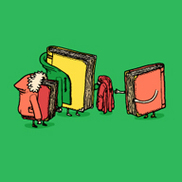 …which is why I like this charming and compassionate Threadless t-shirt that just debuted. It’s by Tenso Graphics and I dig it. God knows the book industry needs some TLC, and weatherproof outerwear (and I’m not talking about Juicy Couture for Kindle) is just the gesture you can make to make it feel better. And keep your bookshelves from a pneumonia outbreak. –E.G.
‘Memory Is Not a Journalist’s Tool’: Janet Malcolm on Autobiography
Jonathan Taylor writes:
At the NYRBlog, Janet Malcolm with four packed paragraphs of “Thoughts on Autobiography from an Abandoned Autobiography“:
When one’s work has been all but done—as mine has been for over a quarter of a century—by one brilliant self-inventive collaborator after another, it isn’t easy to suddenly find oneself alone in the room…
The “I” of journalism is a kind of ultra-reliable narrator and impossibly rational and disinterested person, whose relationship to the subject more often than not resembles the relationship of a judge pronouncing sentence on a guilty defendent. This “I” is unsuited to autobiography. Autobiography is an exercise in self-forgiveness. The observing “I” of autobiography tells the story of the observed “I” not as a journalist tells the story of his subject, but as a mother might.