Category Archives: Looked Into

“The Most Trusted Man in America”: Know Your Jon Stewart

Emily Gordon writes:
While ambling around looking for photos of Jon Stewart and Laura Kightlinger together after hearing her be witty (and briefly mention having dated Stewart) on the Marc Maron podcast recently, I happened on this Moment magazine profile of Stewart by Jeremy Gillick and Nonna Gorilovskaya. Read it! It’s smart and thorough, and explores, among other things, Stewart’s Jewishness and relationship to Israel and Jewish history and politics. Here’s a graf I appreciated, followed by one that I know friend-of-Emdashes Ben Bass will either have already noted on his blog or soon will:

After waiting to hear some “constructive criticism” of Israeli policies that “may not be in the best interest of the world,” Stewart rolled clips of silence and went for the kill: “Oh! I forgot! You can’t say anything remotely critical of Israel and still get elected president! Which is funny, because you know where you can criticize Israel? Israel!”

Although the topic doesn’t come up often, it’s also evident where Stewart stands on intermarriage. In 2000, he married Tracey McShane, a veterinary technician and a Catholic. Stewart, who does The New York Times crossword puzzle daily, popped the question with a puzzle of his own. The paper’s “Puzzle Master,” Will Shortz, found Stewart a puzzle creator for the occasion.

I also liked this, toward the end:

Despite his effort to be a fair and balanced mocker, Stewart’s reputation as the “most trusted man in America” should be taken with a grain of salt. Such stature is not unusual for a comedian, says Nicholas Lemann, the dean of the Graduate School of Journalism at Columbia University. “Johnny Carson in his heyday, you could make that statement about.” Lemann warns against generalizing about how far that trust spreads beyond Stewart’s core audience. “I think that’s a kind of a blue-state perspective and youth perspective. To many of my cousins in Louisiana, Rush Limbaugh is the most trusted man in America.”

Anyway, as I said, read it all!

A Study in the Contingency of Journalism: Arendt’s ‘Eichmann’ Typescript at Tablet

1302299175arendt-380-C.jpg
Jonathan Taylor writes:

Tablet has some fascinating samples of the typescript of Hannah Arendt’s Eichmann in Jerusalem, marked up with New Yorker editor William Shawn’s editing changes. Allison Hoffman explains, “the text that most people have in mind when they talk about Arendt’s report is not, in fact, the one that appeared in the magazine.” Shawn’s

major cuts and alterations to Arendt’s original are striking in their consistency: Almost all of them involve Arendt’s asides about the contemporary Jewish community and its handling of the trial. Many of the most controversial passages made it into the magazine intact, including her assertion that “if the Jewish people had really been unorganized and leaderless, there would have been chaos and plenty of misery but the total number of victims would hardly have been between five and six million people.” But the final magazine text is in some ways less provocative, more streamlined, and–unsurprisingly, given the precision of The New Yorker‘s legendary copy editor Eleanor Gould–more polished than what’s in the book.

Above all, the manuscript pages, and Hoffman’s backgrounder, give a great sense of the contingency of these things. As Hoffman notes, Arendt wrote her report for The New Yorker because Commentary couldn’t afford to send her to the trial, and “one can only imagine that the final product would have been quite different had Arendt been writing for” Norman Podhoretz.

A Drinking Game for Any Cocktail Party: When Anyone Says ‘Apparently’

Jonathan Taylor writes:
Someone’s probably written about this already, but, my sometimes ingenious search skills haven’t managed to draw it out.
Tyler Cowen linked to a post by James Somers from about a year ago, about the skillful deployment of the phrase “It turns out….” He says it can have the magical effect of convincing even alert readers, in the absence of evidence, of a proposal “in large part because they come to associate it with that feeling of the author’s own dispassionate surprise.”
This reminded me of an observation—not exactly related and not nearly so incisive—that I’ve long made about the use of the word “apparently,” by people relating information recently gleaned from the news: “Apparently, GE not only paid no taxes last year, the Treasury actually owed it billions of dollars.” (See Felix Salmon for a great overview on the follow-up to that Times story.)
In fact, this usage is touched on in Google’s dictionary definition: “Used by speakers or writers to avoid committing themselves to the truth of what they are saying.” It’s my guess that people use this particularly often in relation to things they read in the New York Times, because it does require some implicit acceptance of the authority of the source. I think even the same people might not say the same thing about something they heard on NPR, but would more likely say, “I heard on NPR that….” Hearing a voice telling you on the radio maybe makes it too clear that the information is second-hand to you, whereas the disembodied authority of one’s most trusted written word is more easily assimilated to one’s own “knowlege.”
However, “apparently” also suggests an openness to acquiring completely new information; I doubt devotees of the Wall Street Journal editorial page introduce their games of telephone with any such qualifier; after all, that information is previously held and immutable belief, not new data.
In any case, use of apparently, overall, is apparently on the decline. If my theory is correct, perhaps the Times paywall will erode it even further.

Have You Seen the Pearl? Tolkin’s ‘Rapture’ Gets Its Due

Jonathan Taylor writes:
I normally avoid the cross fire of film criticism, but must quickly second Wolcott’s estimation of the “stupendous” post at The Sheila Variations about Michael Tolkin’s 1991 film The Rapture, illustrated with a stunning parade of the faces of Mimi Rogers; as many times as I’ve seen this film, I was too often too focused on what Tolkin was up to, to realize how much Rogers was doing.
I’d even quibble with Sheila’s assessment of the girl who plays Rogers’s daughter—or at least of the hair-raising effect of her whiny plea, “Why can’t we die now, mommy?” (Just see it. Ditto re: “the pearl.”)
I think Gary Indiana somewhere described Tolkin’s films as “period movies about the present.” That present still remains ours enough to still feel this effect, even as it is now enough the past, to add another layer of significance.

Paulette Forever: A Charles Taylor Interview

I was rereading some of Charles Taylor’s beautifully crafted, sometimes contentious reviews on Salon (I didn’t like Million Dollar Baby either), and the web wonderland led me to this 2006 interview with Taylor (or Charley, as I may call him because we’re friends) in Slant magazine. He talked about his career at Salon and elsewhere, the state of film criticism and media outlets (a phrase I already know will make him wince–sorry about that) generally, and more. Here’s a choice response, among many:

JK [Jeremiah Kipp]: You’ve frequently cited Pauline Kael as a major influence.
CT [Charles Taylor]: I got a paperback copy of “Deeper Into Movies” by Pauline Kael when I was in eighth grade. That was a major influence. I still think she’s the best film critic that is ever going to be. She was the best influence and the biggest influence. It was about trusting your instincts, which always the line about her. This is what I loved. This is why all of the “I Was a Former Paulette” articles I’ve read are all, to a one, simply wrong on the facts. I had countless disagreements with her, even arguments. I was never excommunicated. Some of the critics she liked were people she didn’t agree with. She wanted people to be honest. Art should be pleasure, not work. You have to bring your life experience to it, your experience of the other arts to it, you have to be well read, and no one should tell you what you have to like or what you should be interested in. The job of the critic is to help you formulate your own thoughts. Articulate them. Not to tell you what to think, but to get you to think. There was a freedom in her.

Read the whole interview, and the comments, too.

Without Mad Men We’d Go Mad, Men!

Emily Gordon writes:
My friend Meg (famed Short Fat Dictator blogger and recent transcendent vacation host) just alerted me to a distressing possibility: that Seaon 5 of Mad Men might be in danger. This isn’t new news, but it’s newly distressing to me. People are having tedious arguments about contracts and budgets in some Aeron-riddled, humorless rooms, and that means we might not get to see Don Draper wrestle ever more painfully with the sixties and his multiple superego-id hybrids. Worse, we might be deprived of all those jackets and ashtrays!
Hollywood, it’s time to reorder your mangled priorities and make it happen. Give the man what he wants, even if it’s more episodes featuring his son Marten’s peculiar character Glen. Although if Marten’s brother Arlo could appear on the show as a mysterious diminutive fashion maven, perhaps in a Sally Draper dream sequence, we might all get what we want.

Where in the World Is Flat Stanley?

flat-stanley7.jpg
Emily Gordon writes:
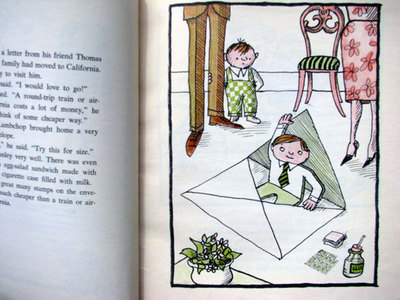
I just discovered The Apple and the Egg, a handsome blog about design and illustration for children’s books. The entry linked here is about one of the great heroic tales of our age (or, in my case, slightly before my age), Flat Stanley by Jeff Brown. Although I’m loath to denounce anyone these days, especially hardworking illustrators and anyone to do with children’s books, I can’t support the terrible decision to replace Tomi Ungerer’s bold, winning, exuberant drawings. You’ll have to turn to Powell’s and eBay to buy the original, and it’ll be yellowed and will possibly have been dropped in the bathtub once or twice. But it’s worth it! For now, The Apple and the Egg will give you the quick fix you need.
Unrelated, and entirely three-dimensional (or even four, since it’s about time): Colin Quinn’s advice for comics on Broadway.

Milton Rogovin and the Book Review that Shook Buffalo

Jonathan Taylor writes:
Atlas_031.jpgAtlas_032.jpg
Milton Rogovin, aptly described on his website as “social documentary photographer,” died in January at age 101. A Buffalo optometrist, he was denounced as the city’s “Top Red” in 1957, and subsequently began photographing working people and the worlds that made them and that they made, in Buffalo and across the globe. For me, the series that stand out are Lower West Side Triptychs, photos of the same residents of that Buffalo neighborhood taken in 1972, 1984 and 1992, and Working People, described here by JoAnn Wypijewski, whose writings accompanied some of Rogovin’s publications:

From 1977 to 1980 Rogovin photographed Buffalo’s working people: two shots of each subject, one at work and one at home…. They are marvelously evocative pictures, chiefly because Rogovin asks his subjects to compose their own portraits. A steelworker may look saucy and conquering on the job; matronly and just a little anxious at home with her kids. An odd-job man may express nonchalance, even a touch of scorn, in the plant; while, seated before a tableau of religious icons, commercial calendars and his own “work” photo, a curious mix of defensiveness and melancholy. You can’t type these people, because each time you return to them, they may disclose a new story.

This passage appeared in a Nation review of Verlyn Klinkenborg’s The Last Fine Time, a portrait of Buffalo’s East Side through the windows of a local bar. Wypijewski, an East Side native, continues, “But Klinkenborg’s people are mute, and their silence accomplishes that other end of romanticism: the annulment of history.” It’s not just a monumental takedown, it’s a stunning throwdown over the turning of social history into “creative writing” for an audience of “the explaining classes.” (Fortunately, it’s online here.)
Wypijewski first dismantles the cliche of Buffalo’s snow: “From the first words of the prologue Klinkenborg disqualifies himself as Buffalo’s biographer. ‘Snow begins as a rumor in Buffalo, New York.’ Snow—the cheap association every amateur joker makes with Buffalo? Rumor—the hint of subterranean preoccupation? Nothing bores Buffalonians I know more than the ready equation of the city with snow-storms; and nothing is approached with more equanimity than those same snowstorms.” But her critique is much deeper:

The book is meant to be an homage to the soul of the old East Side. Klinkenborg catalogues its citizens by occupation, from dressmaker to steamfitter, foundryman to church keeper; and even by name, eight lines of lyrical consonant combinations, with a few Germans thrown in to break up the meter. But even in homage—in fact, because of it—the people are lost, the center becomes the periphery. As romanticist, Klinkenborg is the medium through which the working class can be seen, and the picture he draws—an emotional yet guarded people, brightly striving but always just a bit behind the eight ball of life—is stylized in a way coincident with accepted notions….

….Charitably, I would say that Klinkenborg wrote this book out of love for his father-in-law, and the same reason I was glad not to know the real views of my relatives who baited me about politics may have impelled Klinkenborg to walk only on the safe side of history’s street. The result, though, is that Eddie—and by extension Buffalo—serves simply as a prop for Klinkenborg’s writing, and once the bar is sold and Eddie moves out to the suburbs it is as if he has no meaning except in tragedy. Klinkenborg has got his story.

The review even led to a public debate at Erie Community College between Wypijewski, Klinkenborg and several others. (The Buffalo News reported that Klinkenborg “kept his composure throughout the evening and said it was all part of a learning process.”)
I haven’t even read The Last Fine Time, so I can’t even comment on Wypijewski’s fairness. But it’s undoubtledly an essay that only grows in stature as the book recedes into the past. It’s sad how hard it is to imagine a struggle over art and social history being waged so prominently today on the terrain Wypijewski staked out (though Noreen Malone’s warning against enthusiasm for photography of Detroit’s ruins is a faint echo—and one still richocheting among the explainers).
Even harder, of course, is to imagine what you see before your lyin’ eyes in many of Rogovin’s pictures: “a middle class that included blue collar workers who were able to support their families on a single income,” in the words of Roy Edroso, taking on another would-be representer of a fantasized working class—to whom Rogovin’s photos are an enduring rebuke.
Wypijewski remembers Rogovin both in The Nation and at Counterpunch. And Klinkenborg does, too, at the Times.

Roger Ebert Speaks Truth to Stupidity

Emily Gordon writes:
While recovering from sickness recently, I watched some execrable movies on cable. I love movie-watching so much I rarely suffer in the process of seeing almost any movie, and I saw this one all the way through. But at about the halfway mark I started reading the Rotten Tomatoes reviews as I half-viewed the images and half-listened to the dialogue from my horizontal pillow-state. You can click on the link below to see what movie this was, but it’s not important, I think. What’s important is how grand Roger Ebert is to have written this:

Why? I wanted to ask the filmmakers. Why? You have a terrific cast and the wit to start out well. Why surrender and sell out? Isn’t it a better bet, and even better for your careers, to make a whole movie that’s smart and funny, instead of showing off for 15 minutes and then descending into cynicism and stupidity? Why not make a movie you can show to the friends you admire, instead of to a test audience scraped from the bottom of the IQ barrel?

Let every person sitting in a Hollywood meeting ask himself (or, less likely, herself) these questions, and then answer them!

Department of Factual Verification Dept.

From Wikipedia, which, as Jesse Sheidlower could surely tell us, is also a verb, as in “Wiki that shit before you go around spouting nonsense!”:

Experience of the K-hole may include distortions in bodily awareness, such as the feeling that one’s body is being tugged, or is gliding on silk, flying, or has grown very large or distended.[citation needed] Users have reported the sensation of their soul leaving their human body.[citation needed] Users have also often reported feeling more skeletal or becoming more aware of their bones – the shape of their hands is also often of interest.[citation needed] Users may experience worlds or dimensions that are ineffable, all the while being completely unaware of their individual identities or the external world. Users have reported intense hallucinations including visual hallucinations, perceptions of falling, fast and gradual movement and flying, ‘seeing god’, feeling connected to other users, objects and the cosmos, experiencing psychic connections, and shared hallucinations and thoughts with adjacent users.[citation needed]

Yes, primary sources, people!