
_Pollux writes_:
Yesterday, I was listening to “NPR”:http://www.npr.org/templates/story/story.php?storyId=127517884 and heard an interesting factoid: more Americans purchased tickets to see the Soccer World Cup than any other nationality apart from South Africans.
Has America finally fallen in love with soccer? Well, it’s complicated.
As David Wangerin points out in his book _Soccer in a Football World_, the United States may be a soccer-playing nation but we’re not a soccer nation. “Certainly the game has not managed to permeate popular culture,” Wangerin writes, ” – office conversations, school playgrounds, radio phone-ins and so forth – the way the major sports do, and it seems a long way from doing so.”
The United States may go to war for many reasons, but not for soccer. Our archives aren’t filled with blood-soaked, possibly spurious histories about the origins of soccer involving medieval peasants chopping off the heads of Vikings (actual Vikings, not the American football team) and kicking them around (“And thus the game of football was born”).
Timothy Sexton “attributed”:http://www.associatedcontent.com/article/38628/why_americans_hate_soccer_but_not_golf_pg3.html?cat=9 the lack of popularity of soccer in America to the fact that the sport isn’t hand-based. “We still have the memory of our pioneer genesis close to the surface of our society,” Sexton remarks. “This country was literally built from the ground up. We love to do things with our hands. In soccer, you don’t use their hands all that much. It’s a foot-based sport and somewhere deep inside our pioneer psyche, I think we just don’t care for that.”
Why should we care that many of us don’t care about soccer? Does loving soccer finally allow us entry into a Soccer Security Council or a G-5 of Goals? Should we get into fist fights at bars over the merits of the New York Red Bulls versus the Columbus Crew? Should armor-plated policemen charge our soccer fields when riots explode after a terrible 13-0 loss suffered by the New England Revolution?
Why is soccer’s lack of popularity in the United States considered a national defect and a source of wonder and bewilderment? Wind power’s lack of popularity in the United States is more of a problem.
America’s relationship with soccer is like our relationship with Sting’s music: we’re familiar with it, we know that it’s both English and international, that it buys villas in Italy -but who is going to the stadium? Mostly people who grew up listening to Sting’s music.
Category Archives: Looked Into
Better Tworld: Beautiful Tweet, Beautiful World
_Pollux writes_:
“I believe we can build a better world! Of course, it’ll take a whole lot of rock, water & dirt. Also, not sure where to put it.”
This tweet, by Canadian Marc MacKenzie, was “crowned”:http://news.bbc.co.uk/2/hi/uk/10250967.stm the most beautiful tweet at England’s Hay Festival.
The judge? The brilliant Stephen Fry, who is a prolific tweeter himself.
Will Gary Coleman’s Death Affect the Gary Coleman Role in “Avenue Q”?
Emily Gordon writes:
The blog Instant Tea, part of the Dallas Voice, asks the same question, as does the Washington Post, in this live chat exchange (the questioner is not, I assume, anyone from the actual show):
Avenue Q: Do the producers retire its “Gary Coleman”?
Hank Stuever: Hmmm. Good question. Get me rewrite. There are so many living, washed-up tv stars to sub in.
Maybe our friend Ben Bass can provide some insight, since he knows the folks behind the musical. Having reported a rejected Talk of the Town piece back when Obama was elected, about whether the line “George Bush is only for now!” would be replaced (they decided to keep it), I have a hunch they may hold on to the Gary Coleman character, too.
Besides, how many leading parts for black women (Coleman is played by a woman; in New York, currently by Danielle K. Thomas) are there in high-profile, touring shows? Not that many. I vote to preserve Coleman’s memory in this highly affectionate, vibrant portrayal of what his life might have been if he’d taken another path. Till our dreams come true, we live on Avenue Q.
The BP Logo: Emblem of an Evil Empire

_Pollux writes_:
You’ve seen it in the news a lot recently. You’ve seen it online. It graces the sides of unsafe oil rigs. It’s the BP logo.
The sunburst logo debuted in 2000 in an explosion of green, white, yellow. The logo unveiling was accompanied by mythological references to Helios, the Greek god of the sun (and the father of Phaëton, who irresponsibly set the earth on fire).
Greenpeace rightfully mocked the logo after its debut. Margarit Ralev “writes”:http://logoblink.com/2009/06/18/greenpeace-laughs-at-bp-logo/ about an incident in which Greenpeace handed out fake copies of the _International Herald Tribune_ at a summit in Brussels.
The newspaper included a satirical BP advertisement that proclaimed: “When we greened our identity, we felt confident that cosmetic changes would be enough.”
Corporate logos are tied to identity, but they reveal nothing about a company beyond the image they wish to project. Cosmetic changes are meaningless without management, structural and safety modifications that would have avoided, for example, the Deepwater Horizon disaster. When dictators come to power, they change flags, coins, country names, and city names, and care much less about improving the lot of their people.
Cosmetic changes are simply easier. It’s much easier to change one’s stationary than it is to reform Station 42872 (“Deepwater Horizon”).
And now the Gulf of Mexico isn’t seeing friendly sunrays of green and yellow, only an ocean of fire, gooey emissions, and dead porpoises. We don’t see sunbursts on the news, only burst pipes.
_Star Wars’_ evil Galactic Empire also had a logo:

Perhaps it’s time for BP to perform another redesign:

Threadless Watch: Another Great Shirt

_Emily writes:_
This 2 is a skunk. It’s by Aaron Barnes, whose portfolio you can and should see here.
Recently in Threadless Watch: Is “Helvetica” An Aphrodisiac?
(Review) Back to Back: Jules Feiffer’s Backing Into Forward
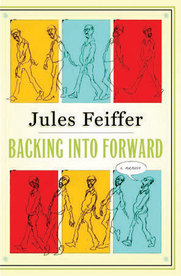
_Pollux writes_:
On a recent trip to New York, I was accompanied by Jules Feiffer’s autobiography, Backing Into Forward (published by Nan A. Talese). Between snatches of fitful, airborne sleep and occasional glances at a muted version of _Hachiko: A Dog’s Story_, Feiffer’s book served as a great and inspiring companion.
_Backing Into Forward_ can be read non-linearly. Feiffer’s book reads less like a traditional autobiography than a collection of self-contained, stand-alone essays. Like Feiffer’s comic strips for _The Village Voice_, each piece throws light on a particular anxiety, time period, or person. _Backing Into Forward_ has chapters named, for example, “The Jewish Mother Joke,” “Hackwork,” “Mimi,” “Lucking Into the Zeitgeist,” and “Process.”
The chapter named “Process,” for example, consists of a single page. Feiffer describes his process for arriving–or not arriving–at a completed comic strip. “I’d be humming along nicely–and then I’d arrive at what should have been the last panel without a thought in my head. I didn’t know how to end the thing. So I’d stash the idea in a drawer and forget it. A year or ten or twenty-five went by and, searching for something else, I’d come across the unfinished idea. Thirty seconds later the ending would announce itself. I’d draw it and send it in. Twenty-five years in the making: a comic strip.”
Feiffer skips backward and forward into time as he writes about his childhood in the Bronx, his journey to the West Coast and back again as a hitchhiker, his time in the army, his mother, his rise to fame, and his entry into the world of comics via work as Will Eisner’s gopher and subsequent ghost writer. As he tells it, Feiffer was a wimpy kid who found refuge in the world of comics. As a young man, he was tongue-tied and awkward around women. Feiffer is funny and honest about what fame did to his relations with women: now _they_ had to nervously come up with an opening line if they wanted to talk to him.
The same distinctive voice that reverberates through _Sick Sick Sick_ and _Feiffer_ is here: Feiffer is both acerbic and candid about his childhood, talent, family, doubts and frustrations (both sexual and creative), and fears (most of all, his fears). But it is an autobiography about hope and determination as well: nothing, not even a Korean War-era draft, an overbearing mother, or heartbreak- could stop Feiffer’s goal of becoming a comics artist.
Feiffer’s work appeared often in The New Yorker, but, interestingly, he writes that it was the dream of newspaper work that propelled him towards his goal. “Although I had been an admirer of _The New Yorker_ since childhood, the magazine had never played a part in how I worked or thought about work… [A]s much as I loved the work of Peter Arno, Charles Addams, Whitney Darrow, George Price, Helen Hokinson, Gluyas Williams, Alan Dunn, Sam Cobean, Frank Modell, and other _New Yorker_ regulars, I could not imagine myself appearing in their magazine.”
It is his candor that made his comics, plays, children’s stories, and screenplays unique and mordant examinations of American Anxiety from the Vietnam era to our present decade. Feiffer is still relevant. His “Obama! Ourbama!”:http://www.jeanalbano-artgallery.com/feiffer-exhibit/feiffershow.html print captures the optimism that took hold of many of us at the beginnings of 2009, sizeable shreds and shards of which still remain.
_Backing Into Forward_ includes many illustrations and photographs, and it ends with three pages of drawings in a chapter called “Last Panels.” Feiffer, in tux and top hat, ends with a _Sick Sick Sick_-style farewell: “Now the great thing about being a cartoonist…is that you can draw yourself as anyone you like….So excuse me…As I finish my dance.”
Wikivamp: Wikipedia’s New Look
_Pollux writes_:
Wikipedia looks different today. That’s because the Wikimedia Foundation has revamped the site, including “redesigning”:http://blog.wikimedia.org/2010/05/13/wikipedia-in-3d/ its “puzzle globe” logo.
Now we have improved search suggestions, so if you start to type in, for example, the word “punctuation,” you get the suggestions below.

What is “Punctuation (chess)”? Acccording to the article, chess commentators use punctuation marks to designate whether a chess move was bad or good.
The Google-like search suggestions are definitely an improvement. Google in fact donated two million dollars to Wikipedia in February. Google’s own collaborative encyclopedia, Google Knol, at its release dubbed a “Wikipedia killer,” is not even guilty of minor assault.
For editors, Wikipedia has revamped the toolbar designed to make editing much easier and intuitive. Wikipedia is encouraging feedback, and has a submission form at their New Features section.
A revamp of Wikipedia was inevitable as the online encyclopedia reached maturity. Whether the revamp is a real improvement or just a series of cosmetic changes remains to be seen, but to use my newfound knowledge of chess punctuation, **!?** (interesting move).
Flash Drive: Mark Fiore’s Pulitzer for Online Video Cartooning
_Pollux writes_:
Editorial cartoonists have been winning “Pulitzers”:http://www.pulitzer.org/bycat/Editorial+Cartooning since 1922 (the first ever winner was Rollin Kirby), but 2010 marks the year in which an online video cartoonist has won the prize.
The winner? Mark Fiore of SFGate.com, the website for the _San Francisco Chronicle_.
Fiore uses Flash animation and biting satire to do what editorial cartoonists always hope to do: point a magnifying glass onto our times, make us laugh, and scorch the villains of each respective era.
Fiore’s animated cartoons can be seen “here.”:http://www.markfiore.com/pulitzer/
Is “Helvetica” an Aphrodisiac?
The movie and the typeface. I liked this account of seeing it in the theater by the designer Robert Gould, whose “I Came to Dance” Threadless t-shirt I just bought. (Thanks, Robert!) He writes in his comments section for the design:
It was very intriguing with exceptional interviews, perfect imagery and a lovely soundtrack to boot. I would NOT recommend this for a first date movie unless you are both design, type/ font nerds….. Hell, there was one part toward the end where they were showing a poster and the kerning was terrible (NAIL), you just heard ppl in the audience, including yourself, saying “KERNING!” ha, bliss, hahhaa.
Bliss is right. I’m glad I own the movie. If you haven’t seen Objectified yet, also by Gary Hustwit, do.
–Emily Gordon
The Times Appoints a ‘Gimlet Eye’: Guy Trebay Covers the Riprap
Jonathan Taylor writes:
“DOES anyone remember that, long before Madonna was a zillionairess with a fake British accent, she used to dance at the Roxy with a posse of Latino b-boys?” asked The Times‘s Guy Trebay in his April 7 profile of Paper magazine coeditor Kim Hastreiter. (Hastreiter does.)
Does anyone remember that, since long before becoming a fashion writer at The Times—and turning out some admittedly not-unmockable trend pieces there—Trebay has been a keen collector of the throwaway lines and gestures that take place well out of New York City’s spotlight? I do. His Hastreiter piece is a bit of a puff. But it apparently inaugurated a new rubric for his pieces, The Gimlet Eye, portending, I hope, a resurgence of rangier columns like those I used to cut out from The Village Voice with scissors.
Soon after Trebay joined The Times, a piece on “mopping,” or organized shoplifting of designer clothes—featuring a “transgendered person” named Angie E.—promised to bring to the paper’s ludicrously straight-faced fashion writing a bit of the unruly gentility Trebay had cultivated at the Voice. But as the years passed, I thought the Trebay I followed was slowly fading into the patterned wallpaper of the Sunday striving section.
To be sure, his fashion criticism has kept its zing, as in a recent Fashion Diary from Paris, in which he likens Ingrid Sischy, self-described as “triste” and yapping haplessly for Karl Lagerfeld after the Chanel show, to a baby seal stranded on an ice floe.
But in this past Thursday’s Gimlet Eye, Trebay reprises his Voice role as a one man Walk of the Town, feeling for the worn seams of the city’s public facades that betray its private dilemmas. Trebay gets predictable mileage from the presence of a safari game guide at a party at the Pierre. But it’s the second half of the column’s high society/New York freak dichotomy that showcases his laconic empathy. On an upper-Manhattan stretch of the Hudson shoreline, he talks to “Bridget Polk, who shares a name but little else in common with a famous Warhol actress,” and who makes ephemeral sculptures there by balancing local rocks atop each other [UPDATE: here’s Bridget’s “rock work” at her own site.] As in Trebay’s old collections of scraps of telephone conversations in the Voice, Trebay catches New Yorkers at their most ringingly Beckettian:
“People watch and watch and then they work up the courage to ask a question,” she said. And what do they ask? “They say, ‘Do you do these here?’ ”
The sculptor laughed then, as she does a lot, at the absurdity of other people and her own. “People say, ‘Do you use glue?’ ”
They ask whether she assembles the sculptures first and brings them with her to this stretch of shoreside riprap….
Still, she added, “I get more attention for this than anything I’ve ever done.”
Plus, I learned the word riprap—previously used in the Times only three times according to an archive search, all in connection with bridge collapses (unless you count a star racing horse of 1926–27, Rip Rap).