
_Pollux writes_:
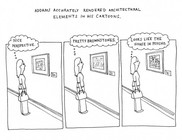
Up-and-coming _New Yorker_ cartoonist “Amy Hwang”:http://www.amyhwang.com/Amy_Hwang.html has created a “review in pictures”:http://urbanomnibus.net/2010/04/addams-big-apple-a-review-in-cartoon/ of an “exhibition”:http://www.mcny.org/exhibitions/current/charles-addams-new-york.html in the Museum of the City of New York that features the work of the legendary Charles Addams.
Hwang’s illustrated “Addams’s Big Apple” reveals not only her fascination with Addams’ genius, artistic methods, and relationship with the urban landscape, but also Hwang’s considerable talents.
Hwang, who is not only a cartoonist but also an architect, transforms her visit into an artistic diary that showcases her own irreverent humor as well as Addams’ use of the city in his cartoons (Addams used accurate architectural elements in his work).
The Addams exhibition will run until June 8, 2010. Click on the image above to enlarge it!
Category Archives: Looked Into
Although We Are No Longer a Blog Exclusively About The New Yorker
…we continue to be admirers of the magazine and many of its contributors, naturally. We’ll still be posting about New Yorker-related stuff, just alongside a wider range of other subjects. Here’s the transcript of today’s Washington Post live Q&A with David Remnick about his new book, The Bridge: The Life and Rise of Barack Obama. Martin wrote up the recent New York Public Library conversation between Remnick and Ta-Nehisi Coates.
Here’s a snappy answer to a stupid (or maybe just absurdly vague) question:
Johannesburg, South Africa: Shortly after President Obama was inaugurated the U.S. media let slip that directly after law school President Obama encountered a dark cloud. The insinuation was that he had fallen into bad company. And then gone on to a meteorically successful private career in Law. Although I haven’t read your book, I would be interested to hear what you say about this.
David Remnick: It doesn’t sound like reality to me.
And a taste of Remnick’s reading life:
Delaware: Your book, Lenin’s Tomb, is one of my favorite books ever. I initially read it for a Russian history class in college. I’ve read it at least twice since then, each time more impressed with how prescient and cogently organized it is. I’m looking forward to picking up The Bridge this weekend. Wondering, what do you enjoy reading (besides The New Yorker)?
David Remnick: Thanks so much! I really appreciate that. I was delighted to see that my old friend, David Hoffman, at the Post just won a Pulitzer for his extraordinary book on secret Soviet weapons programs. The strangeness, the darkness, and the complexity of the world under Soviet rule remains a subject of great fascination for me, so that is one area where I try to keep up. And I try to read and re-read work by writers like Josef Brodsky, and Nadezhda Mandelstam, and Anna Akhmatova, as much as I can. I read, both for my work and my life (sometimes I wonder about the differene) pretty omnivorously. Not long ago I finished a slender, profound book about Jewish history called “Zakhor” by Yerushalmi and right now I am reading a couple of novels: one by David Grossman, called To the End of the Land, and a book of short stories by Denis Johnson. There is a huge new history of Christianity by MacDiarmid that just landed on my desk with a thud, but I am determined to read it.
–E.G.
Thirtysomething: Our Past, Our Future
Emily Gordon transcribes:
From season three, “Legacy,” which aired Oct. 31, 1989:
Lucy, Synergy magazine editor, to Hope, writer: It’s times like this that make me glad I’m in media. This is a remarkable piece, Hope.
**Kit, another editor:** Lucy and I were talking about it all morning.
**Hope:** I’m glad you liked the article.
**Lucy:** With a little work, we think it’ll make a powerful article.
**Hope**: Uh–it already is an article.
**Kit:** We mean an article for us, an article for the NEW Synergy.
**Lucy:** You see, one of the things we’re very anxious to do is to address the problem of–digestibility.
**Kit:** For a consumer magazine to succeed in reaching out to the public, it must be scannable. It has to present itself in a quick, visual, high-impact way that’s readily absorbable and instantly usable.
**Hope:** Are we talking about an article or an antiperspirant?
Later: Here’s a complementary passage from that excellent 2008 Atlantic essay “Is Google Making Us Stupid? What the Internet is doing to our brains.” Nicholas Carr writes:
The Net’s influence doesn’t end at the edges of a computer screen, either. As people’s minds become attuned to the crazy quilt of Internet media, traditional media have to adapt to the audience’s new expectations. Television programs add text crawls and pop-up ads, and magazines and newspapers shorten their articles, introduce capsule summaries, and crowd their pages with easy-to-browse info-snippets. When, in March of this year, The New York Times decided to devote the second and third pages of every edition to
article abstracts, its design director, Tom Bodkin, explained that the “shortcuts” would give harried readers a quick “taste” of the day’s news, sparing them the “less efficient” method of actually turning the pages and reading the articles. Old media have little choice but to play by the new-media rules.
By the way, so that I could reread Carr’s relatively longish piece, I found myself doing the following to keep my brain on track: 1) magnifying the text to a gigantic size so that the ads and sidebars in the margins were forced off the screen; 2) hiding my OS X dock so I wasn’t distracted by the idea of all the other applications I could be jumping to, and 3) turning off NPR. I read in focused peace until…I reached the paragraph I quoted above to switch Safari tabs and amend this post. Curses!
I Guess We’ve Got That Speed-of-Light Thing Figured Out: Google Queries Around the World
Jonathan Taylor writes:
There’s been a lot of fun lately looking at Google’s search query completion suggestions (what’s the better phrase for those?). With the hullaballoo about Google in China, I realized I hadn’t yet seen comparisons of these searches across international Google sites. To wit: Here’s what comes up on Google.com.hk (Hong Kong) when you type in “why” (in English):
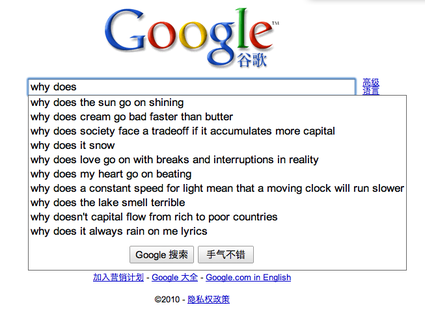
Um, are you ready for the U.S. site’s questions?

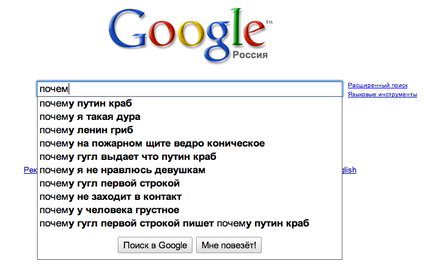
Meanwhile, the Russian Google site’s top query—”Why is Putin a crab”—is itself the subject of other queries, asking why that is the case. (There’s an answer somewhere behind the wall at the Moscow Times):
And in Italy, the questions include both “Why do women bathe?” and “Why doesn’t my girlfriend bathe?” (and “Why did Michael Jackson become white?”):
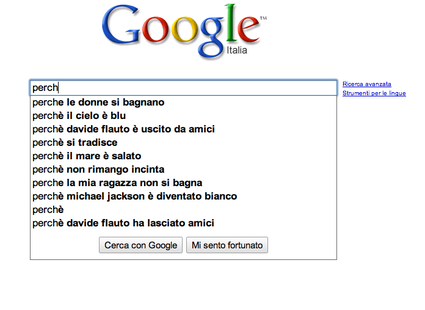
Any linguists care to tackle other foreign Google sites?
A New Formula: The “Christ, What an Asshole!” Caption
_Pollux writes_:
“Don’t take it as a matter of course,” the Austrian-British philosopher Ludwig Wittgenstein once wrote, “but as a remarkable fact, that pictures and fictitious narratives give us pleasure, occupy our minds.”
Christ, what an asshole!
I refer not to Wittgenstein, but to a universal caption that could be applied to all _New Yorker_ cartoons in the magazine’s caption contest. Emily “wrote”:http://emdashes.com/2006/02/more-uncaptions-for-your-click.php on the phenomenon when it made its appearance in cyberspace.
As scientifically “demonstrated”:http://modernarthur.com/blog/christwhatanasshole.html by Charles Lavoie, “Christ, What an Asshole!” can be applied to multiple _New Yorker_ cartoons without sacrificing their humor or coherence.
The caption seems to work, creating a fictitious and humorous narrative. Perhaps it’s the shock value of using profanity for classic _New Yorker_ cartoons, or the fact that it exposes their basic formula: a bizarre figure or situation amidst a normal, workaday one.
“Christ, What an Asshole!” gives us pleasure and occupies our minds.
Georgia O’Keeffe at the Slots: More on Casino Carpets
Jonathan Taylor writes:
One holiday season of the high 1990s, I drove over from New Orleans to rendezvous with some friends at the Beau Rivage casino in Biloxi, Mississippi. I had to head back late the same night to catch a plane the next morning. But after an evening on the casino floor, back in my friends’ room I realized I had dropped my keys—somewhere. By the time I called Lost & Found, they had already been turned in, which I still consider inexplicable, and you would too, if you’ve been in a casino and seen what the carpet patterns are like. (Not quite as good, though, as the guy in London who returned the wallet I jet-laggedly left in a phone booth—a guy whose job was to put up those cards and stickers for prostitutes that used to plaster London phone boxes.)
Anyway, Lauren Collins has a nice Talk piece on a gallery show of photographs of casino carpeting by Polish-born, Swedish -raised Chris Maluszynski at 25CPW “this week” (gallery site seems to have no info on the show). It reminded me that there was another nice short piece on the topic in The Believer a few years ago, “Rolling Out the Carpet for Homo Ludens” by Alexander Provan (the print issue had a nice insert of sample patterns).
Provan wrote:

….hotels and casinos are increasingly looking to trade gimmickry for packaged elegance, starting with the carpets. Oddly, many of the new floor-coverings feature forms and figures that would look familiar to the so-called non-objective filmmakers, animators and painters emergent in the first half of the twentieth century, such as Oskar Fischinger, Jordan Belson and the Whitney Brothers–call it visual Muzak. On a recent trip to Las Vegas I saw densely packed geometries, monochromatic patterns, abstract figures in various stages of metamorphosis. The new carpets at Harrah’s appropriate the quivering striations of Georgia O’Keefe’s “Music–Pink and Blue II” and wash all tension away with buckets of brown and orange. At the Mirage, russet amoeba cartoons exchange organic matter over a tan backdrop. At Carson City’s Nugget Hotel, Paul Klee’s “Variations (Progressive Motif)” is amplified beyond the bounds of good taste and supersaturated in canyon hues….
Mark Pilarski, a longtime Vegas insider and consultant, agrees that the abstract geometric patterns are used “to break up the space,” in accordance with the Friedman Standards. But he also contends that, for those in the business, “The main reason is that your eyes are focused to look up at the machines. You just can’t keep looking at that busy pattern when you’re walking.” A solid pattern, he adds, “would look like a football field. I’ve seen this once–the casino looks like the runway of an airport, like infinity. But the guests don’t want that, they don’t want it to be infinity out there.”
“Friedman” is Bill Friedman, author of Designing Casinos to Dominate the Competition.
The ‘Demagogic Blowfish’ of Yesteryear: The New Yorker’s Chronicle of the Last Health Care Battle
Jonathan Taylor writes:
In 1966, a five-part [correction: four-part, as correctly stated in today’s subsequent Back Issues post] Annals of Legislation piece by Richard Harris in The New Yorker chronicled “the long, legislative, and anti-legislative activity which preceded the achievement of ‘medical care…a basic human right’ certainly in a country whose people had not only been ‘ill fed, ill housed’ but also ill,” in the words of the Kirkus review of the book version of the series, A Sacred Trust.
Kirkus continues:
The fight went on for more than three decades from the time when the A.M.A., a monolithic obstruction in the body politic, determined to keep “public health in private hands,” spent fifty million dollars opposing what ultimately would result in Medicare. This traces the whole unhealthy history of A.M.A. political power ploys, first in the hands of that demagogic blowfish, Dr. Fishbein, then in those of a p.r. organization, down through all the administrations and bills, submitted and defeated, on Capitol Hill.
The Baffler Online: Information Wants to Be Free, in Its Own Sweet Time
Jonathan Taylor writes:
Yves Smith of Naked Capitalism posts her article on Wall Street culture, “Indefensible Men,” from the December 2009 issue of the revived Baffler, whose slowness or reluctance to post many of its articles have helped it make so much less of a splash than it would have, given contributors including Matt Taibbi, Naomi Klein, Lydia Millett and Michael Lind. (Yves Smith link via Matthew Yglesias, who notes in particular the handsome Niebuhr epigraph.)
I received, nth-hand, an e-mail sent out by a Moe Tkacik desperate to distribute her article at a time when it hadn’t seemed to materialize in either paper or pixels (it has in the latter, at least). As for Christine Smallwood’s “What Does the Internet Look Like?”, we’ll just have to keep looking at the rest of it.
In 1995, the original Baffler threw a party at the Knitting Factory in New York that was covered in a Talk piece, which is written in that style of deadpan that mocks weakly with a sort of faux-naif air, so annoying to me, and, I think, less commonly deployed than it used to be: “About three hundred people showed up, mostly striving writers and publishing types. Dress was exceedingly casual.” (It followed an item about Nutella—”pronounced ‘noo-tella.'”)
The Baffler also made a cameo in a 2008 Jeffrey Eugenides story, “Great Experiment“:
For sixteen years now, Chicago had given Kendall the benefit of the doubt. It had welcomed him when he arrived with his “song cycle” of poems composed at the Iowa Writers’ Workshop. It had been impressed with his medley of high-I.Q. jobs the first years out: proofreader for The Baffler; Latin instructor at the Latin School.
Did or does The Baffler even have paid proofreaders?
Ireland/Movieland: Richard Brody’s St. Patrick’s Day Pick
_Pollux writes_:
On the New Yorker site, Richard Brody “talks”:http://www.newyorker.com/online/blogs/movies/2010/03/top-o-the-morning.html about movies to watch on St. Patrick’s Day for the feature called “The Front Row.”
Brody recommends a movie called _Rocky Road to Dublin_ (1967). A documentary by Peter Lennon, the re-released film includes some goodies and extras for your visual enjoyment.
Orange on St. Patrick’s Day?: A 1933 Talk of the Town Anecdote
_Pollux writes_:
_The Talk of the Town_ for the March 25, 1933 issue of _The New Yorker_ offers this St. Patrick’s Day-themed anecdote. An “observant and conscientious gentleman,” glancing at the storefront of Altman’s on Fifth Avenue, sees an array of dresses, none of which are green-colored.
Of the dresses, “fully half of which were orange.” The gentleman calls Altman’s and gets in touch with the stylist. The stylist is grateful for the gentleman’s call.
That very night, “the display had been changed to include a liberal sprinkling of emerald…”
Happy St. Patrick’s Day!