
Category Archives: Looked Into

The Karl Kraus of Killeen? Roy Edroso Headed for Texas

Jonathan Taylor writes:
I’d call him the Wolcott of Williamsburg, but even better to note that anyone writing, on or off the Internet, would do well to aspire to be the Edroso of their environs. Roy Edroso of Alicublog and the Village Voiceprofiler of Emdashes, tormentor of conservative bloggers who can’t keep up—announces the imminent shift of his operations to Texas, into the arms of a “girlfriend.” I’ll just pretend it’s Jerry Hall, in light of the way Edroso has lived the life of New York:

More to the point, New York has been my home. It hasn’t always been an easy place to live, but if I was ever bored it was my own fault. Here I’ve been chased by cops in the Tompkins Square riot, and heard Allen Ginsburg [Yeah, yeah, Ginsburg, schminzberg] read poetry there some days after (“Look, I’m wearing a tie — am I a yuppie?”); fretted with my Williamsburg neighbors as the ruins of the Twin Towers smoked on the horizon; walked over the Williamsburg Bridge during a blackout; spilled a giant thug’s beer in a basement after-hours, apologetically bought him a new one, and been rewarded with fat lines of coke; read poetry at St. Mark’s Church; played CBGB so many times I forgot it was a shrine; been advised by Jimmy Breslin on how to talk to cops, handed a flyer by Jean-Michel Basquiat, advised on my music career by Lieber and Stoller, given a tour of Terry Teachout’s art collection, yelled at by Hilly Kristal and several members of the NYPD. And at the Voice I held a desk next to Tom Robbins. Everywhere I met remarkable people, because this is one of the places they like to be, and saw and did remarkable things, because here they happen all the time.

Of course, New York is the most provincial city of all. So often it “dulls the mind and blunts the instrument” (PDF, and worth it) by convincing that it doesn’t. Like those fat lines, it gives a foolproof high by making you want only one thing—it. Edroso doesn’t say exactly where he’s going—giving pursuers a lot of ground to cover—but I’ll say the advantage of being anyplace that’s not “the capital of everywhere” is that the smart people, by definition, have to be interested in the wider world. They should be in the capital, too, yet so many aren’t—and, in truth, aren’t exactly too searching about the capital either.
But Edroso is right about the remarkable people and things, of course, because he is one. And you can tell he has made the most of his New York days, because he’s so cold-eyed about the city, he easily laps its suburban would-be ill-wishers.
Cherished and Cursed: Louis Menand and Stephen J. Whitfield Discuss Salinger’s Catcher in the Rye

_Pollux writes_:
“But how so transparently charming a novel can also exercise a peculiar allure and even emit disturbing danger signals may serve as an entrée into post-war American culture…” So writes Stephen J. Whitfield on his landmark commentary on Salinger’s _The Catcher in the Rye_.
Stephen J. Whitfield’s article for the December 1997 issue of the _The New England Quarterly_, called “Cherished and Cursed: Toward a Social History of The Catcher in the Rye,” is considered one of the Journal’s most popular articles.
And, in light of Salinger’s recent passing, Louis Menand will be interviewing Whitfield in a “new podcast.”:http://www.mitpressjournals.org/page/podcasts
Read Whitfield’s fascinating article, listen to the podcast, and join the discussion today!

Q: Where Is the U.S.’s Largest Abandoned Subway Tunnel?

A: _Jonathan Taylor writes:_
I was pained by Patricia Marx’s “shopping column on Brooklyn”:http://www.newyorker.com/online/blogs/goingson/2010/03/what-to-buy-in-brooklyn.html in the March 8 issue, but she was correct to highlight the thrilling “tours of the Atlantic Avenue Tunnel”:http://brooklynrail.net/proj_aatunnel.html (also the subject of a 1982 “Talk piece”:http://www.newyorker.com/archive/1982/11/01/1982_11_01_033_TNY_CARDS_000333539 by Bill McKibben).
But that didn’t prepare me for these pictures from a tour of “Cincinnati’s never-completed subway”:http://queencitydiscovery.blogspot.com/2009/03/cincinnati-subway.html (via “Lawyers, Guns & Money”:http://lefarkins.blogspot.com/2010/03/queen-city-subway.html)—they’re a must see.

Number of Appearances by The New Yorker in Harper’s Index: 2

Jonathan Taylor writes:

  • Via the neatly searchable archive of the Harper’s Index, they are:

    (Jan. 1993) Percentage of New Yorker articles since Tina Brown became editor whose first sentence includes a person’s name: 70
    (July 1996) Chances that a cartoon in The New Yorker‘s Women’s Issue was drawn by a man: 5 in 6

  • In the Times Book Review, Craig Seligman shares some (self-) revealing recollections of St. Clair McKelway, on the occasion of a new collection of McKelway’s New Yorker reporting.
  • At the Edge of the American West, a historian’s reflection on Paul Krugman’s comments about studying economics versus studying history in the recent New Yorker Profile of him—with some spirited exchanges in the comments. Coincidentally, “Undercover Economist” Tim Harford’s latest column in the Financial Times illustrates the persistence of long-ago history in contemporary outcomes.
  • Continuing on the history tangent, I was delighted to see Adam Cohen’s Times Editorial Observer appreciation of the BBC Radio 4 program (and podcast) “In Our Time,” in which Melvyn Bragg harries his academic guests into distilling great topics in civilization into their pithiest essence. (Will Self also wrote about “In Our Time” recently in the London Review of Books.) WNYC’s Laura Walker wrote a letter to the Times defending U.S. radio against the suggestion that it doesn’t host such erudite discussions. But Walker’s counterexamples are telling: All the topics are basically contemporary; none represents the undiluted interest in the past that “In Our Time” exhibits.
  • I reviewed Country Driving, by Emdashes fave Peter Hessler, at Bookforum.com.

Ground Zero Performance: Paul Goldberger on 60 Minutes

_Pollux writes_:
Paul Goldberger, architecture critic at _The New Yorker_, appeared tonight on CBS’ _60 Minutes_, which ran a “story”:http://www.cbsnews.com/video/watch/?id=6228927n on the delayed and knotty redevelopment of the World Trade Center. In 2004, Goldberger published a book, _Up From Zero_, on the attempts to revitalize a site that remains disputed land entangled by conflicting visions and lethargic bureaucratic machines. As Scott Pelley remarks on the story, “failure has many architects.”

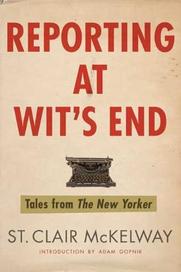
Reporting at Wit’s End: The Collected Essays of St. Clair McKelway

Reporting at Wit's End-book cover.jpg
_Pollux writes_:
The newly published “_Reporting at Wit’s End: Tales from The New Yorker_”:http://www.amazon.com/gp/product/160819034X/ref=s9_simi_gw_p14_i1?pf_rd_m=ATVPDKIKX0DER&pf_rd_s=center-2&pf_rd_r=1FDBYXJN2NYY47SFW8D3&pf_rd_t=101&pf_rd_p=470938631&pf_rd_i=507846 collects the essays of _New Yorker_ reporter “St. Clair McKelway”:http://en.wikipedia.org/wiki/St._Clair_McKelway (1905-1980), who wrote for the magazine from the 1930s to 60s. At a hefty 620 pages, _Reporting at Wit’s End_ is a substantial contribution to classical American journalism and _New Yorker_ history.
McKelway’s pieces pulsated with the power of the personalities he profiled. McKelway wrote pieces on figures like Stanley Clifford Weyman (born Stephen Jacob Weinberg), a “dedicated imposter.” Weinberg, like many rogues and con men, tinkered with his name, posing as “Royal St. Cyr only when he wished to drum home to himself and other people the notion that he was a lieutenant in the French Navy, which he wasn’t.” In 1940, McKelway profiled and radio commentator Walter Winchell, who, “although he has never been shot at and has been beaten up only twice, he is always expecting to be attacked.”
With an introduction by Adam Gopnik, _Reporting at Wit’s End_ is the best tribute (who needs another statue in a park?) and service that can be made to a writer of St. Clair McKelway’s caliber.

The Invisible Man: Finding Rea Irvin

_Pollux writes_:
What does Rea Irvin look like?
In this “post”:http://www.newyorker.com/online/blogs/tny/2010/02/chris-ware-rea-irvin.html on the New Yorker site, Chris Ware explores the difficulties of finding a photograph of the _New Yorker’s_ first art director.
Although Irvin’s legacy remains clear and apparent, Irvin the man remains a shadowy, elusive figure. Any student of Irviniana will share the same gratification that Ware experienced when he found a mysterious photograph of Irvin on the beach, in a meditative pose. Irvin turns out to be “an affable, rotund chap, with an unruly swoop of hair.”
With the benefit of finally knowing what he looks like, Ware depicts Irvin on an upcoming anniversary “cover.”:http://www.newyorker.com/online/2010/02/15/slideshow_100215_anniversarycovers#slide=3
What does Rea Irvin look like? Now we know.

Hapworth 16, 1924: The Screenplay

July-2010-revision-Pollux.png
_Pollux writes_:
For many, J.D. Salinger’s short story “Hapworth 16, 1924” is a story that one feels obliged to read, if only to see what all the fuss is about. It certainly makes easier reading than Joyce’s _Finnegans Wake_, but for readers looking for structure and narrative, Hapworth may be a disappointment.
Nevertheless, Hapworth remains an object of wonder, due to the fact that it is the last piece of work that Salinger published. Its aura is increased by its inaccessibility in print, although if you have access to The New Yorker Digital Reader, you may read it in full in the June 19, 1965 issue. Just log in, turn the digital pages to page 33, and smile at the 1960s ads for booze, vacation spots, and Woody Allen’s “laugh record” (Volume 2).
Salinger’s deal with Orchises Press to publish Hapworth collapsed like a pack of cards.
Whither Hapworth? For fun, I’ve given myself the difficult and unsanctioned assignment of trying to adapt Hapworth for the screen.
As this piece in _Slate_ “points out”:http://www.slate.com/id/2242990/, adapting any work by Salinger is an impossibility due to legal and artistic difficulties (although an undercurrent of Salinger-like characters and inspiration has existed in American cinema since the publication of _Catcher in the Rye_).
How should I adapt Hapworth? Beads of sweat roll down my forehead.
Like Nicolas Cage’s character in _Adaptation_, I feel that coffee and a muffin may help me write, but then again, I could reward myself with those items after I do some solid writing. I need to get to work.
Where does one begin?
INT. BUNGALOW 7. CAMP SIMON HAPWORTH.-DAY.
The BUNGALOW is sparsely furnished and decorated, save for some PRINTS on the wall that feature, in turn, Tolstoy, the Hindu goddess Gāyatrī, Cervantes, Balzac, and Flaubert.
Below the prints, we see SEYMOUR, a boy of seven. He scribbles furiously on sheets of lined paper. Suddenly, he stops and picks up the last part of the letter. He reads aloud from it.
_SEYMOUR_
Please, please PLEASE do not grow impatient and ice cold to this letter because of its gathering length!
SEYMOUR chuckles.
Or else we start with Buddy Glass:
INT. BUDDY GLASS’ ROOM-NIGHT.
Sounds of a typewriter fill the room. PAN on BUDDY GLASS, typing. He is typing up the contents of an old, hand-written letter. An opened envelope, with a “Registered Mail” slip, sits on his desk.
PAN on the letter, the beginning of which reads: “Dear Bessie, Les, Beatrice, Walter, and Waker:…” CUT TO:
The exterior of CAMP SIMON HAPWORTH. A Maine forest.
But these points of entry may be suffering from the phoniness or mawkishness that Salinger may have despised. Finding the right child actor may also pose some difficulties. A child actor appearing in a Salinger adaptation? Whoever it would be would become an instant celebrity. The actor would become a new Seymour Glass in his own right, suffering and benefiting from the effects of instant fame.
As Emdashes editor Martin Schneider “points out”:http://emdashes.com/2010/02/why-did-salinger-once-seem-so.php, Salinger may have been the first American writer in the postwar era to explore the issues of fame and celebrity. The Glass Family siblings were celebrities who gained their fame as a result of appearing in a radio program called “It’s a Wise Child.”
Perhaps we should use a succession of child actors to play Seymour Glass, from scene to scene. Perhaps we should not use live actors at all.
“Hapworth 16, 1924” may be best adapted as a stop-motion film or a film with Japanese shadow puppets.
Camp Hapworth. Day. Several small boys, including SEYMOUR GLASS, push a cart out of the mud. They are encouraged in this exercise by MR. HAPPY.
In the car afterwards, a clay-mation (or puppet) Seymour says to a clay-mation (or puppet) Mr. Happy: “We are fairly talented singers and dancers, sir, though amateurs. If I lose my leg to gangrene, I will suggest that my father sue you. Nevertheless, since this situation is so risible, I tend to bleed less profusely, so no harm done.”
Alas, we may never see a film version or a version of Hapworth in the Indonesian shadow puppetry of “Wayang”:http://en.wikipedia.org/wiki/Wayang, which Salinger may have loved. Or how about The Glass Family Cartoon, as I imagined in the drawing above?
One can dream. All this is pure experimentation and speculation, but in experimenting and speculating, we honor the author and honor the work.
_DISSOLVE TO_:
The end of this POST.

When You Bend It, You Can’t Mend It

Emily Gordon writes:
I should have known Hendrik Hertzberg would be a Kate McGarrigle fan, and here is his heartfelt, ardent tribute to her. I heard about her death on Jonathan Schwartz’s timeless, dreamlike radio show last weekend and have had her songs caught in my head, even more than usual, since then. “And it’s only love, and it’s only love,/That can wreck a human being and turn him inside out.”
Hertzberg wrote this (and more–read all of it) as a Carnegie Hall program note for a McGarrigle Christmas show, and I think it’s just right:

The songs and singing of the McGarrigles have turned out to be a font of consolation: a pool of sweetness, a well of sadness, a geyser of exaltation. They have music to suit every stage of love and life. And they are the muses and matriarchs of an extraordinary family circle–a raffish orchestra of parents, siblings, offspring, exes, friends, and collaborators. We, their fans, are part of this circle, too. There are enough of us to assure our uncompromising heroines of a livelihood, but not so many that we risk the loneliness of a crowd.

Every stage of love and life–including this one, the unreal, suspended sadness of hearing one of your favorite voices on the radio and in your thoughts, and knowing the breath and mind behind that voice are gone.

Cartoonists A – Z: Michael Maslin’s Directory of New Yorker Cartoonists

_Pollux writes_:
It’s a work in progress, but Michael Maslin’s “Directory”:http://michaelmaslin.com/index.php?page=nyer-cartoonists-a-z of New Yorker Cartoonists serves as a very useful compendium of _New Yorker_ cartoonists’ names and biographies.
Maslin includes useful information, such as when a cartoonist’s work began appearing in the magazine.
Maslin’s _New Yorker Cartoonists A – Z_ also includes some photos and self-portraits, as well as some interesting biographical details about the diverse pantheon of people who have contributed their immortal cartoons to the magazine. Enjoy!