
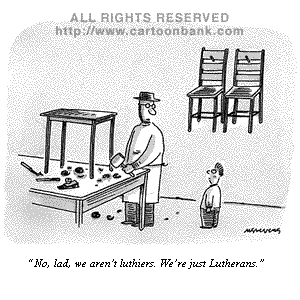
Apologies to Mick Stevens, and all religions. And kudos to Burkhard Bilger for writing such a kick-ass piece about visionary guitar builders. I was in Wolcott, Vermont, or thereabouts, yesterday and saw a sign for a custom guitar shop; I wonder if that guy knows Ken Parker, the subject of Bilger’s profile (not a Profile, I know, but it’s kind of a profile anyway)?
Here’s the original cartoon to which I refer in my Photoshop adulteration there. Wasn’t it in the magazine just a few months ago rather than in 1999, or am I confusing dates and times again? It does happen.
Category Archives: Seal Barks
The Current Cover Is by Ivan Brunetti, and So Is This Event and This Book
From Fantagraphics comes this welcome news:
Fantagraphics Bookstore & Gallery Presents “Misery Loves Comedy: New Works by Ivan Brunetti”
May 19 through June 20, 2007, with Artist Reception June 8
Fantagraphics Bookstore & Gallery is pleased to debut the lively exhibition, “Misery Loves Comedy,” featuring new and recent work by Chicago-based artist Ivan Brunetti. The show opens on Saturday, May 19 and continues through June 20, 2007 at 1201 S. Vale St. in Seattle’s creative Georgetown arts community. The gallery hosts a festive reception for the artist on Friday, June 8 from 6:00 to 8:00 PM.
This exhibition commemorates the publication of Misery Loves Comedy by Fantagraphics Books, an anthology of the first three issues of
Brunetti’s “Schizo” comic book and other works. Brunetti’s self-deprecating comic stories portray his emotional battles with depression, divorce and high anxiety, employing compelling dark humor and visual acuity. His therapist actually provides the book’s introduction. “I’m not going to explain things to readers,” Brunetti comments in a recent edition of Publishers Weekly. “I don’t know if I can explain them to myself.”
In addition to Brunetti’s new collection, Seattle-based Fantagraphics Books has published four issues of “Schizo” and two volumes of his gag cartoons, “Hee!” and “Haw!” Brunetti recently organized “The Cartoonist’s Eye” exhibit at the A+D Gallery of Columbia College Chicago and edited the companion bestseller “An Anthology of Graphic Fiction, Cartoons and True Stories,” published by Yale University Press. He has drawn comics and illustrations for The New Yorker, The New York Times Sunday Magazine, Entertainment Weekly, and Spin, among many others.
“I enjoy watching Brunetti suffer.” —ART SPIEGELMAN
Those Illustrated Ads in the Current Issue: Jill Calder Explains It All to You
If you’re anything like me (and you are—at least a little, little bit), you’re wondering what’s going on with that series of ads for Mass Mutual Financial Group in this week’s New Yorker, the ones in which a red-headed woman is overwhelmed by insurance. From iSpot‘s blog:
Jill Calder’s whimsical artwork takes over the April 16, 2007 issue of the New Yorker magazine with a narrative series of ads for Mass Mutual Financial Group. The New Yorker selected about 40 illustrators for Mass Mutual and their ad agency, Mullen, to choose from, which eventually whittled down to Jill; her job was to bring their concept to life.
…
[Jill Calder:] I started by creating a character, whom I named Stella (rather than “the Mass Mutual woman”!) – female, 30’s, capable, confident and busy, but sometimes too busy to tend to her insurance needs. I also created a colour palette which would keep the look of the ads consistent but give me flexibility and a generous range, as I love colour. The Mass Mutual corporate blue was one of the colours, which gave the ads a strong, if subliminal, branding…. I had to show Stella in all manner of situations, some quite surreal and others quite lifelike, that were basically “barriers” preventing Stella from getting her financial needs sorted out. The first full page image was of Stella surrounded by an extreme amount of paperwork, teetering piles of it, which described her misconception that applying for insurance would be complicated and involve too much paperwork. In the next image, Stella decides she has no spare time to deal with insurance – this again is illustrated in a dreamlike fashion: she appears in an hourglass, trapped but still moving forward. Cont’d.
People of Cover
Martin Schneider writes:
I wanted to address reader Bruce’s comment to the last “Squib Report” post. Here’s what he wrote:
What is so interesting about the current cover is that this is the second time in the magazine’s history that they have shown people of colour in the drawing. Otherwise it is not a great cover.
When I first read this, I immediately thought of Tina Brown’s second-ever cover, which celebrated Malcolm X (and was timed to coincide with Spike Lee’s movie), and Art Spiegelman’s “controversial” 1993 Valentine’s Day cover.
A few minutes with The Complete New Yorker produced this list:
January 19, 1929
January 10, 1931
November 21, 1936
March 9, 1940
February 7, 1942
January 9, 1971
December 28, 1992
September 13, 1993
October 17, 1994
January 16, 1995
January 30, 1995 (sort of)
December 4, 1995
March 11, 1996
April 28, 1997
July 26, 1999
January 17, 2000
February 14, 2000
April 2, 2001
October 27, 2003
June 28, 2004
September 12, 2005
I am sure there are many other examples—and this list only counts Africans or African-Americans. If we broadened it to include Asians, Inuits, Native Americans, and so on, the list would be considerably longer.
I’m sure we can all take issue with The New Yorker‘s blind spots or paternalism over the years—it’s been a tumultuous eight decades!—and The New Yorker has certainly never been easily confused with Ebony. Still, Bruce—you’re going to have to make your case in some other way!

Investigation: Bruce McCall’s Wheel of Article Ideas
Happy 82nd birthday, New Yorker! (The magazine debuted on Feb. 17, 1925, with the Feb. 21 issue.) I asked Martin Schneider, Emdashes Squib Report bureau chief, to do a little sleuthing into a corner of Bruce McCall cartoon on pp. 168-69 of this week’s anniversary issue.
As Emdashes’s resident archival expert, I found McCall’s cartoon of the first-ever guided tour of The New Yorker‘s offices highly irresistible. My favorite invention is the “Wheel of Article Ideas,” which pokes fun at the identifiably New Yorker blend of subjects—often fascinating, often arcane, sometimes too trendy, sometimes too dusty, but never, ever straightforwardly or unselfconsciously au courant. (After all, any magazine can be merely up to date; only a special magazine asks what in going on in J.Lo.’s brain.)
Does there lurk in this inscrutable amalgam a hidden code, each item pointing to a different era or major leitmotif of The New Yorker? Were I better versed in New Yorker lore, would it be within my grasp to crack that code and watch the different shards of the enigma interlock into a grander pattern? (The other possibility is that it’s just a cartoon.)
Anyway, let’s get to it. Did McCall include any topics that The New Yorker has already handled? Armed with the bottomless Complete New Yorker, I decided to find out.
LOGS
In the 2/13/1984 issue, The New Yorker ran a poem by Karl Shapiro called “The Sawdust Logs.” Quoth Shapiro, “Why shouldn’t sawdust have its day?”
NAPS
In the 5/31/1941 issue is a cute little TOTT about two young women who are prepared for their suburban journey out of Grand Central. They produce an alarm clock and nap right up to one minute before their train arrives in Scarsdale. Then they scamper off the train.
OXEN
In the 8/24/1946 issue, Berton Roueche reports on a day in the company of Percy Peck Beardsley, breeder of Devon oxen, who plies his weary trade in the bleak and pitiless plains of…Connecticut. In my opinion, this is a dig at the Shawn era, what with its E.J. Kahn “Staff of Life” treatises on wheat and the like.
BALLET DESIGN
Joan Acocella’s 5/28/2001 review of a Jerome Robbins bio cites “Balanchine’s grand, unfolding design.” Arlene Croce’s 11/17/1997 showcase on Merrill Ashley refers to “the design of classical dancing.” I suppose any ballet production has set and costume designers, and the corps may have designs on the prima ballerina’s primo position, but I take “design” here to mean something closer to an engineering term. Essentially an absurd juxtaposition.
J.LO I.Q.
Astoundingly, The New Yorker has never devoted any significant space to the question of Ms. Lopez’s intellectual gifts. In the 10/2/2000 issue, however, Christopher Buckley did float the idea of someday replacing future VP Dick Cheney with J.Lo. So back off, hatas! If “Oxen” is the kind of profile Shawn would have run, here we surely hark back to the Tina Brown era.
MAMBO
This seems to be a dig at the uneasy fit that such a steamy, sultry subject would be in the pages of The New Yorker, and McCall certainly has a point: The New Yorker has never produced much copy on the subject. There’s a TOTT from 4/18/1988 about an uptick in dance-course enrollments in the wake of Dirty Dancing. There was also that 2000 Oscar Hijuelos book The Mambo Kings Play Songs of Love, which got some coverage too.
IRAN’S BILLBOARD CRISIS
No such thing. I take this somewhat absurd reference to be essentially a compliment. The implication is that The New Yorker has a knack for producing fresh coverage—perhaps at times perversely—even on hot spots that have already received plenty of exposure. Who can forget that 2002 look at trampoline fetishism in Karbala?
FERNANDO PÓO
What a marvelously supple reference. Fernando Póo, Fernando Pó, and Fernão do Pó refer to both a person and a place. He was a Portuguese explorer who in 1472 discovered an island off the west coast of Africa in the Gulf of Guinea that for centuries was named after him. In 1979 it assumed the name Bioko after some sort of revolution. His name was also applied to certain places in Cameroon, which he also explored, this fact leading to the only mention I could find in The New Yorker—a 2/18/1961 TOTT about “Cameroun.” Other Fernandos mentioned in The New Yorker include Meirelles, Luis Mattos da Matta, Scianna, Medina, Collor, Henrique, Ferrer, Ochoa, Valenzuela, and Nottebohm. The Fernandos created by ABBA and Billy Crystal have apparently escaped The New Yorker‘s notice.
JAM
Oh, could we get any more quaint and cozy? Why not just choose the tea cosy, for that matter? As it happens, jam figures prominently in the searing 9/10/1966 TOTT on the National Fancy Food and Confection Show. So there.
MILLARD FILLMORE
Ah, our most risible president. Does anyone even know whether he was any good or not? His amusingness seems a priori. Alas, the world awaits the definitive New Yorker treatment of the subject. In the meantime, Morton Hunt’s 11/3/1956 account of the presidential race of 1856 will have to do.
Can anybody read that last one? “Zoo”? I await further clarification (shout? murmur?) from Mr. McCall.
Extra! New Yorker Cartoons Talk!
Roz Chast said recently that it took so much effort to get her characters to walk across a screen she wondered if she’d stop having fun with them, cool though the technology was. Art Spiegelman once said in jest that he’d agree to make Maus into a movie only if he could use real mice. (Then, I’ve heard, that wag Errol Morris called up to say he’d be happy to work on the project, since he’s good with rodents.) For some reason, the only people who know about this seem to be a couple of podcast directories. But you’re going to be excited about it: New Yorker cartoonists are making animated short-shorts, available as a video podcast from RingTales, and the RSS feed is here. I’ve already watched a fetching Charles Barsotti scenario in which a receptionist has an unusual suggestion for a caller on hold. I’m going to watch more now. The animations seem to be already existing cartoons slightly expanded for the shorts; remember Eric Lewis’s cartoon “I should have bought more crap”? Here it is in motion. Besides Lewis, other contributors so far include Danny Shanahan, Sam Gross, Frank Cotham, Tom Cheney, Peter Steiner, Christopher Weyant, cartoon editor Bob Mankoff, and, a nice surprise, Chast too. If this is the direction newyorker.com 2.0 will be taking within a few weeks (the website’s being completely redesigned as we speak), I’m enthusiastically for it. You think I’m enthusiastically for everything? Ah, there’s where you’re wrong.
If readers get to vote, or something YouTubey like that, on which cartoons will be sprinkled with pixie dust and come alive like the Nutcracker toys, my pick this week would be Drew Dernavich’s nutty, funny fish ladies, who would wiggle most entertainingly. Still, movement isn’t everything. All the cartoons in this issue, especially this fantastic George Booth drawing and this ridiculous J.C. Duffy concoction, are perfect just as their two-dimensional, stationary selves.
Update: There’s now a press release with details: “Subscribers to the free advertiser-supported podcast will receive three new animations of The New Yorker “RingTales” each week.”
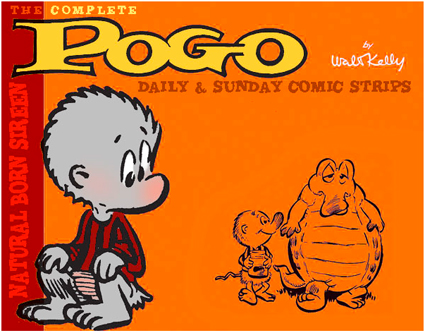
Jes’ Fine: Huge Pogo News From Fantagraphics
From the most exciting press release I’ve seen in months, if not years:
FANTAGRAPHICS TO PUBLISH WALT KELLY’S POGO, DESIGNED BY JEFF SMITH
Fantagraphics Books is pleased to announce that it has acquired the rights to publish a comprehensive series comprising Walt Kelly’s classic POGO comic strip. The first volume of Fantagraphics’ POGO will appear in October, 2007, and the series will run approximately 12 volumes.
Each Pogo volume will be designed by Jeff Smith, the award-winning cartoonist and creator of the Bone graphic novel, and a lifelong admirer of Walt Kelly.
Walt Kelly (born Walter Crawford Kelly Jr.) was born in 1913 and started his career at age 13 in Connecticut as a cartoonist and reporter for the Bridgeport Post, his local newspaper. In 1935, he moved to Los Angeles and joined the Walt Disney Studio, where he worked on classic animated films, including ‘Pinocchio,’ ‘Dumbo,’ and ‘Fantasia.’ In the mid 1930s, he drew his first comics work for the future DC Comics. Kelly left Disney in 1941 rather than take sides in their bitter labor strike. He moved back east and began drawing comic books for Western Publishing Company and the Dell line of comics.
It was during this time that Kelly created the character Pogo Possum. The character first appeared in Dell’s Animal Comics as a secondary player in the ‘Albert the Alligator’ feature. It didn’t take long until ‘Pogo’ became the comic’s leading character. After the Second World War, Kelly became artistic director at the New York Star, where he turned Pogo into a daily strip. When the Star folded in 1949, the Hall Syndicate took ‘Pogo’ into syndication, so that the strip soon appeared in hundreds of newspapers. Until his death in 1973, he produced a feature that has become widely cherished among casual readers and aficionados alike as a classic comic strip.
Kelly blended nonsense, poetry, and political and social satire in making POGO an essential contribution to American “intellectual” comics. As the strip progressed, it became a hilarious platform for Kelly’s scathing political views in which he skewered national boogeymen like Joseph McCarthy, J. Edgar Hoover, George Wallace, and Richard Nixon. Kelly was considered a sufficient threat that his phone was tapped and the US Government corresponded with a newspaper reporter who claimed that the eccentric patois Kelly created was a secret Russian code.) Pogo is well known for its elaborate and ornate lettering and for Kelly’s distinctive use of language and lush brushwork. It is one of the few comic strips that succeeded in blending humor and politics into an uncompromising and entertaining whole.
The consecutive run of Pogo has never before been systematically collected into book form. (Fantagraphics published a series of 11 softcover volumes reprinting five-and-a-half years of the strip in the ‘90s.) This will be the definitive series collecting all of his Pogo strips from 1949 to 1973. “Walt Kelly is unquestionably in the pantheon of great newspaper strip cartoonists,†said Gary Groth, President & Publisher of Fantagraphics Books. “Our Pogo books will present Kelly’s work the way it should be published — in a beautifully designed hardcover format, with careful attention paid to reproduction quality, and with knowledgeable introductory material.â€
“I am very excited that Fantagraphics has chosen to publish Pogo in such wonderful books,†said Carolyn Kelly, Walt’s daughter. “For many years people have been telling me how much they want to own this series, and I am thrilled that Pogo will now be so carefully compiled and available to us. Ol’ Walt would be proud.â€
“This collection has been a long time coming,” said Jeff Smith, “I’ve been waiting for it ever since I was nine. I’m very happy to be helping the Kelly family and Fantagraphics bring this comic strip masterpiece to a new audience.”
Love Conquers All*: Emdashes Readers’ Valentines for The New Yorker
I asked some friends of Emdashes (whose abbreviation is not FOE) if they’d like to send some virtual valentines to a person, thing, or idea at The New Yorker. OK, that’s not completely true—I actually asked them to send a virtual holiday present back in December, but you know how these things go. So whether you hate Valentine’s Day or just sort of hate it, I hope this is a happy diversion, and I personally send kisses (and I’m told they’re quality) to every single one of you. Oh, and you’ll need to skip to the jump for the funny and gorgeous drawings by Patricia Storms; the first, while Christmas-themed, is eerily perfect for this week’s anniversary Tilley cover. Definitely click to enlarge!
Daniel Handler (Adverbs: A Novel, Lemony Snicket’s The End, &c.):
For Malcolm Gladwell: Three poems by Elizabeth Bishop, the first season of Golden Girls, a TRS-80 computer, a jar of dill pickles, and the results of a sociological study from the 1950s, with the expectation that he can find a life-guiding philosophical principle which governs all these specific items.
Mac Montandon (writer for Radar magazine and the author of the nonfiction book Jetpack Dreams, to be published by Da Capo Press in 2008):
1. Weekly assignments for Nick Paumgarten, Mark Singer, and Dana Goodyear.
2. A few more kids for Adam Gopnik—the better to generate story ideas.
3. A standing invitation for Ian Frazier to stop by any time and entertain me and my family with wonderful, witty tales.
4. The opportunity for David Remnick to reconsider that Silence of the City book idea.
5. Comma quotas for all!
Jesse Thorn (host, The Sound of Young America):
I would like to send Roger Angell season tickets to the Red Sox and an elixir of eternal life.
Carolita Johnson (Newyorkette and New Yorker cartoonist):
1. I’d send a beautifully tender, juicy, crackly-skinned, roasted chicken to Gary Shteyngart, with whom I had fun eating and talking about food at the Gin and Books party!
2. To Adam Gopnik, Microsoft Word’s Random Metaphor Check (as soon as it becomes available).
3. And to Orhan Pamuk, I’d send a chill pill after reading “My Father’s Suitcase”! I’ll throw in a self-flagellatory whip (one-time use only, because I do so like him).
A fan who prefers to remain anonymous has $500
for humorist Patricia Marx.
David Marc Fischer (proprietor of Blog About Town and frequent loser of the Cartoon Caption Contest):
1. To Sasha Frere-Jones: A crate of heart-shaped rockist crackers.
2. To Emily Gordon: The return of Elk Candy. [Yes, please! —Ed.]
3. To Zachary Kanin (gatekeeper of the Cartoon Caption Contest): Whatever he wants, capische?
John Bucher (New Yorker Comment and, if all goes well, brand-new Emdashes intern):
1. Backup batteries for Rik Hertzberg’s common-sense Taser.
2. A ride on an icebreaker ship (or the biggest dump truck in the world) for John McPhee.
3. A spot for Elizabeth Kolbert in the VP’s next shooting party.
4. For Malcolm Gladwell: a Golden Ticket and a tour of the factory.
Patricia Storms (freelance cartoonist and illustrator living in Toronto, who’s illustrating a children’s book for Scholastic Canada and a humor book for Chronicle Books, both out fall 2007; a book of her cartoons about Valentine’s Day will be out in February 2008 from Red Rock Press):
1. This may sound sappy, but I’d love to give Eustace Tilley a big fat kiss as a thank-you for delighting me with such a stellar magazine. I’m feeling especially mushy about The New Yorker this year, because after many years of my reading my mom’s used New Yorker copies, she finally decided to give me a year’s subscription as a Christmas present. What the hell took you so long, ma? (Kidding, I’m kidding.)
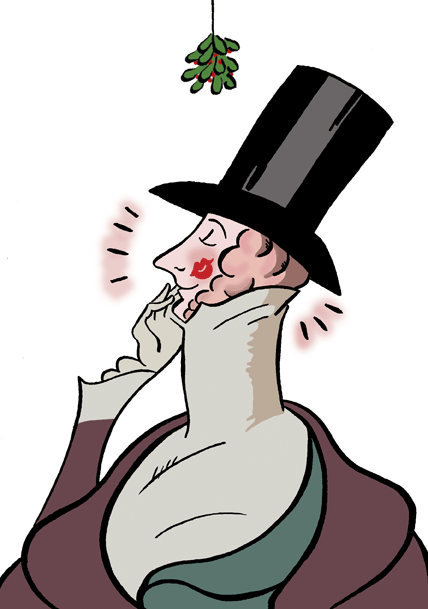
2. And in the spirit of the season, even though I tease poor Franzie mercilessly in my cartoons, I’d like to give good ol’ Jonathan Franzen, contributor to The New Yorker and lover of all things Charlie Brownish, a hug. I think he needs it.

∗ Love Conquers All is a 1922 book by Robert Benchley that you can read in full here.
Gravestones Are Forever, Plus Lillian Ross Pictures and More Allen Shawn
From Boston’s The Weekly Dig, a whole story about Drew Dernavich’s cartoons and tombstones. Didn’t know Dernavich engraved tombstones? Then you haven’t read this Boston Globe story about how the relatives of deceased Beantowners are up in arms over whimsical Boomer epitaphs like “The Happy Tomato” and “Who the hell is Sheila Shea,” and marble portraits that are less than Puritan. Dernavich is quoted there, but the new story’s a real profile:
“I’m not drawing in cartoony style. They’re like prints with captions,†Dernavich explains. “I’ve always been interested in printmaking and woodcuts. It makes sense to me. It feels natural. At first, I’d draw like this and think, ‘This isn’t a cartoon style.’ I tried to teach myself to draw cartoony; I guess I taught myself pretty badly. They all had this kind of schizophrenia—you’d have a realistic-looking pant leg with a cartoon head on top. It took a long time for me to figure out that your work doesn’t have to look like SpongeBob to be a cartoon…. I’ve always liked the stark black and white of the German expressionist printmakers, even though you’d never call that stuff humorous. Actually, it’s incredibly depressing—woodcuts of people hanging themselves. It’s very painful, but I love the stark look of it. I don’t know if that makes it any funnier. But I can draw a guy with a bulb nose and buck teeth, and that doesn’t make it funny, either. You don’t have to have a funny style if your material is good. You don’t need a laugh track—people can figure out what’s funny on their own.â€
Also, in re dead people, happy birthday, Robert Burns. Not at all in re dead people: The MoMA is having a film tribute to Lillian Ross from February 23-28, and the Times has a nice profile of Allen Shawn.
Andrew Miksys: Seattle Photog Makes Good
Hometown pride, in The Stranger‘s blog, for the creator of the striking photo that illustrates “Bravado,” the William Trevor story in the 1.15.07 issue:
How many expressive young men are sitting around Seattle dreaming of one day being in The New Yorker? Who can keep track… But here is one Seattle native, photographer Andrew Miksys, who has actually made the leap. His picture “Kissing Couple,” from 2001, accompanies William Trevor’s short story in the current issue of the magazine.
…
Here’s a cleaner version of the photograph. It’s from Miksys’s time in Lithuania, where he’s focused much of his attention on the Roma. Miksys will be at Seattle’s CoCA on Jan. 26, along with NPR commentator and poet Andrei Codrescu, to present images from Miksys’s new book, BAXT.If you go, ask him about this lady.