
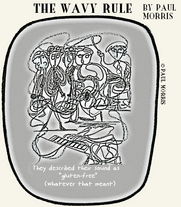
Today we commence a promising new series in which the artist undertakes to pitcher—er, picture—clever homophones. Click to enlarge!

More by Paul Morris: Enter our exciting contest to name the upside-down question-mark! Entries accepted until August 25. Plus, “The Wavy Rule” archive; “Arnjuice,” a wistful, funny webcomic; a smorgasbord of multimedia at Flickr; and beautifully off-kilter cartoon collections for sale and free download at Lulu.
Category Archives: The Catbird Seat: Friends & Guests
The Wavy Rule, a Daily Comic by Paul Morris: Fighting Varietals
What’s all this about a global war on terroir? Righteous epaulets, dude! As always, click to enlarge!

More by Paul Morris: Enter our exciting contest to name the upside-down question-mark! Entries accepted until August 25. Plus, “The Wavy Rule” archive; “Arnjuice,” a wistful, funny webcomic; a smorgasbord of multimedia at Flickr; and beautifully off-kilter cartoon collections for sale and free download at Lulu.
The Wavy Rule, a Daily Comic by Paul Morris: Amusing Line Drawing
Who says you can’t be pretentious with simplicity, or simple with pretension? Not me—click to enlarge!

More by Paul Morris: Enter our exciting contest to name the upside-down question-mark! Entries accepted until August 25. Plus, “The Wavy Rule” archive; “Arnjuice,” a wistful, funny webcomic; a smorgasbord of multimedia at Flickr; and beautifully off-kilter cartoon collections for sale and free download at Lulu.
The Wavy Rule, a Daily Comic by Paul Morris: Jazz on a Summer’s Day
Paul writes of today’s syncopated (and very modern) “Wavy Rule”: “Central Park Summerstage, Blue Note, Dizzy’s Club Coca-Cola, Iridium–all jazz venues that are reviewed in the latest issue of The New Yorker.” Click to enlarge!
More by Paul Morris: Enter our exciting contest to name the upside-down question-mark! Entries accepted until August 25. Plus, “The Wavy Rule” archive; “Arnjuice,” a wistful, funny webcomic; a smorgasbord of multimedia at Flickr; and beautifully off-kilter cartoon collections for sale and free download at Lulu.
Klemperer, Barthelme, Borowitz, and Other Dactyls: It’s Intern Friday!
Each Friday, the Emdashes summer interns bring us the news from the ultimate Rossosphere: the blogs and podcasts at newyorker.com. (A dactyl is a metrical foot used in poetry. “Poetry” and “marmalade” are dactyls.) Here’s this week’s report.
Adam Shoemaker
George Packer writes in this week’s edition of Interesting Times about the diaries of Victor Klemperer, a Jewish scholar whose love of Germany, even amid the degradations of the 1930s, kept him from leaving his home. Packer is interested in Klemperer’s attack on nationalism, which stemmed from a tenaciously stubborn belief in the rationality of the Enlightenment. The Nazi Olympics are much on the mind these days, and while Packer refuses the easy comparison of that regime and Communist China, he is unable to resist hearing “a faint echo” from 1936 and feeling the broad, dangerous reverberations of nationalism. [Albert Speer’s son did design the Beijing Olympic complex, after all. –Ed.] Packer also offers his thoughts on the dialogue pinging around the media this week concerning Barack Obama’s alleged aloofness and his candidacy’s meaning in the larger sphere of black politics.
Hendrik Hertzberg takes time this week in “Notes on Politics, Mostly” to uncover the hidden racial undertones of John McCain’s new television advertisements, which include an almost subliminally short shot of Barack Obama playing basketball and, less subtly, juxtaposes the Illinois senator with those hardly chaste white women, Ms. Hilton and Ms. Spears. A reader also spurs him to ponder the phallic imagery of the spots. The obelisk as virility symbol is old hat for this art history major; if McCain’s ad makers are going to pin their hopes on hidden visual cues, they could at least take a few pointers from the master.
I was thrilled this week to see Sasha Frere-Jones report on one of my favorite bands, Bon Iver, a.k.a. Justin Vernon, and a performance he “would be celebrating more loudly if Vernon hadn’t wiped [his] mind clean.” These clips may help explain why sharing is often the only proper form of music recommendation: “hyperbole will somehow ruin things.” Frere-Jones also reports on Rock The Bells, where he saw Mos Def, Method Man, Redman, Nas, Jay-Z, and Q-Tip. Pithiest line: “Mr. Def makes his rhymes clear, enjoys moving around, and seems to accept that his job involves being entertaining. His pants were extremely bright.”
In this week’s New Yorker Out Loud, David Grann talks about his look into the bizarre story of Frédéric Bourdin, the shockingly successful French con man whose grandest and possibly last imposture involved a missing child come back from the dead. Just trying to imagine a thirty-year-old Frenchman passing as a Texan high schooler—or wanting to—makes the mind reel. Bourdin is no flesh-and-blood phisher or 419 boy; he dupes in the name of love. Both the article and interview are highly recommended.
Finally, Andy Borowitz uses The Borowitz Report to make a public service announcement to the nation’s “many jerks and douchebags” who are at increased risk of brain tumors due to their incessant cell phone usage. The eminent Dr. Logsdon offers his condolences: “All in all, this has been a tough summer for assholes.”
Sarah Arkebauer
The Cartoon Lounge continues its dueling-sandwich-shops saga with second and third installments. Even as I laughed at how ludicrous the cartoonists’ sandwich shops would be, I found myself wanting to visit them! It seems like everywhere I turn, I am greeted with the symbol of the Olympic games, so I was amused by the cartoon published earlier this week of the Olympic rings as a Venn Diagram.
Meanwhile, in an equally humorous post, the Book Bench linked to an imagining of Hamlet in the form of Facebook’s Newsfeed bursts, and I also enjoyed the photograph post of what are presumably the recent galleys at the New Yorker office. I was pleased, too, to see another update in the “Bookspotting” series; reading the “Bookspotting” posts reminds me to check out what the people I see in public are reading. On a more somber note, the Book Bench reported on a tragic barn fire in Bucks County, Pennsylvania, that destroyed thousands of valuable books, an unfortunate development with the International PEN Poem Relay, and an extensive remembrance of Aleksandr Solzhenitsyn.
Goings On also posted on Solzhenitsyn; the post is replete with links to articles written about him in the New Yorker over the years. Each profile brings to light a different facet of Solzhenitsyn’s life and times, and both long-time admirers and those new to his work will find much to enjoy and enlighten here. In other news, I’ve mentioned before how much I enjoy outrageous slang, and so I was thrilled to see the August 1 post on “Soda-Luncheonette Slang and Jargon” from America Eats!, Pat Willard’s new book on American culinary history. I’m afraid much of the slang is a little out of date, but it’s still wonderful to read about, and I’ve already picked out a couple of gems for my patois.
For my Fiction Podcast update this week, I went back into the archives and listened to Donald Antrim read Donald Barthelme’s 1974 short story “I Bought a Little City.” The story’s opening is punchy and delightful, and the rest of it—and the discussion thereafter—doesn’t disappoint. Indeed, I laughed out loud more than once. The story is short but potent, with an appeal that ensures I will revisit it in the years to come.
Previous intern roundups: the August 1 report; the July 25 report; the July 18 report; the July 11 report.
The Wavy Rule, a Daily Comic By Paul Morris: It’s Monk Time
If Edward Gorey were still with us, and drinking fine wine, this is the fine wine we think he’d be drinking. Today’s “Wavy Rule” returns us to the world of weird wineries, far, far from Napa Valley: First there was the pinot, then the pigeons, and now this. Click to enlarge!

More by Paul Morris: Enter our exciting contest to name the upside-down question-mark! Entries accepted until August 25. Plus, “The Wavy Rule” archive; “Arnjuice,” a wistful, funny webcomic; a smorgasbord of multimedia at Flickr; and beautifully off-kilter cartoon collections for sale and free download at Lulu.
The Wavy Rule, a Daily Comic By Paul Morris: The Granola Archipelago
Can the eminent and august be lightly kidded? Sure, we think so. In today’s “Wavy Rule,” Paul considers the mountainous refuge of Aleksandr Solzhenitsyn–who died last week, and whom we admired. David Remnick did a Letter From Moscow about the writer in 2001, and Blake Eskin notes The New Yorker‘s coverage of the great Russian over the years. We are glad to contribute this cartoon to the conversation. Click to enlarge! Here’s Paul:
Fun facts: Solzhenitsyn lived in Cavendish, Vermont, from 1977 to 1994. Locals protected his privacy. He attended town meetings, and his children attended the local schools. There’s a good NPR story about his time in Vermont here. Below, a plausible scene of northern discontent.

More by Paul Morris: Enter our exciting contest to name the upside-down question-mark! Entries accepted until August 25. Plus, “The Wavy Rule” archive; a very funny webcomic, “Arnjuice“; a motley Flickr page; various beautifully off-kilter cartoon collections for sale and free download at Lulu.
The Wavy Rule, a Daily Comic by Paul Morris: Sideways
In today’s avian “Wavy Rule,” Paul continues the whimsically sinister wine label series he began with a grisly pinot grigio. In this edition, a cab takes its name from some disturbingly immobile residents of the vineyard. Click to enlarge!

More by Paul Morris: Enter our exciting contest to name the upside-down question-mark! Entries accepted until August 25. Plus, “The Wavy Rule” archive; a very funny webcomic, “Arnjuice“; a motley Flickr page; various beautifully off-kilter cartoon collections for sale and free download at Lulu.
Special Guest Post: Revisiting John McPhee on NYC’s Greenmarkets
Our friend Jonathan Taylor writes:
I saw this news of a vendor ejected from New York City’s Greenmarket farmers markets, for offering products not raised on his own farm, just after I read John McPhee’s “Giving Good Weight,” an article on the markets from the July 3, 1978, New Yorker. (Not online; link is to abstract.) The Greenmarket program had only begun in 1976. McPhee worked for several months for Hodgson Farm of Newburgh, N.Y., manning stands (in “black Harlem,” Union Square, the Upper East Side and Brooklyn) and observing the initial interactions between farmers–who were new to selling on the streets of the city–and urbanites, who were often clueless about agriculture but, of course, were also finicky know-it-alls.
“Giving Good Weight” was reprinted in a 1979 book of the same title. Also in that volume is “Brigade de Cuisine,” a lengthy portrait (from the Feb. 19, 1979, issue) of a Tri-State-area country farmhouse restaurant so superb, and so happily off the Manhattanite radar, that McPhee insisted on concealing the real identities of the establishment and its chef, “Otto.” Farmers markets, and a restaurant said to be secretly the best table within 100 miles of Manhattan: both of these could be topics of articles you’d read in The New Yorker (or New York) today–but together, they suggest how the business of informed eating has changed over the past 30 years.
As described by McPhee, the early markets are recognizable, but differ from the epicenters of that brand of local and sustainable consumption that now defines the city’s aspirational food culture. McPhee glancingly notes just one “organic” producer, in quotation marks. Many of those first vendors came to the market as last-ditch effort to save a generations-old farm from ruin. The “grow-your-own” rule was in effect from the beginning, although then, at least, there was a provision for supplementing with small amounts of a “neighbor’s” crops.
McPhee saw the farmers–“friendly from the skin out, they are deep competitors”–accuse each other, sometimes even justly, of offenses that today would be more scandalous than Dines’s: acquiring produce trucked in to the Hunts Point Terminal in the Bronx, and passing it off as their own. But the growers and the Greenmarket organizers were still taking risks on each other in pursuing their common goal, the markets’ success; in this freewheeling atmosphere, a crate of California peaches earns only the stern, readily obeyed order from a Greenmarket official: “They must go back on the truck.”
The Greenmarket program was established in response to a situation in which “New Yorkers complained of brown lettuce and hard tomatoes while local farms went bankrupt,” in the program’s own words. In McPhee’s words, it provided “tumbling horns of fresh plenty at the people’s feet,” in something like an Old World market day, where the full spectrum of New Yorkers descended to drive a hard bargain. McPhee calls the Brooklyn market “the most cornucopian of all” and “a nexus of the race”:
Greeks. Italians. Russians. Finns. Haitians. Puerto Ricans. Nubians. Muslim women in veils of shocking pink. Sunnis in total black. Women in hiking shorts, with babies in their backpacks. Young Connecticut-looking pants-suit women…country Jamaicans, in loose dresses…white-bearded, black-bearded, split-bearded Jews. Down off Park Slope and Cobble Hill come the neo-bohemians, out of the money and into the arts.
When McPhee would arrive in the early morning hours at the lot, the Brooklyn market then occupied, at Atlantic and Fourth Avenues, “a miscellany of whores is calling it a day.” (The site, I believe, is now a P.C. Richard.)
Taken together, today’s markets probably offer up a similarly kaleidoscopic vision, although with 45 locations now, the stratification that McPhee observed between the Brooklyn “nexus of the race” and the 59th Street market (“Mucho white people,” another seller said) is even more advanced. For many customers’ dollars, markets compete not so much with the brown lettuce of bodegas, but with Whole Foods and pricey specialty stores. Much as I think market produce is worth every penny, I doubt I’ll ever hear, “How can you charge so little?” as McPhee did.
That dialogue between growers and customers is the meat, so to speak, of McPhee’s piece:
Woman says, “What is this stuff on these peaches?”
“It’s called fuzz.”
“It was on your peaches last week, too.”
“We don’t take it off. When you buy peaches in the store, the fuzz has been rubbed off.”
“Well, I never.”
Today, the repartee between the metropolitans and those who sustain them (and whom they sustain in turn) goes on; it’s more elaborate, now that the regulars are more preoccupied with the food they eat and how it came to be. Management consultant-turned-hot pepper and tomato grower Tim Stark describes, in the August issue of Gourmet (not online), the conversational duels he has to engage in with capsicum freaks and deeply skeptical West Indian women just to make a couple bucks’ sale. McPhee’s Hodgson Farm, by the way, is still at the Union Square market.
(Another fine account by a writer working a spell for a New York Greenmarket vendor–although on the farm rather than at the markets–is the one by poet and novelist James Lasdun‘s in the London Review of Books.)
“Brigade de Cuisine” is even more of a blast from the past, and I found it a bit embarrassing to read even before I found out what happened when the piece was published. The accolades that David Chang gets are nothing to McPhee’s opening pronunciation that meals at “Otto’s” resaurant would occupy the first “twenty or thirty” spots on his all-time list of best repasts–eventually followed, “perhaps,” by “the fields of Les Baux or the streets of Lyons.” (McPhee probably does have such a list; in 2007 he wrote in The New Yorker about his “life list” of the unusual foods he’s eaten.) This was taken as a brazen insult to the city’s restauranteurs, compounded by Otto’s dismissal of New York’s ranking French restaurants as “frog ponds.” (The magazine subsequently ran a note saying that Otto had “guessed wrong” when he suggested to McPhee that Lutece’s turbot was frozen.)
This Time article nicely describes the ensuing caper: New York Times critic Mimi Sheraton identified, and panned, Otto’s table within days. (Otto, a.k.a. Alan Lieb, had, by the time McPhee’s article came out, moved on to a new restaurant, the Bullhead Inn in Shohola, in northeastern Pennsylvania.) More details of the aftermath are in Sheraton’s memoir Eating My Words. She wrote that “many years later,” she “unwittingly” dined at Lieb’s subsequent restaurant in the Poconos, but gives no further details “because it is no longer of public interest.”
Reading “Brigade de Cuisine” today, it’s not hard to conclude that McPhee was too easily impressed, as he worshipfully recounts Otto’s every move: “His way of making coffee is to line a colander with a linen napkin and drip the coffee through the napkin.” McPhee invites the reader (in vain, in my case) to fantasize about being able to follow Otto around New York and imitate him: “With luck, you will be seated at a table near him. Listen. Watch. He orders spiedino. You order spiedino…. He orders a bottle of Verdicchio. You order a bottle of Verdicchio.”
Most of Otto’s actual cuisine sounds stuffy and old-fashioned (veal cordon bleu), standard (osso buco) or sometimes just unappetizing (“sauteed chicken breasts with apple-cider sauce”), rather than visionary. It conjures the obsolete mode of food appreciation that went by the name “gourmet,” a word that now sounds quaint in the “foodie” world that encompasses Thomas Keller and the Red Hook ballfields, Chowhound and Top Chef.
McPhee contrasts Otto’s restaurant with the industrialization of even somewhat upscale restaurants, visiting Idle Wild Farm Inc., a provider of frozen “instant entrees” to “kitchenless kitchens.” He implies that his desire to keep Otto’s identity secret is intended to protect the last of a dying breed: the restaurant where fresh, seasonal food is cooked carefully by a perfectionist chef for an intimate group of regular appreciants. But apart from the merits of his dishes, in this respect Otto’s enterprise seems a precursor to modern priorities rather than “the wave of the past,” as McPhee wrote. There are certainly as many factory-made entrees by the likes of Idle Wild being served, in casual-dining and hotel restaurants, as McPhee might have feared. But his description of Otto–whom another acolyte calls “the last great individualist”–reads in many ways like almost a parody of the archetypical hot New York chef of today.
It’s easy to say that with hindsight, but this points to what strikes me as a shortcoming in both pieces: a certain lack of perspective, a tunnel vision. Though McPhee is recording change–a new way of buying food in New York, a seeming decline in culinary craftsmanship–his writing here lacks, for me, enough of a sense of the specificity, the contingency of the moment: a sensibility found (if sometimes to a portentous fault) in the work of other great chroniclers like Joan Didion, George Trow, Renata Adler. McPhee’s especial drive to get into the thick of things, materially, might serve his writings on nature better than it does social subjects like this one. But it does preserve invaluable raw material for food anthropologists of New York, professional and amateur, and that’s satisfying nourishment.
The Wavy Rule, a Daily Comic by Paul Morris: Snow-Capped Ivory Tower
Paul explains today’s pleasantly frosty “Wavy Rule”:
My inspiration comes from my re-reading of that wonderful book by Simon Winchester, The Meaning of Everything: The Story of the Oxford English Dictionary. A must-read. (Oh, and I’m all out of Augie Vasterbotten the Lexicographer commemorative T-shirts.)

More by Paul Morris: Enter our exciting contest to name the upside-down question-mark! Entries accepted until August 25. Plus, “The Wavy Rule” archive; a very funny webcomic, “Arnjuice“; a motley Flickr page; various beautifully off-kilter cartoon collections for sale and free download at Lulu.