
Each Friday, the Emdashes summer interns bring us the news from the ultimate Rossosphere: the blogs and podcasts at newyorker.com. Here’s this week’s report.
Adam Shoemaker:
George Packer devoted most of this week’s posts in Interesting Times to Burma, complementing his wonderful article in the latest issue of The New Yorker. He gives us a slideshow of photographs, a list of good charities focusing on the region, and thoughts on being a journalist in that tormented land. He marvels at the Burmese people’s extraordinary bravery in helping him in spite of their legitimate paranoia. “I’ve never been anywhere I liked the people more and the government less,” Packer writes. These posts add a personal dimension to his article, showing us what it is to live in the Dickensian Burma, which one interviewee said “is at least one or two centuries behind the Western world,” and where we might direct our efforts to fight the junta’s repression, a power that has placed the land under a “magic spell that only some external force can break.”
Packer also wonders at NBC’s refusal to spend even a small portion of its Olympics coverage on legitimate criticisms of the Chinese government’s “full-court press against any negative moment marring the coming-out party.” Having just returned from Beijing myself, it’s depressing to hear that America’s experience of the games has differed so little from that of the Chinese, aside from swapping CCTV’s blatant Nationalism for NBC’s all-absorbing patriotism.
Notes on Politics, Mostly: I’ll admit it was a little hard to focus on Hendrik Hertzberg’s lament on Barack Obama’s wasted opportunity at Saddleback Church; the photo he attached to the post was just a little too amazing. It reminds me how little has been made of Obama’s Hawaii years (and the surfing pictures sure to accompany them) and how unfortunate that it is. Hertzberg reports on pastor Rick Warren’s interviews with both Sen. Obama and Sen. John McCain, in which he thinks Obama should have stood taller, and which also illuminate the strange role of evangelical Christianity in this election. Hertzberg also writes about his eager anticipation of a new book. Obama’s Challenge, by Robert Kuttner, he writes, illustrates persuasively that the Illinois senator has a “fighting chance to lead the country into a deep and lasting era of positive change.” Hertzberg only hopes that he can first survive the “Republican onslaught based on crude nationalism, simpleminded militarism, “cultural” xenophobia, fear, and lies.”
Meanwhile over at his blog, Sasha Frere-Jones reports on African hip-hop, his inability to grasp the “beef between Nigeria and Ghana” (shared by this intern), and the joys of Eba, a common Nigerian food that tastes “like a savory version of cookie dough.” This followed on an earlier post in which Frere-Jones considered the attraction of Lil Wayne’s “A Milli,” a song with a beat that is “simple, genuinely odd, and half-empty, ready to be filled with words.” Wayne’s filler includes a boast that he is “tougher than Nigerian hair,” inspiring Frere-Jones’ investigation into African rap responses. He hasn’t found any yet, but I think cookie dough is a pretty good consolation prize.
Over at The New Yorker Out Loud, Matt Dellinger interviews the composer John Adams, who writes about finding his musical voice in this week’s issue of the magazine. Adams’ phone conversation provides more background and personal details about his early days in California in which he wrestled with the profound influence of John Cage’s minimalism and attempted to reconcile his foray into avant-garde composition with his love of Classical music and the enduring power of harmony (a “bugaboo” for modern composers).
Finally, in the Borowitz Report, Andy Borowitz enters the political fray with breaking news about Sen. Joe Biden’s anticipatory 50,000-word acceptance speech for the Democratic Vice Presidential nomination. The three-day oration is apparently a trimmed-down version of the 200,000-word piece the senator hoped to deliver upon accepting the Presidential Nomination in 1988. At that length, I suppose a lack of originality is inevitable.
Sarah Arkebauer:
I dug through the archives of the New Yorker Fiction Podcast and found a gem from March of this year. It’s Jonathan Lethem reading James Thurber’s “The Wood Duck.” The story has a sharp, movie-like quality that makes me wonder why Thurber is often so underappreciated.
Over at The Rest Is Noise, Alex Ross posted just one short item: a link to an article he wrote on Shakespeare at Glimmerglass. I first heard about Glimmerglass from a Nancy Drew book I read as a child, but since then I’ve discovered its cultural offerings to be on a much higher plane. This series should be no exception.
I was happy to see two posts, by Sally Law and Jenna Krajeski, in the “Bookspotting” category at the Book Bench this week. Macy Halford also notes a development in the saga of what will become of Kafka’s papers. Also worth looking at is Ligaya Mishan’s post about the newest City of Literature, which also contains information on honored cities of years past and information on how your city can become a City of Literature as well.
The Cartoon Lounge added installments six and seven to the Sandwich Duel banter. Drew Dernavich also alerted me to a hilarious new web project from the “I Can Has Cheezburger” people. The project is a space for users to upload humorous graphics they create using Microsoft Excel. It almost makes me want to whip out my spreadsheet skills.
Mike Peed at Goings On just posted yesterday with an important finding for anyone who loves tasty, organic street food. I also enjoyed finding out from Ben Greenman what music is on Michael Phelps’s iPod, learning (from Andrea Thompson) about what’s behind the names of New York restaurants and shops, and, via Greenman once
again, putting my mind at ease in the wake of the supposed Bigfoot discovery.
Taylor House:
Dana Goodyear at Postcard From Los Angeles spots a bittersweet missed connection stapled to a telephone pole in North Hollywood. Ed Ruscha’s old open-air studio space in Venice is being paved over and converted to a parking lot. Some say Ruscha’s presence in the city is one of the main reasons for its current popularity.
Mick Stevens visits the infamous Jack Z over at I Really Should Be Drawing. They talk comics over olive-filled martinis and ask the all important question, “When you’re working, which comes first, the drawing or the caption?”
Steve Brodner catalogues his recent trip to Israel in photos and text at Drawger. Little commentary but lots of great visuals. No worries, though, he’s still jabbing at John McCain.
Previous intern roundups: the August 15 report; the August 8 report; the August 1 report; the July 25 report; the July 18 report; the July 11 report.
Category Archives: The Catbird Seat: Friends & Guests

The Wavy Rule, a Daily Comic By Paul Morris: Our Man O’Malley
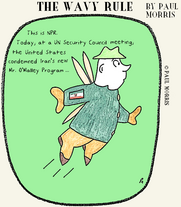
An important message from “The Wavy Rule”: Don’t forget to enter the Emdashes contest to name the upside-down question mark! We’re accepting submissions through this Monday, August 25. ¿Can you best the entries that have already been posted? There’s only one way to find out! Back to our regularly scheduled program; Paul writes of today’s aerodynamic cartoon:
Mr. O’Malley was the product of Crockett “Harold and the Purple Crayon” Johnson’s imagination, and a character in Johnson’s “Barnaby.” Mr. O’Malley, a fairy godfather, was a member in good standing of the Elves, Leprechauns, Gnomes, and Little Men’s Chowder & Marching Society, ran for Congress, worked as a Wall Street tycoon, and smoked Havana cigars. A great resource on Barnaby and Crockett Johnson can be found at Philip Nel’s site. Click to enlarge!
More by Paul Morris: “The Wavy Rule” archive; “Arnjuice,” a wistful, funny webcomic; a smorgasbord at Flickr; and beautifully off-kilter cartoon collections for sale (and free download) at Lulu.
The Wavy Rule, a Daily Comic By Paul Morris: The Thin Blue 1830s Line
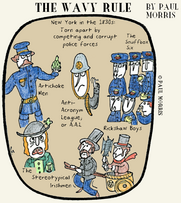
Paul takes a look at the very serious historical issue of moustaches, four-leaf clovers, and the Snuffbox Six in Gotham City, circa some time ago. Click to enlarge, but stay on the right side of the law!
More by Paul Morris: Enter our exciting contest to name the upside-down question-mark! Entries accepted until August 25. Plus, “The Wavy Rule” archive; “Arnjuice,” a wistful, funny webcomic; a smorgasbord of multimedia at Flickr; and beautifully off-kilter cartoon collections for sale and free download at Lulu.
What’s in a Trope? We Find Clues in Cartoons From Vintage Gourmets
From our friend Jonathan Taylor, who recently wrote a meditation on John McPhee and the evolution of greenmarkets:
“The great urban visual art is the cartoon,” Jonathan Raban writes in his 1974 book Soft City. The book is a meditation on the idea that cities are where strangers live. A common observation, perhaps, but so ruling a reality that after fifteen years of living in New York City, I think I am only now really awakening to this philosophy’s peculiarity and implications.
And that bears out Raban’s point: cities permit, and require, their dwellers to inhabit the most private worlds, which they then interpret as “life” itself. Raban describes the “person-spotting” skills developed in the city to make instant judgments of strangers–who will remain strangers–through the most immediate visual emblems: “accents, clothes, brands of car, my reactions to endomorphic or ectomorphic figures.” Hence, the cartoon.
The acknowledgments in Soft City note that parts of the book had previously been published in Encounter, London Magazine and The Listener, all now-defunct exemplars of the 20th-century magazine. And the “New Yorker cartoon,” with its stock characters denoted with ideographic brushstrokes–the lawyer, the psychiatrist, the boozer at the bar–is itself the near-lone survivor of a genre once common to that stripe of magazine.
There’s a nice reminder of this in Gourmet‘s online gallery of some of the single-panel cartoons that ran in every issue of the magazine in the 1940s and 1950s. They have their own subset of spottable strangers: short-order cooks, ladies who lunch, and waiters in jackets (back when, as I wrote here recently, “foodies” were “gourmets”). Some are as deflating as a weak New Yorker caption contest winner, but it’s key for a magazine historian or admirer to understand what met rigorous standards of semifunniness in the past. The “punch line” to this one gives satisfaction of perhaps more of the puzzle-solving kind than the humorous one. And this cartoon is a downright prescient take on what Raban calls the “emporium of styles,” the city in which classes are no longer defined by what they produce, but by what they consume.
The Wavy Rule, a Daily Comic By Paul Morris: Owl in the Family
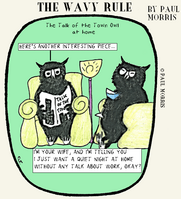
Paul and I are both intrigued by the inner life of the Talk of the Town owl. Here he is at home, having a little bit of familiar-sounding domestic friction.
More by Paul Morris: Enter our exciting contest to name the upside-down question-mark! Entries accepted until August 25. Plus, “The Wavy Rule” archive; “Arnjuice,” a wistful, funny webcomic; a smorgasbord of multimedia at Flickr; and beautifully off-kilter cartoon collections for sale and free download at Lulu.
The Wavy Rule, a Daily Comic By Paul Morris: The Surreal Life
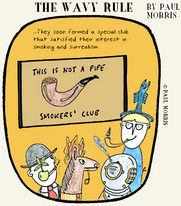
Here’s Paul on today’s filial and aromatic cartoon (click to enlarge!):
I dedicate this cartoon to my dad, C. Brian Morris, whose life’s work has been on Spanish surrealism. He is the author of such books as Surrealism and Spain 1920-1936, This Loving Darkness: The Cinema and Spanish Writers, 1920-1936, and Son of Andalusia: The Lyrical Landscapes of Federico Garcia Lorca.
More by Paul Morris: Enter our exciting contest to name the upside-down question-mark! Entries accepted until August 25. Plus, “The Wavy Rule” archive; “Arnjuice,” a wistful, funny webcomic; a smorgasbord of multimedia at Flickr; and beautifully off-kilter cartoon collections for sale and free download at Lulu.
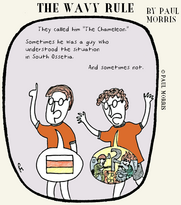
The Wavy Rule, a Daily Comic By Paul Morris: Karma Chameleon
Here’s Paul on today’s politically minded cartoon (click to enlarge):
“The Chameleon,” David Grann’s recent New Yorker story about con man Frédéric Bourdin, inspired this cartoon, as did the tragic and dangerous situation in South Ossetia. And yup, that’s S. Ossetia’s de facto flag.
More by Paul Morris: Enter our exciting contest to name the upside-down question-mark! Entries accepted until August 25. Plus, “The Wavy Rule” archive; “Arnjuice,” a wistful, funny webcomic; a smorgasbord of multimedia at Flickr; and beautifully off-kilter cartoon collections for sale and free download at Lulu.
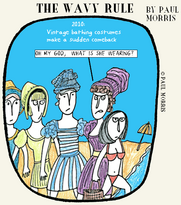
The Wavy Rule, a Daily Comic by Paul Morris: Billow Fight
Today, Paul contemplates the impending revival of damp pleats. On a related note, how big is steampunk really? Does anyone know? Tell us in comments! We’re a bit a skeptical here. As always, click to enlarge.
More by Paul Morris: Enter our exciting contest to name the upside-down question-mark! Entries accepted until August 25. Plus, “The Wavy Rule” archive; “Arnjuice,” a wistful, funny webcomic; a smorgasbord of multimedia at Flickr; and beautifully off-kilter cartoon collections for sale and free download at Lulu.
Danza, Zogby, and Thom Yorke[r]: The Friday Intern Roundup
Each Friday, the Emdashes summer interns bring us the news from the ultimate Rossosphere: the blogs and podcasts at newyorker.com. Here’s this week’s report.
Sarah Arkebauer
The Cartoon Lounge was brimming with gems this week. Zachary Kanin continued his Sandwich Duel with a fourth installment, this one featuring Tony Danza. Chris Onstad fired back with his own endorsement—from Mick Jagger. I was delighted to see that Kanin interviewed Josh Fruhlinger, the man behind the Comics Curmudgeon, which is one of my favorite blogs. [You’re not alone! —Ed.] Since I read Mary Worth, Rex Morgan, M.D., and Apartment 3-G daily, I couldn’t have been happier to see Kanin post not just one but two of his own soap-opera strips. I can assure you that they’re fresher and funnier than the newspaper soaps.
The Book Bench this week included a thoughtful remembrance of Mahmoud Darwish. The post contains a hauntingly charming excerpt from his poem “Remainder of a Life,” which The New Yorker published in 2007. This week’s posts also included a scintillating “In the News” feature in which I discovered provocative tidbits about nursing home patrons, Guitar Hero, and Gordon Brown. I also enjoyed the treasure trove of fun facts in the post about pollster John Zogby’s new book.
Goings On posted eloquent memorials of Bernie Mac and Isaac Hayes. Both posts include thoughtful insights on their careers and characteristic video clips. The blog also put up two rather bizarre posts. One is an examination of the food it takes to fuel Super-Olympian (and my current personal hero) Michael Phelps; the sheer amount of food he eats every day is unbelievable (especially since he doesn’t cook). The second bizarre piece posted was a report on Pascal Henry, the man who disappeared while eating his way through every Michelin 3-star restaurant in Europe.
I got a surprise this week from The Rest is Noise: Alex Ross offered some insights on the Olympic opening ceremonies. I hope he permanently returns from summer hiatus soon!
I was excited to see a new Fiction Podcast up for August this week. The post is of Jeffrey Eugenides reading Harold Brodkey’s short story “Spring Fugue.” I wasn’t very familiar with Brodkey before listening to the podcast, but I liked what I heard. Even though spring is far away, Brodkey’s crackling descriptions of allergies and love and other springtime tropes felt close and familiar.
Adam Shoemaker
This week in “Notes on politics, mostly”, Hendrik Hertzberg takes umbrage at a respectable publishing house’s willingness to put forth a less than respectable attack on Barack Obama. He also shares the latest McCain attack ad and suggests that the Republican contender (as well as the other fogies of American politics) are in a snit because the junior senator from Illinois has made them seem, well, uncool. Two more McCain moves that have Hertzberg upset: drilling (he thinks it would merely be a drop in the bucket—but that we have to pay for the bucket) and a clever little move we might call the preemptive “not playing the race card” approach.
Sasha Frere-Jones considers the state of the bass guitar, and tallies up the possible causes of its recent marginalization; he also shares his observations on Thom Yorke’s “new rave moves.” This Radiohead fan was glad to hear that its lead singer has moved on from the neck bashing of a few years hence, which surely verged on vertebrate-snapping. Last Friday, Frere-Jones, in a list-making mood, offered readers a list of musical events organized by his predicted reception, from “Robust, Calm Happiness” to “Hiring People to Throw Themselves in Front of These Things So They Don’t Accidentally Brush Against Me.”
George Packer didn’t write anything this week in “Interesting Times.” A year ago, though, he wrote Karl Rove’s epitaph, an act that, despite the Bush advisor’s resignation that week, might have been a bit premature. Packer’s prediction was right, though, and now that the “Boy Genius” has been reduced to mere punditry, I wonder whether Packer would maintain that his statement then, that “the Rove approach to governing helped lose Iraq,” still applies, or if hope has sprung in the year since his demise—a development that might be described by Rove’s other nickname.
I also dug into the archives of New Yorker Out Loud this week to indulge myself in Matt Dellinger’s interview with Burkhard Bilger back in April, when the magazine published Bilger’s article on Art Rosenbaum and Lance Ledbetter’s quest to hunt down the last of Southern folk music. It was this piece that inspired me to purchase Goodbye Bablyon this summer, whose nailed wooden box—stuffed with raw cotton—and old-timey typography helps illustrate the strangely seductive power of the “authentic,” on which Bilger muses in the interview. He claims, and I believe it, that although few people pick up gems like Goodbye Babylon and The Art of Field Recording, those who do invariably want to start making music themselves. I’m thinking I’ll start with a banjo—or maybe an mbira.
Last but not least, The Borowitz Report manages to conjure up two of our potent Sino-fears: Chinese lead paint and allegations of the country’s duplicitous Olympic committee. The gold medals, Andy Borowitz reports, have been found to have high lead content. Normally I’d have no reason to doubt Mr. Borowitz. But, writing as I am from China, I can’t help but note the medal count. One would hope that this rising Olympic power might be a little more careful not to poison its own, especially considering the effects of lead on young children.
Previous intern roundups: the August 8 report; the August 1 report; the July 25 report; the July 18 report; the July 11 report.
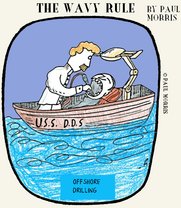
The Wavy Rule, a Daily Comic by Paul Morris: Wave of Irrigation
Today the artist cops to a flight of fancy, based on a term that’s much in the news lately. (“Irrigation” is the term for what you do when the dentist asks you to spit.) Click to enlarge!
More by Paul Morris: Enter our exciting contest to name the upside-down question-mark! Entries accepted until August 25. Plus, “The Wavy Rule” archive; “Arnjuice,” a wistful, funny webcomic; a smorgasbord of multimedia at Flickr; and beautifully off-kilter cartoon collections for sale and free download at Lulu.