
Last week, we introduced Paul Morris’s new daily comic for Emdashes, “The Wavy Rule,” named for Rea Irvin’s signature wiggly line for The New Yorker.
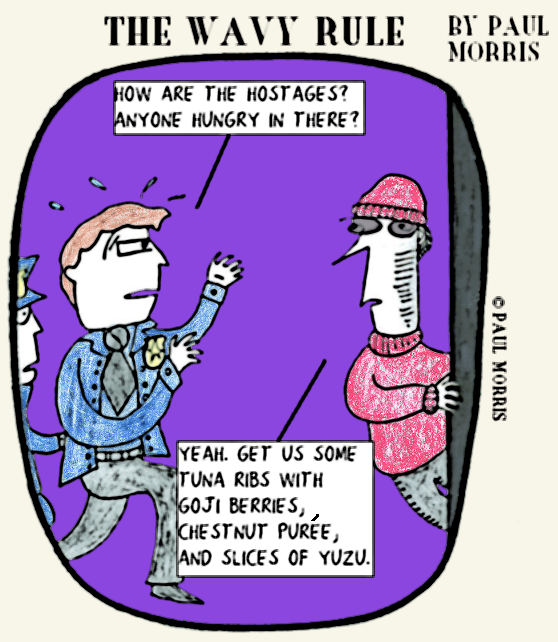
Today’s edition–like another of Paul’s recent cartoons, which dealt with the ire of Gordon Ramsay–concerns fine dining; here, it’s the especially captive kind. You’ll notice some delectable details that were first served in Ligaya Mishan’s recent Tables for Two review of Bar Q. Click to enlarge!
Category Archives: The Catbird Seat: Friends & Guests
The Wavy Rule, a Daily Comic by Paul Morris: Michelin Man
Last week, we introduced Paul Morris’s new daily comic for Emdashes, “The Wavy Rule,” named for Rea Irvin’s signature wiggly line for The New Yorker.
Today’s edition–which will recall Bill Buford’s sizzling story about hot-headed chef Gordon Ramsay–is below. Click to enlarge!

The Wavy Rule, a Daily Comic by Paul Morris: Foodie Revolution
This past week, we introduced Paul Morris’s new daily comic for Emdashes, “The Wavy Rule.” Today’s edition is below–click to enlarge.

The Wavy Rule, a Daily Comic by Paul Morris: So I Married a Butterfly Spotter
This week, we published the first and second of Paul Morris’s new daily comic for Emdashes, “The Wavy Rule.” Today’s edition is below–click to enlarge.

The Wavy Rule, a Daily Comic by Paul Morris: Punctuational Punishment
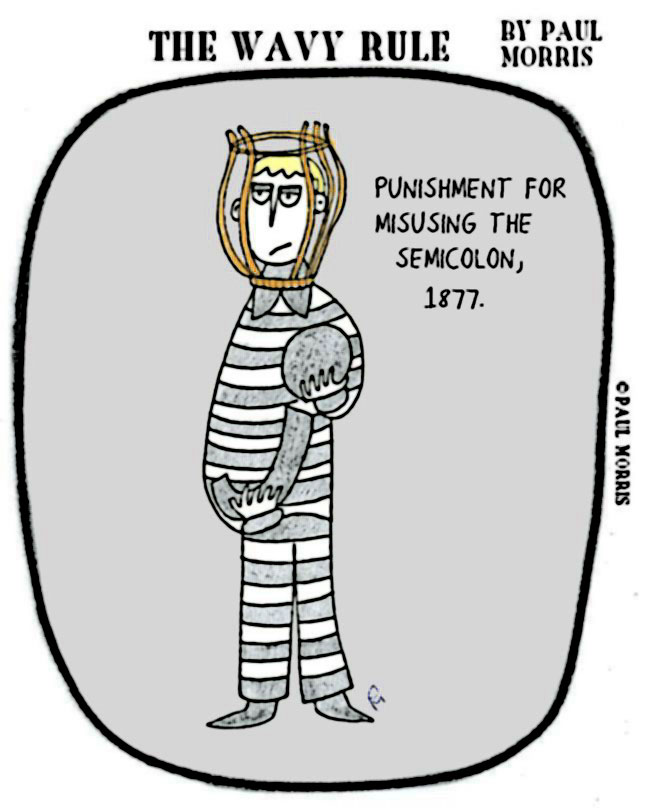
This week, we introduced Paul Morris’s new daily comic for Emdashes, “The Wavy Rule.” Today’s installment is below–click to enlarge.
Introducing “The Wavy Rule,” a New Emdashes Comic by Paul Morris
We’re delighted to announce that Emdashes will be publishing a daily comic by friend and fellow New Yorker admirer Paul Morris, on themes typographical, historical, and technological, on personalities of all kinds, and, of course, on the magazine past and present. It’s called “The Wavy Rule” in honor of Rea Irvin‘s signature squiggly line.
Born in Beverley, England, Paul has a B.A. in History from UCLA and a Master’s in History from Brown University. Since 2006, he’s written and drawn a webcomic called “Arnjuice.” You can see more of his work on his Flickr page, and he has collections for sale at Lulu. He’s currently studying graphic design at the Art Institute of California, Los Angeles.
We’re so pleased to have him drawing for us–we think he’s a perfect addition to the crew. If there’s a New Yorker-related or other idea you’d like see Paul draw, please email us and we’ll pass it along for his consideration. After the jump, the first installment of “The Wavy Rule,” inspired by Paul Goldberger’s recent story “The Forbidden City,” about the makeover of Beijing.

Guest Post Friday: A Skeptical View of Animated Cartoons
Our friend Jeff Simmermon, fearless globe-trotting reporter, weighs in on those animated versions of New Yorker cartoons that you know and love (and some that you’ve never seen before). Read on.
The New Yorker‘s website has merged its paper cartoons with web animation into a series of ten-second creations that deliver neither the punch of a static cartoon nor the fun of a quick web video.
Ten seconds is eight or nine seconds too long. Single-panel comics are haiku jammed halfway through a looking glass; the process of getting them is nearly immediate, but requires your perception of the situation to flip over halfway. It’s safe to say that New Yorker subscribers are some of the world’s most practiced readers, and safe to assume that it takes those readers two seconds, tops, to read a New Yorker cartoon.
This is a good amount of time to invest in a cartoon. If it’s not funny, it’s quickly forgotten. And if it’s hilarious, the rapid intake makes the cartoon hit harder. The New Yorker’s cartoons are rarely hilarious; they’re not meant to be knee-slapping guffaw-makers—it’s just not their style. Rather, they’re dry and sly, a subtle inversion of ordinary life that makes the lips curl upward a bit. I often think “Wow, that’s funny,” but rarely do I show it. Drumming up expectations for the cartoon and stretching it out five times as long in video form deflates the fun.
Here’s a breakdown of a recent release, an animation of a 1999 Harry Bliss cartoon:
The intro music—usually a few jazzy notes on the bass while a cute cat pulls a sign bearing the “RingTails Presents/A New Yorker Cartoon” logo across the screen—says “Get ready, folks, you’re gonna laugh at something cute and wacky!” We’ll just see about that.
The “camera” pulls back to reveal a doctor holding a needle. As soon as the nervous little boy is in the frame, we’ve got the whole story. Because doctors are supposed to say something reassuring—and we know we’re watching a cartoon—the first law of comedy is to do the exact opposite of what the audience expects from a normal situation. So of course the doctor says “This is going to hurt like hell.” The little boy’s weeping underscores the point too heavily. It’s the cartoon itself saying “See what I did there?†The whole enterprise would have been a little more interesting if the doctor had said “Relax. You’ll just feel a little pinch and then our benevolent alien overlords will welcome you into the comforts of their heavenly bosom.”
Comics are notoriously difficult to translate into moving pictures, and getting a familiar cartoonist’s style right in motion can be tough. Gahan Wilson’s loopy, maniacal style, for instance, translates visually but suffers in translation. Nevertheless, apparently there are folks who like these little hybrids. Editrix Emily Gordon herself told me over coffee, “You know, those video cartoons are really popular.†I’m sure they are, and so are Big Macs and American Idol—quick, cheesy, and overdone.
—Jeff Simmermon
The Times They Are A-Changin’
My final New Yorker Festival wrap-up—in rhyming couplets!—and the return of Pick of the Issue, coming soon to a Mainly Nice New York Media Blog (patent pending) near you. For all of our coverage of the 2007 Festival—for which I thank, from the bottom of my not-yet-bilious bloggy heart, the incredible contributors Martin Schneider, Quin Browne, Toby Gardner, and Tiffany De Vos, as well as everyone at The New Yorker and Print who made it possible—take a gander here.
Avenue Queue: Special Festival Report From the Front (& Middle & Back of the) Line
I had the privilege to meet the talented young writer Ben Bass after the Steve Martin event at the New Yorker Festival this past weekend. Ben was kind enough to send me his report from the impressive–in length and in fervor–line that formed on the festival’s opening day.
When advance tickets for the eighth annual New Yorker Festival weekend went on sale online, events sold out quickly. Happily, more tickets were released on the weekend in question, and so it was that a line formed outside Metropolitan Pavilion on West 18th Street on the first day of the Festival.
First in the queue was Eileen Fishman of North Caldwell, New Jersey, who arrived four hours before tickets went on sale. Unlike others in line, who stood or sat on the pavement, she surveyed the landscape from the nylon comfort of a Tanglewood-appropriate collapsible lounge chair. Someone observed that Fishman looked like a hardcore fan camping out for Bruce Springsteen tickets at the Meadowlands. “I bought this chair around the corner at Bed Bath & Beyond,” she explained. “My kids are coming in from Boston and I want to get Calvin Trillin tickets.”
Arriving early was a wise move. There was room for only thirty people at this year’s version of Trillin’s popular gastronomic walking tour, and magazine insiders were rumored nearly to have cornered the market. Tickets to it are an October tradition not unlike the post-season base hits of Alex Rodríguez: more talked about than seen.
The Festival also evoked Yankee Stadium in the way that it brought families together. Lisa Kittrell of Mississippi, seventh in line, chose this weekend to visit her daughter, an NYU film student. “She told me she’d go to Miranda July with me if I went to Judd Apatow with her,” said Kittrell, who was attending her fourth straight Festival.
As the line slowly lengthened in the bright October sunshine, people settled in for an afternoon of purposeful idling. One might have expected to find some of them reading this magazine, but iPod listening and text messaging were the distractions of choice, and the most prominent magazines on display were Us Weekly and InStyle. “When you go see a band, you don’t wear their T-shirt,” explained Angie Rondeau, 28, an Oxford Press production editor who nonetheless was furtively perusing a New Yorker article on Elizabeth LeCompte.
Not everyone agreed with Rondeau’s fashion mandate against bringing coals to Newcastle. Suzanne Undy, a freelance writer fifteenth in line, was clad in a New Yorker T-shirt emblazoned with a George Booth dog drawing. She was waiting to buy tickets to see Jeffrey Eugenides and Oliver Sacks. “Everything sells out so quickly,” said the first-time Festival attendee, sounding like a veteran.
Wearing a Los Alamos National Laboratory polo shirt, Columbia M.D.-Ph.D. student Sean Escola, 26, whiled away the time working on a full-page theoretical neuroscience problem resembling the contents of a blackboard in a Pat Byrnes cartoon. Blithely unaware of the attractive fellow student forty spots behind him in line with an “I Love Nerds” button on her backpack, Escola (who, in fairness, projected a certain Weezeresque charisma) was third in line, well positioned for tickets to the Icelandic music group Sigur Rós. Their two Festival concerts had sold out online in seconds.
Hoboken’s Carter Frank, thirty-eighth in line, was buying tickets to see a panel of television writers. “I’ve got a soft spot for David Milch since he hired my daughter as a writing intern on John From Cincinnati,” she said. Asked whether she’d read the magazine’s recent Milch profile, she replied, “They got his bad back right. He interviewed my daughter lying flat on the floor.”
As the sun beat down and ennui mounted, patrons become more forthcoming with their petty New Yorker grievances, both Festival and magazine. Josh Frankel, 19, a Drew University economics major, complained that The New Yorker had attracted too much attention to his favorite hidden gem, the Brooklyn Heights restaurant Noodle Pudding.
“They ruined it,” he said. “They put a profile right in the front of the magazine and now you can’t get a table there after 5 p.m.” Princeton senior Amelia Salyers, twentieth in line, expressed dismay that Salman Rushdie and Junot Díaz were appearing at the same time; they represented two-thirds of her thesis topic, along with Vladimir Nabokov.
Less conciliatory was Marty Katz of Bloomfield Hills, Michigan, a perennially frustrated online Festival ticket buyer. “It sucks,” he said. “They should get a bigger venue.”
Predictably, the media-centric weekend spectacle also attracted Fourth Estate types, though relatively few from breakaway former Soviet republics. Shorena Shaverdashvili was covering the Festival for a literary magazine in Georgia, “the country, not the state.” Shaverdashvili, the magazine’s publisher, winkingly disavowed any conflict of interest in awarding herself the New York City weekend gig. “I just subscribed to The New Yorker because they added Georgia,” she said. “I used to have to buy it in airports or get my friend to send it to me.”
Shortly before tickets went on sale, the door to the Pavilion swung open and patrons were ushered inside. As the line started moving, a burly security guard tried to maintain open space in front of the building next door, where an Hermès sample sale was attracting a steady stream of customers. “You wouldn’t think these Hermès ladies would be that tough, but they are,” muttered the guard. “One lady this morning almost knocked an old man over. She said she was a columnist from the Post so I should let her in early. I told her to come back when we were open.”
Finally it was 3 p.m. and the ticket counter opened for business. The Festival was underway. —Ben Bass
Festival: Werner Herzog Hates Penguins
Continuous reports from the 2007 New Yorker Festival, by the Emdashes staff and special guest correspondents.
“Is there such a thing as insanity among penguins?†Werner Herzog poses this question to a taciturn biologist seated before an Antarctic field full of the flightless birds. Before the perplexed scientist can fully answer, Herzog cuts to a shot of a lone penguin who suddenly decides to make a dash for the distant mountains. As the shot widens to reveal a desolate, white world dotted by a mad penguin, Herzog, in his familiar solemn narration, asks “But why?†and then informs us that this penguin is certain to meet death.
The scene, from Herzog’s newest film, Encounters at the End of the World, invoked both wonder and laughter from the audience during Saturday night’s screening. Sitting in the row in front of the director, I turned to register the reaction of the German genius to the round of gasps and chuckles. I was curious to see if he would be put off by the reaction. Indeed, the edges of Werner’s lips crept ever so slightly up into a smile.
Billed as a documentary about Antarctica, Encounters is certainly unlike anything else I have ever seen about the frozen continent. Neither a homage to the wonders of the outdoors nor a call to arms to protect our endangered environment, it’s ultimately a dark and existential film. It’s vintage Herzog, who is ever interested in the people who choose to put themselves in the middle of the brutal, unpredictable chaos we call nature. In many ways it picks up where Grizzly Man left off, but instead of focusing on a bear-lover who answered the call of the wild, Herzog spends time with the scientists and lab techs, the fork lifters and mechanics who call Antarctica home.
All the characters, including Herzog, seem to share a Wanderlust. But Herzog is out to debunk the myth of Antarctica as an unspoiled, pristine frontier. Instead he proclaims “the end of adventure.†For an artist who has focused so much energy on studying explorers, the film exudes a deep sense of loss. While the film is something of an elegy, it’s not depressing. In fact, it’s mesmerizing, because Herzog is one of the few artists who can make a compelling film that, to me, is also a profound philosophical discourse.
What is perhaps most surprising is that Herzog’s newest masterpiece will be shown on the Discovery Channel. I am curious to know how it will translate to the small screen, possibly disrupted by commercial breaks. I only wish I could see people’s reactions when they turn on the tube to catch a rerun of Cash Cab or Dirty Jobs, but instead see an extended shot of a man crawling through an ice tunnel and hear an ominous, heavily accented voice state, without a trace of alarm, that “the end of human life is assured.â€
March of the Penguins this certainly is not.
More on the film and the post-screening discussion to come. —Toby Gardner