Category Archives: The Catbird Seat: Friends & Guests

Deviant Matters: A. M. Homes and Miranda July

Continuous reports from the 2007 New Yorker Festival, by the Emdashes staff and special guest correspondents.
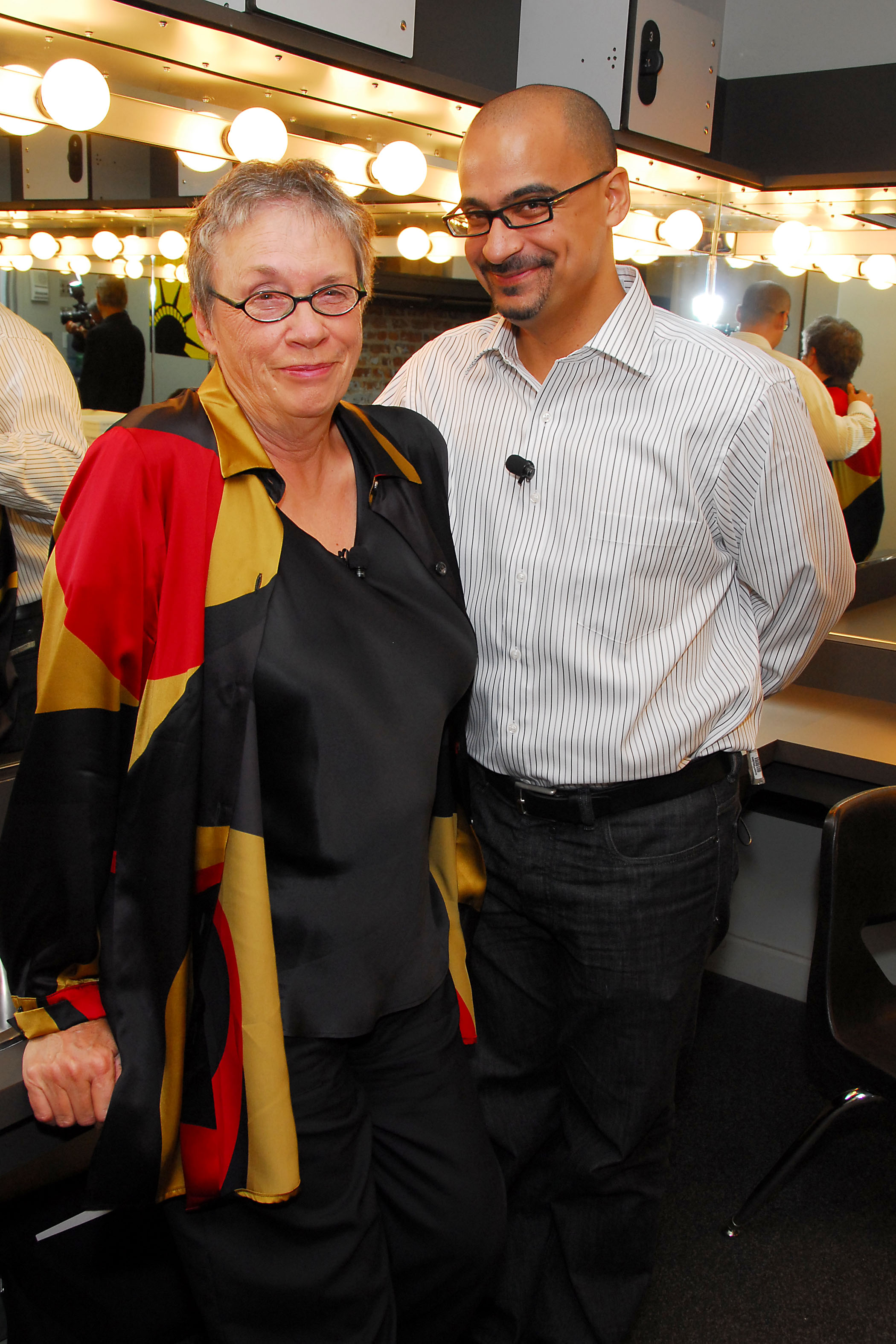
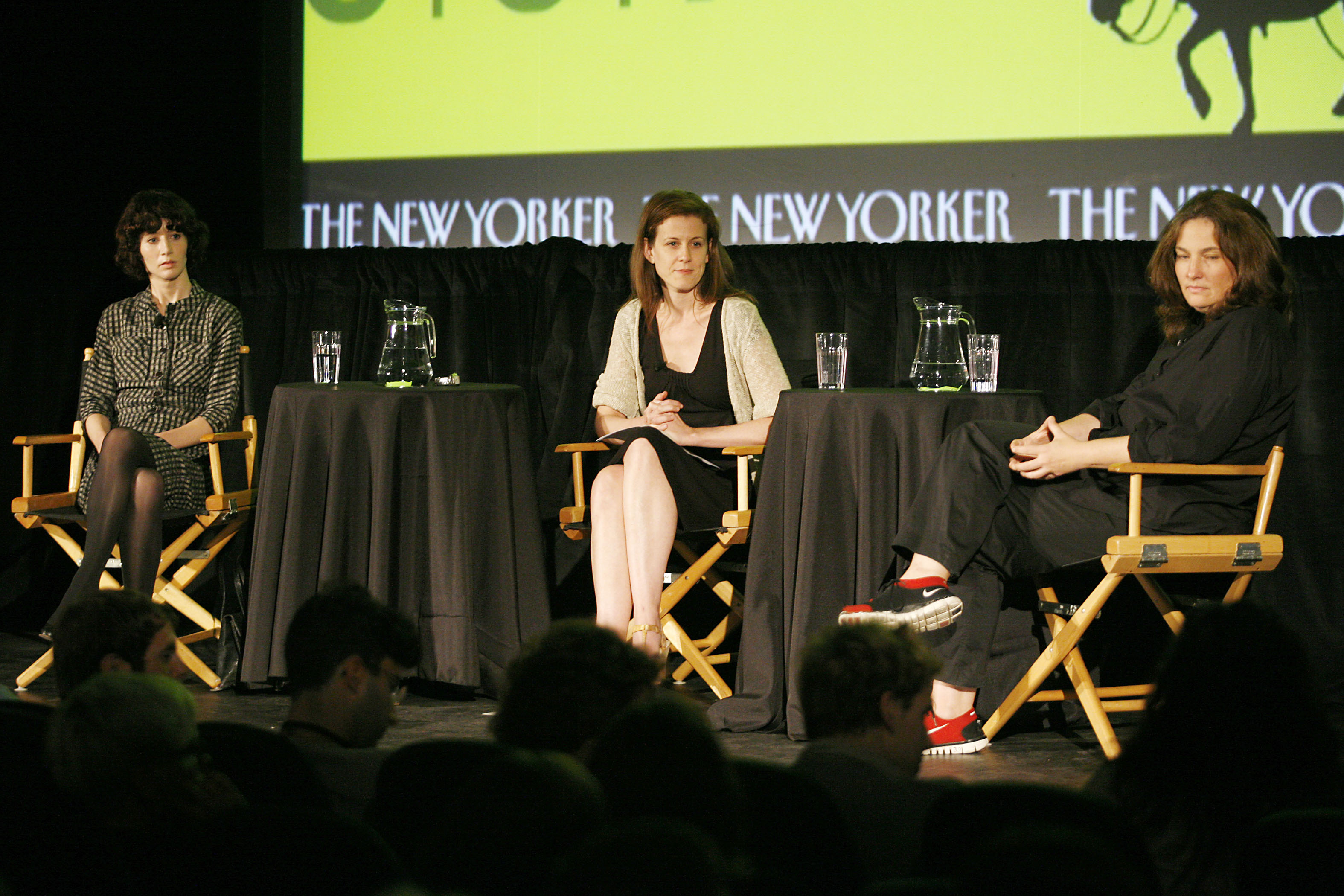
One of my favorite moments from Friday night’s conversation on deviants between Miranda July and A. M. Homes occurred at the very start. After Homes opened rather seriously by proclaiming that we are all deviants, July squirmed slightly in her chair, turned to Homes seated far across the stage and shyly said, “Um, yeah. I pictured us closer together.” The large audience, generally young and solidly hipster in style, exploded in laughter and, just like that, the tone for the evening was set. Perhaps the physical distance (see photo) partly accounted for the lack of sustained engagement between Homes and July. More likely, it had to do with the two artists’ approaches. While Homes the writer and July the performer never seemed to click entirely, the juxtaposition made for an entertaining evening accented by insights into the unique approaches of each artist.

BCA8062229.1.JPG

The fun was no more evident than when July attempted to engage the audience in a trivia contest about Homes’s work. What she thought would be a fun little activity quickly turned humorously awkward. Her first two questions on rather obscure details from Homes’s work were not only met by the audience’s collective silence but also seemed to stump Homes herself. A slightly flummoxed July lightened the mood, timidly saying that she now realized that “no one reads like this unless they’re writing trivia questions.” Homes, who seemed a bit uncomfortable with the whole situation, suggested that the questions should be about July’s more popular film. July asked one final question about a character’s nickname from Homes’s recent memoir, someone thankfully knew the answer was “Dragon Lady,” and order was restored. (The prize? Two well-earned Festival tickets to Saturday’s debate on the Ivy League. )
Oh wait, wasn’t this talk supposed to be about deviants? Despite moderator Carin Besser’s efforts, the conversation weaved in and out of the topic. It turned out to be more of a springboard into some of Homes and July’s fascinating insights into their motivations as artists. Homes spoke about the joy of inhabiting brains other than her own. Beyond sheer pleasure, this act of distancing is actually what enables her to write fiction. She indicated that occupying the mind of a pedophile, as she did in her book The End of Alice, in some sense was easier than simply drawing on personal experience. At the same time, she acknowledged the difficulties of fully stepping outside oneself and spoke of “the inescapability of the artist’s mark.” At one point, after some pauses and false starts, July summarized her artistic intention beautifully, saying she tries to get to the place where mystery is supposed to make sense. She added that, in her work, she is “going beyond getting to have it be correct.”
The evening became even more intriguing when the subject turned to pen pals. Homes and July have each been correspondents with some rather interesting characters. While Homes had communicated with the likes of Pete Townshend and filmmaker John Sayles (who, in one letter, apparently advised the college-aged Homes to suffocate an annoying roommate with a pillow), July maintained a multi-year correspondence with a convicted murderer (July said he will be released in 2012). With her typical sensitivity and humor, she said, “I was lucky, he was a good guy.”
Next year’s panel recommendation: John Sayles on deviants. —Toby Gardner

In the Company of Men: Neil LaBute and John Lahr

Continuous reports from the 2007 New Yorker Festival, by the Emdashes staff and special guest correspondents.
Into a venue filled with avid Neil LaBute fans, I committed the grievous sin of arriving late. Thankfully, Neil LaBute doesn’t have a Catholic bone in his body, so, I wasn’t punished by being sent to Limbo and denied access to his chat with John Lahr.
Mormon, misogynistic, misanthropic, male: the first three words are wrongly used when reviews or interviews are written and comments made about the playwright/screenwriter/director. Only the last is true.
LaBute opened the discussion by saying his time on stage with Lahr was better than therapy, and all of his issues should be worked out by the time they were done. He was easygoing, with an affable manner tinged with the sharp wit that is found in his writing—some of which moved past his audience’s heads, then boomeranged back to catch them after a beat or two. He has gimlet eyes that hold down the person he is directing his answers toward and a grin that belies the gaze.
The subject was Men. And there was 90 minutes to discuss it with the man who has created some of the most vile male characters ever seen in film or on stage. For LaBute, the discussion started with the father. His own was a distant man, a hard man, someone who was not easy to grow up with or around—a man frustrated in his own life, who displayed the proper emotions and actions to the world but changed when the doors were shut and the curtains closed. His older brother emulated their father, something LaBute couldn’t do; he says he paid a price for that decision. He said the atmosphere in his home was Pintersque, quiet yet volatile. He had no control there; things there “shifted with the breeze.”
Lahr asked, “When you show us in your work how we are, does it go to the silence of your life?” LaBute’s answer: “I never felt it was my work to draw from that dark place.”
While LaBute grew up in a home that didn’t nurture a playwright, he says, his parents were filmgoers. These days, his mother sees his work in motherly terms; she mentions the language on occasion, and “wishes I’d write more comedies.” He started writing monologues for himself to see if he could fool his teachers into believing they were actual monologues that he’d discovered. Once he put pen to paper, he said, he didn’t stop. Writing gave him something he didn’t have elsewhere: control.
“Wow. I’m really feeling better. How much do I have to pay for this session?” he asked Lahr. Laughter again.
Attendance at B.Y.U, mandated one thing; students signed a paper agreeing to its terms. By the time LaBute had become a graduate student, the love affair between his brilliance and the strict doctrines taught weren’t exactly bound for marriage. They blocked his stage time, and closed theaters to him. In order to stage Lepers, which later became Your Friends and Neighbors, he gave a one-hour exam, then quickly staged the play for its one-time performance. A director friend of mine was part of that audience, his theater experience after returning from his two-year Mormon mission. It’s theater he still talks about, in all of the right ways.
The discussion moved on to the film In the Company of Men. Lahr asked, “Do you feel Restoration comedy and its entertainment and the society of the 1990’s, when you were writing this, had parallels?” LaBute: “I saw the more privileged groups who were taunting me [the audience laughed], but I just couldn’t hear them.”
Clips were shown from the film, starting with the scene where Chad (Aaron Eckhardt) admits to Christine (Stacy Edwards) that, yes, she’d been set up. He is harsh, stinging in the delivery of his words, and you can hear the wind howling in the wound he leaves behind. Apparently, according to LaBute, you were also close to hearing the film as it ran out in the camera.
LaBute said he felt uncomfortable watching the scene, and then went on to discuss the ascetics of the creative process behind the making of a film that got to the pinnacle for all independent filmmakers: the winner of the 1997 Sundance Filmmakers Trophy. On his first film, ever.
“This film isn’t an editor’s film,” he said. “This is an actor’s movie. We didn’t do any cutting back and forth between faces. We did it in one long take. Aaron was starting to worry because he knew we only had a little bit of film left in the camera.” He calls this particular scene, “a textbook of male behavior—lies, charm, and ‘fuck it; it’s too much work. I’m leaving.'”
“On a first film, you stand around and (moves his hands) and say, ‘Oh, fuck.’ Thing is, there are other people standing around saying, ‘Oh, fuck.’ So, you have to have some authority—and you [moved his hands firmly] and say, ‘OH, FUCK!'”
The next scene discussed at length was the steam room scene in Your Friends and Neighbors. The intensity of dialogue is matched by Jason Patric’s delivery when he describes the best sex he ever had, with a young schoolmate, Timmy, who is gang-raped in the showers at school. It, too, was shot in one long sequence, with pick up shots taken afterwards of Aaron Eckhardt and Ben Stiller’s reactions to this revelation.
Lahr: “Something about all of your plays is a passion for ignorance. Pinter hears pauses. You hear something else.”LaBute: “I hear a self-regard. We spin circles in life—back on ourselves. ‘Whatever’ is an example. When people use the word ‘honestly’ a lot, they aren’t being honest at all. We want to connect, but, the cost is too great. We ask people for things we aren’t willing to give. It’s too much. It’s more important to sound interested than to be that way. We ask, ‘How was your day?’ And, when they start to answer, we roll our eyes and think, ‘Oh, fuck.’ ”
The floor opened up for Q & A’s. One young man said he’d started to laugh a third of the way though In the Company of Men when he first saw it.
Q: “What does it take for a man to move from the lying and the way they present themselves?”
LB: A good hour with Mr. Lahr (laughter). I don’t know, really. It’s human behavior. We are good at it. An armour created from youth on. Be strong. Don’t be weak. It’s our culture to come out on top. It that’s our nature…to lose a bit of yourself. To push to come out on top. It’s hard to shed that. You become one with that kind of ethic. I don’t the answers. It’s hard for people to let their guard down.
Q: What’s up with Wicker Man? I didn’t see you at all in the film.
LB: I got into the project because I loved the original. I was asked to give it a go. I kept the concept of a cop, and I took them to a zenith, to a world run by women. The producers wanted something different than I wanted to make.
Q: What is the film rehearsal process and how do you feel about the word “like”?
LB: Like is a serviceable word, and I use it on the page. I like rehearsals. I understand them, the process. I like the process in the theater. You can follow the process in theater, you move from start to finish in a smooth line. In film, what you start out with has to remain that strong seven weeks later. You don’t get the full rehearsal process. Rehearsal is the method along with [at this point, he started discussing yoga, natural foods and this reporter started to laugh. Loudly. Alone. Thankfully, others joined in]. What is going to go on stage…if it’s repeated, will prove if it’s strong or weak with the repeating. Ultimately, when working on a piece we are going to present working on a scene is what it is all about.
Q: How do you work?
LB: No particular clothing or process or food or time of day. I tend to not want to write until I want to write. I tried that, to be disciplined and I threw it all away. I wander around with plots and characters in my head and play devil’s advocate. You look for reasons not to see it through. If they stay with me, if after a year, I still have them in my head, I suddenly start writing dialogue in a hurried frenzy—I don’t do breakdowns of plot—I write. Sometimes, you get to page 50, and think, “There really should be a plot by now.” It’s the most exciting way I’ve found to write and by transference, a way to excite the audience.
Time was up, we all exited, leaving me with a wealth of my own questions, and a greater respect for an artist who produces amazing work. I wish we’d had another few minutes, which would lead to a few more and a few more, and the man would never get another thing done. But, he’d have his issues worked out thanks to John Lahr, I’d be entertained, and in the end, it’s really all about me. Or so I’d like to think.
—Quin Browne (Read more about Quin.)

Jonathan Franzen and Anne Beattie: The Crotches of Others

Continuous reports from the 2007 New Yorker Festival, by the Emdashes staff and special guest correspondents.
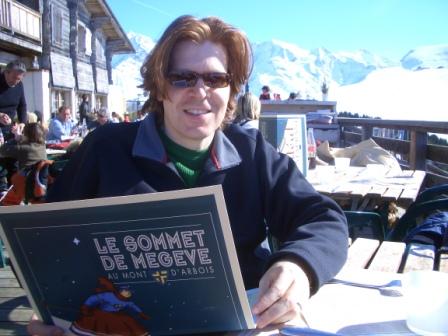
The magic began late, in a frigid warehouse of folding chairs. My guest and I had been gazing for several moments at the cheery yellow New Yorker projection when Jonathan Franzen lurched out, accosted a chair, and bullied himself into a seated posture. Under the guise of switching off my cell phone, I nabbed a shadowy but unmistakable pic of the one-man discomfort zone.
thefranz.jpg

Far from the chap zipped into a bulky brown tuxedo at a Poets & Writers party a few years prior, Franzen 2.0 was sleek and Queer-Eyed in a well-cut grey suit jacket, pressed white shirt, and whiskered dark jeans. Why was I gazing at that section of the Franzen anatomy, you ask? Why, simply because I grew up during the Girbaud era and have never quite kicked the habit of allowing my eyes to graze the crotches of others for that small horizontal tag. Only this and nothing more.
The anemic moderator gave us an unsourced (I suspect Brian Greene) overview of string theory and the microgeometry that hides the other nine dimensions from our sight, comparing the microgeometric force to an Ann Beattie story. Ann Beattie herself loped up to the Lucite podium and introduced “Skeletons,” a “Halloween story.” Like a good 65 percent of her audience, her person was lanky and aquiline, hair a slight frizz. The story began with a lengthy description of an outfit no one should wear: sweatpants and a Chinese jacket. There was someone named Garret and someone named Kyle, and Linda, who was engaged to one of them. The odd fellow out was a Mormon, and his identification as such constituted the great humor of the story, according to the audience, who expulsed their first collective chuckle when the landlady of the story printed “Mormon” at the top of his telephone messages. Somewhere in the microgeometry of the story, Linda was a child again, in a skeleton outfit, leading some boys forward with a pumpkin flashlight; not much later, she was appearing in a ghostlike vision to the Mormon (heh heh heh) at a gas station, just before a crash. Feeling thoroughly tripped up by the many strings, N’Sync-style, I gave up and allowed Ann Beattie’s level alto to lull me into a passive fugue. Only the tetchy observation, to my guest, that characters should never be English majors or in therapy, roused me. Jonathan Franzen’s presence crackled nearby, gulping and grasping for water and replacing the glass.
After a flurry of academic applause for Ann Beattie, the moderator ambled up for a bizarrely tepid praise session of Le Franz. He joked, unsuccessfully, that our chap was an “up-and-comer” who wrote “mammoth undertakings,” and extolled him further as a “guest star on the Simpsons.” No string theory or geometries, micro- or macro. During his introduction, Franzen himself appeared to be folding himself into his torso, and had the air of an unengaged student. Putting off his approach until the last second, he finally hauled himself into the air, only to bend a second time to retrieve his glass of water, which was stowed modestly under his chair.
Several copious throat clears preceded a tousled, boyish, “Hi.” A greyed wing of Franzen fleece fell rakishly over one eye as he grinned frightfully and paid tribute to Ann Beattie’s work as “effortless, heartbreaking, and humane.” His cadence grew easier as he warned that his next story would be 32 minutes long and “unpleasant.” Centering on the relations between a detestable couple named Betsy and Jim, the trademark Franzen forked tongue delivered some splendid one-liners. In the moment, something was delightful about the sentence, “She had never spent a day with someone she disliked as intensely as her husband,” and the observation that Betsy and Jim are “each obliged to the other for overlooking so much.” Titters accompanied observations about how the indolent couple declines to participate in the battles for the best prep schools and allows their children to consume soft drinks. “Perfect characters for the New Yorker crowd,” observed my guest. The story swelled with the adipose tissue of an empty nest, an affair (Jim’s), and Franzen’s own nettled compassion for the characters. I revised my previous decree against characters in therapy when Franzen narrated Betsy’s visit to a therapist named Frank Clasper (here I pictured a salesman of the overly sincere variety). From Dr. Clasper emerges the pithy, Protestant observation about why Betsy’s brainy, acerbic older sister was preferred over Betsy, the pretty one: good looks are a symbol of social injustice and unmerited privilege; brains are something one works at. Resentful of being forced to talk, and wary after finding white dog hairs in her dog-less apartment, Betsy eschews the incisive clasp of the Dr. for a human “vending machine” of psychopharmaceuticals. On her way home from a visit to the vending machine, Betsy sees a Jack Russell terrier (aha, white hairs!) gazing intently into a bookstore window. She follows his gaze to the broad back of her pinstriped husband, standing in the fiction section (!) and clasped at the armpit by a younger version of herself. Enraged, she spits upon the dog, twice, and returns home, waiting to confront her husband. Franzen earned a hearty round of New Yorkerian guffaws for his observation that Jim laughs at Betsy as he does “at Democrats.”
At the finish, Franzen’s pleasant ease dropped from him like a pair of sweaty gym shorts. During his descent from the stage, I noticed a tender but insistent belly pushing out the pressed front of his button-down. Adipose tissue aside, he regained his chair as if he had been tasered and began to hunch actively.
The Q&A were full of the typical inquiries–who inspired you? What’s a typical writing day for you? An elfin sycophant with a handlebar mustache skipped whimsically to the mic and inquired of both Beattie and Franzen what they felt was their best work. Beattie replied that she was largely unable to judge and was never entirely happy; Franzen quipped that “‘like’ was not a verb that had [his] work as predicate.” His best work, he said, involved the rare moments when he said something sincere, that he still believed, and didn’t sound stupid soon after it was written. His tone suggested that the quantity of such somethings were not tremendous.
One sycophant, who purred that he was a “huge” fan of “The Corrections,” informed Franzen that he had a “pretty good idea” of why he used the name Aslan for the drug in that same, being also a “huge” fan of Narnia. At this point, Le Franz needed only an air sickness bag to bring his posture to full fruition, but he responded with a cordial invitation to the Narnian to interpret the reference, assuring him he could probably do a much better job than Franz himself. The sycophant deferred for a nanosecond before prattling that Aslan was a Jesus figure in Lewis’s “Chronicles,” and that Franzen had probably been making the point that the psychiatric drug was the messiah of the 21st century. He grinned, proud as a graduate reading his thesis to Mom. Franzen looked mildly tickled, and answered that even if that was what he meant, he would never admit it in public. The sycophant was seated, no doubt still feeling clever.
The requisite question about technique: what were the more difficult points for each? Beattie answered seriously that dialogue was easy, but transition and exposition were still challenging. With time, she added, she had developed a more innate sense of how to move through a story, rather than basing every story on its predecessor. Franzen approached the question with typical self-deprecating drollery, professing an unwareness, for the first five years of his writing career, that anyone would actually read what he wrote, which resulted in copious pages of writing that “only their father would love.” He described one afternoon where he saw the light and began slashing pages “in big chunks.” Aslan, the “six different layers of symbol and allusion,” and the “great, colorful, metaphorical, two-page paragraphs fell away.”
Outside the venue, a waxed black limo (license plate: MUSICP) waited, a “Franzen” sign taped to the window under the driver’s nose. I did not, for the record, jump into the back seat like a Motley Crüe groupie.
—Tiffany De Vos

“She Was His DNA”: Donald Antrim and Colm Toibin

Continuous reports from the 2007 New Yorker Festival, by the Emdashes staff and special guest correspondents.
The remarkable thing about New Yorker Festival events is their unique ability to bring together seeming diverse writers, only to find out they have a similar approach to the same issue. Two writers, both brought into the venue to discuss mothers; two men who saw their mothers in a different light.
The first, Donald Antrim, is the author of The Afterlife, a memoir about his mother. He openly admits he hated her at a number of points in his life, and it took therapy and this book to bring him to a point where he could deal with his feelings. He likened her to a resistance fighter—a woman who was forced into a mold she didn’t want by a woman she didn’t like. His mother was an alcoholic who got sober in the last part of her life, a woman who always insisted they were both artists. She created clothing of unusual design, shape, color, form, the subject of one of his New Yorker essays that’s also in The Afterlife.
Until this book, he said, he’d never written about “mother” in any of his novels. When he first started the book, he had no plans on publishing it, he told himself. He ran it past his family before it was published, and everyone was okay with how it turned out. He now misses her at times. And this is good.
Colm Toibin grew up with four siblings and a mother who would say, “Oh, if I’d have known about birth control, there’d have been none of you.” She was, as he put it, an absent mother. He never felt she knew anything about him, nor paid any attention to what he said or who he was. It was when he was driving her one day, and she said, “You drive like you are—you are constant,” that he realized she’d ever noticed him at all. He was quite pleased with this kind of non-attention, which allowed him to go about his business as a teen in a household where the older siblings were gone, his father had died when Toibin was 12, and he and his younger brother were still there with their mother. He puts her in most of his work, and never plans on writing directly about her. He’s killed her off, married her, put her away—done everything to her on the page. She always pretended that she was not the source of the mothers in his fiction, and he helped her maintain that fiction about the fiction. He spoke of the ebb of grief that still will sweep over him, of how he misses her still. There was no love or hate, their relationship was limbo; still, she was his DNA, his pulse, and he wishes her back.
The two approaches to mothers was unique, yet both men held their mothers in regard in different ways. One, Antrim, was fascinated that his mother had turned out to be the artist she’d claimed to be, even if he cannot keep her art on display, since the pain associated with its creation is too intense. The other, Toibin, laughs at the fact that the only coming out he ever did was out the front door. Both seem at ease, in their own way, with their relationships with their mothers, who happened to die a few months apart from each other. Mothers and sons. Intense, deep, complex relationships. Books are written, plays, films. And we sit in a small venue and listen to two men give their up their memories of their lives with their mothers. Some funny, some heartbreakingly sad. Women who shaped how they write simply by bearing the name “Mother.”
—Quin Browne

“It’s Literary Women That I Drive Hours to See”: Annie Proulx and Junot Diaz

Continuous reports from the 2007 New Yorker Festival.
The audience who gathered for a reading from these two authors was a human Chex mix: bits and pieces of every group were there to listen to Annie Proulx and Junot Diaz, who write in different styles, have different cultural backgrounds and different styles of writing, and clearly respect each other a great deal as friends and as artists.

proulx.JPG

High energy abounded. “It used to Mick Jagger that got me excited,” said the woman next to me. “You know, rocker boys. Now it’s literary women that I drive hours to see.” Junot Diaz read a short paragraph from his novel The Brief and Wondrous Life of Oscar Wao—a paragraph in which, once again, his protagonist was being beaten up. He was self-deprecating as he read, apologetic to the audience, as if we wouldn’t enjoy his beautifully constructed sentences and wordplay. He was mistaken.
He talked about the fact that he continues to write short stories about humans and their failings in relationships. “As long as you keep cheating, I’ll keep writing.” he said. To prove this, he read the story of Alma and her lover; Alma has long arms, beautiful legs, and “an ass that exists beyond the 4th dimension.” Alma is all her lover isn’t, but as much as he loves being with her, he cheats on her, writing it all in his journal—which she finds. It’s not the journal that is his downfall, though, but the lie he tells to explain the contents that end it all with the delectable Alma.
Annie Proulx spoke briefly of the book she’d just finished about Wyoming’s Red Desert. When asked by a friend to write the text in his book of photography on that part of the country, she was surprised to find nothing written about it, and it became her next project to produce a book of short stories set there.
As she was researching the book, someone asked her to fill the chasm in sagebrush stories—less than a dearth, there have been none till now—and that brought about the short story she read next. “The Sagebrush Kid” is about the Sandy Skull stagecoach station, run by Mizpah and Bill Furr. Unable to have children, thwarted by eagles and coyotes not understanding that the piglet and dressed-up chicken were substitute children (you had to be there), Mizpah adopted a special sagebrush, and fed it gravy and bones and, well, that sagebrush grew and grew. While it grew, the station gained a reputation of, shall we say, not a place you wanted to spend the night.
Laced with the wonderful richness of language Proulx uses in all her work, we heard sentences that were spectacular in their music and accuracy: “He would buy cattle for a song, fatten them up, then sell them for an opera.” The story ends years later, with the understanding that the Sagebrush Kid has a cousin somewhere, and her name is Audrey.
The Q. & A. that followed was brisk, with both authors advising other writers to remember that fiction has to be disciplined, very structured and organized. Diaz said he felt that Proulx respects humanity, and that he’s a “self-hating boy,” because Proulx treats both sexes equally in her writing and doesn’t allow her subject matter to be defined by her sex. It was obvious that despite their differences, both writers have a great deal of admiration for each other, and that made for a cozy, stimulating evening.
—Quin Browne (Read more about Quin.)

Joining the Coalition of the Willing: Greetings From Our Roving Correspondents

Martin and I will be reporting from the New Yorker Festival throughout the weekend, so look for our frequent reports! In the meantime, there are a few other people we’d like you to meet. —E.G.
Toby Gardner: With the New Yorker Festival upon us and so many events scattered across the city, the Emdashes Powers That Be (EPTB) saw the need for a new strategy: the Pepper Mill, whereby several correspondents are sprinkled throughout the proceedings like so many flavor-enhancing spices. And I am one of their new recruits. I hope I get called up for tonight’s chat between Miranda July and A.M. Homes on Deviants. There’s also a Town Hall meeting about the war in Iraq, but how relevant is that, really?
Although EPTB offered to pay off my student loans in exchange for my services, I said that really wouldn’t be necessary. [While we’re at it, we really should pay off ours, too. —Ed.] The honor to help cover this exciting festival is payment enough. So if you see a bald guy with a Mac G4 and a winning attitude, say hello. I’ll be working hard to make ensure that Operation Pepper Mill is a success.
Quin Browne will be covering a couple of events for Emdashes this weekend. She was born in New Orleans under one name, and writes in New York under this one. Blatherings about this and that can be found at www.fmdn.blogspot.com; actual shorts are located under her name at www.sixsentences.blogspot.com.
Tiffany De Vos‘s name and musical tastes owe much to the ’80s. She is a poet, pet chinchilla enthusiast, and teacher. Her stories and poems have appeared in Pedestal, The Saint Ann’s Review, Washington Square, Small Spiral Notebook, and the Global City Review. Her hair often falls over her right eye, but she is by no means a hipster.

O Caption! My Caption! Winner #100, the Cartoonist, Dark Humor, & the Ark

The hundredth New Yorker Cartoon Caption Contest is now past, but the Emdashes bloodhounds, just as the trail was falling cold, picked up the winner’s scent. In a gathering-momentum tradition, the victor sat down with assiduous Canadian intern John Bucher to discuss his win.
Congratulations to David Kempler, of Island Park, New York, for winning Cartoon Caption Contest #100—a drawing of a tourist couple marooned on Noah’s Ark—with the line, “Don’t tell Noah about the vasectomy.” This week, an additional treat: commentary from the cartoonist himself, Mick Stevens. The bolded questions are for David, and so it probably works best if you read the slanty portions, which are Mick’s, in a Wonder Years-style voiceover. —JB
It wasn’t clear to me until this last, much closer scrutiny that it was in fact a woman saying to a man, “Don’t tell Noah about the vasectomy.” I’d assumed it was one of those nonplussed-looking elephants. How did you first take in this drawing, and how did the caption come to you?
First off, you’re right that it’s often difficult to tell who is actually doing the talking in New Yorker cartoons, and I’ve actually submitted two entries in the past that had the wrong person talking.
Says Mick: I can see why you didn’t see right away that it was the woman speaking. I should have emphasized her a bit more. Cartoons depend on getting the visual across right away, otherwise the joke gets blunted some.
As to how this caption came to me, I’m not really sure. I do know that how I used to construct my entries didn’t seem to work so a few weeks before this particular cartoon I decided to try and think like a New Yorker staff member. After playing with that idiotic notion for a while I dropped the strategy and just went back to think what I thought was funny. I think I just got lucky.
Says Mick: The idea for the cartoon came to me this way: I started with the “Noah’s Ark” cliché, then started thinking about the various animal couples on the boat and what they might say to one another. Then I thought about the fact that humans are animals, too, and imagined them as tourists who had booked a cruise and somehow ended up there.
I think David’s caption is a good one. In most cases, those drawings are done specifically for the contest, but this one originally had a caption. The editors decided to drop mine and use the drawing by itself. (My original one: “Next time, I book the cruise.”)

Your caption, David, is a riff on the sacred and the profane—or, at least, the Biblical and the genital. What is your religious temperament, generally, and what are your feelings about the Noah’s Ark story?
I was raised Jewish and am the only child of two Holocaust survivors. I think I have a morbid sense of humor. Whether or not that is because I am a child of Holocaust survivors is impossible to determine. I also participate in a celebrity death pool, where I have enjoyed some success. They get about 1,200 entries for each game, and I have won a couple of times and been in the money a few other times.
I’m not religious but, as I get older, I reflect more upon my family history. This past March I was invited to Germany by a woman who started a program that features an artist who puts plaques outside the buildings from which people were taken to concentration camps. They unveiled four plaques—for my mother’s mother, father, sister, and brother. My mother did not attend because she felt it would have been too upsetting. It was a good decision on her part.
I view the Noah’s Ark story the same way I view all of the Bible. To me, it’s a somewhat honest attempt to represent history. Unfortunately, it suffers from the same problems you encounter playing a game of telephone, where one person reads a passage to a second person, who repeats it from memory to another, to another, etc. Eventually the story veers pretty far away from the original.
Let’s pursue the connection between morbidity and humor a bit more. What impact, if any, did your parents’ being Holocaust survivors have on your sense of humor? Do they share your sense of humor? And what is black humor, exactly?
Hard to say their impact on my sense of humor: I’ve never experienced life as another person or in different circumstances. Maybe I understand better than some how quickly our lives can be snuffed out. My father is dead. He was always clowning around but not in a morbid way. His brother shared my sense of humor. My mother is a much more serious person than my father was.
Black humor is comedy with an underlying uneasy feeling that tells you perhaps you shouldn’t be laughing. One of my favorite examples of black humor is the movie Happiness. One of the plot’s central points concerns child molestation. I thought it was brilliant—but both times I saw it in a theater about a third of the audience walked out, offended.
What is your first memory of reading The New Yorker? What are three pieces that stand out for you?
I don’t remember my first reading, but it was probably in college. Top three is tough and I’m sure I’ll forget something, but, off the top of my head, I would have to go with the Richard Preston piece about Ebola that ended up as the book The Hot Zone—one of the most terrifying things I have ever read. My favorite cover is the Art Spiegelman silhouette of the World Trade Center after 9/11. My favorite reading is anything by Hendrik Hertzberg.
I can’t help but ask a person who confesses a morbid sense of humor: What will your tombstone read? Or, if you prefer, what song will you have played at your funeral?
Never thought about my tombstone, but perhaps I should. Final song would be either something by David Bowie or Elvis Costello. “The Angels Wanna Wear My Red Shoes” pops into my mind at the moment.

***

Other Emdashes caption-contest interviews:

  • Robert Gray, winner #106 (“Have you considered writing this story in the third monkey rather than the first monkey?”)
  • David Wilkner, winner #99 (“I’d like to get your arrow count down.”)
  • Richard Hine, winner #98 (“When you’re finished here, Spencer, we’ll need you on the bridge-to-nowhere project.”)
  • Carl Gable, winner #40 (“Hmm. What rhymes with layoffs?”)
  • T.C. Boyle, winner #29 (“And in this section it appears that you have not only alienated voters but actually infected them, too.”)
  • Adam Szymkowicz (“Shut up, Bob, everyone knows your parrot’s a clip-on”), winner #27, and cartoonist Drew Dernavich interview each other in three parts: One, Clip-On Parrots and Doppelgangers; Two, Adam and Drew, Pt. Two; Three, Clip-On Parrots’ Revenge
  • Evan Butterfield, winner #15 (“Well, it’s a lovely gesture, but I still think we should start seeing other people.”)
  • Jan Richardson, winner #8 (“He’s the cutest little thing, and when you get tired of him you just flush him down the toilet.”)
  • Roy Futterman, winner #1 (“More important, however, is what I learned about myself.”)

Hersh, Not Squirrels: Remnick at ASME Was “the Conscience of the Conference”

An editor friend writes:
“How many of you got into journalism because you wanted to be an editor at The New Yorker?” David Remnick asked as he began a talk entitled “The Importance of Great Reporting” at an ASME conference for about 50 junior editors earlier this week. Two hands went up. Things didn’t get much better during the Q. and A., when one of the attendees asked Remnick if he ever worried about reader exhaustion. The implication being, You know, these loooong stories about the water shortage, global warming, war war war—whew, I’m tired!
Remnick’s response: “I don’t.” (And now I’m paraphrasing.) “Because if I start worrying about cutting our 10,000-word Seymour Hersh article on Abu Ghraib down to 5,000, then it’s 3,000, and then before you know it, we’re doing feature articles on squirrels.”
He was essentially the conscience of the conference. Later on the in session, he remarked, “Sometimes the best thing you can do is walk away” to ensure your journalistic credibility. He also mentioned two words, one German, one Yiddish, I believe. The translation boiled down to: The key to great reporting is “the ability to sit on your ass.”

O Caption! My Caption! Winner #98 Speaks

Due to popular demand, the New Yorker Cartoon Caption Contest interviews are back! Hardworking Canadian intern John Bucher interviews a brand-new member of a truly select group.

CIMG1995comp.JPG
Richard Hine, on the bridge to somewhere


Congratulations to New York’s own Richard Hine (above) for winning Cartoon Caption Contest #98—a P.C. Vey drawing of a man gazing into a wall through a telescope—with the line, “When you’re finished here, Spencer, we’ll need you on the bridge-to-nowhere project.” I asked Richard to address some critical questions for Emdashes readers. —JB
What, for you, goes into writing a caption? I’ve tried the contest (always with miserable results), and I’ve come to feel it is, in many ways, a mental exercise—of identifying an idea related to the drawing, but not an immediately obvious one. Do you have a method?
The short answer is: Yes, but I would hate to give away trade secrets. The long answer is: First, I look at the cartoon online, before my magazine arrives. This, I feel, gives me a crucial head start on other captioneers. I stare at the screen, bite my bottom lip, and shake my head slowly. “Don’t waste your time,” I tell myself, “this one’s impossible.” When my magazine arrives, I look again, searching for details I missed the first time. “Maybe,” I tell myself, “just maybe.” Then, I start making a list of ideas for a few minutes. When I feel confident enough, I test them on my girlfriend. She usually tells me they are lame. So I immediately stop and try and do other things, like write a novel. I come back to my caption list once or twice during the next few days, just to see if I have any other brainwaves. There have been too many weeks when I’ve sent what I thought was my best caption too early in the week, only to come up with something far superior on a Thursday afternoon. I don’t know what other people do, but I only ever enter one caption per week, so once I have a favorite, I try writing it a few different ways and only send it when I feel it’s just right. This method, is of course, 100 percent guaranteed to fail 99 percent of the time.
Your caption has two features that are uncommon among the winners so far—length (fourteen words) and a reference to current events. Brevity, of course, is the soul of wit, and current events have a way of seeming try-hard. Why does this one work?
I was a finalist once before, in contest #82, with a fairly long caption. Of course, I lost out to a shorter, snappier, more crowd-pleasing line. But the experience of being a finalist emboldened me. These days, I allow myself to flex my long caption muscles more and more. Of course, I’ve nothing against short captions. I still send in a short one from time to time. In regard to current events, even though I’ve spent most of my career working for Time and The Wall Street Journal, I usually avoid referencing news items, as they seem not to work well in this contest. But in the case of this P.C. Vey cartoon, I went crazy and broke all my own rules! I not only abandoned my previously described method, I brought in current events, too. As soon as I looked at the cartoon I realized it had “time-wasting” written all over it—both in what it depicted and in its potential to suck up hours of my own time. Through sheer force of will, I made myself come up with a caption quickly and send it in immediately. I figured the “bridge-to-nowhere” concept summed up the reality of corporate thumb-twiddling pretty well, even if not everyone was familiar with the current-events angle.
I’m sensing an emerging time-wasting theme. What, for you, occasions a leap into the ephemera of non-work? What is your most enduring diversion, other than the caption contest? And what gets you back?
Each day, I wake up striving for the ideal balance between productivity and procrastination. I left the corporate world a few months ago, so my definition of “work” and “non-work” has shifted. I’ve finished my first novel and, while hunting for an agent, have started another. I write every day. I also do freelance and consulting projects. My girlfriend, Amanda Filipacchi, actually gets paid to write her novels, so we take advantage of the flexibility we have to travel when we can. On a daily basis, my standard forms of procrastination include: watching The Daily Show and The Colbert Report online, reading news and blogs on Huffington Post and rearranging my Netflix queue. And working out, of course. I plan on doing a lot of that soon.
What’s been your favorite New Yorker cartoon in recent memory?
One of my favorites was actually another caption-contest winner. It was also a P.C. Vey cartoon: two men are looking through a door at an arm sticking up through quicksand and one says to the other: “Of course, the current tenant will be gone before the first of the month.” I don’t think I entered the contest that particular week, but I would not have stood a chance against that line!
If you were convalescing in hospital, what public figure, past or present, would you want in the bed beside yours?
Sir Laurence Olivier would probably have some great stories to tell and if he ran out of anecdotes, I’d just ask him to quote Shakespeare.
Picture the two of you in a cartoon frame. You’re lying back, and your broken leg is suspended in traction. Sir Laurence, his mouth open, inclines himself to you. What’s the caption?
“Should I have said ‘good luck’ instead?”
***

Other Emdashes caption-contest interviews:

  • Robert Gray, winner #106 (“Have you considered writing this story in the third monkey rather than the first monkey?”)
  • David Kempler, winner #100 (“Don’t tell Noah about the vasectomy.”)
  • David Wilkner, winner #99 (“I’d like to get your arrow count down.”)
  • Carl Gable, winner #40 (“Hmm. What rhymes with layoffs?”)
  • T.C. Boyle, winner #29 (“And in this section it appears that you have not only alienated voters but actually infected them, too.”)
  • Adam Szymkowicz (“Shut up, Bob, everyone knows your parrot’s a clip-on”), winner #27, and cartoonist Drew Dernavich interview each other in three parts: One, Clip-On Parrots and Doppelgangers; Two, Adam and Drew, Pt. Two; Three, Clip-On Parrots’ Revenge
  • Evan Butterfield, winner #15 (“Well, it’s a lovely gesture, but I still think we should start seeing other people.”)
  • Jan Richardson, winner #8 (“He’s the cutest little thing, and when you get tired of him you just flush him down the toilet.”)
  • Roy Futterman, winner #1 (“More important, however, is what I learned about myself.”)

Dept. of Fresh Faces: The Intern Speaketh

You may remember that a little while back, I sought an intern. John Bucher, the one I found—or vice versa—is splendid, he already writes intelligently about The New Yorker, and he’s Canadian, too. There will be a logo for such posts, by the way, but Rome wasn’t built in a day, and neither was Rome.com. (There is now; thanks, Pretty!) Read on.
Hello from Vancouver—John the Intern here. I’m the journalism student from the University of British Columbia who’s won the right to toil in the Emdashes archives for the summer. It’s a step up; the bulk of my year went into learning the unhappy art of newswriting, and also something called “multiplatform” journalism—technical training for a mixed-up future in TV, print, and online. Anyway, I’m supposed to return to school in September, but, with a few good bounces, this interstitial summer will run deep into my forties.
My relationship with The New Yorker began a decade ago, when I was twenty, with a raft of back issues borrowed from my Aunt Susan and consumed in a basement in Esquimalt, B.C. I got a subscription for my next birthday, and I’ve been a steady reader since. The magazine, while always a reason to look forward to the mail, became an intellectual lifeline during my three years as an editor in Taiwan, where my only contact with proper English was Starbucks menus and The Taipei Times.
New Yorker Comment, my blog about the magazine, began as a class assignment in January of this year. We were supposed to write about a “beat,” and so, having promiscuous interests, I chose one with no practical limits. The site has done okay—several thousand people seem to have read it—although I just made the dispiriting discovery that 60 percent of my visitors leave after ten or so seconds. Perhaps I’ll pick up a bit of snap by osmosis here at Emdashes.
For cadence and pitch I like Hendrik Hertzberg, and E. B. White’s quietly moral “An Approach to Style” is the neatest summary of my writerly aspirations. The next step for me is getting a job and paying down my student debt, and I’m on the lookout for prospects, at home and elsewhere.
You’ll hear from me again, and in the meantime, if you see anything particularly inspiring or functioning especially well on Emdashes, you may give me all the credit. [I wrote that last bit. Welcome, John! We’re so glad to have you. —Ed.]