
Emily and I are very pleased to introduce a new member to the Emdashes team. His name is Benjamin Chambers, and some of you will recall his e-mails on past New Yorker essays and his post comments over the past weeks. We’ve been very impressed by his powers of expression, and we look forward to his sure-to-be-insightful posts.
Benjamin’s column will focus on fiction and will be called The Katharine Wheel, aptly named after The New Yorker‘s first fiction editor, Katharine White. We feel certain that Benjamin will roam wherever his interest takes him, stories appearing in The New Yorker each week, stories from the distant past encountered in The Complete New Yorker, novels by people associated with The New Yorker, and so on. And if he has any diverting comments on any other subject, we hope he’ll feel free to contribute those too!
Benjamin is the editor of The King’s English, a prizewinning online magazine that specializes in novella-length fiction, which you should definitely check out. He received his MFA from Washington University in St. Louis and has had his fiction, poetry, and essays published in numerous journals, including The Iowa Review, ZYZZYVA, MANOA, and the Mississippi Review.
I’ve enjoyed corresponding with him in recent days, and I’m sure his wit, wisdom, and good taste will enhance this humble project. Welcome, Benjamin!
—Martin Schneider
Category Archives: The Squib Report
This Just In: E.B. White Was Versatile
Yesterday, Bill Christensen of Technovelgy.com reported that the Russians have plans to construct a new space platform and have it in use by the year 2020. According to Christensen, there have been serious proposals for a “earth satellite vehicle program” as far back as the 1940s, but the first use of the term “space platform” may have appeared in E.B. White’s short story “The Morning of the Day They Did It,” published in the February 25, 1950, issue of The New Yorker. Christensen describes the story as “scary,” and, if I’m following my links correctly, elsewhere writes,
Absolutely first-rate story by White makes me think I completely misunderstood Stuart Little. A man who works on a Stratovideo plane in the nascent television industry writes the story of the end of the world. This story is so up-to-date you’ll whimper with fear by the end. Highly recommended.
Mercy! Well, I couldn’t resist an endorsement like that. I busted out The Complete New Yorker to have a look.
I won’t admit to whimpering, but the story is very well turned indeed. It’s got a few dated bits but not too many; Christensen has a point that it holds up well. (Good writing remains good writing.) It reminded me of nothing so much as 2001: A Space Odyssey, which I suppose is unavoidable. (If you’re wondering, Arthur C. Clarke‘s story “The Sentinel” was written a couple of years earlier but seems not to have been published right away.)
Just to enhance the mood, here’s a 1949 painting of a similar object by legendary fantasist Frank Tinsley:
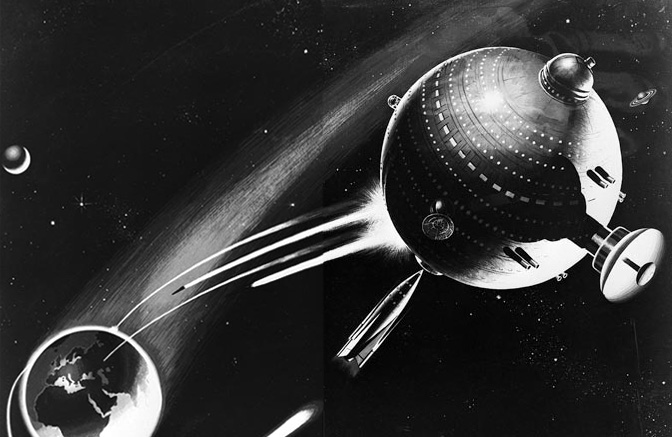
The story is full of imaginative touches—the Americans invent a pesticide that accidentally kills off all the birds and the bees (except for the whooping crane, for some reason), and all human beings have to get a special injection every three weeks in order to ward off the poisons now in the food. The story features a TV studio in outer space and a character named Major General Artemus T. Recoil.
And the United States does end up destroying the world, but you know what?
We meant well.
—Martin Schneider
Found in the Chapter Menu: The President’s Analyst
The President’s Analyst, written and directed by Theodore J. Flicker and starring James Coburn in the title role, was released in 1967—which fact is screamingly evident in virtually every frame. I saw a big chunk of it many years ago, and in my mind it’s always remained a mashup of Dick and I Love You, Alice B. Toklas! with a little bit of Skidoo thrown in. (We learned recently that David Denby is a big fan of Otto Preminger—I’d love to know what he makes of Skidoo.)
Let’s be frank: The President’s Analyst is kind of a mess. Its hallmark is the sort of hysterical puerility much better carried off some years later in The In-Laws. Watching the DVD (and enjoying the movie about as much as I had), Friend of Emdashes Jarrett noticed something odd: the people responsible for the DVD menu, rather than select some swirly go-go typeface, as seen in for instance the poster, went with a close approximation of Irvin. (In the poster, the title is set in the shape of an analyst’s couch, which is one of those “good” ideas better off relegated to the dustbin. You can see this idea carried over in the words “Scene Selection.”)
Jarrett kindly provided Emdashes with some screengrabs. Here they are:
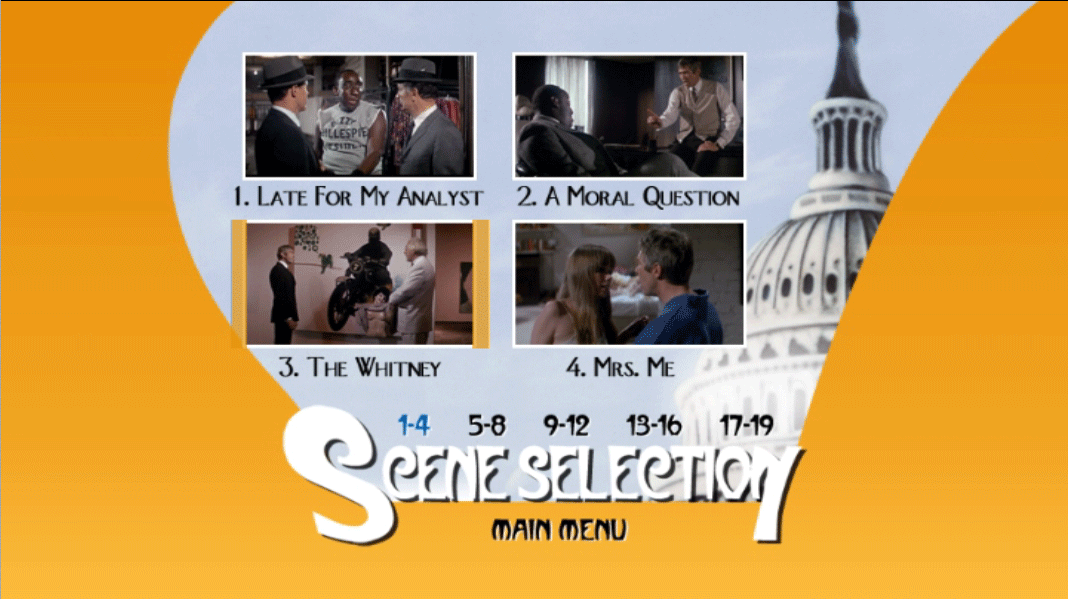

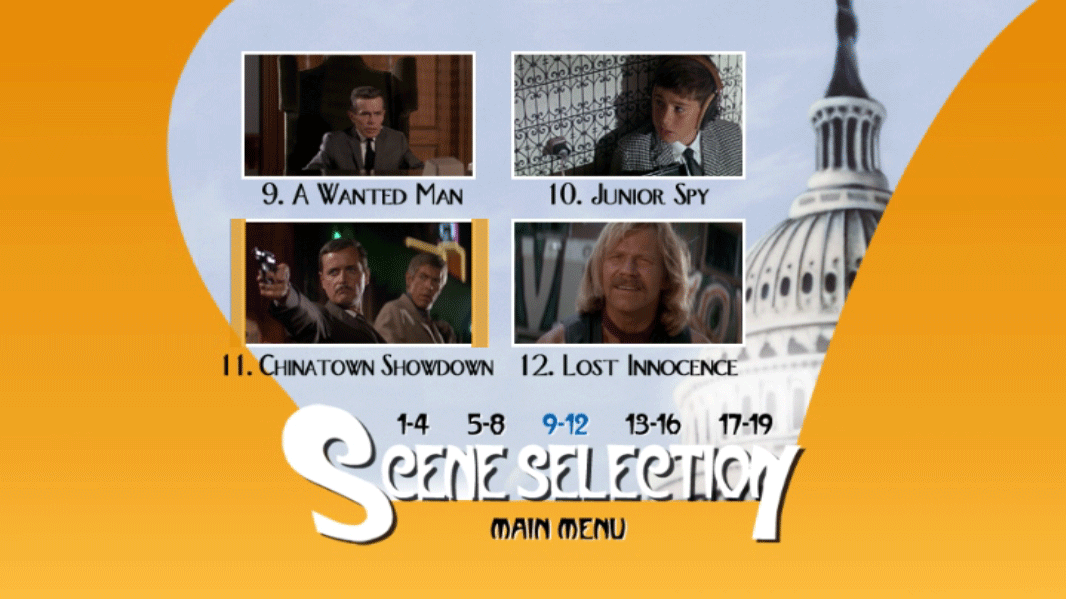

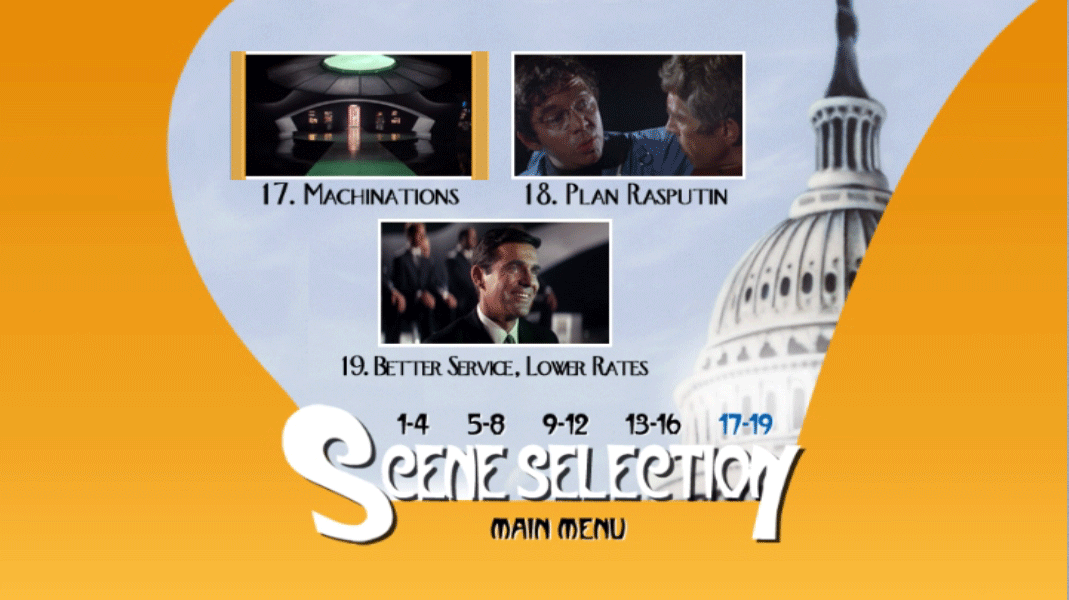
It’s not quite a perfect match, I don’t think, but it’s very close. Nice to see my distant relative Dwayne F. Schneider there in that final chapter. Oh, here’s that silly couch lettering:

And here’s a random still from the movie with Coburn jamming on some kind of gong:

Incidentally: what did The New Yorker make of the movie, anyway? Brendan Gill reviewed it in the January 6, 1968, issue. He didn’t like it either:
“The President’s Analyst” … has a fine idea for a comedy, which it wantonly tosses away…. From the moment the analyst turns up in a fright wig at a folk-rock party, the movie loses control of itself and pitches headlong into greater and greater exaggeration.
Exactly.
—Martin Schneider
Today Votes the Mitten: Will It Be Romney?
The “mitten” is, of course, Michigan, and today the Republicans there are participating in a primary election. In a welcome change of pace from the past couple of weeks, the media is not treating the contest as the most pivotal event ever to occur in western civilization.
Today the focus is on Mitt Romney, because he hasn’t won a big contest yet (he did win the Wyoming caucus, which hardly anyone noticed) and because his father George was governor of the state for much of the 1960s. It’s illuminating to read up on the New Yorker coverage of George Romney’s infamous 1967 slip that he had been “brainwashed” during a trip to Vietnam two years earlier, which sure did a number on his chances at a presidential bid the next year. Check out the last line of William Whitworth’s Comment from the September 23, 1967, issue:
It seems to us that, in their fascination with Governor Romney’s Vietnam ordeal, the newspapers have ignored something at least equally significant in this episode—that the debate over the war has reached a point at which a prominent moderate Republican seeking his party’s Presidential nomination has publicly declared that the United States should never have entered the war.
Doesn’t that sound like the kind of thing you would read today? Of course, thus far, Mitt has chosen not to emulate dear old dad; his position, as expressed in an April 2007 speech, is that “walking away from Iraq, or dividing it in parts and then walking away would present grave risks to America.”
As it happens, the very same issue has a Letter from Washington by Richard Rovere that also mentions Romney’s catastrophic utterance. It’s interesting to see Rovere grappling with a highly unpopular president and war—within six months, the country would see LBJ withdraw his reelection candidacy, and American forces taken by surprise in the Tet offensive. I don’t draw Iraq/Vietnam comparisons lightly, but the whole thing seems mighty familiar.
On another political topic, the polling debacle in New Hampshire a week ago got me thinking about that profession a bit. It must be bizarre for a politician to have some consultant come in and say, “White males hate your guts” or whatever. I fully expect to get a letter someday informing me that I really need to shore up my numbers among Hispanic professionals over 35.
The man who started it all is George Gallup, and The New Yorker‘s Russell Maloney, who seems to have been a real mainstay at the magazine back in the day—I’ve been running into his name a lot lately—did a bang-up Profile on him in 1940. It’s called “Black Beans and White Beans.” We learn that Gallup was apparently given to quoting Talleyrand to the effect that “the only thing wiser than anybody is everybody.” Paging James Surowiecki!
—Martin Schneider
New Year’s New Yorker Short Story Resolution: Installment II
More dispatches from my short story resolution:
Kay Boyle, “Kroy Wen,†July 25, 1931
Plot: Movie mogul harrasses poor Italians on a cruise.
Noah Webster alert: “repine” means both to complain and to pine.
George Milburn, “The Apostate,†June 4, 1932
Plot: Rotarian learns there’s more to life than the club.
Just wait forty years: “longhairs”
Excellent term of endearment: “you mangy old son of a hoss thief”
Excellent term of abuse: “sourbelly”
Jerome Weidman, “Chutzbah,” February 29, 1936
Plot: Charming boy from the old neighborhood is a bit of a shyster.
Inscrutable reference: Anyone know what “Leevio” means?
Good question: Is this story anti-Semitic?
J.F. Powers, “Death of a Favourite,†July 1, 1950
Plot: Parish priests in Minnesota perform an exorcism on a very unlikely subject.
Worthy of note: Title is likely a Thomas Gray reference.
Hot quotation: “Then they were gone, and after a bit, when they did not return, I supposed they were out killing poultry on the open road.”
Daniel Fuchs, “The Golden West,†July 10, 1954
Plot: Hollywood people suffer during a garden party.
Censorious Shawn alert: “whatsis” used to denote female posterior.
Hot quotation: “Mrs. Ashton was an intensely serious person, and as she lunged and flung herself about, she clearly had no idea of the violent effect the game was having on her bosom.”
A crank would say: The Osterman Weekend without the machine guns. Or possibly L’Avventura on Benzedrine.
Best story: “Death of a Favouriteâ€
—Martin Schneider
Previously: Installment I
How Much Do They Pay Her If Obama Wins?
In this political season, we note with interest that former New Yorker editor and recent Princess Diana memoirist has signed a deal with Doubleday to write a book about the Clintons. Her last book was called The Diana Chronicles; this one is tentatively titled The Clinton Chronicles. Judging from the title, we may have another Sue Grafton on our hands! (I’d certainly pay to read her Rick James Chronicles or Chuck Norris Chronicles.)
It’ll be interesting to see how this plays out. On the one hand, Brown was uniquely qualified to write a book about Diana, and she really came through on all levels. One doesn’t know if she has the same access to the Clinton story or even to what extent she is a political animal. However, The Diana Chronicles did prove that she has considerable talent in entertainingly synthesizing huge amounts of information on heavily covered (I almost wrote “chronicled”) subjects. And, as I noted in June, she’s already been giving Hillary Clinton a bit of thought.
—Martin Schneider
Brave, Lonely Dissents Are the Best Kind
I admit it. I’m an Obama man. I was psyched after Iowa, and I was dejected upon hearing the news of Hillary Clinton’s victory this morning (wrong time zone for prime time results). Several hours later, I see the positive side of Clinton’s comeback, and I find myself looking forward to the spirited few weeks of political combat to come.
Not many people saw Clinton’s strong showing yesterday coming, but I did want to salute Hendrik Hertzberg for being one of the very few people to get at least a small part of the story dead right, a mere day after the Iowa result, when the Obamania was at its freshest and most difficult to contravene.
I confess that when I listened to the last installment of the delightful New Yorker podcast “The Campaign Trail”—which usually features The New Yorker‘s Washington correspondent, Ryan Lizza, and executive editor, Dorothy Wickenden (they make a very good team), but the day after Iowa also included Hertzberg, the magazine’s chief political commentator—I made a dismissive clucking sound with my tongue upon hearing Hertzberg’s negative assessment of Obama’s prepared caucus-night speech and praise for Clinton’s “gracious” concession. Just as we learned not to be overhasty about writing any candidate off, we likewise shouldn’t read too much into what was likely a small part of Clinton’s comeback.
But the fact remains, that Hertzberg, both in the podcast and on his blog, may have foreseen Obama’s tendency to turn his movement into a hazy abstraction and Clinton’s newfound need to hunker down and show her more affable side. It’s already difficult to reconstruct how heretical that take seemed on Friday, and Hertzberg deserves credit for not letting the prevailing winds buffet him about.
I hope Hertzberg participates in the next podcast so he can crow over his prescience! (Which he surely won’t.)
—Martin Schneider
Update: I think Karl Rove might be a “Campaign Trail” podcast enthusiast. After Hillary won, his surprisingly trite (and, less surprisingly, racially coded) article in The Wall Street Journal made a similar observation:
And Mr. Obama, in his own way, is often as calculating as Mrs. Clinton. For example, he was the only candidate, Democratic or Republican, to use a teleprompter to deliver his Iowa and New Hampshire election-night speeches. It gave his speeches a quality and clarity that other candidates, speaking from notes or the heart, failed to achieve. But what he gained in polish, he lost in connection.
—MCS
The New Yorker and Excel Work So Well Together
The Millions has just posted a really juicy spreadsheet that a teacher named Frank Kovarik sent in. It’s got basic information on every short story that has appeared in The New Yorker since 2003. I salute Kovarik for his industry and public-spiritedness! I also use Excel to make sense of The Complete New Yorker‘s vastness. Indeed, I think those two just might be the new PB&J, the new franks and beans, the new vodka and tonic. It’s possible I overstate.
I’m sure I’ll have more to say about this data, but I hope that Kovarik elucidates the meaning of the “Rating” column. I suspect it refers to his own personal opinion of the story, on a scale from 1 to 10. If that guess is correct, he sure doesn’t like Roberto Bolaño!
One aspect of this information that has already gotten some attention is the statistics on gender. Obviously, The Complete New Yorker permits comparison across eras, so that’s something I’d like to look into soon. —Martin Schneider
“Best American Essays” List Complete!
I am very pleased to announce that our project of listing the New Yorker essays in Houghton Mifflin’s “Best American Essays” series has moved from “spotty” to “thoroughgoing.” We were fortunate to spark a “completist mania” (his words) in stalwart Emdashes supporter Benjamin Chambers, who doggedly tracked down the nine missing years for us. We are so vastly grateful to Benjamin for helping us close out that post for good.
When he’s not giving Rebecca West’s Black Lamb and Grey Falcon a close reading (West wrote 24 items for The New Yorker, ahem), Benjamin is working his way through every single essay in these volumes, a foolhardy but surely a rewarding undertaking. We’ll have further updates from his reading progress (on the essays, not on West) in the near future. Benjamin runs the award-winning literary website The King’s English, which we urge you to check out. —Martin Schneider
New Year’s New Yorker Short Story Resolution: Installment I
Readers may recall that I resolved to read all of the short stories in a certain three-volume anthology of New Yorker stories. Here’s the first batch:
Dorothy Parker, “Arrangement in Black and White,” October 9, 1927
Plot: A silly socialite is cluelessly racist to a black jazz musician at a party.
Noah Webster alert: A “grass widow” is a divorcée.
Marc Connelly, “Barmecide’s Feast,” December 24, 1927
Plot: A wealthy couple make the rounds on Christmas Eve but lack a certain something.
Worthy of note: The word “phoned” has an apostrophe in front of it.
Noah Webster alert: “Kelly pool” is a type of pocket billiards as well as the source of the phrase “behind the eight ball.”
Joel Sayre, “Love in the Snow,” January 9, 1932
Plot: A teenage boy at a winter resort finds that love cannot conquer all.
Hot quotation: “George Bush got very embarrassed, and, although they teased and coaxed him a long time, he kept insisting that he didn’t have any girl and finally got sore and told Bill Preston to shut up before he got a rap on the jaw.”
Noah Webster alert: a “one-step dance” is, er, a kind of dance.
Dated reference: Charlie Jewtraw
Edwin Corle, “The Great Manta,” May 5, 1934
Plot: A doorman at a movie palace is unruffled by the arrival of marine competition across the street.
Hot quotation: “Sixth Avenue is an ambiguous street.”
St. Clair McKelway, “Ping-Pong,” September 12, 1936
Plot: After a game of ping-pong at a resort, a shallow fellow tells a virtual stranger about his son’s suicide.
Worthy of note: Long monologues—no longer fashionable. Elaboration of the pain lurking behind a man’s bland façade would not work today; readers would assume as a matter of course that a bland person was hiding pain.
Best story: “Love in the Snow”
—Martin Schneider