
Martin Schneider writes:
Last Friday I attended one of the most memorable (not exclusively in good ways) author events I have ever been to. The estimable Tina Fey has a new book out (Bossypants), and she made one author appearance in the New York City area (she will visit only four other cities in the entire tour).
At the event, scheduled for 7pm at the largest retail event space in the city (the Barnes and Noble on Union Square, 4th Floor), Fey would be interviewed by The New Yorker‘s editor in chief, David Remnick; Fey has recently published two sneak excerpts in the magazine.
I harbored a strong suspicion that the event would be very crowded well before the scheduled start. I underestimated just how crowded. You can see the Twitter results for “tina fey noble” for April 8 to get a sense of just how early the massive fourth floor filled up. (Yes, I did get in, and stood many, many yards away. By the time I got there, it seemed silly to leave after already having made my way there.) I’ve never seen that space so crowded, but a friend told me he could remember another such occasion—when Fey’s 30 Rock castmate Tracy Morgan appeared there!
The authorities at B&N kept the interview short, in order to accommodate the many hundreds of people who wanted their books signed (Fey graciously agreed to stay until every person got his or her copy signed, a process that surely took a couple of hours).
In his interview, Remnick hewed closely to the contents of the book, even going so far as to read the wacky faux-blurbs on the back cover (every person in attendance was clutching the book as a requirement for entry, so this seemed a bit pointless).
As expected, Fey was intelligent, forthright, modest, and amusing, even as she was fighting off a cold. All evidence suggests Fey’s core fans are a very intelligent and attractive subset of the female population, and it was great to see so many sharp women come out and worship their hero. I don’t know if Fey is poised to become the next Nora Ephron, but whatever she is or is becoming, I’m all for it.
Sidney Lumet, 1924-2011
Martin Schneider writes:
I’ve always liked Sidney Lumet’s movies, and I’ve always liked the idea of Sidney Lumet’s movies, the elevation of sheer storytelling craft over self-indulgent personal expression. Lumet had plenty to express, all right, but he did it with a minimum of fuss and always with his full attention on entertaining the viewer in an intelligent way.
One of the nice things about a career that is so long and varied and apparently free of auteurist mannerisms is that every fan will have a different collection of favorites. Some champion Network; give me The Morning After instead. You like Equus? I’ll take Murder on the Orient Express. Oh, you want Before the Devil Knows You’re Dead? I’m happy with Prince of the City. And I’ve left out at least ten pieces of compulsively watchable Hollywood product.
He had his turkeys, and he had his hits. He made a lot of movies, and most of them were darn good. I think someone once called him the greatest hack director who ever lived; I think he would have understood the profound compliment implied therein.
PS: For more on Lumet, the comments in this ArtsBeat post are uniformly wonderful.
Literally, Extra: Newspaper Nail Art
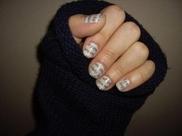 Emily Gordon writes: Thanks to Jennifer Hadley (who also created the original Emdashes logo!) for this: newspaper nail art, courtesy of old media, carefree youths unaware of their own impending obsolescence, rubbing alcohol (“or vodka”), and clear polish. Via, in turn, Je t’aime Morgan and Not Martha. Jennifer thoughtfully follows up with this YouTube video with better instructions. I see this not as a stomp on the corpse of newsprint but as a tribute to its beautiful ordinariness. It’s likely the twentysomethings posting these tips see it as beautifully retro or vintage. I guess that’s OK, too.
A Drinking Game for Any Cocktail Party: When Anyone Says ‘Apparently’
Jonathan Taylor writes:
Someone’s probably written about this already, but, my sometimes ingenious search skills haven’t managed to draw it out.
Tyler Cowen linked to a post by James Somers from about a year ago, about the skillful deployment of the phrase “It turns out….” He says it can have the magical effect of convincing even alert readers, in the absence of evidence, of a proposal “in large part because they come to associate it with that feeling of the author’s own dispassionate surprise.”
This reminded me of an observation—not exactly related and not nearly so incisive—that I’ve long made about the use of the word “apparently,” by people relating information recently gleaned from the news: “Apparently, GE not only paid no taxes last year, the Treasury actually owed it billions of dollars.” (See Felix Salmon for a great overview on the follow-up to that Times story.)
In fact, this usage is touched on in Google’s dictionary definition: “Used by speakers or writers to avoid committing themselves to the truth of what they are saying.” It’s my guess that people use this particularly often in relation to things they read in the New York Times, because it does require some implicit acceptance of the authority of the source. I think even the same people might not say the same thing about something they heard on NPR, but would more likely say, “I heard on NPR that….” Hearing a voice telling you on the radio maybe makes it too clear that the information is second-hand to you, whereas the disembodied authority of one’s most trusted written word is more easily assimilated to one’s own “knowlege.”
However, “apparently” also suggests an openness to acquiring completely new information; I doubt devotees of the Wall Street Journal editorial page introduce their games of telephone with any such qualifier; after all, that information is previously held and immutable belief, not new data.
In any case, use of apparently, overall, is apparently on the decline. If my theory is correct, perhaps the Times paywall will erode it even further.
‘The World’s Largest Interior Visual Design Medium’

_Jonathan Taylor writes:_
“Via”:http://andrewsullivan.theatlantic.com/the_daily_dish/2011/04/ode-to-airport-carpets.html Andrew Sullivan, an appreciation of “airport carpets”:http://www.iconeye.com/index.php?view=article&catid=1:latest-news&layout=news&id=4576:crimes-against-design-airport-carpets&option=com_content&Itemid=18, from George Pendle at IconEye.
What Is the Best Book About Cokie Roberts?
Jonathan Taylor writes:
An intriguing tip for choosing books to read, from Tyler Cowen:
5. The very best books in categories you think you cannot stand (“gardening,” “basketball,” whatever) will be superb. It is not hard to find out what they are.
Have You Seen the Pearl? Tolkin’s ‘Rapture’ Gets Its Due
Jonathan Taylor writes:
I normally avoid the cross fire of film criticism, but must quickly second Wolcott’s estimation of the “stupendous” post at The Sheila Variations about Michael Tolkin’s 1991 film The Rapture, illustrated with a stunning parade of the faces of Mimi Rogers; as many times as I’ve seen this film, I was too often too focused on what Tolkin was up to, to realize how much Rogers was doing.
I’d even quibble with Sheila’s assessment of the girl who plays Rogers’s daughter—or at least of the hair-raising effect of her whiny plea, “Why can’t we die now, mommy?” (Just see it. Ditto re: “the pearl.”)
I think Gary Indiana somewhere described Tolkin’s films as “period movies about the present.” That present still remains ours enough to still feel this effect, even as it is now enough the past, to add another layer of significance.
Paulette Forever: A Charles Taylor Interview
I was rereading some of Charles Taylor’s beautifully crafted, sometimes contentious reviews on Salon (I didn’t like Million Dollar Baby either), and the web wonderland led me to this 2006 interview with Taylor (or Charley, as I may call him because we’re friends) in Slant magazine. He talked about his career at Salon and elsewhere, the state of film criticism and media outlets (a phrase I already know will make him wince–sorry about that) generally, and more. Here’s a choice response, among many:
JK [Jeremiah Kipp]: You’ve frequently cited Pauline Kael as a major influence.
CT [Charles Taylor]: I got a paperback copy of “Deeper Into Movies” by Pauline Kael when I was in eighth grade. That was a major influence. I still think she’s the best film critic that is ever going to be. She was the best influence and the biggest influence. It was about trusting your instincts, which always the line about her. This is what I loved. This is why all of the “I Was a Former Paulette” articles I’ve read are all, to a one, simply wrong on the facts. I had countless disagreements with her, even arguments. I was never excommunicated. Some of the critics she liked were people she didn’t agree with. She wanted people to be honest. Art should be pleasure, not work. You have to bring your life experience to it, your experience of the other arts to it, you have to be well read, and no one should tell you what you have to like or what you should be interested in. The job of the critic is to help you formulate your own thoughts. Articulate them. Not to tell you what to think, but to get you to think. There was a freedom in her.
There Are Delicious Sensations: The Paris Review Celebrates Sybille Bedford
Jonathan Taylor writes:
Last Thursday, the Paris Review hosted a convivial reading from the works of novelist, memoirist and journalist—of author—Sybille Bedford, who would have turned 100 this year (and came closer than most; an Alan Hollinghurst article headlines her as a “Child of the Century“). The event was organized by Lisa Cohen, the author of the forthcoming All We Know—”portraits of the neglected modernist figures Esther Murphy, Mercedes de Acosta, and Madge Garland”—and a friend of Bedford.
Cohen called Bedford a “sympathetic, vulnerable mind,” exhibiting something of the gift for “compression” she also noted in Bedford’s writing. To wit: Courtney Hodell read from the opening of Bedford’s travelogue of Mexico, A Visit to Don Otavio, which includes the observation that “Arrival and Departure are the two great pivots of American social intercourse…. What counts is that you are new. In Europe where human relations like clothes are supposed to last, one’s got to be wearable.”
And in an assessment of her protagonist’s first sexual encounter with a man, in the novel Jigsaw, Bedford wrote, and novelist Sylvia Brownrigg read, “There were no delicious sensations.”
Poet and memoirist Honor Moore read climactically from the opening of Bedford’s last book, Quicksands, in which Bedford plunges back through the decades to resurrect that vulnerability in her formation as a writer.
These were all passages I knew, but a dramatic reading of Bedford’s account of the British Lady Chatterley’s Lover obscenity trial, by Cohen and Caleb Crain, revealed to me for the first time the felicitous role of Richard Hoggart, the British pioneer of cultural studies and author of the wondrous The Uses of Literacy in 1957. (I also just learned that Hoggart assembled the words “Death-Cab for Cutie”—as a made-up title for a type of “sex and violence novel,” as part of The Uses of Literacy‘s study of the encroachment of mass popular culture on traditional working-class culture.)
Born in 1918, Hoggart is not much younger than Bedford would have been (yes, is—still alive!). He argued that Lawrence’s novel was essentially “puritanical” in its sense of exceedingly stringent responsibility to conscience. Bedford recorded prosecutors’ smug attempts to mock his hypothesis by reading him passages laden with four-letter words (or five, in the pertinent case of “balls”). As played by Cohen, he responded as an enthusiastic teacher might to eager students thirstily requesting further demonstrations of his wisdom.
The reading had a little bit of a feel of a private party, a slumber party in Lorin Stein’s rec room. It was not inappropriate to the esprit of the friends you might find gathered, in her books, in a Provence farmhouse; nor to the consequent sense of being in good company one feels privy to, once you’ve started reading Bedford. I read her books at the same time as I did a number of her contemporary authors of travel and discovery, like Lawrence Durrell and Patrick Leigh Fermor. More than theirs do Bedford’s books crackle with the formation of thought amid the unpredictable eventfulness of company.
Thus it was a bit disappointing that the podium was limited strictly to readings, with no further discussion or reminiscence, what with Cohen in the house, as well as (if I understood correctly) Bedford’s friend and literary executor, Aliette Martin. Fortunately, the Paris Review‘s site promises to post a series of “essays and archival finds” on Bedford, beginning with this post by Cohen, this by Brenda Wineapple, and a 1963 Review interview.
TV Talkers Jeff Greenfield and Charlie Rose Talked at 92Y
Martin Schneider writes:
Last Sunday 92Y perpetrated a switcheroo. Longtime TV analyst Jeff Greenfield has hosted a recurring series of interviews at 92Y for (if I heard the intro right) something like 30 years, a forum he has used to interview people like Newt Gingrich and presumably also people whose opinion is worth a damn. (Although, to be fair, Greenfield referred to that interview in a way that made it sound worth watching.)
At the moment Greenfield has a new book to flog, Then Everything Changed, an entertaining exercise in alternate history from the sound of it. So for this one night, Greenfield was the subject of the interview, and 92Y enlisted longtime friend Charlie Rose to host the proceedings.
In short, the event featured two of America’s best and smartest professional talkers, although perhaps not the most exciting two people in the world. Not surprisingly, Rose and Greenfield are such fluent talkers/thinkers and also such political junkies that the event was highly amusing and entertaining.
Rose, whose affable drone has occupied the 11pm slot on PBS for a generation now, was remarkably amusing and fluid as the host on this night. Greenfield spoke at length about two former bosses, Robert F. Kennedy and John Lindsay, both of which feature in the book to some extent. It was fun to hear Greenfiled explore the possibilities of an RFK presidency (and therefore no Nixon presidency, no Watergate) and similar scenarios.
Late in the session, Greenfield made some quite critical remarks about President Obama for not making the urgency of the economic crisis of 2008-09 (and ongoing) the central theme of his presidency. Greenfield ventured that he “may have been overtaken by events.” He also noted the political wisdom of “acknowledging the elephant in the room,” a move that voters appreciate and that Obama has not done sufficiently.
I was a little surprised that Greenfield had swallowed the conventional wisdom about the election of 2010 to that extent, but then again, he works for a major news network — as smart as he is, it’s not his role to push a big alternate version of events (given his book, ironic) in which most of what Obama did worked fairly well and so forth. But I’m picking nits. It was a good time!