Martin Schneider writes:
It’s not every day that a major news network dedicates important programming time (Wisconsin and Hawaii today!) to a discussion of in exactly what ways a recent New Yorker article is so awesome, as happened just a few minutes ago (a little before 2 p.m. Eastern). The article in question was Lizza’s look at John McCain in the most recent issue. They even showed a screenshot of the New Yorker website.
Update: They kept Lizza on after the 2 p.m. jump—he’s rather telegenic! I hope to see more of him.
Monthly Archives: February 2008
John McPhee Wins George Polk Career Award; Semicolons Are Vindicated
From the UPI story:
New York’s Long Island University announced this year’s George Polk Awards for excellence in journalism in 14 categories, led by a writer for the New Yorker.
The announcement from the school’s Brooklyn campus said John McPhee, a New Yorker non-fiction writer, has won the George Polk Career Award for “his extraordinary contributions as a prolific author, essayist and educator, who is considered to be one of the pioneers of creative non-fiction.”
Congratulations! Here’s McPhee’s New Yorker bio (I don’t much like using the abbreviation “bio” as a legitimate word, but “biography” makes me think of books and A&E specials, so there isn’t a perfect synonym), with links to several of his most well-known pieces.
Speaking of words and things, here’s a Louis Menand-approved semicolon, on a New York City Transit sign, no less. (It’s Lynne Truss-approved, too, which may rile Menand, who doesn’t have much truck with Truss, as you recall.) Dig the funny correction, too. Too bad Times reporters probably can’t freelance for The New Yorker; this would’ve been a perfect Talk of the Town.
Back in the Zoo with Jean Stafford
The second installment of a new column on New Yorker fiction, past and present, by writer and editor Benjamin Chambers.
Stories Discussed: Jean Stafford’s “In the Zoo,†published September 19, 1953; “The Shorn Lamb,†published January 24, 1953; “The Liberation,†published May 30, 1953; and “Children are Bored on Sundays,†published February 21, 1948.
When Martin recently posted the contents of some old anthologies of fiction from The New Yorker, I saw a lot of familiar stories, but none so welcome as Jean Stafford’s “In the Zoo.â€
I first read it 20 years ago in graduate school, where New Yorker author Deborah Eisenberg was a visiting professor and put it on the reading list. Unlike the other stories on that list, the Stafford story stayed with me, and now that I’ve re-read it, I can see why. It doesn’t glitter like a diamond, but it’s tough enough to cut glass.
For such a short story, “In the Zoo†has a very long opening and denouement. At first, I found myself impatient with the opening paragraphs’ slow pan over various animals in the Denver Zoo, but the setup works, thematically and dramatically, giving the piece the capacious feel of a much longer work. It’s a mark of Stafford’s precise verbal economy that she can do this. Look how neatly she characterizes Mrs. Placer, the woman who takes in the narrator of the story and her sister Daisy during the Depression, after their parents have died:
If a child with braces on her teeth came to play with us, she was, according to Gran [Mrs. Placer], slyly lording it over us because our teeth were crooked, but there was no money to have them straightened. And what could be the meaning of being asked to come for supper at the doctor’s house? Were the doctor and his la-di-da New York wife and those pert girls with their solid gold barrettes and their Shetland pony going to shame her poor darlings? Or shame their poor Gran by making them sorry to come home to the plain but honest life that was all she could provide for them?
The way Stafford catches and mocks Mrs. Placer’s voice is impressive. But even as we smile at this Dickensian grotesque (to borrow a Stafford phrase), we sense her malevolence clearly enough that we’re not surprised when the narrator concludes, “Steeped in these mists of accusation and hidden plots and double meanings, Daisy and I grew up like worms.†Worms!
The girls’ one happiness is visiting Mr. Murphy, a kindly drunk with a small menagerie who does “nothing all day long but drink bathtub gin in rickeys and play solitaire and smile to himself and talk to his animals.†One day, he surprises them with the gift of a stray puppy, half-Lab, half-collie. The girls convince Mrs. Placer to let them take the dog in, and for a while it is their playful, well-trained pal.
Mrs. Placer intervenes, however, in the molding of the dog’s character and very quickly transforms him into a vicious bully, loyal only to her. The girls, heartbroken, turn to Mr. Murphy, who, it turns out, has something of a vicious temper. Roused from his nodding, alcoholic stupor by the harm Mrs. Placer has done to the sweet dog he gave the girls, he goes to confront her in one brief, shattering high noon.
In life, there’s rarely an easy escape after a climactic confrontation, and neither is one vouchsafed the girls in this story. They grow to adulthood under Mrs. Placer’s roof, their spirits virtually broken; the denouement makes clear that, though they are well into middle age, they have not recovered from her insidious influence, and never will.
For all that, though, “In the Zoo†is not grim at all, merely sad, and comic. Its ironic, confident tone makes it almost sprightly at times; nonetheless, when you’ve finished, you know you’ve been through something.
Stafford published two other stories in TNY in 1953, “The Shorn Lamb,†and “The Liberation,†so I figured I’d read them as well, along with “Children are Bored on Sundays†from 1948, which, I happen to know thanks to Martin, was a Best American Short Stories pick, as well as the first story Stafford published in TNY.
The focal character of “The Shorn Lamb†is Hannah, a five-year-old girl whose father has just cut off her beautiful golden hair so that she now looks like a boy. There is no action in the story proper: the little girl listens to her mother tell the whole sordid tale to her sister, and it is through this conversation and the accompanying summary that we learn of the war between Hannah’s parents.
Hannah’s haircut, we realize, is both an indirect way for her father to attack her mother (who has beautiful hair of her own), and to sever her mother’s relationship with an artist, a man who has been painting a portrait of mother and daughter. (Mysteriously, Hannah’s haircut makes it impossible to ever continue the portrait.)
The harshness of the conflict between the parents is well-drawn, but Hannah is a clumsy and cloying medium for portraying it. The first Monday after her haircut, she’s left at home as usual while her older siblings are taken to school. She waves to them as they leave, calling, “Goodbye dearest Janie and Johnny and Andy and Hughie!†And when she overhears her mother say, “I’m very anti-man, today,†she repeats to herself, “What is antiman?†Ick.
The emotional violence perpetrated on Hannah by her parents, however, seems to be a preoccupation of Stafford’s, at least judging from the four stories under discussion. It’s the central dynamic of “In the Zoo,†of course, as well as “The Shorn Lamb,” and it shows up again in “The Liberation.â€
“The Liberation†concerns the plight of Polly, a thirty-year-old teacher of German who still lives at home with her bossy aunt and uncle, who would like nothing better than to keep her there. She is largely content with her dull, constricted life until a surprise marriage proposal offers her a chance of escape. Steeling herself to tell her aunt and uncle that she will be getting married and leaving them, she prepares for a contest she fears she cannot win. Her victory is quick, however, though placed in jeopardy at the last moment by the news that her fiancé has died (conveniently for the author). I won’t spoil the story’s eventual resolution, but I will say I found it unconvincing.
Stafford’s troubles with making “The Liberation†work might have had to do with her doubts that people can ever fully escape the tyranny of others. Certainly, “In the Zoo†argues otherwise, and “Children are Bored on Sundays,” similarly, is a case study in how an adult free of her parents’ control suffers from exclusion and disparagement by her peers.
The story’s protagonist, Emma, is a young woman recovering from an emotional breakdown brought on by the pressure of trying to fit in with an intellectual coterie. Dividing the world between “rubes†and intellectuals, she is fully at home with neither, and the unkindness of the latter has, apparently, turned her into a basket case.
When she finally feels strong enough again to venture out to a museum, she quite naturally runs into one of the intellectual set, Alfred Eisenburg, the sight of whom disturbs her fragile equilibrium. (Personally, I was much more startled by Salvador Dalí, who turns up a couple of times in the crowd of museum-goers.) Alfred, however, is also the worse for wear, and he and Emma go off for a drink together, relieved for the moment of the burden of being, as Stafford says, “grownups.” (Respite, in Stafford’s world, means escape from the meanness of others, and can only be, like childhood, temporary.)
The problem is, the conflict is finally too abstract, and the story never quite real—the tone too arch for us to find the reasons for Emma’s breakdown completely believable (indeed, it’s not clear whether we’re meant to find Emma sympathetic or to laugh at her simplicity and frailty). If there’s tragedy or comedy here, it’s unrealized.
“Zoo,†however, delivers. Only in this story does the conflict occur on stage, so to speak, with clear, comprehensible stakes. And its classical proportions serve it well, for while the violence of the collision between Mr. Murphy and Mrs. Placer makes the story remarkable, it needs the subsequent fate of the girls in later life—the long, unending denouement—to give it such lasting weight. Look it up, by all means.
Amazing Digg Challenge Makes Brangelina and James Frey Blush
Not really, but Gawker challenges us all as follows: “Gold star for anyone who converts this week’s New Yorker into Diggable headlines.” Emdashes readers, surely you can oblige…but keep it clean!
Gladwell Raises New and Troubling Questions About New and Troubling Questions
Martin Schneider writes:
The Adam Baumgold Gallery has been on New Yorker streak lately. In addition to showcasing a number of intriguing works by Saul Steinberg, the gallery is putting on “Chris Ware: Drawings for New York Periodicals,” which features a number of New Yorker covers in the draft stage. Here are a couple of examples:

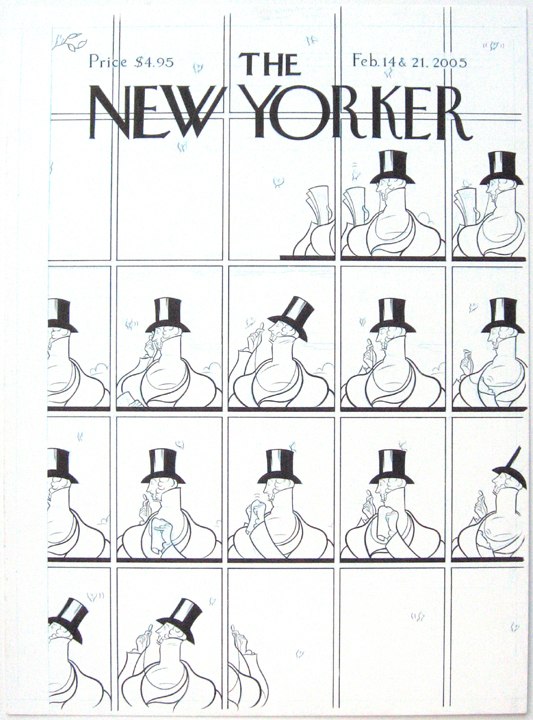
I find these images haunting; I don’t know why. I run a little hot and cold on Ware, but his technique is undeniably staggering. Judging from these images, the show provides a great deal of insight into his way of working.
The gallery is located at 74 East 79th Street, and the show runs through March 13. I can’t wait to check it out.
Meanwhile, in a more aural vein, last week’s episode (#348) of This American Life featured Malcolm Gladwell describing some prankery from his days at The Washington Post. The mp3 is available on TAL‘s website, and you can also get it on iTunes. For those who don’t own iPods or are allergic to podcasts, Gladwell told a version of this story in a 1996 Slate diary.
“Cartoons Are Like Fruit Flies”: Bob Mankoff Interviewed in Psychology Today
Matthew Hutson interviews the cartoon editor about why he left experimental psychology, the effect of morbid stimuli on the funny bone (I know “funny bone” is a big ol’ cliché, but suddenly it seems so silly and hilarious to me; have I been exposed to any death imagery lately, or just the usual apocalyptic reverie?), and why he came back to experimental psychology, but with jokes instead of pigeons.
Get Post-Apocalyptic on Valentine’s Day
A friend forwards this heartening bulletin from Brooklyn’s indie bookstore Freebird:
Just a reminder that this Thursday, Feb 14, at 7:30 pm, Freebird is kicking off our monthly Post-Apocalyptic discussion group with a special A/V presentation of Ray Bradbury’s classic short science fiction, “There Will Come Soft Rains.” Come listen to the ’50s radio play version, watch a 9-minute Soviet animated adaptation, and hear about the forthcoming months’ book and film selections. And if you’d like to read it beforehand, check out this site.
That reminds me of “War of the Worlds,” not surprisingly; if you haven’t heard it for yourself, listen—laugh, but it’ll spook you. Here’s an incredible old-radio site I just discovered, which includes the Orson Welles classic. One of these days, I want to hunt down my great-grandmother’s recordings. She was a pip, from what I’ve heard!
While we’re on the subject of radio, I’d be denying you the pleasure of hearing this if I didn’t mention the BBC Radio 2 documentary on the Jackson Five that my friend and Scrabulous opponent Chris Skinner produced. It’s not stuff you’ve heard before, and it’s really about the music.
Meanwhile, I went to a merry event today for Andre Dubus III’s new book The Garden of Last Days, at which the charmingly persuasive Dubus urged me (a group of us were talking about classics we haven’t read yet, including The Sun Also Rises, for which he provided a very un-Cliffs Notes synopsis; wonder if Freebird has any in stock?) to read Joyce Carol Oates’s short stories, especially “Where Are You Going, Where Have You Been?” So I’m about to do that, right here on Oates’s website. They made a movie from the story in 1985, Smooth Talk. Move to top of queue?
Dept. of Intense Admiration
I saw the comedian Will Franken at Upright Citizens Brigade a few months ago, and I’m still reeling from, marveling at, trying to process the hilarity, erudition and outrageousness of Franken’s mind and his eerie gift for projecting dozens (multiple, manifold dozens!) of personalities in a single performance. Download his podcast. Listen to an interview he did with Jesse Thorn of The Sound of Young America (completely coincidentally, I appear as a voice at the beginning of this recording). Watch some videos. If you’re still not convinced, read this Gothamist interview. And see him live. The next New York show is this Saturday, Feb. 16, at Karma Lounge, 51st 1st Ave. (between 3rd and 4th Sts.), 8 p.m. And I’m not just promoting a friend; I don’t even know him yet. But please take my word for it—his talent and imagination are well out of the ordinary.
Banned Words and Phrases: More Things That Are Not One Word
“Eachother,” “sortof,” “nevermind” (I know that’s how Kurt spelled it, but I’m afraid he was wrong), “highschool,” and especially “moreso.” All are in fact two words, not one. The last of these non-words appears frequently in my statistics tracker — people google “moreso one word?” — and I’m glad they’re double-checking, because, as you know, it is not. That’sall fornow. See how typing that way makes you sound drunk? (More banned words and phrases, including “moreso,” which I include again to underscore its two-worded state. It’s overused anyway, don’t you think?)
Eustace Tilley Conquers Austria
Martin Schneider writes:
My mother is the American correspondent for the Austrian newspaper Der Standard. Recently she started a blog on American topics, a mix of quick bursts about the primaries (for now) and clarifications of American expressions or habits that never get explained in the standard resources that a German-speaking audience would consult (“selling the Brooklyn Bridge,” “Dear John letter,” and so on).
The recent Obama/Clinton cover remix prompted her on Monday to introduce her readers to a certain waistcoated dandy. Whether you read German or not, enjoy the Eustace-y goodness.
Update: Confronted with a deluge of requests (well, one), I supply the following quick and dirty translation. I fully await adjustment from my mom, who has me cornered in the German department.
“The New Yorker, yes, The New Yorker” for a long time was the theme of an ad campaign for this esteemed magazine. This statement of confirmation was the answer to the astonishment of an unseen listener in the face of all of the interesting, unexpected, and not-at-all-old-fashioned things that could these days be found in the by no means stodgy New Yorker.
Once again, The New Yorker has surpassed everyone: The following cover [refers to first link below, Clinton/Obama Eustace cover] is a variation on the likeness of a certain Eustace Tilley, a made-up character who every February for decades (indeed, from the very beginning) captured in simultaneously traditional and satirical (“tongue-in-cheek”) fashion the cool detachment of New Yorker readers.
The week of February 5 (it’s the edition of February 11, but it appears much earlier) The New Yorker ran the following cover:
http://www.newyorker.com/images/covers/2008/2008_02_11_p323.gif
I am perhaps also permitted to hark back to the simple, elegant, and endlessly moving New Yorker cover after 9/11:
http://en.wikipedia.org/wiki/Image:Spiegelman-cover.jpg
Hope that helps!
—MCS