Monthly Archives: May 2008

Pencil It In

Michael Leddy at the site Orange Crate Art (clearly, someone I would enjoy talking to) wonders if the author of a 1953 Talk of the Town about pencil use at the Eagle Pencil Company might, by virtue of the story’s eloquent phrasing (“We ducked as lead flew about us”) and its attention to pencils, have been longtime editor William Shawn. In fact, according to the Complete New Yorker, it’s by E. J. Kahn, Jr. Here’s the abstract.
Leddy also notes the sad passing of Mona Hinton, the wife of Milt Hinton and a friend of Leddy’s family, who died on May 3rd. He quotes the Hinton website:

The Hintons first met at Milt’s grandmother’s funeral in 1939 and were inseparable for the next 61 years. Mona traveled extensively with Milt throughout his career. She was the only spouse on the road with the Cab Calloway Orchestra in the 1940s, where, according to Milt, she was extremely helpful in finding rooms and meals for band members especially when the band worked in small towns during the Jim Crow era. During the ’50s and ’60s when Milt was working day and night in the New YorkWi studios, Mona kept the books and made often complicated transportation arrangements. And during the last two decades of his life, Milt and Mona got to travel to jazz festivals and clinics around the world — first class.
In Praise of Potty-Mouthed Panda Saviours

The funny U is in honor of Georgina Sowerby and Brian Luff, whose incomparable podcast “The Big Squeeze,” now known as “It’s Sowerby & Luff,” is three years old this week. These Crouch Enders, who have become my friends and houseguests (not to mention Will Franken and Eliza Skinner admirers), have some exceptional associates, from Thesaurus Walrus and Candy Carrot-Cake to Doctor Rabbit and Nursey Lamb to the Queen herself, not to mention legions of fans in London and far, far afield. Raise a pint to them, won’t you?

The New Yorker Conference Is Quotable: Day Two

Undeclared superdelegate Rahm Emanuel’s declarations at the New Yorker Conference proved newsworthy, and the magazine has posted the video of Emanuel’s interview with Ryan Lizza on its website. Now we can fact-check my scribbled quotations together! Yesterday I posted the finest lines from day one, and here are my favorites from the conference’s windup. —MCS
“You cannot get a healthy meal in a New York airport unless you bring it yourself and figure out how to get it through the security checkpoints.” —Paco Underhill
“I believe passionately in rubber-soled shoes.” —Paco Underhill
“Metal chairs should not be part of an airport’s lexicon.” —Paco Underhill
“The filthiest place in the first world is the bathroom in the economy section of a crowded airplane.” —Paco Underhill
“I think of the airport as a Berlin, with a Berlin Wall and a Checkpoint Charlie.” —Paco Underhill
“Has anyone had a pleasant experience at airport security? It’s a Stasi moment.” —Paco Underhill
“I think almost all of us agree that the airport experience is miserable.” —Paco Underhill
“World of Warcraft is the best-designed reality of all time.” —Jane McGonigal
“I have a dream of building an M.M.O. where your dog is your avatar.” —Jane McGonigal
“Miles per gallon is the new high score.” —Jane McGonigal
“I think there are people that know the Obamas better than Rahm does, there are probably people that know the Clintons better than Rahm does, but i don’t think there’s anyone in American politics that knows both the Clintons and the Obamas as well as Rahm does.” —Ryan Lizza
“At this point Barack is the presumptive nominee.” —Rahm Emanuel
“The reference point for change is George Bush.” —Rahm Emanuel
“Like in ’06, you’ve got to go take it from them. They don’t give up power easily.” —Rahm Emanuel
In the two recent special elections in Louisiana and Illinois, “The Republicans ran on taxes in Republican districts and their ace for the last thirty years came up joker.” —Rahm Emanuel
“When Hillary Clinton says, ‘I’m not a quitter, I’m a fighter,’ that is an accurate depiction of who she is.” —Rahm Emanuel
“The government has succeeded in universalizing health care for a population, not the population.” —Rahm Emanuel
“It’s not a coincidence that the big discussion in the Democratic Party is about trade and the big discussion in the Republican Party is about immigration.” —Rahm Emanuel
“Verizon is in the record business. Proctor and Gamble is in the record business.” —Steve Stoute
“The poster child for that ‘no sellout’ thing was Bob Dylan, and he ends up in a Victoria Secret ad.” —Steve Stoute
“We know that New York is the number-one terrorist target in the United States.” — Raymond W. Kelly
“You’d be hard-pressed to look at the high-end fashion industry and say they’re in trouble.” —James Surowiecki
“A copyright on the pinstripe would certainly be troubling.” —Scott Hemphill
“H&M is kind of like a gateway drug.” —Kal Raustiala
“I have a certain aversion to most famous people.” —Sheila Nevins
“The fictionalization of war seems better suited for after the war.” —Sheila Nevins
“Daytime is boring.” —Sheila Nevins
Real Sex is our Sesame Street—people re-learn the alphabet every day.” —Sheila Nevins
“Opera fans are as fanatical about opera as sports fans are about sports.” —Peter Gelb
“One of the common errors that Americans make is to believe that all good things go together.” —Fareed Zakaria
“The real story is that the rest of the world is rising.” —Fareed Zakaria
“Over the last ten or fifteen years, China has opened up a lot more than people realize—but there are no political rights.” —Fareed Zakaria
“John McCain has drunk the neocon Kool-Aid.” —Fareed Zakaria
“It’s a good thing for there to be other centers of wealth.” —Fareed Zakaria
“In the Middle East, you had oil, you had failed dictatorships, and the two combined to form kind of an unholy alliance.” —Fareed Zakaria
“Being the 800-pound gorilla in the room is very different from being a small mouse in the room looking at the 800-pound gorilla.” —Fareed Zakaria
Note: Quotations are as accurate as I could make them; in a couple of instances I have replaced a pronoun with its antecedent.

The New Yorker Conference Is Quotable: Day One

Martin spent the day yesterday flying down the heady waterslide that is the New Yorker Conference, where inventors, scientists, politicians, filmmakers, programmers, musicians, and others with an eye on the daunting/thrilling place that is the future talk with New Yorker editors and writers about their work. Now in its second year (it’s timed to go with the apparently now annual Innovators Issue), it’s a brainy mini-marathon, punctuated by sweeping visual effects (thanks in great part to Frank Gehry’s floaty IAC Building) and fancy snacks.
All of which I was sorry to miss this year, along with the strong and welcome sense that I had become smarter in a single day. Luckily for us, Martin got back from Austria just in time to attend, and is even now being walloped with more visionary ideas, but in the meantime, he’s collected some of the most memorable lines from the first set of conference conversations. Kottke has been blogging the conference as well (and made the magazine’s new Twitter feed), and we can look forward to hearing more from Martin soon. Will some of the talks be available later on video? As a low-tech guru once said, signs point to yes. —EG

“Malcolm Gladwell has a new book coming out next year. It has already sold two and a half trillion copies.” —David Remnick
“Imagine this enormous room filled with incredibly sweaty teenagers with teeth missing.” —Malcolm Gladwell
“Scouting combines are, for lack of a better word, a disaster.” —Malcolm Gladwell
“I don’t think anyone could look at the President of the United States and not conclude that we have a massive mismatch problem.” —Malcolm Gladwell
“Ninety-nine percent of what policemen do is relational—resolving disputes and so on. So why are all cops big beefy guys?” —Malcolm Gladwell
“More politicians should screw up more often.” —Gavin Newsom
“I was trying to figure out why I am speaking third today. I think I was the top choice of all the sports combines.” —Andy Stern
“Change is inevitable; progress is optional.” —Andy Stern
“S.E.I.U. had to go from a lapdog of a political party to a watchdog for its members.” —Andy Stern
“Originally ‘Workers of the world unite’ was an ideological formulation; now it is a practical one.” —Andy Stern
“I am a very bad caffeine metabolizer.” —Michael Specter
“Rapidity in genetics is higher than Moore’s Law.” —Michael Specter
“For geeks like me, sexual data repositories are heaven.” —Michael Specter
“Drugs on average only work on 40 percent of the people who take them.” —Linda Avey
“Earwax is, you know, breathtaking.” —Anne Wojcicki
“We used to think, ‘We’ll figure out the gene for breast cancer, we’ll figure out the gene for Parkinson’s, we’ll figure out the gene for why I talk too much.'” —Michael Specter
“Anyone here seen those old James Bond films? Well, you’re looking at Q—actually, Q’s boss.” —Eric Haseltine
“Intellipedia is the single greatest advancement in the intelligence community since 9/11, and it cost zero dollars and took eighteen months.” —Eric Haseltine
“In the Cold War, the NSA came to mirror the Soviet Union.” —Eric Haseltine
“You cannot kill an idea with a bullet. You have to kill it with a better idea.” —Eric Haseltine
“Intelligence isn’t neat gadgets. Intelligence is computers and math.” —Eric Haseltine
“We developed a robotic hand but it developed arthritis.” —Yoky Matsuoka
“I have Duncan Sheik to thank that in my house, ‘Some Enchanted Evening’ now segues into a song called ‘Totally Fucked.'” —Susan Morrison
“Rock and roll in musicals—it’s like seeing your grandmother in a hula hoop.” —Duncan Sheik
“Of all the continents in the world, the one with the most hybridized conditions is Africa.” —David Adjaye
“These are like the three coolest chefs you will ever see in your life.” —Bill Buford
“Twenty-five years in Switzerland is maybe enough.” —Daniel Humm
“If you don’t go nuts in the kitchen at least once a day, it’s not worth it.” —Marc Taxiera
“I always think when a new season comes—this is my favorite season.” —Daniel Humm
“I think New York has more than four seasons. It has like twelve seasons.” —Daniel Humm
“Cooking is the only profession I know where you get to act like a buffoon all day with your friends.” —David Chang
“I can tell a California cook from a New York cook any day of the week—they’re slower…. I’m calling out all of California, pretty much.” —David Chang
“This is why I became a writer—my grandmother sucked in the kitchen.” —Bill Buford
“Ten years ago everyone wanted to have an omelet.” —Bill Buford
“The Berlin Wall fell in 1989. It’s probably the most important economic event in any of our lifetimes.” —Michael Novogratz
“Ramen noodles is everyone’s friend during two-dollar-a-day week.” —Amy Smith
“The truth is, there are ingenious people everywhere.” —Amy Smith
“I found out that most of these divas, whether Italian or American, were attached to needlework.” —Francesco Vezzoli
Note: Certain quotations altered very slightly to make comprehension more seamless. Not that short-term memory is flawless anyway.

Dept. of Things That Make Us Grin, in Couplets

New Yorker letters: a batch you can buy!
Sublimely ridiculous scene: Family Guy.
The New Yorker Conference has been blazing all day!
Able Martin is on it—I’m closing away.
Walt Kelly in Madison, posing with Pogo;
Crazed MFA humor—Shouts & Murmurs take note.
That last, loosely rhymed item refers to a piece by Tom Hopkins, who has concocted something for everyone—wailing fiction writers, gnashing poets, and everyone in between.
And thanks to the all-seeing B.K. for the Pogo and eBay links above. Anyone have $995 they can lend me? If yes, after I read all the letters in this batch (“In one, Harold Ross declines the suggestion for a feature on Washington affairs, but suggests writing for other departments; ‘You could put a lot of things in there with a slight sarcastic touch'”), I think they should be given a proper home with their true friends in the New York Public Library, where they will be loved, enfolded in calm, cool boxes, and available to visit whenever we begin to miss them.

LOL, LOL: LOL

On the Moth podcast (which I love so much I’m now going to the live shows—backward, eh?), Adam Gopnik riffs endearingly on being the father of an adolescent boy, control, communication, silences, and the abbreviations within the abbreviations.

Designing Woman Tina Brown

From today’s New York Post (via MediaBistro): “Tina Brown has turned to legendary avant-garde design firm Number 17 to handle her new yet-to-be-named Web venture, a news-aggregation service that is being backed by her longtime friend, media mogul Barry Diller.” I can attest both to No. 17‘s design acumen and their laudable foosball hosting and playing skills.
Elsewhere in design, journalism and political science double major (and keyboard player) Teddy Applebaum, given the challenge of a mock blow-in card, struggled among various versions of Rea Irvin’s New Yorker typeface and their cost (“oodles of cash”), and had to settle for a poor imitation. Occasional spelling oversights aside, I think the kid‘s got something, don’t you?
Speaking of blow-in cards, there was an eloquent defense of them in Wired some months ago that I keep thinking about, and not just because of the witty execution. It seems the cards really bring in the dough, and in these uncertain times, that’s something we’ve got to support (as this Jack Ziegler cartoon suggests), right? Or at least not judge too harshly, especially when in the forest, which could probably use more edifying reading material, anyway.

Links of More Than Routine Interest: Benchley, Gawanke, Gladwell, &c.

Martin Schneider writes:
S.L. Harrison at Editor & Publisher digs Robert Benchley’s “The Wayward Press.”
Software engineers find Atul Gawande’s checklist useful.
Malcolm Gladwell is one of the five most influential “business gurus” in America, per WSJ. (Related: Where are the women?)
Forbes appreciates Calvin “Bud” Trillin’s London election coverage.
Ten talented cartoonists, essays and drawings, and Sex and Sensibility, a book Emily has celebrated.
And the headline source:

The Lap of Luxury (Hotels), Circa 1958

Benjamin Chambers writes:
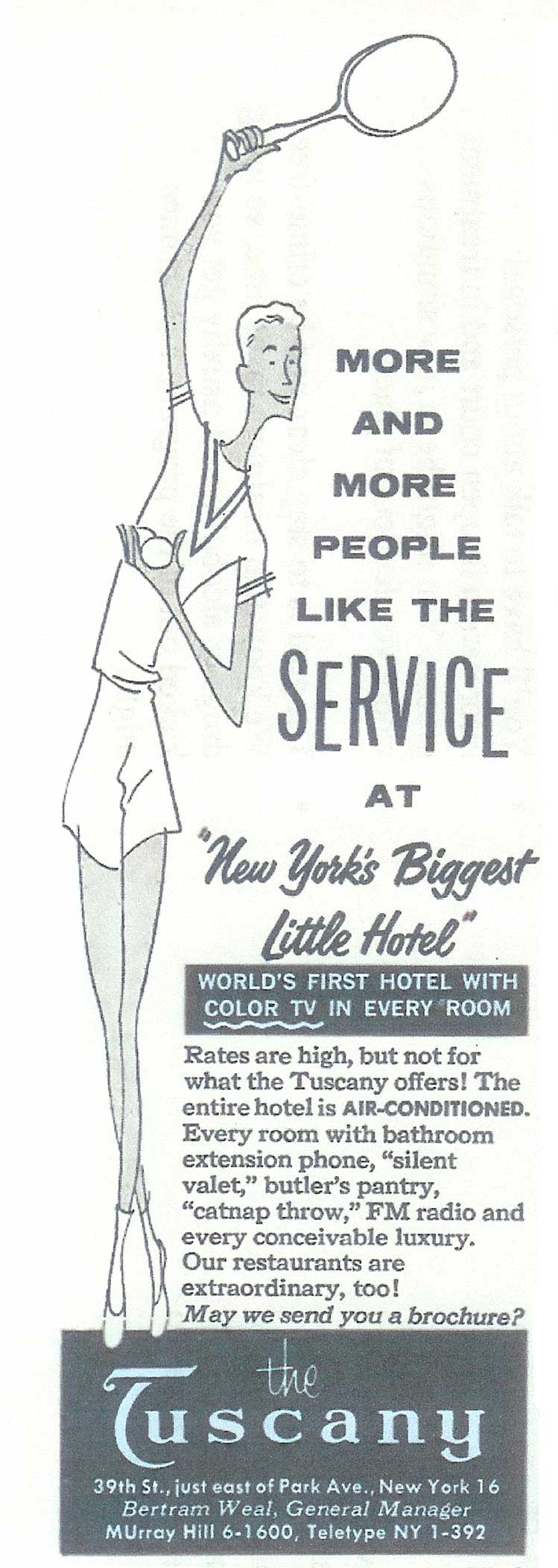
One of the sweeter pleasures of paging through the Complete New Yorker is looking at the dated advertising, especially when a copywriter describes, with a flourish of trumpets, amenities we regard as either standard or puzzling.
For example, if you’d been looking for a quiet, upscale hotel in 1958, you’d have done well to choose The Tuscany on 39th Street. I know, because I came across an ad for it while reading a sweet-but-forgettable memoir by Grover Amen in the June 14 issue of that year. (I’ve displayed the ad here for your viewing convenience, much as The Tuscany’s staff would have turned down your bed at night.)


TuscanyHotel_1958.jpg

How could you beat a hotel that was the first in the world to have color TVs in every room? Plus, each room had FM and AC, and every guest could count on finding a phone extension in the bathroom: all items at least as breathtaking, apparently, as its rates.

So what else would you get for your money? A “catnap throw” (pillow), butler’s pantry (a small staging area in which to store plates, glassware, and silverware), and a “silent valet” (a rack on which to hang your clothes).

All part of a strategy, it would appear, to net readers of The New Yorker who wanted class, but who were new to travel. These small details imply that prospective guests will be waited on by their own staff of quiet, liveried servants. After all, if one’s room has a “butler’s pantry,” the butler it belongs to has to be there to count the silver, right?

Ah, innocence! Gone now, though I see hotels still advertise silent valets, so maybe we’re still suckers for promises of elegance. But the romance of travel has definitely waned. These days, hotels simply hand over the keys to the mini-bar and don’t even pretend that a genteel staff member will be there to serve you the contents.

Whither The Tuscany? The hotel is still extant, it appears, appropriately upgraded and still advertising a “chenille throw” fifty years later. Imagine all the people who’ve passed through there since (many no doubt loyal readers of The New Yorker).

O, if only those valets could speak!

How Do You Say “Gently Sir” in Japanese?

Martin Schneider writes:
If this video doesn’t make you think of George Price, well, it certainly should.

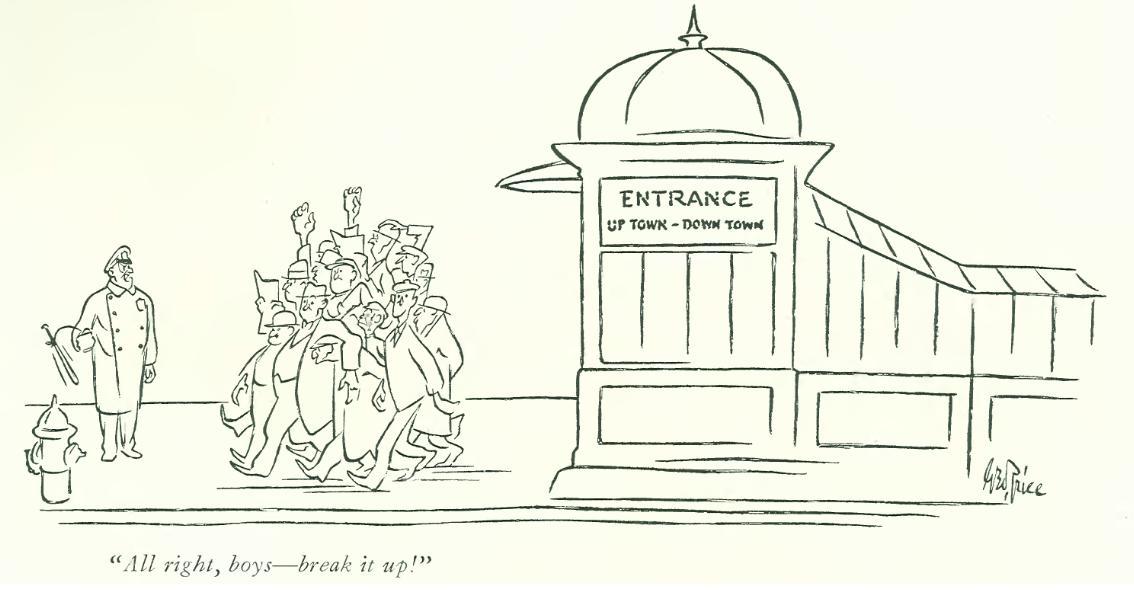
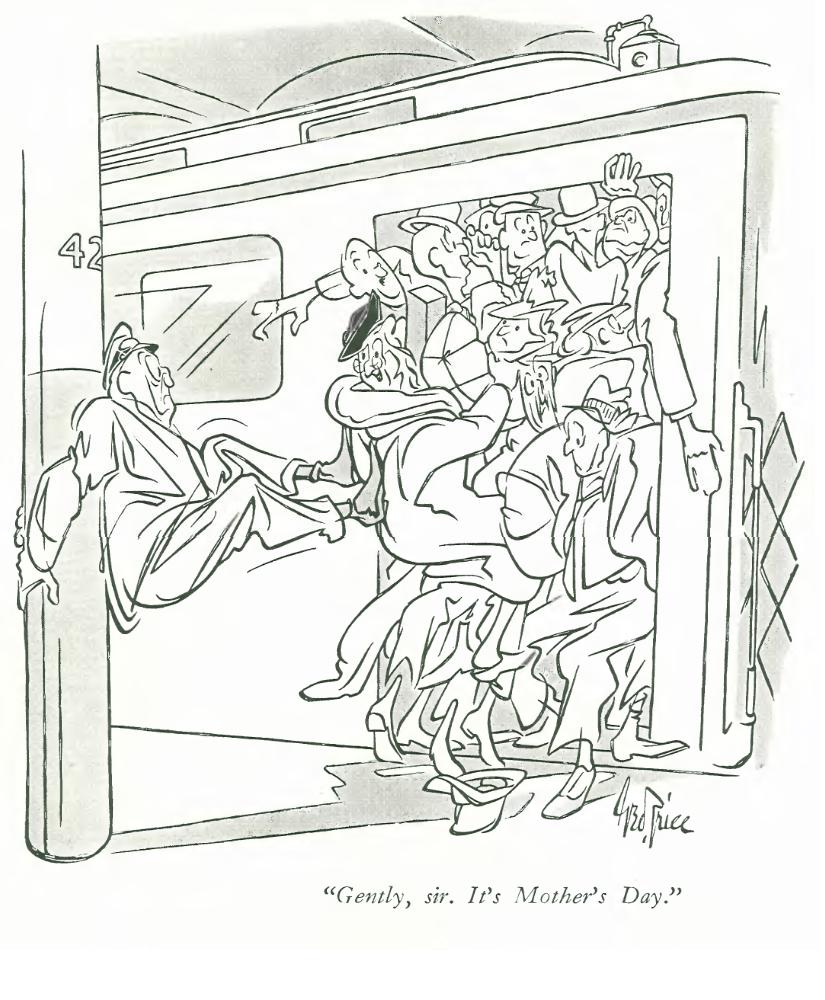
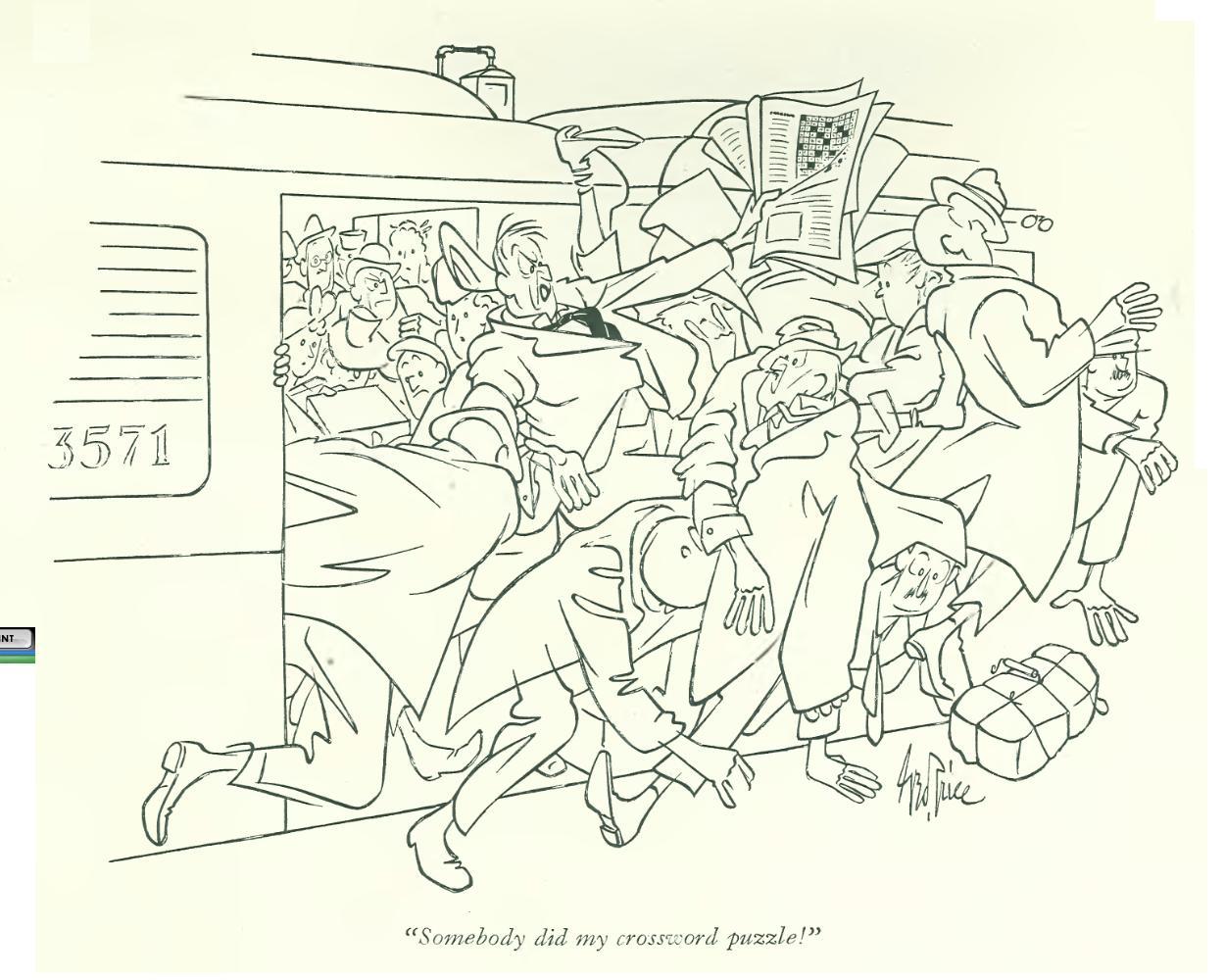
As a reminder, a few classic cartoons from Price’s “crammed subway” period:

break.JPG

“All right, boys — break it up!” (February 25, 1939)
gently.JPG

“Gently, sir. It’s Mother’s Day.” (May 11, 1940)
crossword.JPG

“Somebody did my crossword puzzle!” (December 11, 1943)

That first one is a favorite of Emily’s, the second a particular favorite of mine. (We’ve discussed all of this already, natch.)