Monthly Archives: July 2008

A Micro-History of Satire on New Yorker Covers

Today’s Daily Heller, the blog/e-blast by PRINT contributing editor and lead greyhound Steven Heller, addresses this week’s New Yorker cover (by Barry Blitt), which has been stirring up a little controversy. Why take things to such extremes? There’s a reason, as Steve writes:

This week’s New Yorker cover [pictured] by Barry Blitt is just that: A satirical commentary on all the slanderous rumors being dumped on Sen. Barack Obama.

Titled “The Politics of Fear,” the cover trenchantly attacks “the use of scare tactics and misinformation in the Presidential election to derail Barack Obama’s campaign,” according to a press release about the current issue.

But the Obama campaign (as well as that of Republican rival John McCain) slammed the cover as offensive[…]

In satire, however, context is everything–a delicate balance, to be sure. It must be pitch perfect, but not everyone need agree on whether it succeeds. Nonetheless, as a cover of The New Yorker, a magazine known for many covers, cartoons, and articles that “expose and discredit vice or folly,” it’s difficult to see this as anything other than what it is. And like the covers below, satire is designed to make readers question social, political, and cultural assumptions.

See the rest of Steve’s post for a handful of good examples from New Yorkers past. It was ever thus, or, as Carly Simon once sang, it’s coming around again. Election season is bound to produce a few more covers that jangle the carefully calibrated image making of both parties. Some may even twit the voters. We’ll live.

As for this the danger that a satirical image will instantaneously vaporize all life as we know it, not to mention the chances of our guy taking the White House, I’ll quote David Remnick out of context (he was talking with Folio, back in May, about the Democratic race): “The edifying parts of it I’m enjoying. The nonsense, the bullshit, the got-you things that mean nothing, are exhausting and meaningless, obviously.” Breathe: November’s still a few months away, and it’s going to be a bumpy ride.

What to Do in NYC This Weekend? See Kabluey!

It’s easy to narrow down the movie options in New York this weekend: Kabluey. It’s at Cinema Village. Buy tickets here. See a hilariously melancholy, cautiously life-affirming movie about the unexpected magic a round-blue-headed corporate mascot creates for a scattered military household in chaos, a Thermos-loving man, a big-eyed beauty in a supermarket, a lady-killing boss, and indeed, an entire town–and help a talented first-time feature-filmmaker at the same time. How can you lose? You can’t! Every Emdashes reader who goes to see it this weekend will get a treat. Email me on Monday. It’s a good one.

Friday Feast of Blog Roundups: Our Interns Review the Week at Newyorker.com

This summer’s talented Emdashes interns will be performing many welcome tasks for our contra-profitable yet strangely satisfying project. One of these tasks, I think it’s fair to say, out-metas even our generally mega-meta mode: Each week, Sarah, Taylor, and Adam will explore all the active blogs at The New Yorker‘s website, and post a report each Friday on what they’ve discovered. They each have a variety of beats, which you will see below. They had only a day or two to file their first reports here, by the way, rather than the full week they’ll have hereafter. Let’s see what they have to say!
Sarah Arkebauer writes:
**The Book Bench** this week contained some interesting tidbits. I found Rollo Romig’s mention of Ben Lewis’s new book about the history of Communism fascinating, but what really drew me in was Andrea Walker’s analysis of the cover of Christopher M. Kelty’s new book, Two Bits. The picture of the cover itself piqued my curiosity, while the surrounding text both fed and rebuffed my love of judging books by their covers.
Cartoonist of the Month did not update this week; nor did Malcolm Gladwell.
On his blog, **The Rest is Noise**, Alex Ross brought to light a disturbing trend–the firing of classical music critics and arts writers generally–in his Wednesday post.
Taylor House writes:
Mick Stevens’s I Really Should Be Drawing is my current favorite blog, though unfortunately Stevens has just gone on hiatus to Martha’s Vineyard for an indeterminate period. We might not be seeing much of Stevens this summer, but his archives are full of odd anecdotes describing the cartoonist’s condition and whatever doodles don’t make it into the magazine. In “The Formula,” he lets us in on the secret concoction that transmogrified him into a cartoonist–and his assistants into a neighing Italian pony and a self-conscious fridge, respectively. I
guess even doodlers need to summer.
Dana Goodyear, who writes Postcard From Los Angeles, is just returned from her summer vacation, and breaks her blog fast with a gripping clip from a recent Times piece on the semantic history of South Central (or Eastside, or La Newton). I can’t get enough of this L.A. history stuff–looking forward to much more from Goodyear.
Steve Brodner’s comics are about as menacing as the neocon characters he laments in his Person of the Day posts–and just as unsettling. He does throw in the occasional uplifting tidbit, like this recorded and illustrated interview with John Lennon, but the standard seems to be highlighting vestiges of Nixon in the current administration and strategizing how best to stomp it out next November. The question I’m pondering: is Brodner a political cartoonist? And if yes, how does he differ from the traditionalists? Discuss.
Hilton Als (Et Als) hasn’t posted since February; maybe he’ll make a comeback before the summer’s done.
Adam Shoemaker writes:
At Interesting Times, George Packer meditates this week on Christopher Hitchens, the exhibitionist essayist. When Hitchens took on Vanity Fair‘s dare to subject himself to waterboarding, it was to understand the debate that much better. But for Packer, it was also an opportunity to witness “the limit to Hitchens,” to see why he will never be the next Orwell (Packer admits to sharing Hitchens’s hero worship here). Hitchens’ prolific and contrarian writings (a few here) do tend to make him into a spectacle with, as this writer puts it, a “strong presence of the ‘I'”, and it is useful to read a deconstruction of this character, whom Packer deems compulsively readable if not always worth the serious consideration he demands.
On his blog (subtitled “Notes on politics, mostly”), Hendrik Hertzberg contemplates the value of a journalist’s access when he (in this case, Zev Chavets) fails to exploit its potential (not much) and the crime of hiding behind the Constitution to avoid the very freedom it guarantees. Hertzberg is grateful neither to Chavets nor the New York Times for the Magazine’s portrait of Rush Limbaugh, which he finds long on “the vulgarity and ostentation of [Limbaugh’s] domestic arrangements” and short on substance.
Hertzberg likewise spares no ire in his indictment of Rhode Island Governor Donald L. Carcieri. He dissects the governor’s excuses for vetoing his state’s National Popular Vote bill, and in so doing demonstrates the danger in allowing our statesmen to hide behind their own idea of the Constitution without reading the document on its own terms. “Not all Republicans are averse to popular election,” Hertzberg grants, but there are enough like Carcieri to make him worry about the possibility of reforming the Electoral College, even at the state level.
“Untitled” is the name of Nas’s new album, but **Sasha Frere-Jones** spends three paragraphs considering the title Nas conspicuously removed in May: Nigger. Frere-Jones also wonders about the motivations behind making an elaborate video for “Be a Nigger, Too,” when it too was removed from the album. A slightly different YouTube link gives us “The Walrus Speaks,” an elaborately visualized interview with John Lennon, complete with a satisfying conspiracy based on Canadian squares. I too have known a few.
On Tuesday Frere-Jones chose, reluctantly, a song of the summer. This hesitation, he reports, was due both to the greatness of the tradition and to the sad state of this year’s offerings. In the end he picked Ryan Leslie’s “Diamond Girl,” despite judging him “the last dude I would want at my barbecue.” I’m not sure I’d want this boombox there either.
Meanwhile, for **The Borowitz Report**, Andy Borowitz leads with a story about liberals’ discomfort with Barack Obama’s now seemingly-determined attempts to claim the White House. “Any Democrat who voted for Dukakis, Mondale, or Kerry should regard this as a betrayal,” says Tracy Klugian of “LoseOn.org.” While we can rest confortable that when it comes to November, Howard Dean is not actually trying to “talk him out of it,” Borowitz’s final prediction seems destined to come true even if Obama turns the tide and decides “to lose the thing”: either way, the Democratic candidate “should brace himself for some really mean blog posts.”

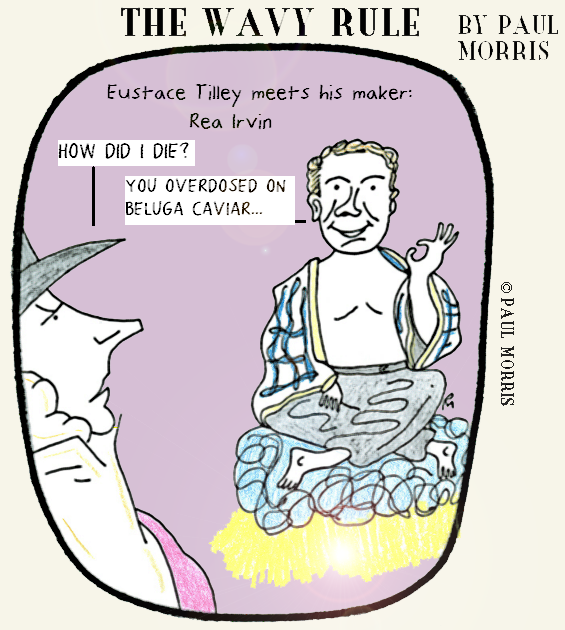
The Wavy Rule, a Daily Comic by Paul Morris: Tilley Meets His Maker

As you might expect, since I just spent a number of months collecting material for a piece about Rea Irvin for PRINT, I am in love with all things Irvin. Paul–whom I thank in the piece because he’s shared numerous invaluable resources and insights with me about Irvin’s aesthetic–is as keen on the early years’ co-genius as I am. About this cartoon, he writes: “Inspired by the photograph of Irvin in Lee Lorenz’s wonderful The Art of The New Yorker. A must read.” I agree. Sweet Knopf: Please bring it back into print! Click to enlarge.
wavyrule_tilleyirvin.png
More Paul Morris: “The Wavy Rule” archive; his very funny webcomic, “Arnjuice,” a motley Flickr page, and beautifully off-kilter (and freely downloadable) cartoon collections at Lulu.

The Wavy Rule, a Daily Comic by Pollux: Feel the Beat of the Tambourine

Pollux writes of his Mamma Mia! and Iron Man fantasia, “I know this is a gross generalization, but in terms of media frenzy, it’s all about the Streep and the Stark.”
Here’s David Denby’s review of
Iron Man; Mamma Mia! isn’t out till July 18, but you can be sure Anthony Lane will eviscerate it. John Lahr wrote of the stage version of Mamma Mia!, “In dark times, art can raise the pulse and lift the heart of a community. Unfortunately, ‘Mamma Mia!’ is nothing but hokum.” Danny Shanahan did a cartoon about the show (which I would link to, but I can’t track it down on the Cartoon Bank; it’s from 2001, too), and in 1939, there was a one-line Talk of the Town item (under “Incidental Intelligence”) that read simply: “The Mamma Mia Importing Company has headquarters in Brooklyn, where it imports something or other.”
Click to enlarge!

2008infilmc.png
Check out the “Wavy Rule” archive! More drawings by Pollux: his very funny webcomic “Arnjuice,” his motley Flickr page, and satisfying cartoon collections to download at Lulu.

I Wish I Could Limn-y Like My Sister Kate

On The New Republic‘s site, there’s a good video co-starring my brainy sister Kate, a progressive energy policy analyst, who’s lately been working with Newark mayor Cory Booker (about whom Peter J. Boyer wrote an excellent Profile early this year) on labor and environmental projects:

As part of TNR TV’s series about the new environmental movement, TNR reporter Dayo Olopade sits down with environmental activist Kate Gordon and policy specialist Bracken Hendricks to discuss whether “green jobs” can actually help solve the current economic crisis.

Just in case you haven’t read Elizabeth Kolbert’s piece on the Danish carbon-footprint-reducers, by the way, it’s really something special. (Warning: It will make you feel weird about flying.) The New Yorker has been doing a swell job upholding its reputation as a leading voice on the environmental crisis, I think. Its coverage of China has also been increasing dramatically, if I’m not mistaken–I can think of half a dozen recent pieces that are gradually mapping China’s environmental, social, educational, athletic, architectural, financial, and musical life in intensely entertaining detail.

Mary Lavin: Surf’s Up–Way Up!

You should read Mary Lavin’s short story “The Great Wave” as soon as you possibly can. The story appeared in the June 13, 1959 issue of The New Yorker, so if you have to buy your own copy of The Complete New Yorker to read it, and this story is the only thing you ever read in the CNY, it’ll be worth it.
I hadn’t heard of “Mary Lavin”:http://en.wikipedia.org/wiki/Mary_Lavin before, but given her eminence, it appears I should have. If you scan Martin’s “partial list”:http://emdashes.com/2007/10/the-best-american-short-storie.php of fiction from TNY that has also appeared in the Best American Short Stories anthology series, you’ll find that Lavin’s name fairly jumps out at you. Between 1959 and 1976, she published 15 stories in TNY, of which six, or 40%, were selected for BASS.
That’s a huge percentage. A toes-and-fingers count shows that even the mighty “Alice Munro”:http://www.newyorker.com/search/query?query=alice+munro&queryType=nonparsed&submitbtn.x=0&submitbtn.y=0&submitbtn=Submit, who knows Mary Lavin’s work and “was influenced”:http://www.theatlantic.com/doc/200112u/int2001-12-14 by it, has not achieved Lavin’s ratio of TNY to BASS publication. Between 1977, when Munro first published a story in TNY, and 2004, where Martin’s list stops, she published 47 stories in TNY, but only 16, or 34%, were selected for BASS. (Not that she needs to worry about her own eminence. As “Mark Asch wrote”:http://thelmagazine.com/lmag_blog/blog/post__06260809.cfm in “The L Magazine”:http://thelmagazine.com recently, “Alice Munro is the windshield and pretty much every other living writer is the bug.”)
But back to “The Great Wave.” I’ve now read four of the 15 stories Lavin published in TNY, and it’s unquestionably the best so far, even though it didn’t make it into BASS. Since I know not everyone can access the CNY, I’ll sketch it here. (Consider this your spoiler warning–though it’s the sort of story whose power is not lessened when you know the plot.)
Our story begins with a Bishop. He’s being rowed from the Irish mainland to an unnamed island, where he is to perform the confirmation ceremony, as he does every four years. We learn a few things: he’s fussy about his rich vestments, his colleague is jealous of the money that went into them, and the Bishop grew up on the island he’s visiting.
Now, up to this point, it’s natural to think “The Great Wave” will be a quiet story—perhaps the Bishop will meet the girl he loved before he went away to seminary? Whatever the case, one expects it will uneventful, most likely petering out in a bleak, ironic conclusion.
Nunh-uh. Lavin wrote stories like that, it’s true, but this isn’t one of them.
For “Wave” quickly shifts to the Bishop’s childhood. Though all the other men and boys go out to fish, little Jimeen (i.e., the Bish, in knee pants) is kept from the sea by his widowed mother, who has already lost her husband to the ocean and doesn’t want to lose her son as well. As her son grows, the other villagers resent her protectiveness, because they could use an extra pair of hands when the catch comes in. Yet she is right, for they all fish in small, hidebound boats known as “currachs”: men are scarce, because they often drown.
Then Seoineen Keely, a former wild boy turned seminary student, returns to the island for a visit. The very next morning, the seed herring come in, and all the men in the village go out in their boats for the harvest. Seoineen impetuously goes out as well, with Jimeen as his helper. At first, there’s some question of whether Jimeen’s mother will allow him to go, but because Seoineen is practically a priest and correctly prophesied that the catch would come in that morning, sentiment runs in his favor:

“If you’re ever going to let him go out at all, this is your one chance, surely?” they said. “Isn’t it like it was into the hands of God Himself you were putting him, woman?”

Jimeen’s mother relents, and the two push out to sea. At first, Seoineen exults, happy to be back doing the hard, physical labor he grew up with, so different from life at the seminary. The fish are improbably plentiful, too, crushed together like “pebbles on the shore,” and all of the villagers haul in full nets as fast as they can.
Before long, however, a storm rolls in.

As Jimeen rose up to his full height to throw the net out wide, there was a sudden terrible sound in the sky over him, and the next minute a bolt of thunder went volleying overhead, and in the same instant, it seemed, the sky was knifed from end to end with a lightning flash.

Were they blinded by the flash? Or had it suddenly gone as black as night over the whole sea?

After this, they are disoriented, thrown close in one moment to another craft, manned by a fellow villager named Martin, then thrown so far apart their shouts cannot be heard. Although all the boats are threatened by the sudden storm—indeed, they must cut their nets and abandon the harvest to avoid being capsized—Seoineen rages with exhilaration and greed. He wants to be the only one to return to shore with fish, and though he eventually cuts his own net, he refuses to let go of it, even though his fingers are trapped in it and viciously cut by the weight of the fish it carries.
And then comes the wave.

All [Jimeen] saw was a great wall, a great green wall of water. No currachs anywhere. It was as if the whole sea had been stood up on its edge, like a plate on a dresser. Down that wall of water there slid a multitude of dead fish.

Then down the same terrible wall, sliding like a dead fish, came an oar—a solitary oar. And a moment afterward, inside the glass wall, imprisoned as if under a glass dome, he saw—oh God!—a face looking out at him, staring at him through a foot of clear green water. It was the face of Martin. For a minute, the eyes of the dead man stared into his eyes. With a scream, Jimeen threw himself against Seoineen and clung to him tight as iron.

The wave deposits them on the island—not on the shore, where the village lies, but on top of the island’s promontory, which rises “four times the height of the steeple.” When Jimeen comes to, he is under the boat, the fish are littered about, and Seonieen is looking down at the sea. The boy remembers poor, dead Martin and wonders who else has made it back to shore safely.

[Jimeen] craned over the edge of the promontory to see what currachs were back in their places, turned upside down and leaning a little to one side, under the wall that divided the sand from the dune, so you could crawl under them if you were caught in a sudden shower.

There were no currachs under the wall; none at all.

There were no currachs on the sea.

Nor is that the worst of it. Jimeen asks Seoineen why they don’t hear the village women keening over their losses.

“God help them,” said Seoineen. “At least they were spared that.” And he nodded to where, stuck in the latticed shutters on the side of the steeple, there were bits of seaweed and—yes—a bit of the brown mesh of a net.

Everyone has been drowned. Everyone.
The boys take it differently. Seoineen, his hands damaged, is set in bitterness and turned away from the priesthood.

“It was my greed that was the cause of it,” he said, and there was such a sorrow in his face that Jimeen, only then, began to cry. “It has cost me my two living hands,” said Seoineen, and the anguish of his eyes was in his voice as well.

“But it saved your life, Seoineen!” he cried, wanting to comfort him.

Never did he forget the face Seoineen turned to him. “For what?” he asked.

Jimeen has no answer for him, though he has one for himself:

It was a grief too great to grasp, and still, still, even in the face of it, Jimeen’s mind was enslaved to the thought of their miraculous salvation.

The boy—plucked out of the ocean, a maelstrom, a whole way of life— finds what Seoineen has lost. Lavin wastes no time laboriously showing Jimeen’s path to the bishopric because it’s self-evident, for all its unexpectedness. The Bishop himself marvels about the path he’s taken:

“Who knows anything at all about how we’re shaped, or where we’re led, or how, in the end, we are ever brought to our rightful haven?”

Indeed. Lavin has stripped her tale down expertly, condensing a meditation on life’s cruel mystery into a taut package with only a few characters. Indeed, when read (for example) side-by-side with the loose, flabby stories in the TNY’s 2008 summer fiction issue, its brevity and power seem all the more impressive.

“The Great Wave” is stunning. Catch it soon!

Raymond Davidson, a Remembrance

Paul Kocak writes:
His New Yorker covers of the 1970s are quintessential reflections of urban complexity distilled to a serene and sober simplicity. A Zen focus of particularity, here and now. His spot drawings for The New Yorker, signed “R. Davidson,” celebrated Manhattan archways, doorways, a flowerpot on a windowsill, a wrought-iron fence. Raymond Davidson died just after midnight on July 7 at Tara Home, a hospice at Land of Medicine Buddha in Soquel, California. He was creative almost until his very last days, self-publishing poetry and reflections sprinkled with his pen-and-ink line drawings.
We met in the 1980s; he worked at Doubleday, I at Random House. Creativity was, in his view, a spiritual wellspring. He urged me to write haiku poetry as a spiritual exercise. I did.
In those years, fans of the New York Mets often saw a man with a long gray beard and glasses, wearing a seersucker jacket and bow tie, sitting in owner Nelson Doubleday’s box, right next to the Mets’ dugout. He was painting watercolors of the Mets players. These were exquisite depictions of light and shadow and color; balletic celebrations of form and grace and movement. They are gems.
They are New York.
They are Raymond Davidson, Brooklyn-born of Norwegian immigrants more than eighty years ago.
When the woman at the hospice told me of Raymond’s peaceful death, she said he looked like someone in an El Greco painting. Yes, majestic and heavenly.
She said he was “easy to love,” a fitting signature to his life and work. Raymond Davidson easily loved the ordinary right before our eyes.
I easily loved him like a father and a brother.
Paul Kocak
Syracuse, New York

The Wavy Rule, a Daily Comic by Paul Morris: Heaven, I’m in Heaven

I think Paul has outdone himself with this one. He writes: “Yes, that’s God. A collection of blue squiggly lines representing both the eternal aether and my own propensity to use Crayola markers to depict celestial beings.” I love it, and the portrait of Ross is, well, heavenly. Click to enlarge!
wavyrule_heavenlyross.png
Check out the “Wavy Rule” archive! More drawings by Paul Morris: his very funny webcomic “Arnjuice,” his motley Flickr page, and satisfying cartoon collections to download at Lulu.