Monthly Archives: August 2008

51 Years of Ruth Prawer Jhabvala

I admit it: I always thought “Ruth Prawer Jhabvala”:http://en.wikipedia.org/wiki/Ruth_Prawer_Jhabvala was born in India (she wasn’t; she was born in Germany to Jewish parents). Nor did I realize she was the primary scriptwriter for Merchant Ivory Productions. And while we’re at it, I may as well ‘fess up and say that I never read anything she wrote before “The Teacher” appeared in the July 28, 2008 issue of The New Yorker.
To atone (at least a little), after reading “The Teacher,” I went back and read “The Interview,” Jhabvala’s first-ever story in TNY, which appeared almost exactly 51 years ago, in the July 27, 1957 issue. (Telling for the time, though, she signed it, “R. Prawer Jhabvala.”) And what interesting bookends these two stories make!
The narrator of “The Interview” is chronically unemployed and looking to stay that way. He is the sweet, good-looking, younger brother of his family, which is based in Bombay, I think. His older brother supports the family with a government job; his brother’s beautiful wife now runs the household; his mother is in her dotage; and his own wife, whose stupidity and ugliness he laments, wishes he’d get a job so that the two of them and their child will be able to move out on their own.
But the narrator has no desire to leave the rest of the family. Nor does he want to get a job: he’s had at least one before, which did not end well; he’s terribly afraid he will make mistakes and be yelled at. Far better, he reasons, to sit and think and let his family coddle him, because he is, he insists to the reader, a sensitive man.
The story’s poignance and the narrator’s weakness of character are perfectly encapsulated as the story comes to a close. The narrator, despite his position as a favorite in the family, is profoundly dissatisfied—and so, he notes, is everyone around him. First he describes his wife’s unhappiness, and then he goes on to describe that of the others:
bq. … my brother, who has a job, but is frightened that he will lose it—and my mother, who is so old that she can only sit on the floor and stroke her pieces of cloth—and my sister-in-law, who is warm and strong and does not care for her husband. Yet life could be so different. When I go to the cinema and hear the beautiful songs they sing, I know how different it could be, and also sometimes when I sit alone and think my thoughts, I have a feeling that everything could be truly beautiful.
Reading that, it’s hard not to feel that the narrator’s anguished passivity is central to the unhappiness of the other members of his family … and he knows it.
Fifty-one years later, in “The Teacher,” Jhabvala writes about Dr. Chacko, who, though hardly anguished, could be an older, stronger, happier version of the narrator of “The Interview”. Like him, Chacko is charismatic—people dote on him, and give him lodging, food, and employment, so that he never lacks—and he, too, is passive. He simply accepts what people give him until they stop giving.
When we meet him, he is teaching an informal workshop in New York on a regular basis. In the course of the story, a disillusioned adherent breaks with him publicly, and the workshops come to an end. Later, the narrator asks him about it.

He said, “People move on. I move on, too.” As he did so often, he answered my question before I had asked it. “There’s always somewhere. One gets used to it.”
I said, “But wouldn’t you rather stay?”
“If there are people who wish me to stay.”
Evidently, he didn’t intend to continue this conversation, and I also realized that there was no need. It was cool outside now, in the night air. Glowworms glittered below, stars above. Instead of talking, he began to hum one of his songs. Was this his teaching? To say nothing? To want and need nothing?

So we see that Chacko’s passivity is different from that of the narrator of “The Interview,” because it has a spiritual dimension—or that’s how others perceive it, at any rate. It’s this perception that makes people want to give him food, lodging, and adulation. The irony is that it’s never clear what he teaches and writes about, though it has to do with “life and death” (which is obviously supposed to be Significant). In fact, it’s not even clear whether Chacko himself understands what he’s trying to teach.
But Chacko’s passivity is not the only point of similarity between “The Interview” and “The Teacher.” Both stories are characterized by pellucid sentences that I imagine are Jhabvala’s trademark; both are written in the first person; and the narrators (both unnamed) each persist in emotional stasis, victimized, sort of, by divorce and marriage respectively.
When we meet her, the female narrator of “The Teacher” has been divorced for 10 years and now lives in a large house outside of New York City. A pair of do-gooder acquaintances convince her to host Dr. Chacko in a cottage located on the grounds surrounding her home for what turns out to be a couple of years. She develops a mild, slow-growing, attraction to him that borders on the non-existent before finally, too late, it fluoresces into visibility. Just then, he betrays her in a minor way that might or might not be educational, but the do-gooders bring lots of orphans and “fugitives from bad homes” to fill the cottage rather improbably with the joys of childhood, and her life continues on, happily enough, though tinged with rue.
Oddly enough (though anyone reading TNY fiction on a regular basis this year, as I have, could have predicted it), she is detached and passive, like Chacko and “The Interview’s” narrator. When the do-gooders suggest she allow a stranger (Chacko) to move into the cottage, she goes along. When they ask her to give her the names of well-off acquaintances from which to request money, she complies. When they ask her to pay for the publication of Chacko’s turgid, and otherwise unpublishable tome, she writes a check.
She’s made powerless by … what? Her loneliness? It’s not entirely clear. But if so, then in her unhappiness, she is much more reminiscent of “The Interview’s” narrator than Chacko is. While she’s not the source of anyone’s unhappiness (if you don’t count one of the do-gooders, who’s a bit unbalanced anyway), she’s just as trapped by her passivity.
So: we have two stories set on two different continents and published 51 years apart that revolve around the same character, the same predicament. What surprising consistency!
I’d have to read more of Jhabvala’s work to see whether these bookends give a distorted view of her work. Probably they do; I hope they do. Still, I can’t help but wonder: should I be impressed by the high quality of Jhabvala’s work in 1957, or weep for her apparent lack of progression?
Perhaps an Emdashes reader knows …


The Wavy Rule, a Daily Comic by Paul Morris: Home of Phones

Today we commence a promising new series in which the artist undertakes to pitcher—er, picture—clever homophones. Click to enlarge!
homophones1.png
More by Paul Morris: Enter our exciting contest to name the upside-down question-mark! Entries accepted until August 25. Plus, “The Wavy Rule” archive; “Arnjuice,” a wistful, funny webcomic; a smorgasbord of multimedia at Flickr; and beautifully off-kilter cartoon collections for sale and free download at Lulu.

The Wavy Rule, a Daily Comic by Paul Morris: Fighting Varietals

What’s all this about a global war on terroir? Righteous epaulets, dude! As always, click to enlarge!
wavyrule_war on terrorismwine_new version.png
More by Paul Morris: Enter our exciting contest to name the upside-down question-mark! Entries accepted until August 25. Plus, “The Wavy Rule” archive; “Arnjuice,” a wistful, funny webcomic; a smorgasbord of multimedia at Flickr; and beautifully off-kilter cartoon collections for sale and free download at Lulu.

The Wavy Rule, a Daily Comic by Paul Morris: Amusing Line Drawing

Who says you can’t be pretentious with simplicity, or simple with pretension? Not me—click to enlarge!
wavyrule_winelabels4.png
More by Paul Morris: Enter our exciting contest to name the upside-down question-mark! Entries accepted until August 25. Plus, “The Wavy Rule” archive; “Arnjuice,” a wistful, funny webcomic; a smorgasbord of multimedia at Flickr; and beautifully off-kilter cartoon collections for sale and free download at Lulu.

Truthiness in Advertising

Benjamin Chambers writes:
Might just be me, but I don’t hear people grumble as much as I used to about “truth in advertising.” Maybe it’s because nobody expects it anymore. As with campaign finance reform, we all wish it could happen, but are afraid to admit we could be so childishly naive.
Well, be careful what you wish for there, in the secret spaces of the heart. Here’s a couple of examples from the October 1, 1966 issue of The New Yorker of why honesty might not always be the best policy. First, a mild, “Yeah-we-screw-up,” from Avis (click for full-size):
Avis.jpg
Then, the major-league, all-our-warts example, from Renault (click to see all the fun):
Renault.jpg
Had it come in the mail, TNY would’ve classed this ad copy under “Sales Pitches We Never Finished Reading.” Check it out, though: 35 mpg. Where can I get one?

The Wavy Rule, a Daily Comic by Paul Morris: Jazz on a Summer’s Day

Paul writes of today’s syncopated (and very modern) “Wavy Rule”: “Central Park Summerstage, Blue Note, Dizzy’s Club Coca-Cola, Iridium–all jazz venues that are reviewed in the latest issue of The New Yorker.” Click to enlarge!
wavyrule_glutenfreejazz.png
More by Paul Morris: Enter our exciting contest to name the upside-down question-mark! Entries accepted until August 25. Plus, “The Wavy Rule” archive; “Arnjuice,” a wistful, funny webcomic; a smorgasbord of multimedia at Flickr; and beautifully off-kilter cartoon collections for sale and free download at Lulu.

Klemperer, Barthelme, Borowitz, and Other Dactyls: It’s Intern Friday!

Each Friday, the Emdashes summer interns bring us the news from the ultimate Rossosphere: the blogs and podcasts at newyorker.com. (A dactyl is a metrical foot used in poetry. “Poetry” and “marmalade” are dactyls.) Here’s this week’s report.
Adam Shoemaker
George Packer writes in this week’s edition of Interesting Times about the diaries of Victor Klemperer, a Jewish scholar whose love of Germany, even amid the degradations of the 1930s, kept him from leaving his home. Packer is interested in Klemperer’s attack on nationalism, which stemmed from a tenaciously stubborn belief in the rationality of the Enlightenment. The Nazi Olympics are much on the mind these days, and while Packer refuses the easy comparison of that regime and Communist China, he is unable to resist hearing “a faint echo” from 1936 and feeling the broad, dangerous reverberations of nationalism. [Albert Speer’s son did design the Beijing Olympic complex, after all. –Ed.] Packer also offers his thoughts on the dialogue pinging around the media this week concerning Barack Obama’s alleged aloofness and his candidacy’s meaning in the larger sphere of black politics.
Hendrik Hertzberg takes time this week in “Notes on Politics, Mostly” to uncover the hidden racial undertones of John McCain’s new television advertisements, which include an almost subliminally short shot of Barack Obama playing basketball and, less subtly, juxtaposes the Illinois senator with those hardly chaste white women, Ms. Hilton and Ms. Spears. A reader also spurs him to ponder the phallic imagery of the spots. The obelisk as virility symbol is old hat for this art history major; if McCain’s ad makers are going to pin their hopes on hidden visual cues, they could at least take a few pointers from the master.
I was thrilled this week to see Sasha Frere-Jones report on one of my favorite bands, Bon Iver, a.k.a. Justin Vernon, and a performance he “would be celebrating more loudly if Vernon hadn’t wiped [his] mind clean.” These clips may help explain why sharing is often the only proper form of music recommendation: “hyperbole will somehow ruin things.” Frere-Jones also reports on Rock The Bells, where he saw Mos Def, Method Man, Redman, Nas, Jay-Z, and Q-Tip. Pithiest line: “Mr. Def makes his rhymes clear, enjoys moving around, and seems to accept that his job involves being entertaining. His pants were extremely bright.”
In this week’s New Yorker Out Loud, David Grann talks about his look into the bizarre story of Frédéric Bourdin, the shockingly successful French con man whose grandest and possibly last imposture involved a missing child come back from the dead. Just trying to imagine a thirty-year-old Frenchman passing as a Texan high schooler—or wanting to—makes the mind reel. Bourdin is no flesh-and-blood phisher or 419 boy; he dupes in the name of love. Both the article and interview are highly recommended.
Finally, Andy Borowitz uses The Borowitz Report to make a public service announcement to the nation’s “many jerks and douchebags” who are at increased risk of brain tumors due to their incessant cell phone usage. The eminent Dr. Logsdon offers his condolences: “All in all, this has been a tough summer for assholes.”
Sarah Arkebauer
The Cartoon Lounge continues its dueling-sandwich-shops saga with second and third installments. Even as I laughed at how ludicrous the cartoonists’ sandwich shops would be, I found myself wanting to visit them! It seems like everywhere I turn, I am greeted with the symbol of the Olympic games, so I was amused by the cartoon published earlier this week of the Olympic rings as a Venn Diagram.
Meanwhile, in an equally humorous post, the Book Bench linked to an imagining of Hamlet in the form of Facebook’s Newsfeed bursts, and I also enjoyed the photograph post of what are presumably the recent galleys at the New Yorker office. I was pleased, too, to see another update in the “Bookspotting” series; reading the “Bookspotting” posts reminds me to check out what the people I see in public are reading. On a more somber note, the Book Bench reported on a tragic barn fire in Bucks County, Pennsylvania, that destroyed thousands of valuable books, an unfortunate development with the International PEN Poem Relay, and an extensive remembrance of Aleksandr Solzhenitsyn.
Goings On also posted on Solzhenitsyn; the post is replete with links to articles written about him in the New Yorker over the years. Each profile brings to light a different facet of Solzhenitsyn’s life and times, and both long-time admirers and those new to his work will find much to enjoy and enlighten here. In other news, I’ve mentioned before how much I enjoy outrageous slang, and so I was thrilled to see the August 1 post on “Soda-Luncheonette Slang and Jargon” from America Eats!, Pat Willard’s new book on American culinary history. I’m afraid much of the slang is a little out of date, but it’s still wonderful to read about, and I’ve already picked out a couple of gems for my patois.
For my Fiction Podcast update this week, I went back into the archives and listened to Donald Antrim read Donald Barthelme’s 1974 short story “I Bought a Little City.” The story’s opening is punchy and delightful, and the rest of it—and the discussion thereafter—doesn’t disappoint. Indeed, I laughed out loud more than once. The story is short but potent, with an appeal that ensures I will revisit it in the years to come.
Previous intern roundups: the August 1 report; the July 25 report; the July 18 report; the July 11 report.

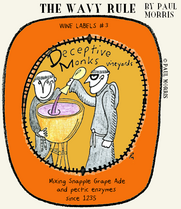
The Wavy Rule, a Daily Comic By Paul Morris: It’s Monk Time

If Edward Gorey were still with us, and drinking fine wine, this is the fine wine we think he’d be drinking. Today’s “Wavy Rule” returns us to the world of weird wineries, far, far from Napa Valley: First there was the pinot, then the pigeons, and now this. Click to enlarge!
wavyrule_winelabels3.png
More by Paul Morris: Enter our exciting contest to name the upside-down question-mark! Entries accepted until August 25. Plus, “The Wavy Rule” archive; “Arnjuice,” a wistful, funny webcomic; a smorgasbord of multimedia at Flickr; and beautifully off-kilter cartoon collections for sale and free download at Lulu.

Bad News, Good News, Good News, News That May Strike You Either Way

Bad news: Nikos (as I now believe it’s spelled), the magazine shop whose politically minded employees I reminisced about not long ago, is closing. I am sad about this in a way I can’t process just now.
Good news: smart young blogger folks who can’t wait to get magazines in the mail. Good news: this list in the Times of London of brilliant boarding school novels, including When JFK Was My Father, written by Amy Gordon, my warm and talented aunt.
News that may strike you either way: I’m going to Quebec till the 17th, so enjoy the posts by the Emdashes brain trust, including the extremely promising interns; Martin “The Squib Report” Schneider, who is particularly busy at the moment, so he may be a bit mum as well; the erudite Benjamin “The Katharine Wheel” Chambers; and, of course, Paul “The Wavy Rule” Morris, who will continue to delight you daily.
If you still find yourself without enough to think about over the next week, try your hand at Emdashes’ exclusive upside-down question-mark naming contest, which is getting very thrilling, and is open to further entries till August 25. ¿Clever? I know you are! When I get back, I’ll check out the new submissions, and by then, it’ll be the crucial last week of competition. This won’t be easy!

Radiant and Terrific: E.B. White Reading Charlotte’s Web

Great story on NPR by Melissa Block a few days back, paying tribute to E.B. White’s immortal Charlotte’s Web. Follow the links to listen to White himself reading an excerpt. Also, be sure to listen to the New Yorker Out Loud interview with Jill Lepore and Roger Angell about White’s Stuart Little. As our intern Adam Shoemaker wrote last month:

On the New Yorker Out Loud podcast, Matt Dellinger speaks with Jill Lepore about her piece on E.B. White’s decidedly unmousy classic Stuart Little. Roger Angell, E.B. White’s stepson, also joins in the conversation. Lepore talks about her fascination with the piece—and the lengths to which that drove her research. The real story, says the author, is not the battle between E.B. White and the celebrated librarian Ann Carroll Moore, but rather the sometimes noble, sometimes cosseted vision of children’s literature the Victorian Moore tried—ultimately, unsuccessfully—to impose on America’s young readers.

Related: Emily’s beef with the stereotypical voice casting for the live-action movie version of Charlotte’s Web.