
In this recessionary holiday season, a good many people are regrettably obliged to give fewer (or less overtly dazzling) gifts. We at Emdashes would like to help you express your inherent generosity (it is a fact that all Emdashes readers are generous and good-looking), if in virtual mode. And you might even get something in return: The person who submits the cleverest entry will receive a copy of Joshua Henkin’s novel Matrimony.
I have not yet read it, but it’s on my wish list (of the mind, not on Amazon). Attentive Emdashes readers (all Emdashes readers also possessing superior powers of recollection) will recall that I have been mightily impressed by Henkin’s blogging style at The Elegant Variation, and I feel confident that he writes good novels as well.
All you have to do is dream up a holiday present for a well-known New Yorker-related personality from the past or present. You can give Harold Ross a comb, Shirley Jackson a rock-proof vest, or George Saunders his own branch of Madame Tussaud’s populated only by statues of waxy Russian novelists (who animatronically recite their works at length). The possibilities are limitless! Each entry should consist of a person, a gift, and a brief (emphasis on the word brief) explanation; if you think the gift alone is amusing enough, you are permitted to dispense with the explanation. Feel free to submit gifts to multiple people; the more the merrier!
Longtime readers—i.e., all Emdashes readers—will recall a Valentine’s post from 2007 along the same lines; feel free to use as inspiration.
The deadline is January 9 (that’s a Friday). Send your submissions to martin@emdashes.com.
Good luck to all entrants!
Monthly Archives: December 2008
The Chicagoan: “No Obeisance to Park Avenue, Mayfair, or the Champs Elysees”
Jonathan Taylor writes:
I only just happened on this New York Times Book Review piece from a couple weeks ago, about The Chicagoan, a short-lived magazine launched in 1926 in ardent imitation of The New Yorker. (The article is by Matt Weiland, late of that Chicago institution The Baffler–or still of it? What is up with The Baffler, anyway?)
The University of Chicago Press is putting out a hefty coffee table book about the magazine, which was seemingly forgotten until some issues were unearthed by historian Neil Harris at the university’s Regenstein Library. Harris notes that The Chicagoan was “an effort to counter the city’s negative reputation” as “a place of raw commerce and crime–brawny, philistine, vulgar, and violent.”
A gallery of Deco-mad covers and other images, PDFs from the book, including a lot more interior pages of the mag, and an interview with Harris, are at the publisher’s site. It’s all just too much to digest here. The attractions are clear: Be off, and be back to discuss!
This Is Not Your Father’s Cartoon–Well, Actually, It Is
Benjamin Chambers writes:
I was astonished by the raw politics on display in this Donald Reilly cartoon when I ran across it in the December 30, 1967 issue of The New Yorker last night:
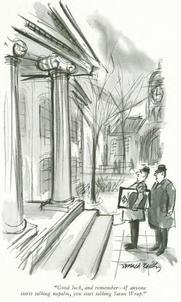
It refers to the October 1967 riots at the University of Wisconsin, when students who objected to the presence of recruiters from Dow Chemicals on campus because of the company’s role in making napalm were involved in a bloody melee with police. Apparently, David Maraniss wrote a very good book about the event, titled They Marched into Sunlight.
At first, I was surprised because I couldn’t remember another cartoon in the magazine that so explicitly named/attacked a single company. (Can Emdashes readers suggest any?) But I’m no longer certain the cartoon is as much of an indictment of Dow as I first thought.
The cartoon seems to speak from a position of comfortable distance, where the absurdity of doing spin for a company that manufactures a horrific weapon of war at the same time that it makes Saran Wrap is as much a part of the cartoon’s humor as the certainty that the Dow recruiter will be greeted with student antagonism of an entirely different order of magnitude.
In other words, what counts in the joke is the mismatch between the two men’s expectations and what the recruiter is about to encounter. One could imagine a parallel cartoon in which two Christians, about to face lions in a Roman arena, marshal their rhetoric.
What do you think?
The Wavy Rule, a Daily Comic by Pollux: Chestnuts Roasting on a Carbon Capture Unit
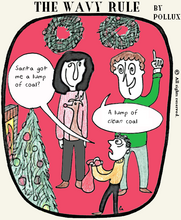
Click on the cartoon to enlarge it!
Read “The Wavy Rule” archive.
The Wavy Rule, a Daily Comic by Pollux: Sir, I Do Bite My Thumb at Thee
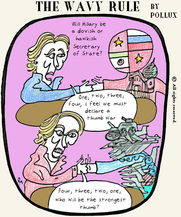
Click on the cartoon to enlarge it!
Read “The Wavy Rule” archive.
The Sound of One Graf Clapping: William Steig and “Disquiet, Please!”

Emily writes (see note below):
I have and am reading Disquiet, Please!: More Humor from The New Yorker, and I expect to post about it again. For now, won’t you join me in admiring this William Steig drawing on the cover? I think it’s glorious and deranged. Actually, it reminds me of a current New Yorker artist’s less well-known work: cartoonist Eric Lewis‘s found-sculpture Garbage Flowers. If I were you, I’d gather some of the inexpensive flowers before they’re all sold (several already seem to be), add the humor anthology, and there’s the formula for your whole Christmas list.
This has been an uncompensated endorsement of unqualified enthusiasm from phantom publisher and fond founder Emily Gordon, whose evanescent presence you will see around here from time to time. In case you’re stopping by for the first time in a while, current editor Martin Schneider is the author of all unsigned posts, so he should get the compliments!
Standups Discuss the 10,000-Hour Rule, in 2006
If you’ve been reading Emdashes the last few weeks, then you’re probably “aware”:http://emdashes.com/2008/11/gladwell-weathers-gauntlet-of.php that the “centerpiece”:http://www.gladwell.com/outliers/outliers_excerpt1.html of Malcolm Gladwell’s new book is the “10,000-Hour Rule,” which is Gladwell’s way of highlighting the importance of dedicated practice, or more properly the capacity for dedicated practice, in permitting a person to become one of the dominant figures in a chosen field. Gladwell has stated that ten thousand hours is about the equivalent of ten years of dedicated practice.
My favorite standup comedian is “Patton Oswalt,”:http://www.pattonoswalt.com/ and I’ve had this “mp3 file”:http://www.podcastdirectory.com/podshows/697440 kicking around my hard drive for a couple years now. It’s a “Hammer conversation” between Oswalt and Jeff Garlin, who plays Larry David’s manager on _Curb Your Enthusiasm._ It was held in Los Angeles at the Redcat Theater and hosted by KCET (I know nothing about Los Angeles, so I don’t know anything about that venue or KCET or much else). The date is listed as August 2006.
I played it recently and—lo and behold!—they start talking about the need for ten years of practice in order to become really good at something. That part is around the 50-minute mark. Here’s a rough transcript of that part:
Patton Oswalt: This is what’s always painful, when I go to like, Montreal, and they have like a sitcom actor or a film actor who they have host stuff, and they’re thinking, “I’ve succeeded as an actor, how hard can it be to be a standup, these guys are clowns.” and they go up and they suck so bad, it’s so painful, and then they look at you, if you get any kind of laughter, they look at you like, “Did you pay the audience off? … What the hell is going on?”
Jeff Garlin: A lot of the young comedians, they want to be famous like that. [snaps fingers] But to me it was never about being famous, it was about being good. If I’m good, everything else will take care of itself, hopefully.
Oswalt: All the great comedians, too, if they go up, and no-one knows who they are, in five minutes they can win a crowd of strangers over, that’s the power of a good standup, is, you go up and they don’t know who you are, and when you’re done they’re like, “Wow, that was funny,” rather than [infantile voice] “That’s the guy from the movie! With the thing on his head!”
Garlin: But most young comedians, when I tell them that it takes a minimum of ten years before you’re decent, they don’t want to hear that.
Oswalt: Because they don’t want to be “decent.”
Garlin: Because they’ve been doing it two years, and they’re sort of like, “No, I want to have a show!” and it’s all about everything but being good, being a good comedian… I always even jump into, like, a violinist, telling a young violinist, “Well you’re twelve years old, you’ve been playing for a couple years, it’s going to take you about ten, twelve years before you get decent.” They’re probably going to be disappointed, but that sounds realistic, doesn’t it?
Oswalt: Right, exactly.
Garlin: And I’m sorry, but doing standup the right way is as hard as playing the violin, if not harder, because you can play the violin to silence, and nobody knows if you suck…except on the inside.
Oswalt: And at the same time, you can do standup for twenty years the wrong way, and just … I remember all these guys, these headliners that I worked with, and they would go, “I’ve been doing this for twenty years, so by default I’m great,” and then you go, “Well, you’ve actually, you’ve done it a year, and you’ve repeated that year nineteen times,” and that’s the twenty years you have under your belt.
Here’s another thing: I remember after Rob Corddry became a regular on _The Daily Show,_ I read an interview with him in which he said something like, “They say that as a young out-of-work actor, you have to keep at it for ten years, before it starts paying off, and I got the gig on _The Daily Show_ after I’d been at it for ten years.” Does anyone remember this? I thought it was in the A/V Club section of _The Onion,_ but I checked “that one”:http://www.avclub.com/content/node/47243 and it wasn’t in there. Is this a showbiz saying, “ten years before you start getting traction”? Anyone know?
By the way, I don’t regard any of this as “catching Gladwell out”; if anything, it’s corroboration.
The rest of that mp3 file is very good too; you’ll hear about the most disastrous Hollywood pitch meeting ever and the time that Patton Oswalt started a modest riot in Pittsburgh in 2003, for criticizing George W. Bush at the start of a war. It’s really funny to hear them talk about how amazing the movie _Borat_ is but not be able to mention any of the details about it because it’s a few months away from coming out.
The Wavy Rule, a Daily Comic by Pollux: Porcus bancarius
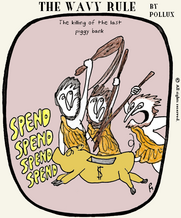
Click on the cartoon to enlarge it!
Read “The Wavy Rule” archive.
Did The New Yorker Really Spark the War on Poverty?
Yesterday, _American Prospect_ blogger Ezra Klein “wrote”:http://www.prospect.org/csnc/blogs/ezraklein_archive?month=12&year=2008&base_name=biden_hearts_rail about VP-Elect Joe Biden’s fondness for railway systems and, more grandly, the happenstance origins of major programs in our country: since Biden likes trains, we might see more train funding, goes the thought. Klein made the following comparison:
For instance, John F. Kennedy’s interest in poverty, which laid the groundwork for the War on Poverty, came because he read Dwight MacDonald’s long essay on Michael Harrington’s book _The Other America._ And thus a national crusade was born. If he’d missed that issue of _The New Yorker,_ the path of American social policy might have proven quite different.
Now _that_ got my attention. I’d never heard of this. Is it really true? Did JFK really move to reduce poverty because of MacDonald’s _New Yorker_ article? MacDonald’s review, titled “The Invisible Poor,” appeared in the January 19, 1963, issue. The full article can be read on the _New Yorker_ “website”:http://www.newyorker.com/archive/1963/01/19/1963_01_19_082_TNY_CARDS_000075671?currentPage=all (Digital Edition link “here”:http://archives.newyorker.com/?i=1963-01-19#folio=082).
If you search on “harrington macdonald kennedy” on Google, it quickly becomes evident that the story is an accepted piece of Kennedy administration lore. I’m guessing that this was a fairly celebrated incident at the time.
Here’s “Jon Meacham”:http://findarticles.com/p/articles/mi_m1316/is_/ai_14687957 in the _Washington Monthly_ in 1993:
President Kennedy read this in the January 19, 1963, _New Yorker,_ in a long review by the critic Dwight Macdonald of Michael Harrington’s book _The Other America._ The book and the review together forced a sea change in American attitudes toward the poor. Just five years earlier, in 1958, John Kenneth Galbraith had declared poverty no longer “a massive affliction [but] more nearly an afterthought,” and nobody thought to contradict him until Harrington, a socialist journalist, came along.
The Harrington/Macdonald case convinced Kennedy, who had first witnessed large scale poverty in Appalachia during his 1960 West Virginia primary campaign. An antipoverty program was being drafted when the president was murdered, and Lyndon Johnson quickly picked up the standard.
Astonishing. I honestly didn’t know that the War on Poverty started with JFK. I thought it was all Johnson, using the memory of JFK as means to his own ends rather than completing his predecessor’s project. I mean, I’d heard that sort of language used to describe it, but I had dismissed it as sentimentality, I guess. But Kennedy really did start it.
To my eyes, MacDonald’s review does not particularly read like an article that would launch $6.6 trillion of government spending (as George Will, a critic of the effort, “reckons it”:http://www.washingtonpost.com/wp-dyn/content/article/2006/03/03/AR2006030301756.html). It is possible that we are more aware of poverty, relative to MacDonald’s audience, or just more accustomed to strong advocacy. MacDonald spends a lot of time carping about the poor writing and evidentiary standards of Harrington’s competitors but duly wades through the statistical evidence with a hardheaded refusal to accept the conclusions of others.
But then, right when the argument is at its most abstruse, out pops clarity. These words sound intended to reverberate in the Oval Office itself:
They [the authors of another book under review] claim that 77,000,000 Americans, or _almost half the population,_ live in poverty or deprivation. One recalls the furor Roosevelt aroused with his “one-third of a nation—ill-housed, ill-clad, ill-nourished.” But the political climate was different then.
Different, eh? Kennedy apparently decided that maybe he could prove MacDonald wrong.
I don’t have much more to add. Were Emdashes readers aware of the significance of MacDonald’s review? I’d love to hear more about it.
The Wavy Rule, a Daily Comic by Pollux: Send in the Clowns
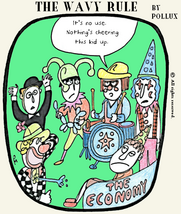
Click on the cartoon to enlarge it!
Read “The Wavy Rule” archive.