Monthly Archives: April 2010

The Times Appoints a ‘Gimlet Eye’: Guy Trebay Covers the Riprap

Jonathan Taylor writes:
“DOES anyone remember that, long before Madonna was a zillionairess with a fake British accent, she used to dance at the Roxy with a posse of Latino b-boys?” asked The Times‘s Guy Trebay in his April 7 profile of Paper magazine coeditor Kim Hastreiter. (Hastreiter does.)
Does anyone remember that, since long before becoming a fashion writer at The Times—and turning out some admittedly not-unmockable trend pieces there—Trebay has been a keen collector of the throwaway lines and gestures that take place well out of New York City’s spotlight? I do. His Hastreiter piece is a bit of a puff. But it apparently inaugurated a new rubric for his pieces, The Gimlet Eye, portending, I hope, a resurgence of rangier columns like those I used to cut out from The Village Voice with scissors.
Soon after Trebay joined The Times, a piece on “mopping,” or organized shoplifting of designer clothes—featuring a “transgendered person” named Angie E.—promised to bring to the paper’s ludicrously straight-faced fashion writing a bit of the unruly gentility Trebay had cultivated at the Voice. But as the years passed, I thought the Trebay I followed was slowly fading into the patterned wallpaper of the Sunday striving section.
To be sure, his fashion criticism has kept its zing, as in a recent Fashion Diary from Paris, in which he likens Ingrid Sischy, self-described as “triste” and yapping haplessly for Karl Lagerfeld after the Chanel show, to a baby seal stranded on an ice floe.
But in this past Thursday’s Gimlet Eye, Trebay reprises his Voice role as a one man Walk of the Town, feeling for the worn seams of the city’s public facades that betray its private dilemmas. Trebay gets predictable mileage from the presence of a safari game guide at a party at the Pierre. But it’s the second half of the column’s high society/New York freak dichotomy that showcases his laconic empathy. On an upper-Manhattan stretch of the Hudson shoreline, he talks to “Bridget Polk, who shares a name but little else in common with a famous Warhol actress,” and who makes ephemeral sculptures there by balancing local rocks atop each other [UPDATE: here’s Bridget’s “rock work” at her own site.] As in Trebay’s old collections of scraps of telephone conversations in the Voice, Trebay catches New Yorkers at their most ringingly Beckettian:

“People watch and watch and then they work up the courage to ask a question,” she said. And what do they ask? “They say, ‘Do you do these here?’ ”
The sculptor laughed then, as she does a lot, at the absurdity of other people and her own. “People say, ‘Do you use glue?’ ”
They ask whether she assembles the sculptures first and brings them with her to this stretch of shoreside riprap….
Still, she added, “I get more attention for this than anything I’ve ever done.”

Plus, I learned the word riprap—previously used in the Times only three times according to an archive search, all in connection with bridge collapses (unless you count a star racing horse of 1926–27, Rip Rap).

Remnick and Coates: Video

Martin Schneider writes:
A couple of weeks ago Emily, Jonathan, and I attended an event at the New York Public Library with David Remnick and Ta-Nehisi Coates. I wrote about it here. The New York Public Library has posted a video of the event here.
That event was pegged to the publication of Remnick’s new book about Barack Obama, The Bridge. In line with that fact, Remnick has recently appeared on The Daily Show and Real Time with Bill Maher. The Daily Show‘s website has video here; HBO, which airs Real Time, doesn’t let you see video for free, but a free audio podcast of all telecasts is available on iTunes.
In the Daily Show appearance, Remnick called Jon Stewart a “sweetie pie,” and Stewart confessed to an unhealthy obsession with The New Yorker‘s weekly caption contest. The two men briefly discussed Barry Blitt’s originally notorious and now merely legendary cover featuring Michelle and Barack Obama from July 2008. Remnick remarked that The Daily Show “saved our bacon” on that particular subject. It’s well worth checking out Stewart’s coverage of that furor, to recall both the truly ridiculous (and apparently unanimous) condemnations The New Yorker received from the cable news outlets and Stewart’s own bottomless sensibleness.

How Presidents Ruin America: An Ideological Thesis

Martin Schneider writes:
A centrist friend today forwarded me an email from a Republican friend. This person, whom I don’t know, is a staunch Republican who works in Boston. The message ran, in part:

Obama is destroying this country, I am not nuts.
Also, read about what is happening in MA with its healthcare. This is what may happen to the country under Obamacare

By now we’re all used to entrenched opposition to Obama’s health care plan, so that part doesn’t faze me at all.
What struck me is the phrase, “Obama is destroying the country.” It occurred to me that a liberal would be less likely to use those words, if the accusation were flowing in the opposite direction.
Let me be clear about what I am and am not saying here. I’m not saying that Republicans are more paranoid or more unfair or more ideological. Those things may or may not be true, but in any case I’m not saying them right now. There was plenty of rhetorical excess coming from liberals when George W. Bush was president, and it’s useless to deny that there is some equivalency between the two sides. This is not about liberals being better than conservatives; it’s about liberals being different from conservatives.
“George W. Bush is destroying the country!” Is that something we heard a lot, a few years ago? I would submit that it is not, although the phrase “George W. Bush is ruining the country” may have been more common. Destroy and ruin are pretty close to synonyms, but I submit that there is a subtle and meaningful distinction. To destroy something is further down the line; destruction is totalistic and irreversible, ruination not so much. To destroy something is to annihilate it, whereas to ruin it might mean making it subpar in some fundamental way. And I think the two groups of speakers were using the words with such distinctions in mind.
What did liberals actually say about Bush? It seems to me that liberals were more likely to worry about Bush “taking over” the country, trample all over our civil rights, take us down the path to fascism, and so on. In short, liberals, deep down, felt that Bush was an obstacle in the way of the good side of America expressing itself. The concept of Bush “destroying” America just seems odd to me—how would he be able to do that without my consent or the consent of many millions of his opponents? He would not be able to do that.
It’s well known that conservatives are attracted to a theory of the “constitution in exile.” I don’t want to debate the merits of that position right now; what’s striking, though, is that conservatives are prone to the idea that there is an essence of America lurking about somewhere, and that essence can be threatened in an almost physical manner. If something should happen to that essence of Americanism, then (one might say) the country is destroyed.
Liberals don’t think like that. Liberals are more likely to think that Americanness, liberty, equality, dignity, and so on are things that reside in individual Americans—every American. Since liberals don’t believe in some Fort Knox of Civic Virtue somewhere underground, it is not in their style to imagine it being threatened by an ideological or despotic nuclear strike, so to speak. (Yes, I have Goldfinger in mind here.) As long as there are Americans who resist despotic government, cherish liberal ideals, and so forth, then America will still exist. Or something like that, this is a tendency and an assumption, not an explicit premise, usually.
One last thing. It’s often been noted that conservatives favor simplicity and liberals complexity. One need only mention Darwin, evolution, climate change to see that difference. Again, I’m not giving out awards for superiority here, this is descriptive. But this idea of a top-down presidential ability to “decide” whether America will be “destroyed” or not, this also strikes me as a conservative way of looking at the world. Ayn Rand believed in the primacy of great men of action, and she is a conservative icon. But there’s another resonance here that interests me.
Students of Tolstoy will be familiar with the epilogue to War and Peace, in which Tolstoy tries to suss out the true meaning of Napoleon: is history dictated by Great Men or is it dictated by the complex and unswervable tides of history? It seems to me that conservatives find more allure in the Great Man theory (“Obama is destroying this country”), and liberals are more attracted by the complex river metaphor.

Charles Addams’ Big Apple: Amy Hwang’s Illustrated Review

addams-urban omnibus-amy hwang.jpg
_Pollux writes_:
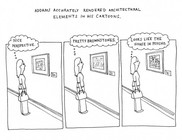
Up-and-coming _New Yorker_ cartoonist “Amy Hwang”:http://www.amyhwang.com/Amy_Hwang.html has created a “review in pictures”:http://urbanomnibus.net/2010/04/addams-big-apple-a-review-in-cartoon/ of an “exhibition”:http://www.mcny.org/exhibitions/current/charles-addams-new-york.html in the Museum of the City of New York that features the work of the legendary Charles Addams.
Hwang’s illustrated “Addams’s Big Apple” reveals not only her fascination with Addams’ genius, artistic methods, and relationship with the urban landscape, but also Hwang’s considerable talents.
Hwang, who is not only a cartoonist but also an architect, transforms her visit into an artistic diary that showcases her own irreverent humor as well as Addams’ use of the city in his cartoons (Addams used accurate architectural elements in his work).
The Addams exhibition will run until June 8, 2010. Click on the image above to enlarge it!

Can Adam Gopnik’s Maturity Countenance Chase Utley’s Glee?

Martin Schneider writes:
There’s been an interesting back and forth on the New Yorker blog pages about Adam Gopnik’s decision to forsake baseball. To recap: Gopnik announced that he no longer much likes baseball, Richard Brody and Ben McGrath responded, then Gopnik wrote again, and so forth. The exchange may not even be over. The best way to follow it all may be to go to the Sporting Scene section and read them in order.
All parties have been intelligent in their advocacy, and I write not so much to correct Brody and McGrath as to supplement them. I find Gopnik’s line of thinking not very convincing and even a bit disingenuous, and since I am a big baseball fan, I thought I would explain why.
Yesterday I attended the home opener for the Cleveland Indians in Progressive Park. The Rangers beat the Indians, 4 to 2, in 10 innings, alas. I was there with three friends, and we had a good time in our outfield seats. Along the way we discussed the unkillable “problem” of baseball losing popularity.
How shall I say this: unlike any endeavor I can think of, baseball is littered with testaments to why baseball is no longer what it once was and also attempts to understand why it will soon not be what it now is. That is to say, baseball fans are constantly telling you that baseball today sucks, and there are two possible offshoots to that premise: first, that the speaker is newly disenchanted (Gopnik); and second, that future generations may not sustain the passion for the sport that we are currently displaying.
I find such worries, to say the least, overdetermined. My position is, to put it bluntly, baseball is still a fine game, its problems are vastly overemphasized, and who really cares if you or some future generations don’t like it so much.
Baseball is incredibly popular. This is a fact. Millions of people attend the games, and millions of people watch the games on television. Millions of people play fantasy baseball (I do), and millions of people pay close attention to the pennant races, playoffs, and World Series. I heard it said on WFAN last week that the revenues for MLB recently passed those for the NFL for the first time in many years.
If this is failure, then I say, Three cheers for failure.
But even if there were serious flaws in the game that were to drastically diminish its popularity short of—I can’t believe I’m writing this phrase—threatening its existence, why should that bother anybody, really? I am not the Treasurer or Accountant for Major League Baseball, and if baseball were to suffer a profound decline in popularity/ratings/revenues of, say, 20 percent, I find it difficult to understand why this would affect me—since I would almost certainly still enjoy the game and derive pleasure from following it.
A hypothetical comes to mind. I am not a serious Star Wars fan. I was seven years old when the first one came out, I had a fairly normal childhood admiration over the first trilogy, and as an adult I’ve come to dislike the whole project quite a bit—yes, the whole thing. Call me the Gopnik of Star Wars, our positions here are probably pretty analogous.
Now, let’s say you, reading this, are a huge Star Wars nerd. What if I were to tell you that, for some imaginary reason, the 1977 gross receipts for Star Wars were, shall we say, 10 percent less impressive than anybody realized at the time? I would essentially be telling you that you have this picture in your mind that Star Wars had Impact X on our culture, and that you, if you were being scrupulous about the truth, would henceforth be forced to downgrade that Impact to something like 90 percent of what you had originally supposed.
Would you find this news distressing? I can certainly imagine that many people would be distressed by that news. The question I have is: Why? If you enjoyed the movie and its sequels as a child, and if you enjoy them today, I don’t really see what difference it makes that a few hundred thousand strangers did not like it as much as you had once thought. The whole concept is alien to me.
Baseball is not your favorite indie band that nobody you know has ever heard of. In that example, it’s sensible to root for the popularity of the project, because its very existence depends entirely on a spike in popularity. Baseball is not in that position.
When we raise the issue of pessimistic prospects for baseball, or investigate one individual’s decision to abandon the sport’s allures, that’s pretty much the situation we’re in. If baseball loses popularity in 2020, 2030, 2040 and there are still strong reasons for my interest to hold steady, I don’t really see what the fact of some unnamed demographic group deciding they like something else better has to do with me. It’s very likely that baseball will still be pretty popular in thirty years, and my desire to watch the World Series, no matter who is playing, will probably also remain. Similarly, I don’t really see why Adam Gopnik’s decision, at the age of 54 or so, to abandon what is after all a child’s game, should interest anybody, in and of itself.
Are we supposed to regard Gopnik’s decision as a canary in the coal mine? I think that is the unmistakable point of Gopnik’s first post, and let’s just say that I disagree with him that the post is actually serving that purpose in any meaningful way.
Having written “around” the problem of Gopnik’s manifesto for several paragraphs, let’s take a closer look at Gopnik’s first post. I don’t want to go through the argument or anything like that, but I did want to hit a couple of quick points.
Start with the opening line: “I am eager to become a baseball fan again.” Frankly, I don’t believe Gopnik when he writes this. The situation that baseball finds itself in is, in my opinion, not so dire that anybody genuinely wanting to love it would truly be barred from doing so. Furthermore, the statement is belied by the rest of what Gopnik writes, which smacks of rationalization, or, as McGrath puts it in the service of a slightly different point, “the use of the statistical record as a kind of moral ballast for what are essentially emotional arguments.”
Be that as it may. Let us now turn to the closing lines of Gopnik’s first post: “The dance of shared purpose and loyalty may be merely a mime—but what else but dancing and miming do we go to games for?”
I understand that it is unpleasantly bracing to realize that athletes are also businessmen, that the teams’ owners are not altruists, that fandom and commerce are intertwined. These are difficult things for an adult to accept about a fondness gained in childhood.
But I must ask: exactly how does Gopnik know that this “mime” is absent, or is being enacted to some insufficient degree? I have an image in my mind, from November of 2008, of a fellow—let us call him a “businessman”—named Chase Utley on a stage in the center of Philadelphia, proclaiming the Phillies the “World Fucking Champions,” to the cheers of many thousands of the city’s citizens.
I must say, his “mime,” which certainly seemed to express a level of jubilation over having won a championship, was a particularly shrewd bit of PR/mime/lying, that would probably have a positive impact on the portfolio of Chase Utley Inc.
But wait—could there be another explanation? Could it be that Utley meant it? Could it be that Utley was sincere in his joy? Is it actually possible that Utley takes pride not so much in his bank account but in his athletic prowess? That the kinship he felt with the other regulars of the “World Fucking Champion” 2008 Phillies was genuine? What if it wasn’t a mime at all?
Gopnik seems to rule out the possibility. Because if he did accept that premise, that Utley is first and foremost an athlete who desperately desires/desired a championship, and not first and foremost a businessman who coolly desires a robust array of assets, then I don’t see how he could have written what he did.
In 2007 I saw Gopnik on stage at the New Yorker Festival, debating with Malcolm Gladwell about the future of the Ivy League. I know from that experience that Gopnik has a subtle mind and can argue creatively and persuasively. For some reason, baseball has a singular tendency to cloud people’s ability to argue cogently. I look forward to a more tough-minded explanation for Gopnik’s new distaste for baseball and its relevance to baseball fans at large.

Although We Are No Longer a Blog Exclusively About The New Yorker

…we continue to be admirers of the magazine and many of its contributors, naturally. We’ll still be posting about New Yorker-related stuff, just alongside a wider range of other subjects. Here’s the transcript of today’s Washington Post live Q&A with David Remnick about his new book, The Bridge: The Life and Rise of Barack Obama. Martin wrote up the recent New York Public Library conversation between Remnick and Ta-Nehisi Coates.
Here’s a snappy answer to a stupid (or maybe just absurdly vague) question:

Johannesburg, South Africa: Shortly after President Obama was inaugurated the U.S. media let slip that directly after law school President Obama encountered a dark cloud. The insinuation was that he had fallen into bad company. And then gone on to a meteorically successful private career in Law. Although I haven’t read your book, I would be interested to hear what you say about this.

David Remnick: It doesn’t sound like reality to me.

And a taste of Remnick’s reading life:

Delaware: Your book, Lenin’s Tomb, is one of my favorite books ever. I initially read it for a Russian history class in college. I’ve read it at least twice since then, each time more impressed with how prescient and cogently organized it is. I’m looking forward to picking up The Bridge this weekend. Wondering, what do you enjoy reading (besides The New Yorker)?

David Remnick: Thanks so much! I really appreciate that. I was delighted to see that my old friend, David Hoffman, at the Post just won a Pulitzer for his extraordinary book on secret Soviet weapons programs. The strangeness, the darkness, and the complexity of the world under Soviet rule remains a subject of great fascination for me, so that is one area where I try to keep up. And I try to read and re-read work by writers like Josef Brodsky, and Nadezhda Mandelstam, and Anna Akhmatova, as much as I can. I read, both for my work and my life (sometimes I wonder about the differene) pretty omnivorously. Not long ago I finished a slender, profound book about Jewish history called “Zakhor” by Yerushalmi and right now I am reading a couple of novels: one by David Grossman, called To the End of the Land, and a book of short stories by Denis Johnson. There is a huge new history of Christianity by MacDiarmid that just landed on my desk with a thud, but I am determined to read it.

–E.G.