
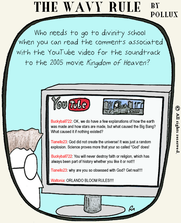
Click on the image for a detailed view!
Monthly Archives: April 2010
Thirtysomething: Our Past, Our Future
Emily Gordon transcribes:
From season three, “Legacy,” which aired Oct. 31, 1989:
Lucy, Synergy magazine editor, to Hope, writer: It’s times like this that make me glad I’m in media. This is a remarkable piece, Hope.
**Kit, another editor:** Lucy and I were talking about it all morning.
**Hope:** I’m glad you liked the article.
**Lucy:** With a little work, we think it’ll make a powerful article.
**Hope**: Uh–it already is an article.
**Kit:** We mean an article for us, an article for the NEW Synergy.
**Lucy:** You see, one of the things we’re very anxious to do is to address the problem of–digestibility.
**Kit:** For a consumer magazine to succeed in reaching out to the public, it must be scannable. It has to present itself in a quick, visual, high-impact way that’s readily absorbable and instantly usable.
**Hope:** Are we talking about an article or an antiperspirant?
Later: Here’s a complementary passage from that excellent 2008 Atlantic essay “Is Google Making Us Stupid? What the Internet is doing to our brains.” Nicholas Carr writes:
The Net’s influence doesn’t end at the edges of a computer screen, either. As people’s minds become attuned to the crazy quilt of Internet media, traditional media have to adapt to the audience’s new expectations. Television programs add text crawls and pop-up ads, and magazines and newspapers shorten their articles, introduce capsule summaries, and crowd their pages with easy-to-browse info-snippets. When, in March of this year, The New York Times decided to devote the second and third pages of every edition to
article abstracts, its design director, Tom Bodkin, explained that the “shortcuts” would give harried readers a quick “taste” of the day’s news, sparing them the “less efficient” method of actually turning the pages and reading the articles. Old media have little choice but to play by the new-media rules.
By the way, so that I could reread Carr’s relatively longish piece, I found myself doing the following to keep my brain on track: 1) magnifying the text to a gigantic size so that the ads and sidebars in the margins were forced off the screen; 2) hiding my OS X dock so I wasn’t distracted by the idea of all the other applications I could be jumping to, and 3) turning off NPR. I read in focused peace until…I reached the paragraph I quoted above to switch Safari tabs and amend this post. Curses!
Shivery Books Need New Jackets
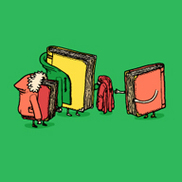 …which is why I like this charming and compassionate Threadless t-shirt that just debuted. It’s by Tenso Graphics and I dig it. God knows the book industry needs some TLC, and weatherproof outerwear (and I’m not talking about Juicy Couture for Kindle) is just the gesture you can make to make it feel better. And keep your bookshelves from a pneumonia outbreak. –E.G.
The Wavy Rule, a Daily Comic by Pollux: To the Lions
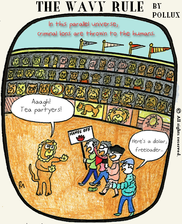
Click on the image for a detailed view!
Sempé Fi: Paw in the Family
_Pollux writes_:
Did you know that there are about a hundred and fifty different rabbit coat colors? The color of rabbit fur can range from orange to opal agouti, from chocolate tortoiseshell to frosted pearl.
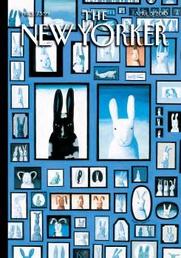
Some of these colors appear in “Kathy Osborn’s”:http://www.kathyosborn.com/ cover for the April 5, 2010 of _The New Yorker_, which is awash with a gouache-based array of various members of an extended rabbit family.
The Easter Bunny always seemed to me a lonely figure, a leporid deity condemned to roam the earth with an incongruous basket of eggs and chocolate. Usually he wears a big bow as well.
But Osborn’s “The Bunny Family” gives us an extensive gallery of countless bunnies in various poses, wearing different expressions. Even bunny families have a hierarchy. In the center of the cover, Osborn gives us a proud black-and-white paterfamilias and the equally important matriarch of this bunny family. Ears twist and swirl; bunnies frown or sleep. Some portraits are group shots.
The web forum known as Pattern Pulp, founded by Shayna Kulik, which is “devoted to tracking ideas and emerging trends that expose, celebrate, share and connect pattern design across all creative platforms,” “sees”:http://www.patternpulp.com/art/follow-up-bunny-portraiture/ a bunny family portrait-themed trend emerging in various forms and formats:
At first glance, last week’s New Yorker cover by Kathy Osborn seems like a cute parody on rabbits, Easter and Grant Wood’s infamous 1930 farmer portrait. The idea of a family tree composed entirely of bunnies, captured in stylistic unison is humorous, charming and rather surreal. A year ago, Bergdorf Goodman’s window display revealed a wall of hand painted bunnies framed against a green backdrop. Fast forward and we now have framed imagery from Hunt Slonem’s Manhattan oasis showcasing his own homage to the bunny world. Joe Zee, Elle’s Creative Director, always says, two times a coincidence, 3 times a trend, so we ask, are other adorable cuddlies going to continue adorning walls around the world or will these visual stories alternate as whims change and moods shift?
But Osborn’s “covers”:http://www.cartoonbank.com/bin/venda?ex=co_wizr-locayta&template=wz_locayta&pageno=1&perpage=20&collate=ivtype%3Apdxtlayout%3Apdxtstyle%3Apdxtdecade%3Apdxtpublicationdate%3Apdxtartist%3Apdxtpublished%3Apdxtperson%3Apdxtdesigner%3Apdxtauthor%3Apdxtlocation%3Apdxtcity%3Apdxtstate%3Apdxtcountry%3Apdxtoriginalartavailable&refine_sort_alph=&fieldrtype=type&termtextrtype=invt&typertype=exact&fieldcatrestrict=xancestorid&termtextcatrestrict=shop&typecatrestrict=exact&typekeywordsearch=keyword&termtextkeywordsearch=Kathy+Osborn for _The New Yorker_ have given us a wide array of original, surreal, and eye-catching imagery.
Osborn’s “Bunny Family” not only can be considered part of a larger trend of rabbit-themed artwork but it also fits as snugly as a bunny in a burrow within Osborn’s colorful, humorous, and off-beat work.
Bluegrass, Matt Diffee, Mark Singer, Zachary Kanin: This Sunday in NYC!
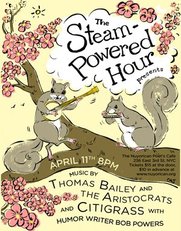
Emily Gordon writes:
The Steam-Powered Hour is one of the best variety shows going in New York. The combination of high-quality bluegrass, New Yorker cartoonists like Drew Dernavich, Carolita Johnson (who drew the merrily sciurine poster above) and Emily Flake drawing live on stage, comedy, storytelling, and spontaneous mass acoustic jams make it a hootenanny-salon you have to experience, trust me.
It’s a monthly party, but it’s taking a break for the summer, so make sure to come to the next two! Especially this one, because Citigrass are some of the rousingest, rollickingest pickers I’ve ever had the pleasure of hearing.
From the Steamers’ latest email:
In April, The Steam Powered Hour welcomes back Citigrass, winners of this year’s Battle of the Hardly Strictly Bluegrass Bands. Also, more bluegrass goodness with Thomas Bailey and the Aristocrats, a story by The New Yorker staff writer Mark Singer and cartoonist Zachary Kanin. Plus, plenty more surprises. Hosted as usual by New Yorker cartoonist Matt Diffee.
April 11th, 8pm
Nuyorican Poet’s Cafe
236 East 3rd Street Between Ave B & C
New York City
Tickets are $15 at the door. Get ’em for $10 in advance at http://www.nuyorican.org.
You can follow The Steam Powered Hour on Twitter and on Facebook.
The Wavy Rule, a Daily Comic by Pollux: The Future of Blogging

Click on the image for a detailed view!
The Wavy Rule, a Daily Comic by Pollux: Recession
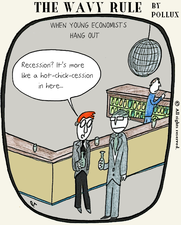
Click on the image for a detailed view!
Report: Remnick and Coates, at the New York Public Library
Martin Schneider writes:
On Tuesday, April 6, I joined my Emdashes colleagues Emily Gordon and Jonathan Taylor at the New York Public Library for the publication day event for The Bridge, David Remnick’s eagerly awaited book about Barack Hussein Obama, the 44th President of the United States. It was an hour of spirited discussion about Obama, moderated by Atlantic Monthly blogger Ta-Nehisi Coates, who has written two articles for The New Yorker and also appeared as a panelist at the 2008 New Yorker Festival.
In the summer of 2008, Remnick and New Yorker executive editor Dorothy Wickenden entered into a wager about the election’s outcome—Remnick’s full explanation of his pessimism was a slow repetition of Obama’s full name. Today, as Remnick rightly says, nobody thinks much about that “Hussein.”
Remnick is so eloquent that I think we may have to invent a new word to describe him. Let me explain. When one listens to Remnick speak, he is so effortlessly precise and profound that one almost wants to use the word “glib”—but, of course, that word implies a want of substance, and nothing could be further from the truth. Is there a word for someone who appears to be glib but in fact is supplying all manner of valuable insight and even profundity? I don’t know, but we need one.
I’ve seen Remnick speak before, but always as the interviewer or moderator, never as the subject. Emily afterward pointed out how easily Remnick took to the role, comfortably reminiscing about his suburban New Jersey upbringing, in a household where radicalism was defined as “sitting too close to the TV set.” In short, a more personal Remnick.
The banter between Remnick and Coates was very amusing—much was made of their offstage editor-contributor relationship. For me, the funniest moment of all came during the Q&A section, when Paul Holdengräber,Director of Public Programs at the NYPL, asked Remnick about “that famous New Yorker cover,” obviously a reference to Barry Blitt’s “notorious” July 21, 2008, cover depicting Barack and Michelle Obama after having converted the Oval Office into a den of Islamist Black Power. Remnick: “The one with the bowl of fruit? The one with the abandoned summer house with the clothesline going across?”
Remnick’s take on the cover was, as always, astute: “I think it’s fair to say that not everybody liked it …. I was surprised at the scale of the not-everybody-liking-it.” It’s a lovely irony that Remnick, of all people, so convinced that the key to Obama’s undoing lay in his middle name, would be the editor to approve that cover. But of course, Remnick’s responsibility was not to ensure Obama’s election. And, in my view—as unpleasant as it must have been for Remnick to be hectored on live TV by the likes of Wolf Blitzer, who noted, with characteristic subtlety, “This could have been on the cover of a Nazi magazine!”—it was an entirely worthwhile gamble. (Remnick, for his part, drily noted that he hoped his mother was not watching CNN that particular day.)
To this day, Coates objects to the cover, on the grounds that the cover showed the right-wing conspiracists’ worst fears as “not ridiculous.” But of course, that is precisely what it did, it rendered them ridiculous. You couldn’t ponder that cover for very long without all of the scary right-wing premises seeming preposterous. I quote Art Spiegelman to that effect here, and contribute my own thoughts here. It may have been in a stealthy way, but Blitt’s cover, if anything, probably helped Obama just a little bit.
It’s impossible to discuss the meaning of President Obama without discussing race, and when the moderator is a black man who has written a memoir that would appear to be a bit similar to Obama’s own memoir, the subject of race is all the more unavoidable—and welcome. Remnick’s and Coates’s comments were unfailingly astute—but I did want to push back on one point that surprised me a bit.
Everyone has a theory about how Obama’s blackness helped him or hurt him. Obviously, Obama was able to maximize the ways it could help him and minimize the ways it could hurt him, the same way that Hillary Clinton would have tried to exploit/downplay her gender, or any other candidate would try to extract the positive aspects of any other notable trait he or she possesses.
But it remains a thorny subject. Our first “black president” is half-white, just as white as he is black, one might even say. Yet he signifies as black, culturally speaking, for reasons that stretch back to the abhorrent “one-drop rule” of slavery. Biracial Derek Jeter might not signify as “all black,” but in the more charged arena of politics, Obama usually does.
Add to this a subject that Remnick and Coates treated with some delicacy, that Obama’s father was not culturally African-American but simply African, which means that Obama had no obvious recourse to the cultural traditions and territory of regular African-American males, the ones descended from slaves. Obama is not a descendant of American slaves, and Remnick and Coates quite properly presented that as a problem for a candidate (Obama) trying to win the votes of African-Americans. You could almost say it could have been a problem along these lines: whites would disinclined to vote for him, since he signifies as “black”—but some black voters might also be (relatively) disinclined to vote for him—because he signifies to them as insufficiently “black.” Certainly that would have been a pickle.
Remnick and Coates were making the point that Michelle Obama sliced through this particular Gordian knot rather tidily. Michelle Obama, née Robinson, namesake of America’s most historic African-American baseball player.
So far, so good. Where Remnick and Coates lose me is their assertion that a hypothetical Obama with a white wife would have faced unusual—possibly fatal—problems. I should stress that I’m not shocked by that statement, and I’m not calling them on it for reasons having to do with political correctness. I’m just not sure the statement is as self-evidently true as the two men seemed to think.
Remnick’s statement was that Obama would not have secured 94% of the black vote if Obama’s wife had been white. Coates’s version, allowing for the usual ambiguity that occurs when people speak extemporaneously, seemed to bleed into the premise that Obama would not have won the election at all. Remnick’s statement is probably true in the narrow sense, if one adds the caveat that he could have secured 93% of the black vote and the statement would still remain true. As for Obama’s general prospects, it’s … a difficult statement to parse.
In some degree, this hypothetical seems to elevate cultural concerns over political ones. The fidelity of black voters to the Democratic Party is a political fact strong enough to trump a lot of other factors. It’s worth pointing out that in 2004, a white native of Massachusetts married to a white ketchup heiress (born in Africa, oddly enough) secured 88% of the black vote—and that was a low figure, in historical terms. And of course, Kerry lost the election. But are we saying that Obama would have done worse than Kerry? Are we saying that Obama’s political career would have stalled in Chicago because he would not have been able to appeal to “more authentically African-American voters” the same way? The counterfactuals are too involved to figure out, and—my real point—they ignore the salient role that the characteristics of specific human beings play.
Racially, Obama is whatever he is. In addition, he’s thoughtful, careful, eloquent, whip-smart, not prone to verbal gaffes … this is the man we are saying who could never have overcome his choice decades earlier to wed a white woman? I see the dynamic involved clearly enough … I just don’t think we can rule any outcome out so easily.
Predictions and hypothetical questions are bedeviled by recourse to average, typical exemplars. As an example, if you had asked a sportswriter, on May 30, 1982, whether any current major leaguer had a chance to break Lou Gehrig’s consecutive games streak, that sportswriter would very likely have said, “No. That is not possible.”
But of course Cal Ripken played the first game of his (quite a bit longer) streak that very day. Obviously the mental processes of that sportswriter would not have been up to imagining the possibility of a glorious outlier like Ripken—even though by definition that record would necessarily be broken by an outlier. Thinking about the ordinary major leaguers are of no use in answering a question like that.
Similarly, if we imagine this white woman that would supposedly have hindered Obama’s chances of becoming president, who is this woman, exactly? Or, more precisely, who might this woman be, exactly? Hillary Clinton? Cindy McCain? Teresa Heinz? Nancy Reagan? Nancy Pelosi? Barbara Ehrenreich? Sandra Bullock? Lorrie Moore? Even that short list of remarkable women shows the potential range involved.
Maybe I’m naive. Obama’s task was formidable enough as it was, and (as Remnick pointed out) his eventual path was in part the result of astonishing good fortune. Maybe it is true that Obama would never have gotten elected within Illinois, much less across the whole country, if he had not had an easy way to make regular black voters relate to him. But I tend to think of the issue in the following way.
Barack Obama married a remarkable woman. It’s safe to assume that if his chosen bride had been white, she would have been a pretty remarkable woman too. Her race might have complicated Obama’s political life. But alongside that, there are two other things one might venture as well: Obama excels at overcoming circumstances that would hold other people back, and this woman would have brought something to the project (I almost wrote “ticket”) in her own right.
I Guess We’ve Got That Speed-of-Light Thing Figured Out: Google Queries Around the World
Jonathan Taylor writes:
There’s been a lot of fun lately looking at Google’s search query completion suggestions (what’s the better phrase for those?). With the hullaballoo about Google in China, I realized I hadn’t yet seen comparisons of these searches across international Google sites. To wit: Here’s what comes up on Google.com.hk (Hong Kong) when you type in “why” (in English):
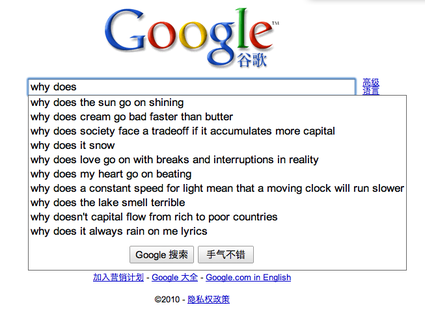
Um, are you ready for the U.S. site’s questions?

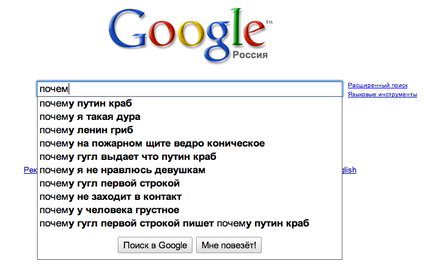
Meanwhile, the Russian Google site’s top query—”Why is Putin a crab”—is itself the subject of other queries, asking why that is the case. (There’s an answer somewhere behind the wall at the Moscow Times):
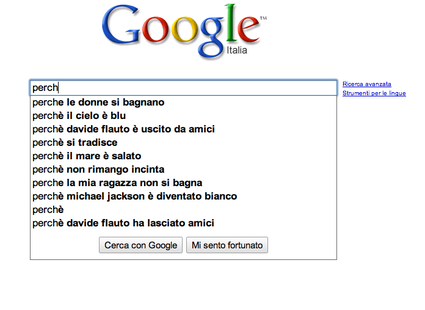
And in Italy, the questions include both “Why do women bathe?” and “Why doesn’t my girlfriend bathe?” (and “Why did Michael Jackson become white?”):
Any linguists care to tackle other foreign Google sites?